Windoro WCR-I001
It's hard to imagine the modern world without robotic technology, which significantly simplifies cleaning. The Korean company Windoro has been developing and implementing smart household robots for many years, combining a variety of features with reliability and safety. The Windoro WCR-I001 window cleaning robot is unique because it attaches to both sides of the window using magnets, rather than relying on vacuum like other models. This article offers a detailed overview of the window cleaning robot's specifications, features, and key advantages and disadvantages.
Equipment
The Windoro car washer's package is minimal, but it includes all the necessary components. The kit includes the following items:
- Window cleaning robot.
- Infrared remote control.
- 12 reusable cleaning cloths.
- Charger.
- Detergent.
- Two scrapers.
- Scraper attachments (6 pieces).
- User manual.
- Warranty card.
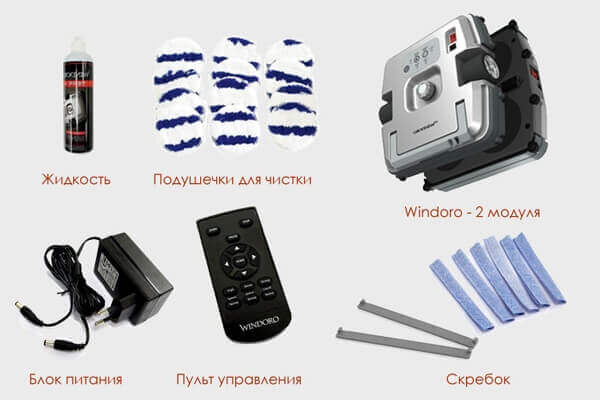
Windoro package
Appearance
The manufacturer has done a great job with the design of this window cleaning robot. It consists of two modules that attach to either side of the window. One module is for cleaning, and the other is for navigation. The two modules are held in place by a strong magnet, which is independent of whether the power is on or off. The Windoro WCR-I001 is available in three colors: red, yellow, and gray.
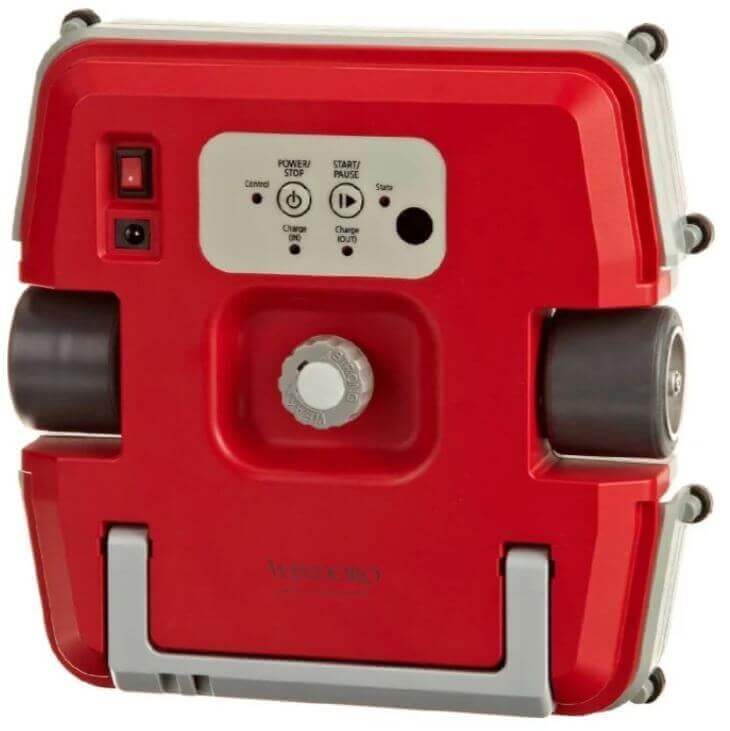
Red
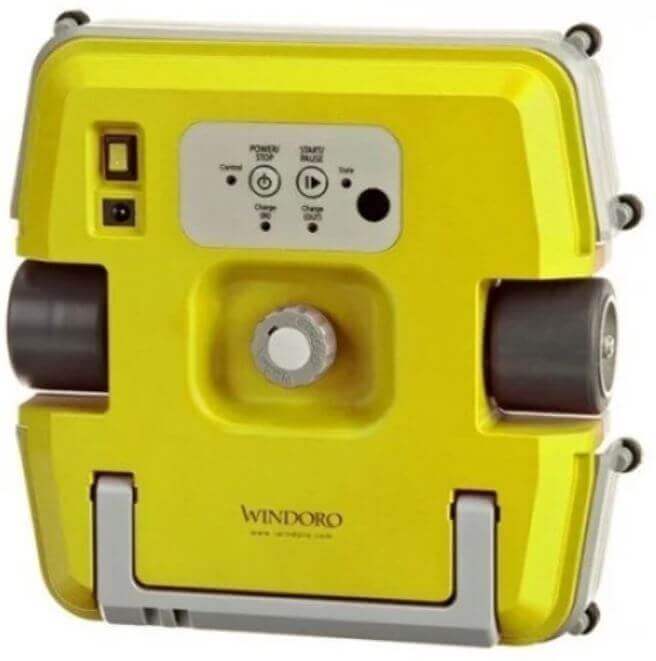
Yellow
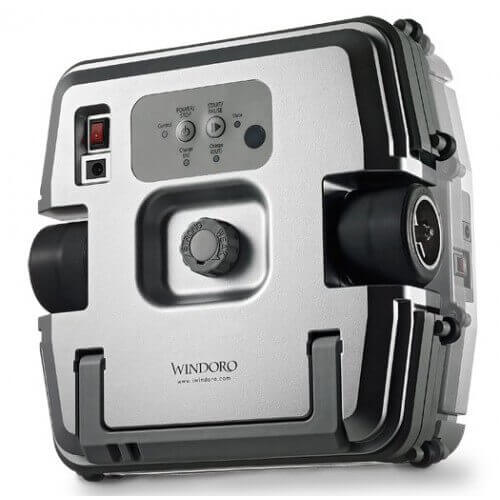
Grey
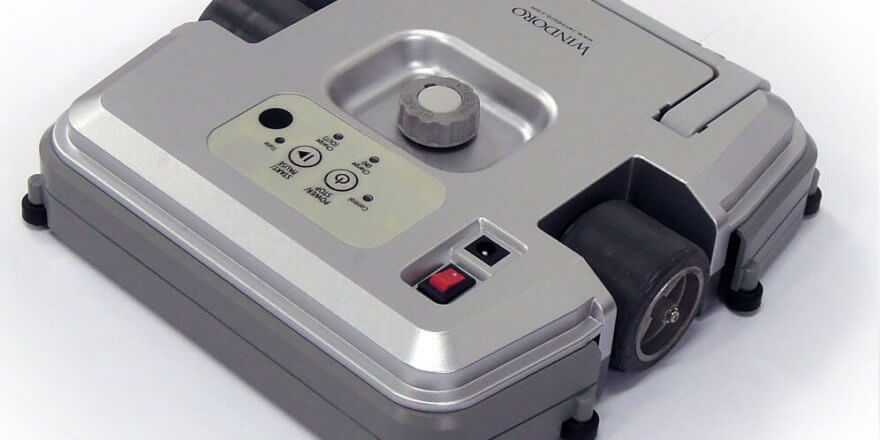
An inspection of the cleaning unit revealed a detergent reservoir located in the center of the front panel. It opens with a simple twist. Below it is a carrying handle for the window cleaning robot. Above the reservoir is a wiper button and an LED indicator indicating the battery level. Movable bumpers are mounted on the front and rear of the unit, each containing mechanical sensors that allow the Windoro WCR-I001 to detect obstacles ahead.
The bottom of the robotic cleaner's cleaning unit consists of four rotating discs to which microfiber cloths are attached. It also contains two scrapers, which are used to clean the edges of the glass. A detailed inspection of the bottom of the housing revealed that the robot is propelled by two small cylindrical wheels and eight smaller wheels located around the perimeter of the housing. The housing houses the battery and the motor for the magnets.
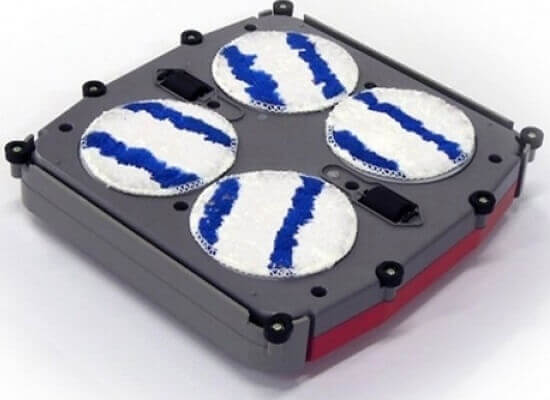
Bottom view
A review of the navigation unit's front panel revealed a central control that adjusts the force of gravity. Wheels on the sides enable the robotic cleaner to move. Below the control, just like on the cleaning unit, is a carrying handle. Above the control knob are the on/off and pause buttons. The front panel also features a power switch and a window for receiving IR beams from the remote control. Below are four magnetic discs that hold the Windoro WCR-I001 modules together.
Technical specifications
All the characteristics of the automatic windshield wiper are summarized in one table:
| Country of origin | South Korea |
| Dimensions | External (navigation) unit – 21.8x21.1x5.1 cm, internal (cleaning) unit – 21x20.8x4.7 cm |
| Weight | 3.2 kg |
| Speed of movement | 8 cm/sec (0.25 m2/min) |
| Charging time | 130 min |
| Battery life | 100 min |
| Battery | Li-Pol, capacity 2000 mAh |
| Noise level | 60 dB |
| Power | 25 W |
| Control | Remote control |
| Thickness of the glass unit | From 15 to 28 mm |
| Minimum window size | There is no limit |
Functional capabilities
The window cleaning robot is held to the glass by two powerful magnets, preventing it from falling even when the power is off. Before starting the cleaning robot, pour cleaning solution into the tank. Then, place it on the surface and turn it on. It will first determine the window's dimensions. To do this, the Windoro WCR-I001 sweeps along the edges and then begins a zigzag motion.
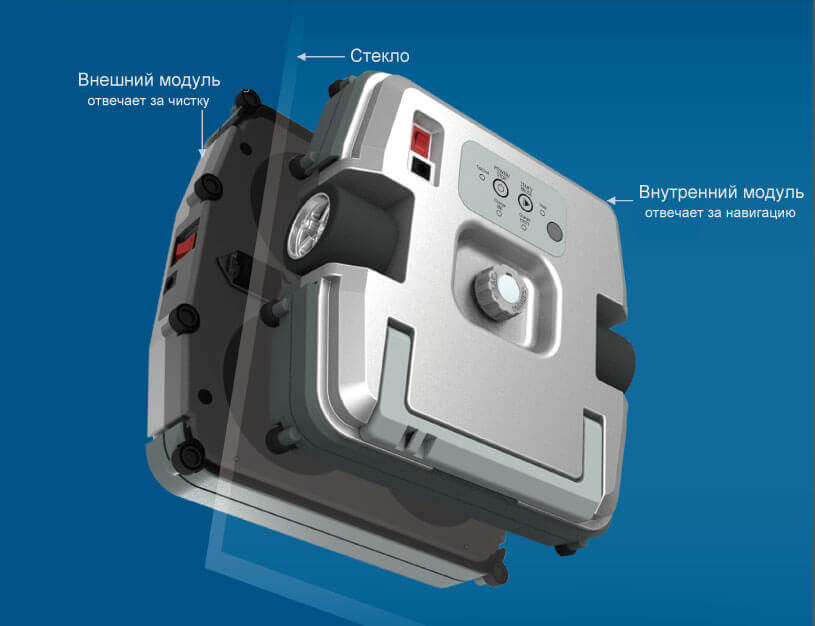
Window mount
If the window is larger than two meters, the cleaning robot will divide it into two sections, which it will clean alternately. First, Windoro distributes a cleaning solution over the surface, which removes dirt using four rotating pads mounted on discs. Then, a scraper removes any remaining liquid from the glass.
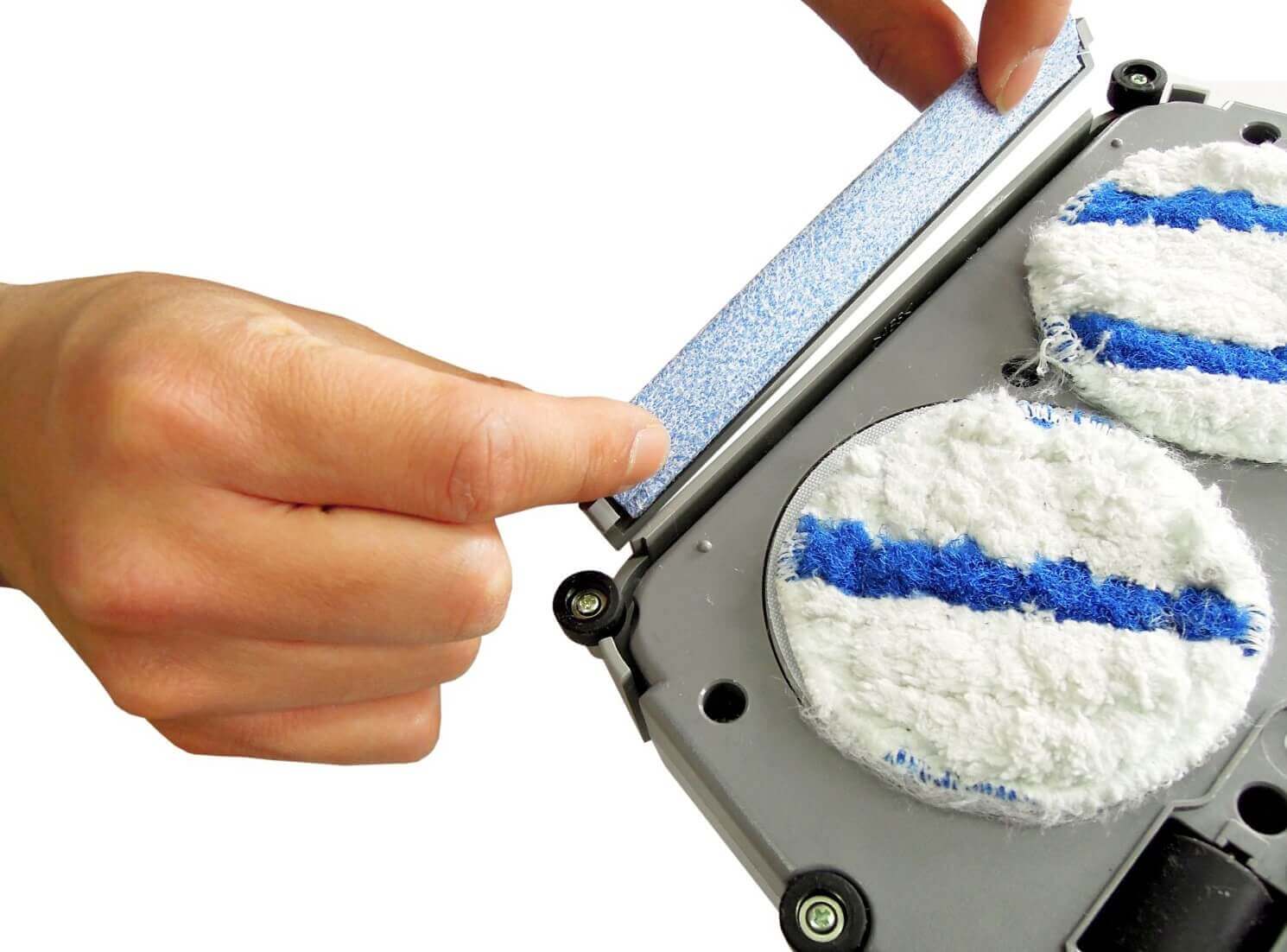
Installing a scraper
The special feature of the windshield wiper is that it can be operated without the power supply, like most window cleaning robots, but from an internal rechargeable battery. This makes the Windoro WCR-I001 very convenient to use.
The robotic cleaner is controlled using buttons on the panel or a remote control. The remote control allows you to start and stop the device, adjust the speed of the robotic cleaner, control the detergent flow rate, and adjust the cleaning intensity based on the surface's dirtiness.
Important! The Windoro WCR-I001 window cleaning robot is available in two versions. One is designed for glass thicknesses from 5 to 15 mm, the other for glass thicknesses from 15 to 28 mm. If the glass thickness is greater than 30 mm, the robot will not clean at all.
Advantages and disadvantages
A review of the model's capabilities highlighted its main advantages:
- Modern and original appearance.
- Possibility of independent determination of the area to be cleaned.
- Tank for continuous supply of detergent.
- Highly durable body material that cannot be affected by various weather conditions.
- It is held on the glass by very powerful magnets, so the washer will not fall off the window even if the power goes out.
- The presence of scrapers that remove residual liquid from the surface.
However, the robotic cleaner also has its disadvantages:
- For window cleaning only. Due to its dual-sided mounting, the Windoro WCR-I001 cannot be used on tiles, mirrors, or other vertical surfaces.
- Depends on the glass thickness.
- Work via a mobile application is not provided.
- Slow cleaning due to low movement speed.
Due to its limited application and lack of versatility, this window cleaning robot is far from the best in its class (priced at around $200). However, it does its basic job well, so if you're looking for a purely automatic window cleaner, you might want to consider this option.
Finally, we recommend watching a video review of the Windoro WCR-I001:
Analogues:
- HOBOT 288
- Demu WS-860
- Redmond RV-RW001
- Bist Win A100
- Ecovacs WINBOT 850
- HOBOT 198
- Mamibot iGLASSBOT W120