Which Xiaomi robot vacuum cleaner is best? A comparison of the best and newest models (Part 1)

Today, our review will compare the most popular Xiaomi robot vacuum cleaners currently on the market (2019). These models include the Mi Robot Vacuum Cleaner, Roborock S50 Sweep One, S55, Xiaowa Robot Vacuum Cleaner Lite, and the new Mi Robot Vacuum Cleaner 1S, as well as the Roborock Sweep T6. While all robots are similar in design and dimensions, each is targeted at a different audience, as the devices differ significantly in features and price. It's worth noting that the S50 differs from the S55 only in color (black and white), so the S55 will not be included in this comparison. Review the information below to decide which Xiaomi robot vacuum cleaner is best for your home or apartment.
Important! At the end of this article, we've included a video comparison of Xiaomi robot vacuum cleaners from the 2019-2020 lineup!
Comparison table
Important! We've already prepared an updated Xiaomi robot vacuum cleaner ranking for November 2020, taking into account all the new products! This is a text version only for now; a video will be published soon on the channel: https://robovac.washerhouse.com/en/rejtingi/robovac-top-10-robotov-pylesosov-xiaomi-2020.htmlPurchase links are also included at the end of this rating. Be sure to read to the end!
To help you compare the key technical specifications and features of the five Xiaomi models under consideration, and ultimately determine which robot vacuum cleaner is best for you, a comparison table is provided below:
| Xiaowa Robot Vacuum Cleaner Lite C102-00 | Mi Robot Vacuum Cleaner | Roborock S50/S55 | Mi Robot Vacuum Cleaner 1S | Roborock T6 | |
| Dimensions | 35x35.3x9.05 cm | 34.4x34.5x9.6 cm | 35.3 x 35.3 x 9.65 cm | 35x35x9.6 cm | 35.3*35*9.65 |
| Weight | 3 kg | 3.8 kg | 3.8 kg | 3.8 kg | 3.6 kg |
| Battery | Li-Ion, 2600 mAh | Li-Ion, 5200 mAh | Li-Ion, 5200 mAh | Li-Ion, 5200 mAh | Li-Ion, 5200 mAh |
| Type of cleaning | dry | dry | dry and wet | dry | dry and wet |
| Opening hours | 60 min. | 150 min. | 150 min. | 150 min. | 150 min. |
| Charging time | 120 min. | 180 min. | 180 min. | up to 300 min | 180 min |
| Cleaning area | up to 80 m2 | up to 250 m2 | up to 250 m2 | up to 250 m2 | up to 250 m2 |
| Charger | automatically | automatically | automatically | automatically | automatically |
| Suction power | 1600 Pa | 1800 Pa | 2000 Pa | 2000 Pa | 2000 Pa |
| Dust collector | 640 ml | 420 ml | 480 ml | 420 ml | 480 ml |
| Water tank | — | — | 150 ml | — | 150 ml |
| Height of obstacles | 2 cm | 1.8 cm | 2 cm | 2 cm | 2 cm |
| Programming | + | + | + | + | + |
| Cartography and navigation | — | + | + | + | + |
| Laser rangefinder | — | + | + | + | + |
| Motion limiter | — | + | + | + | + |
| Control from a smartphone | + | + | + | + | + |
| Remote controller | — | — | — | — | — |
| Average price | $100-$120 | $170 | $250–$300 | $220-$270 | from $270 |
Important! In 2019, a new one appeared on the market Roborock S5 MaxIn the video below, we compare this robot vacuum cleaner to the flagship S6 and the previous S5 model:
We also have a comparative review of the Roborock S5 Max and the new S6 MaxV, which we recommend checking out:
The new flagship was compared to the best models from other brands; this test is a must-see:
And in 2021, the new Roborock S7 hit the market, which was also compared to its predecessor:
Analysis of characteristics
Analyzing the performance of Xiaomi robot vacuum cleaners doesn't require robotics experts. Let's take a quick look at the robots' key external and technical characteristics.
Design
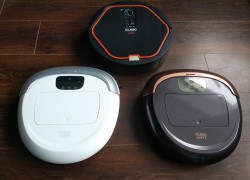
All five robots have a similar appearance. The body is made of durable, high-quality plastic in white or black, featuring a minimalist design. Viewed from above, the robot vacuums are round, but from a wider perspective, they have a traditional puck-shaped form.
Mi Robot Vacuum Cleaner:
Robot Roborock S50 Sweep One slightly larger in size than its two predecessors and the new product 1S, however, it is the same in size as T6This can be explained by the presence of a wet cleaning function. Roborock Sweep One also differs from its predecessor (Mi Robot Vacuum Cleaner) with a spot cleaning button on the body and a large number of sensors. All models except the smallest one are equipped with a laser rangefinder in the form of a protruding "turret." The vacuum cleaner Xiaowa Robot Vacuum Cleaner Lite There is no laser rangefinder, so it is considered a budget option.
Roborock S50 Sweep One:
In addition, the new 1S is equipped with a camera, making navigation even more efficient. The robot now understands doorways, allowing it to plan its route even more efficiently.
Price
The Roborock S50 Sweep One is the most expensive of the three models (average price between $250 and $300), as it's essentially an upgraded version of the Mi Robot Vacuum Cleaner with a wet cleaning function, improved threshold clearance, and more sensitive sensors. The average price of the Mi Robot Vacuum Cleaner itself is around $170.
Mi Robot Vacuum Cleaner 1S:
The Xiaowa Robot Vacuum Cleaner Lite, on the other hand, is considered a simplified version of the Mi Robot. It lacks lidar and room mapping capabilities, allowing it to reduce the price to $130-$150, making robot vacuum cleaners from this brand more accessible to more users.
Among the 2019 new products, the 1S is slightly more expensive than the previous first-generation version (Mi Robot Vacuum Cleaner), as it now features a camera for navigation. Meanwhile, the updated T6 starts at $350, essentially matching premium models.
By the way, these two new robots took the top spots in our updated 2019 rankings. You can check them out:
Cleaning area
All models with lidar under consideration are equipped with the same lithium-ion battery with a capacity of 5200 mAh, which allows cleaning a room of up to 250 m2 on a single charge. Moreover, the battery life is up to 2.5 hours. The budget Xiaomi Xiaowa model has a weaker battery (Li-Ion with a capacity of 2600 mAh), allowing you to clean up to 80 m on a single charge.2, with a battery life of up to 1 hour. All versions feature automatic charging.
Dust container volume
Surprisingly, the budget Xiaowa robot vacuum cleaner has the largest dust bin capacity (640 ml). The first Xiaomi Mi Robot and the updated 1S have a 420 ml dust bin, while the second-generation Roborock S50 Sweep One and third-generation T6 have a 480 ml dust bin.
Suction power
The Roborock S50 Sweep One robot vacuum cleaner and its two newer models boast the highest suction power, with their motor capable of generating 2000 Pa of pressure, compared to 1800 Pa in the original robot and 1600 Pa in the budget model. This means that all robots since the first generation are better at cleaning carpets and more effectively vacuuming fine debris from smooth floors.
Wet cleaning function
Only the most expensive Roborock Sweep One robot and its updated version, the T6, feature a wet mopping function. These machines feature a separate 150 ml liquid tank, which allows the mopping cloth to be evenly mopped while mopping.
Incidentally, it's worth noting that the T6 comes with disposable cleaning cloths, which is more practical (no need to constantly wash them). The new robot also allows you to adjust the flow rate of liquid onto the cloth, and the water supply from the reservoir stops when charging on the base.
Driving modes
The Mi Robot Vacuum Cleaner and Roborock S50 Sweep One have two main operating modes: a single automatic cleaning of the entire available area of the room, as well as localized cleaning of a specific area (for this, the vacuum cleaner must be manually moved to the desired location and started).
According to the manufacturer, the Xiaomi Xiaowa has several cleaning modes (Silent, Standard, Strong, and MAX). All models except the Xiaowa feature increased suction power for cleaning carpets.
The dry cleaning process in all models is carried out thanks to the operation of one side brush, a central turbo brush and a suction hole.
An important innovation is that the latest two models can divide a room into zones and be programmed to turn on not only by day of the week, but also by time for each room.
Navigation and cartography
All robots except Xiaowa, as noted above, have a laser rangefinder for spatial orientation. It consists of a photoreceiver and a laser diode that rotate horizontally and scan the surrounding area at high speed. The Roborock S50/S55 has slightly higher distance accuracy than its predecessor. It also has a larger number of sensors and more sensitive sensing elements, allowing it to avoid collisions with obstacles and falls from elevated surfaces.
As for the 1S and T6, they have improved spatial awareness (especially the camera model) thanks to their new processors. According to the manufacturer, the new Xiaomi robot vacuums clean 20% faster thanks to their improved navigation system.
We've already noted that Xiaomi's budget robot lacks a lidar system, so it navigates solely using infrared obstacle and height sensors, like most budget robot vacuums.
Control
All robots can be controlled remotely using a dedicated mobile app on your smartphone via Wi-Fi. This is certainly very convenient and innovative, but sometimes a remote control is still not enough. Some devices can be controlled using buttons on the body.
What is better to choose?
We've outlined the differences between the models being compared, but in conclusion, we'd like to say the following. If you're unsure which Xiaomi robot vacuum cleaner is best for you among the five reviewed today, consider your budget and priorities (whether wet mopping is more important to you, or whether higher suction power and robotic precision are more important). This way, you'll be sure to find the right option.
Our opinion: when choosing between the Mi Robot Vacuum Cleaner and the Mi Robot Vacuum Cleaner 1S, it's better to choose the updated model with a camera. And when choosing between the Roborock S50/S55 and the T6, it's definitely better to go with the new T6 (just make sure you buy extra cleaning cloths). However, the T6 isn't actively available yet, so the S50 or S55 would be a good choice.
If your budget is limited, you can choose the inexpensive Xiaowa Robot Vacuum Cleaner. It also does a good job. Incidentally, there's a similar model with a wet cleaning function—Xiaowa E202-00 Robot Vacuum Cleaner LiteAt $150, it has all the same features, but also includes a wet mopping unit.
Roborock Sweep T6:
Finally, we recommend watching a video that provides a visual comparison of the best Xiaomi robot vacuum cleaners of 2019-2020:
After reading this article, we strongly recommend that you study Xiaomi robot vacuum cleaner reviewsThis will help you make a purchase decision and learn the real pros and cons of each model.
Thank you, my dear fellow! Those Chinese have come up with so many model names, but they haven't thought to provide a simple description and comparison.
Thanks for helping me make my choice! I chose the Roborock T6 (S6 is the global version). Incidentally, it would be nice to specify this (S6|T6) so users can easily find and localize it.
The T6 is a frankly weak model. Connecting the robot to a phone required using third-party programs (SQL). A casual user unfamiliar with programming shouldn't be tackling such complexities. Cleaning performance drops dramatically after 3-4 months. This is due to the manufacturer's poor selection of roller and brush materials. Similar issues arise with the wet cleaning function. The robot flatly refuses to clean dark areas of the floor, believing them to be abysses. It often skips large sections of the floor for no apparent reason. It's only been two months, and a mechanical failure (a wheel) has already occurred. I had to take it in for warranty repair. They refused to accept the device for repair due to a lack of spare parts. They offered to send it to another city where they thought they had spare parts, but I'm not sure. They also suggested I buy the parts on AliExpress at my own expense. I find this unacceptable.