Robocleaning. Part 1: The Pros and Cons of Industrial Cleaning Robots

Hello to all the project readers! Starting with this review, I've decided to launch a series of publications discussing robotic cleaning. Robotic cleaning is a rapidly growing field. More and more global brands are transitioning to producing industrial robots for commercial cleaning. Having gained some experience in this field and having researched the topic myself, I decided to share some useful information with you. First, we'll discuss the advantages and disadvantages of robotic cleaning, which will be discussed further. So, let's get started!
Using commercial cleaning robots instead of manual labor has many advantages. Here are the main ones:
- The first and most important thing, in my opinion, is the robot doesn't cheat and will clean the entire area selected for cleaning, even if a particular zone appears clean. It simply won't leave any uncleaned areas: it will walk around the entire perimeter, then in a zigzag pattern, or vice versa. If in doubt, you can always view statistics in the app, which displays a report on the area covered and a schematic representation of the route. Traditional human cleaning is not immune to this.
- The next important advantage is that when a robot cleans a room, it actually sucks up dust and debris. robot vacuum cleaner, rather than sweeping, although a sweeping mode can be selected if desired. When cleaning a retail space or an office, cleaning is often limited to sweeping and mopping the floor. Using specialized commercial cleaning equipment is possible, but not always the case. In one personal experiment, a robot was launched after a cleaner had cleaned the space, using a broom, dustpan, and mop. As a result, the dust collector was completely full by the time the robot passed through what seemed to be a clean space. Therefore, a vacuum mode for every cleaning is a very strong point of commercial robots.
- The robot is capable of cleaning autonomously according to a schedule.When staff are absent from the premises. For example, in a shopping mall, this might be after closing. The cleaner, in turn, cleans either during the day when customers are in the sales areas, which can cause discomfort. Alternatively, the cleaner arrives before the sales area opens, but this requires the presence of the store's employees, which, again, is inconvenient and entails additional costs for overtime.
- From an economic point of view, in the long term commercial The robot allows you to save on cleaning servicesWhile it's impossible to completely eliminate the need for a cleaning service, a robot will certainly reduce a significant portion of floor cleaning costs. Again, in one of our experiments, we analyzed the economics with a cleaning company, and they, using very rough calculations, concluded that a commercial robot could reduce cleaning costs by up to 50%. Business owners will be able to independently calculate the ROI of robo-cleaning based on their own circumstances.
- Saving water and detergents – This is another advantage of commercial robots. They use water very efficiently and dispense detergent automatically.
- Representatives of companies that sell commercial cleaning robots also highlight the following advantage: staff optimizationThis primarily involves staff reductions, which means eliminating tasks such as finding new employees, onboarding them, and training them. The robot only needs to be set up once and periodically maintained, which is significantly simpler.
- Well, and the last important plus is – The use of robots for cleaning is attracting attentionThis is a cutting-edge solution right now, generating interest and attracting potential customers. When we tested robots in a large clothing chain store during business hours, people simply stopped by to see what kind of devices they were and how they worked. Now imagine if a similar robot were to drive around in a modern gadget store and, if feasible, offer promotional offers or simply compliments via voice. Believe me, it's very appealing and generates interest in the brand. Like, look how they're keeping up with the times. Furthermore, the use of commercial cleaning robots is still being described in the media as a cutting-edge solution, and word of mouth is spreading. Basically, free advertising is a possibility.
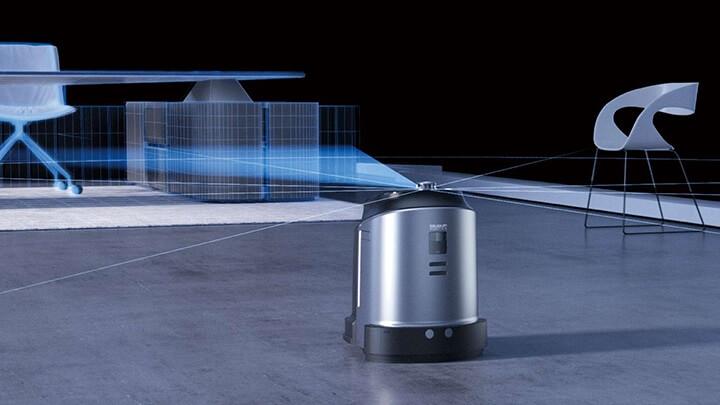
Industrial cleaning robot
But robotic cleaning also has its downsides. The main ones are also discussed in detail:
- First and foremost, commercial cleaning robots are not capable of completely replacing manual laborUsing the same retail space example, robots are unable to wipe shelves and mirrors, clean hard-to-reach areas, or move furniture if, for example, trash falls behind a bench near the wall. Yes, existing solutions can take on a significant portion of the cleaning work, but certainly not all of it.
- Commercial cleaning robots very expensivePrices start at $15,000 and can reach $60,000-70,000 for a single robot. Long-term savings are quite real, especially for large spaces where cleaning costs exceed $100 per month. However, not everyone is willing to pay a large sum for a robot upfront, which is why those who are implementing robo-cleaning services on a large scale are receiving media attention.
- The next disadvantage is the commercial robot needs maintenanceReplacement of consumables, maintenance, and troubleshooting. Ideally, all of these tasks require a dedicated, trained employee who is knowledgeable about the product. Companies that sell commercial cleaning robots offer training and maintenance services for their products. However, this represents an additional expense, so consider whether paying for robot maintenance is more cost-effective than reducing the cost of hiring a cleaning professional.
Well, I would also like to point out the temporary shortcoming of domestic robo-cleaning - lack of full support for foreign manufacturersThis isn't true for everyone. There are also brands that are already localized, but they're few and far between. All the major players in the robot cleaning market either don't sell their equipment abroad at all, offering only local rental services, or they sell it but provide service and repairs only in their home countries. If you order a robot from China, you're not even thinking about sending it back to China for repairs. However, I'm confident that as the market develops, more and more companies will establish branches to sell and support their products, including in the marketplace. Positive momentum in this area is already noticeable.
I'd like to end this review on this note. If you enjoyed the topic of robo-cleaning and would like to receive further interesting information, please let me know in the comments. For example, in future installments, I might share an experiment with household robots for cleaning retail spaces, and what commercial cleaning robots are currently available.
Finally, I recommend watching the video version of this publication:
Happy shopping everyone. Bye!