Xiaomi Mijia Infinite Robot Vacuum-Mop 1S: The Best Xiaomi Robot Vacuum Cleaner of 2022!
- Equipment
- Appearance
- Technical specifications
- Functional capabilities
- Testing
- Navigation
- Recognizing objects on the floor
- Suction power
- Dry cleaning
- Carpet cleaning
- Wet cleaning and carpets
- Wiping off dirt
- Removing difficult stains
- Rinsing the wipes
- Self-cleaning quality
- Obstacle clearance
- Driving on black surfaces
- Noise level
- Observations and recommendations
- Personal opinion
The Xiaomi Mijia Infinite Robot Vacuum-Mop 1S is the company's flagship product as of late 2022. This is the model's name in the Mi Home app, but it is often referred to as the Xiaomi Mijia OMNI 1S, a reference to its predecessor. Mijia OMNI B101CN, which is visually almost identical. Furthermore, the name Xiaomi Mijia Sweeping and Dragging Robot 1S has been popping up online, and this is also the same one. To avoid confusion, the robot and station part numbers are B116+JZ2204. The new product features an updated station, which now includes a compartment for a detergent reservoir and, more importantly, an optional module for connecting to a sewer or water supply. Below, I'll thoroughly test the Mijia 1S, discuss its strengths and weaknesses, and compare the results with the previously released Mijia OMNI B101CN, as many are curious to see if the robot's capabilities have been changed during the upgrade. So, let's get started!
Equipment
In addition to the robot and station, the standard delivery package includes:
- Power adapter with adapter for European socket.
- Instructions in Chinese.
- Detergent tank, 300 ml capacity.
- Robot cleaning tool.
In this configuration, the Mijia 1S costs between $700 and $800.
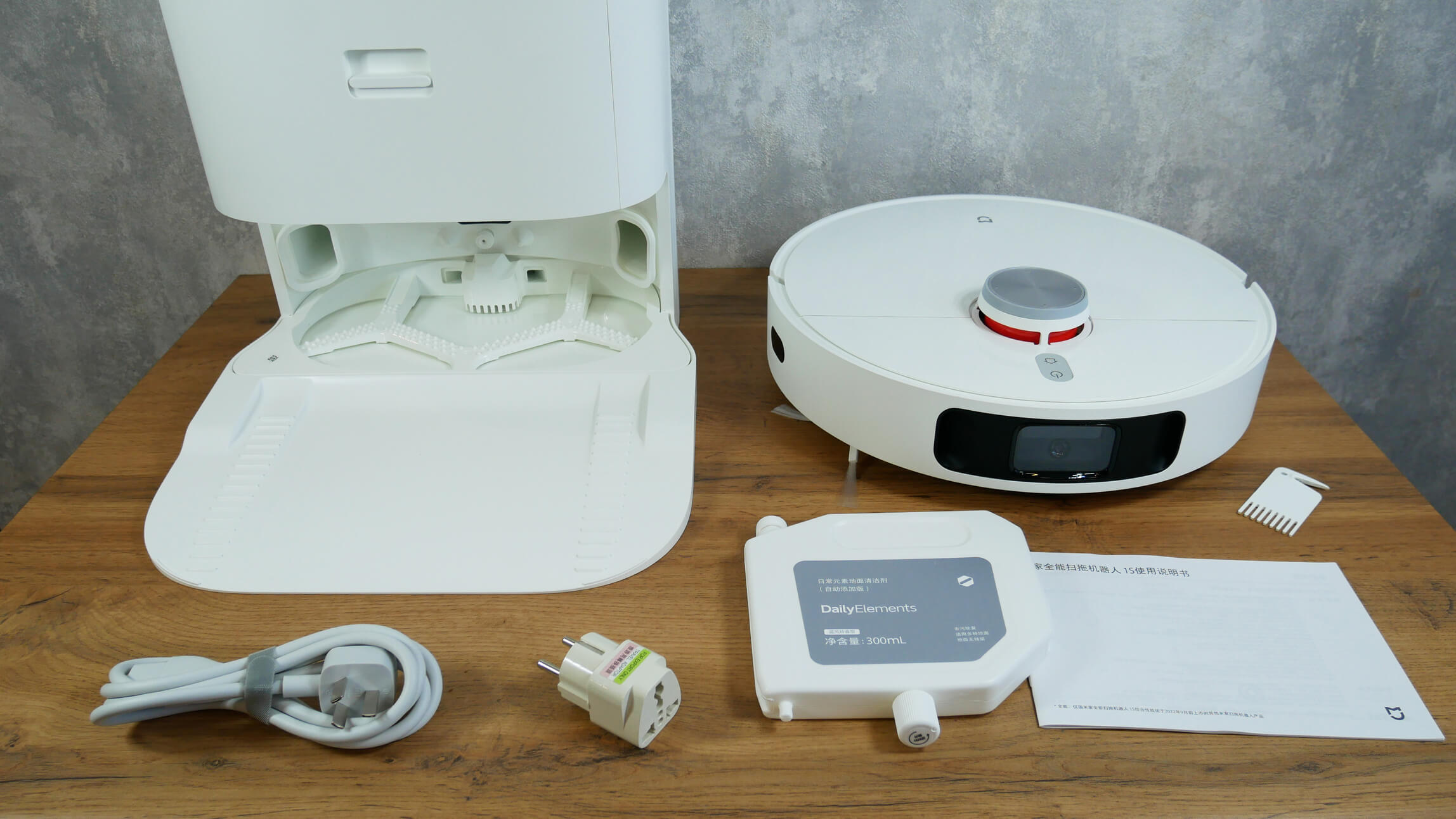
Standard equipment
An optional module for connecting to sewer and water supply systems costs another $150. It was shipped in a separate box, which also contains:
- A magnetic control unit through which water flows from the water supply to the station.
- Plastic pipes for connecting sewerage and water supply to the station.
- Straight through branch from 1/2 inch to plastic 1/4 with ball valve.
- Plastic clamps.
- Double-sided tape.
- Tube holder with self-adhesive pad.
- A perforated hose in which you can hide the tubes from the station, and a special device for pulling them out.
- Angle adapters for connecting tubes to the station.
- Corner retaining clips.
- John Guest type corner connectors.
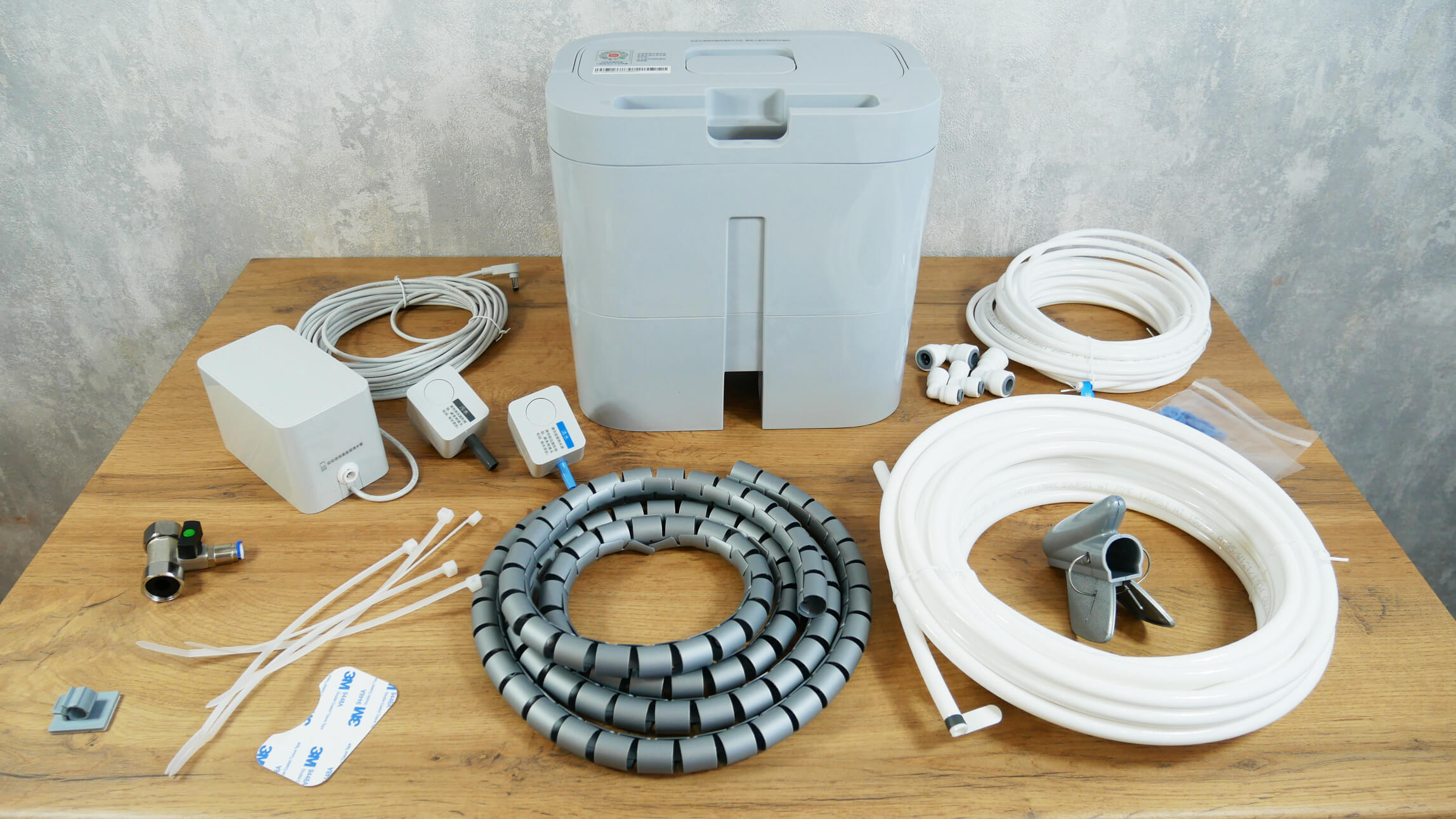
Optional module
Looking ahead, I can say that the accessories are complete; you don’t need to buy anything extra for a standard connection.
Appearance
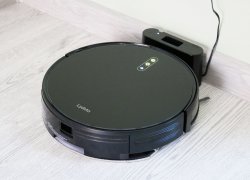
Let's take a look at the Xiaomi Mijia Infinite Robot Vacuum-Mop 1S. Visually, the robot vacuum cleaner is absolutely identical to its predecessor, the Mijia OMNI B101CN. The lidar sensor's color is slightly different, but this isn't significant. So, I'll briefly describe the robot itself and then move on to the station. The body is round and white. A wall sensor is mounted on the right side of the mechanical bumper. A system of sensors is located in the center to detect and accurately avoid objects on the floor.
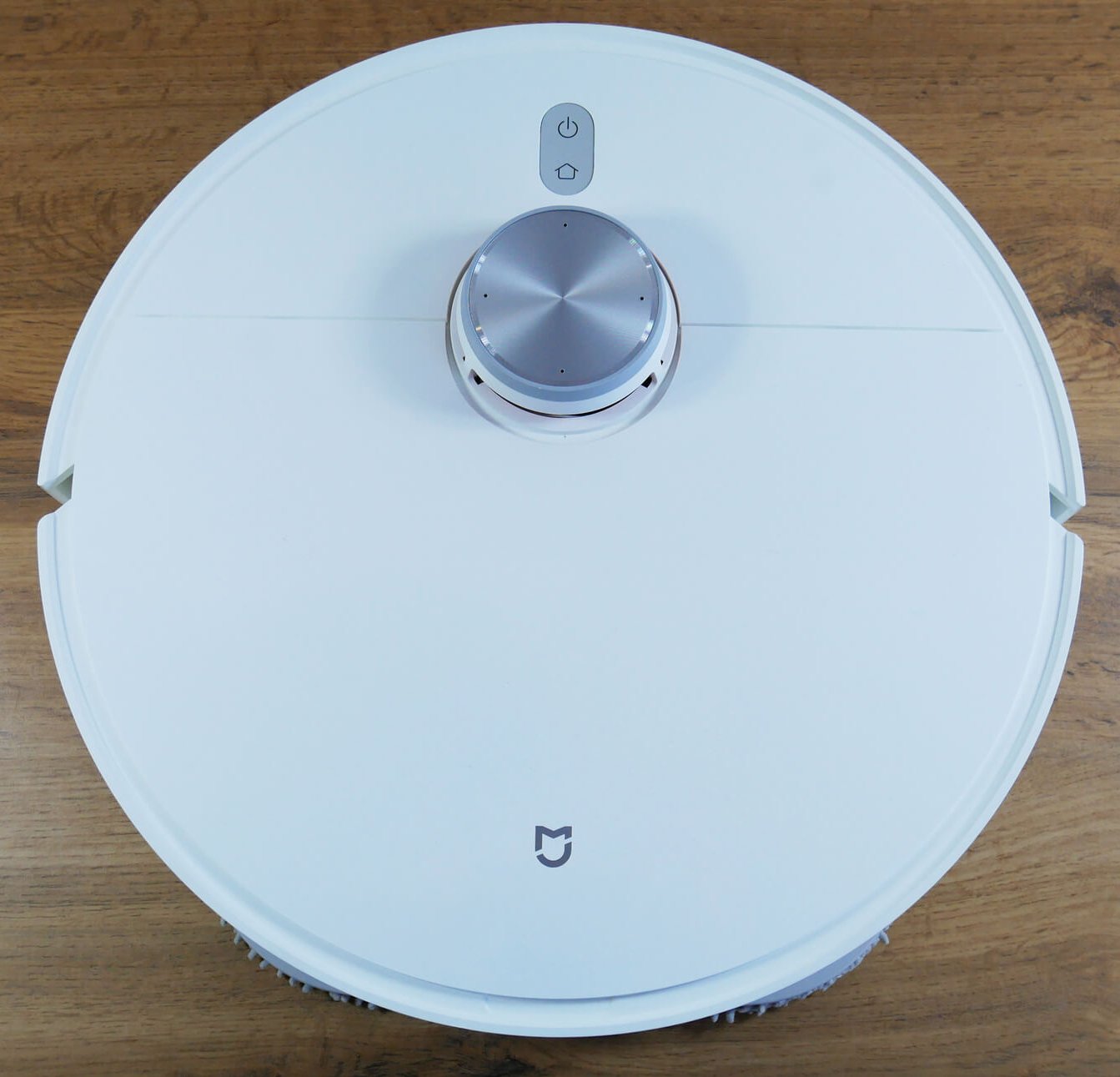
Top view
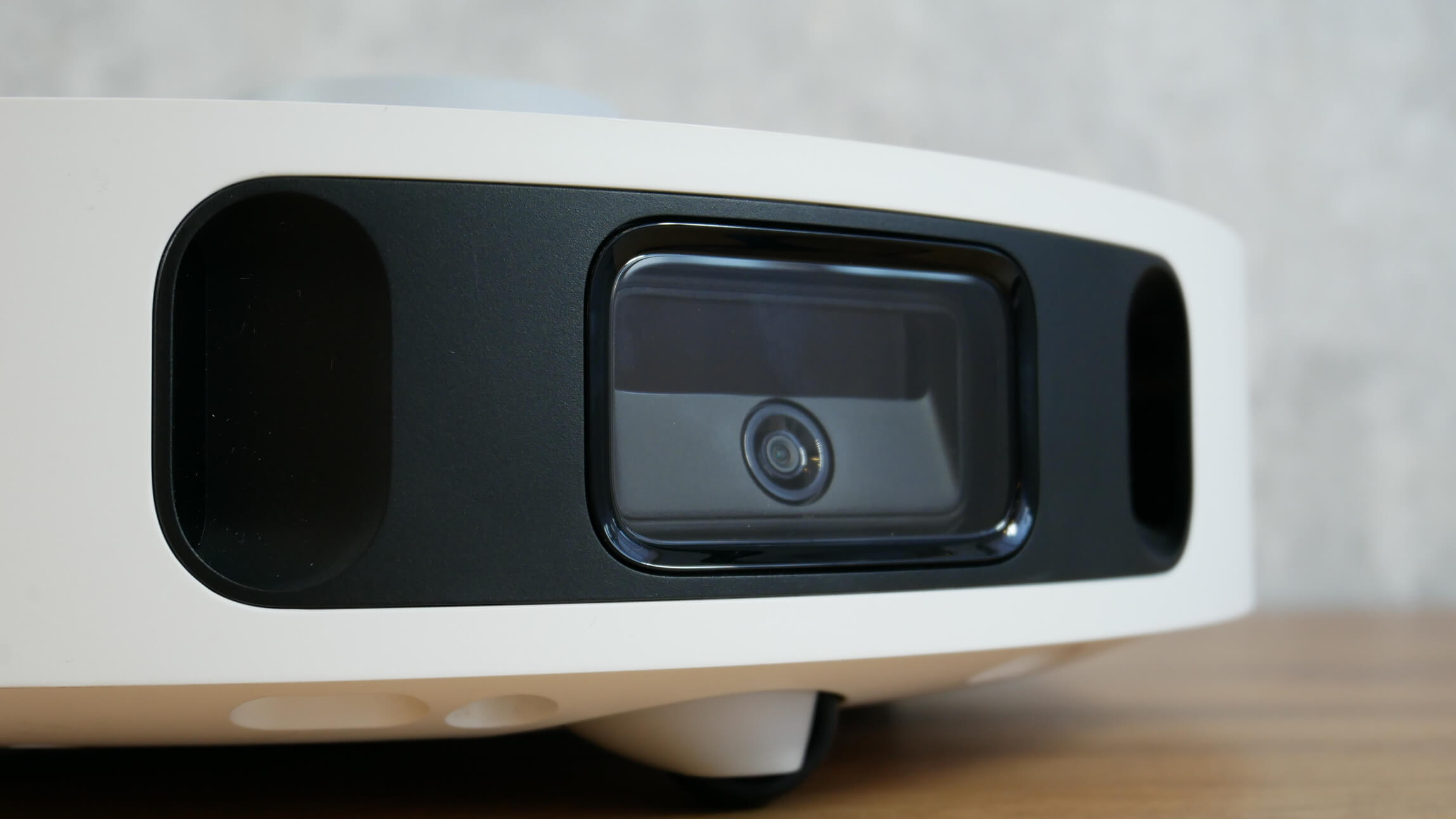
Object Identification System
The control panel features two mechanical buttons. The lidar is equipped with a spring-loaded cover that prevents the robot from getting stuck under furniture. Under the top cover is a dust collector, which is washable with water, as is the HEPA filter. The filtration system is dual: a fine mesh is installed in front of the HEPA filter. The water tank is hidden inside the body and holds up to 80 ml of water. Water is pumped into the robot automatically at the station.
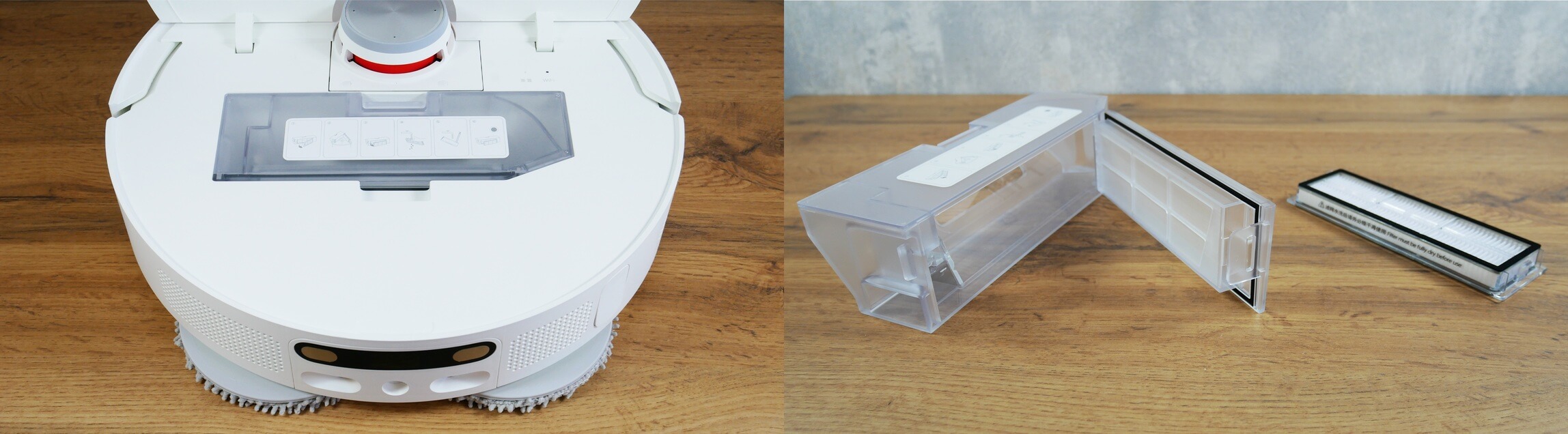
Filtration system
The bottom of the housing is equipped with four fall protection sensors. There's a single, three-beam, quick-release side brush. The central brush unit is floating. The brush itself is made of bristles and petals. Both sides can be removed to remove tangled hair and fur.
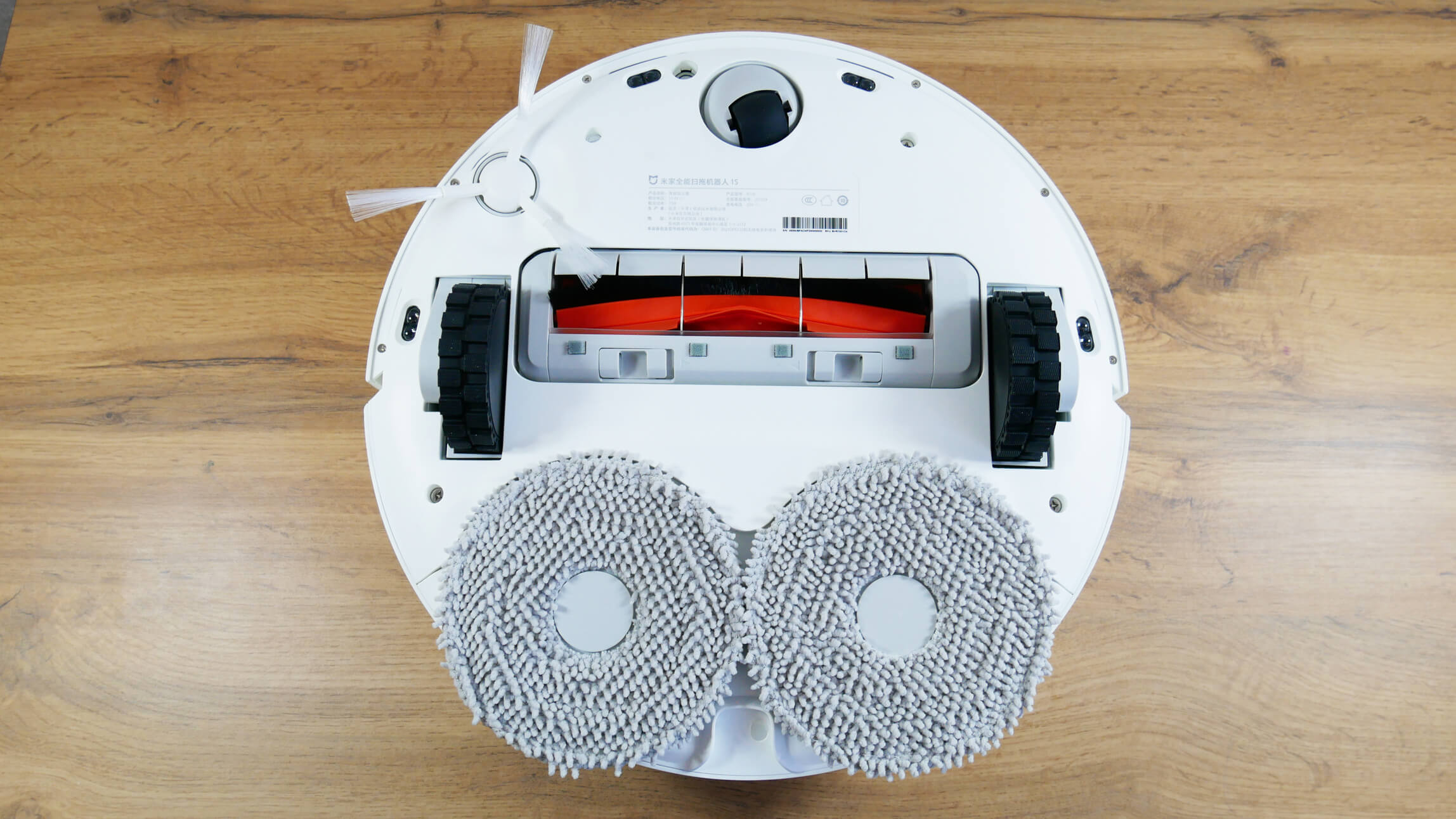
Bottom view
As I already said in the OMNI B101CN review, if you wish, you can order a silicone brush from Dreame Bot L10s Ultra and install it in this robot. The dimensions and shape are identical. The silicone brush is easier to clean from hair and pet hair.
The napkin holders are attached with magnets. The napkins, in turn, are attached to the holders with Velcro. The napkin lifting mechanism is achieved by twisting and unscrewing the platforms themselves.
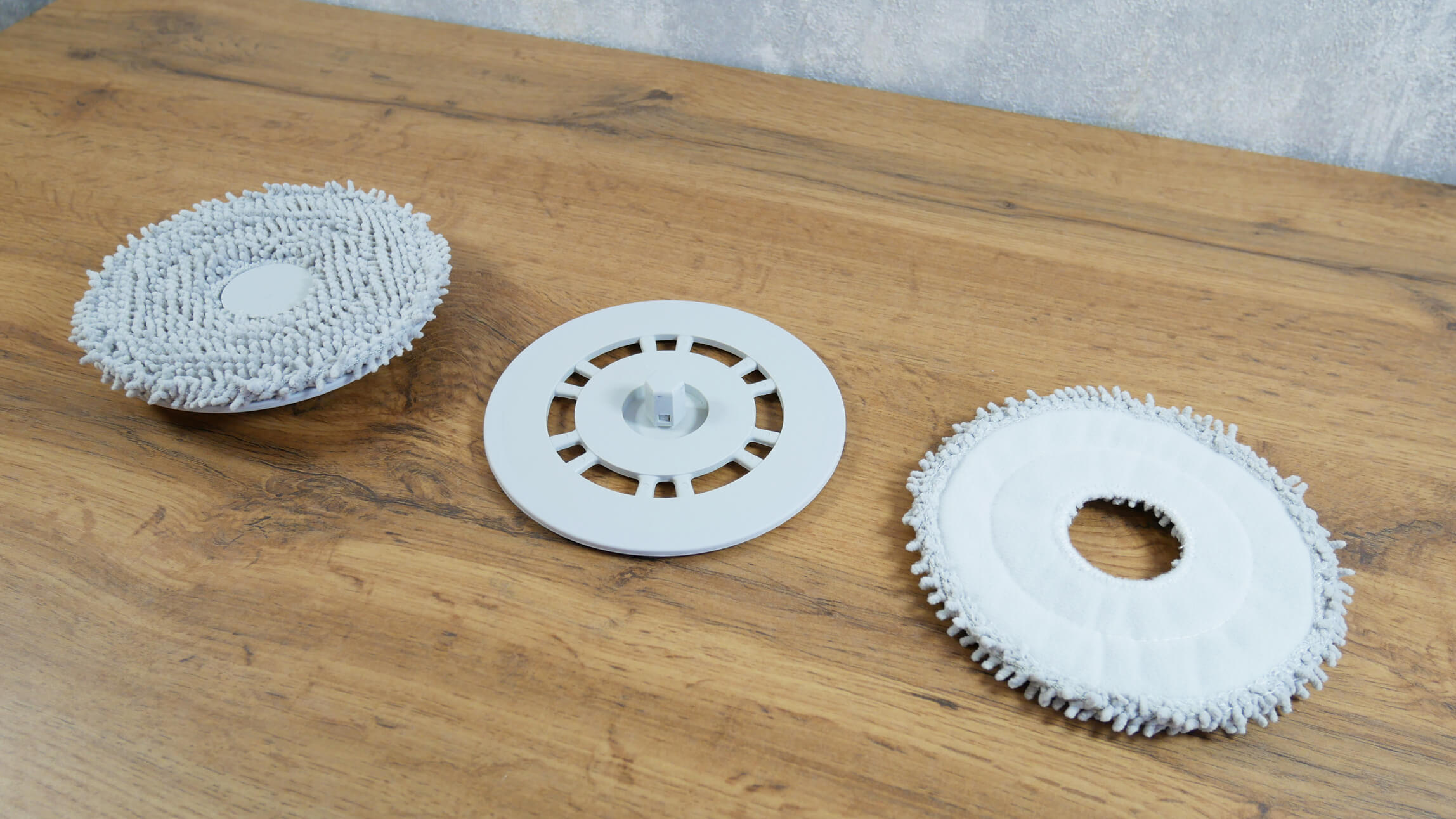
Napkins
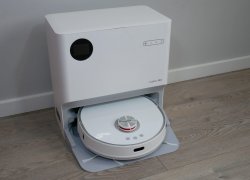
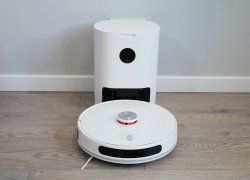
Now that we've sorted out the robot, let's move on to the station. Again, it looks identical to the previously released version. The platform isn't removable, but the cleaning module for the wipes themselves is. Beneath it is a flat surface that's easy to wipe clean. Above, behind a lid with a mechanical latch, is the self-cleaning dust bag. It holds up to 2.5 liters of dry waste.
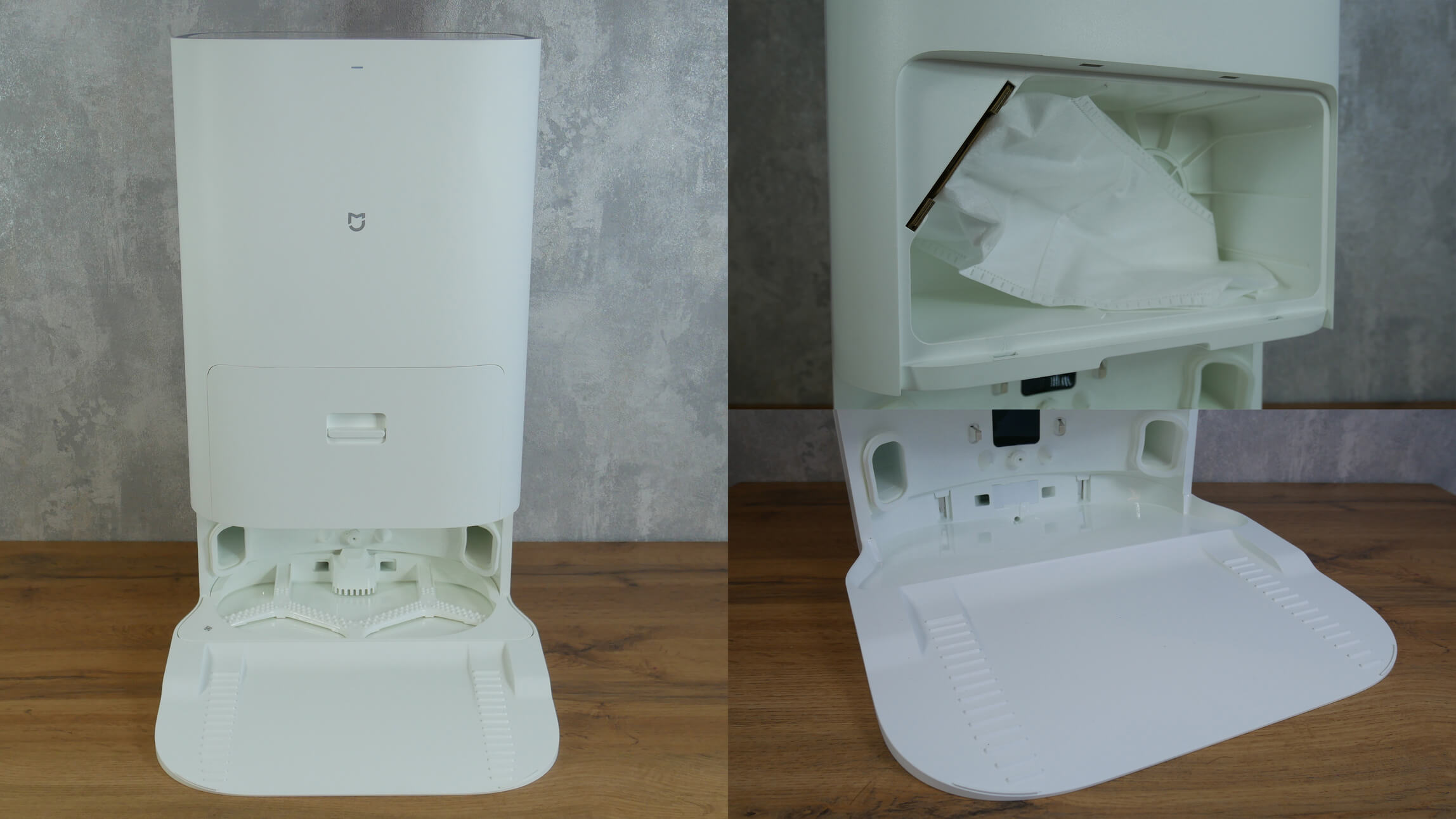
Station
Under the top cover of the station are the dirty and clean water tanks. They are standard, holding 2.5 liters each. A detergent reservoir is installed between them, and this is the first difference from the MIJIA OMNI B101CN. The reservoir itself is the same shape as the Dreame Bot L10s Ultra.
Instead of tanks, an optional module for connection to utility systems is installed. It also contains a compartment for a detergent cartridge. Let's take a closer look at this unit. The top lid is sealed. We can see residual water on it. Apparently, these tanks are tested at the factory before shipping, and that's good. On the right is a compartment for filling with clean water. Inside is a float and even an overflow hole, just under the top. On the left is a compartment for draining wastewater. It contains a mesh filter that prevents clogging of the already thin tube. Wastewater drains at the lowest point of the tank.
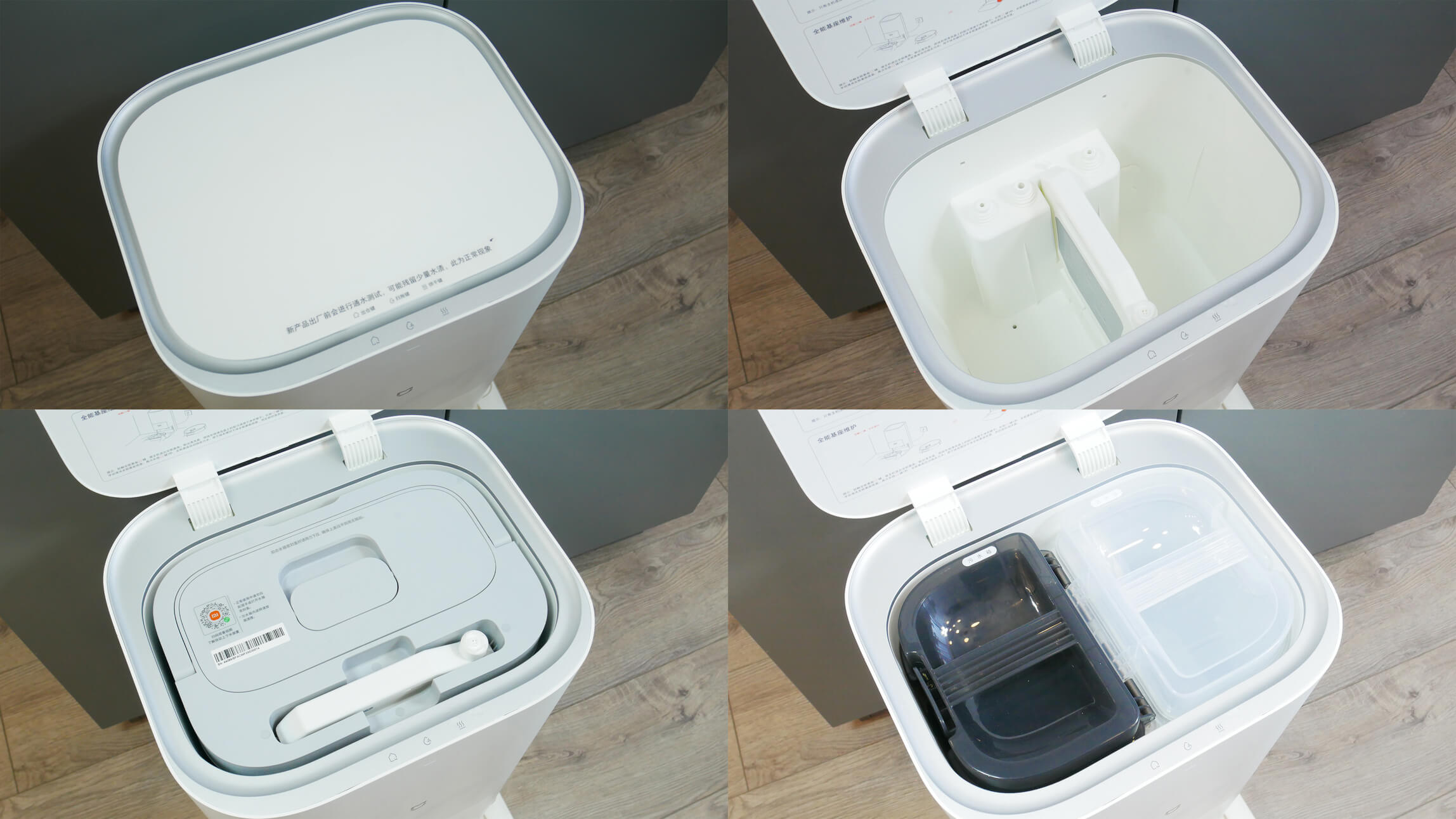
Tanks in the station
After installing the module in the station, remove the cover on the back of the station and use a Phillips-head screwdriver to securely attach the module to the utility connections. After that, you can begin assembling the system.
It's all very simple. First, I installed the corner adapters, which are held in place with mechanical fasteners. Then I measured the required length of plastic tubing from the corner adapters to the floor, cut it, and connected it to the corners. Don't forget to install the locking clamps to ensure secure connections. Next, I connected the magnetic control unit, but this can be done at the site where the station will be installed. All that remains is to connect to the home's utility lines. Since this is a test unit, not a "permanent robot," I didn't bother with the wiring, so I installed the drain in the toilet and a pass-through outlet under the sink in the bathroom. I could have installed a drain here, but I didn't want to break the seal for the sake of visibility. Ultimately, in my case, everything turned out relatively neatly, and the location turned out to be suitable for such a station. Here's what the system looks like in working order. When I plugged the station into an outlet, water began to fill the designated compartment. The robot is ready for testing! But for now, let it charge.
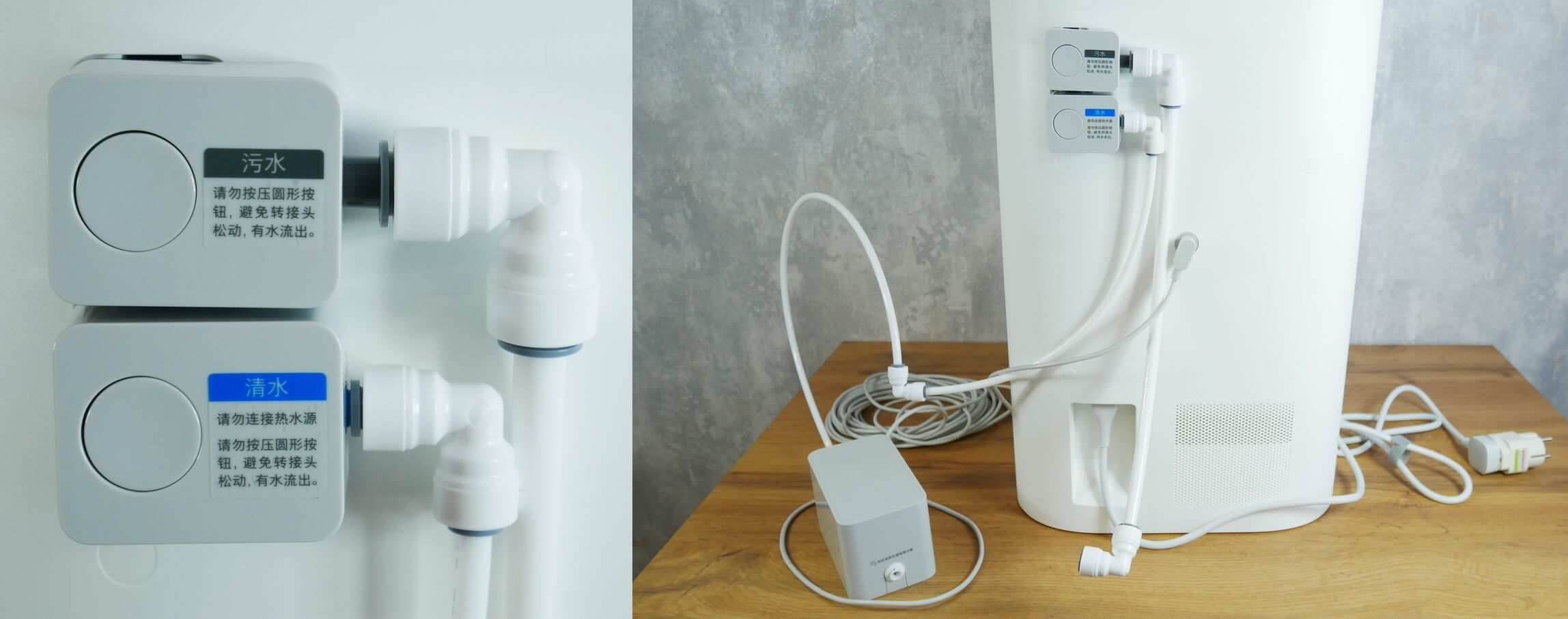
Connecting the station
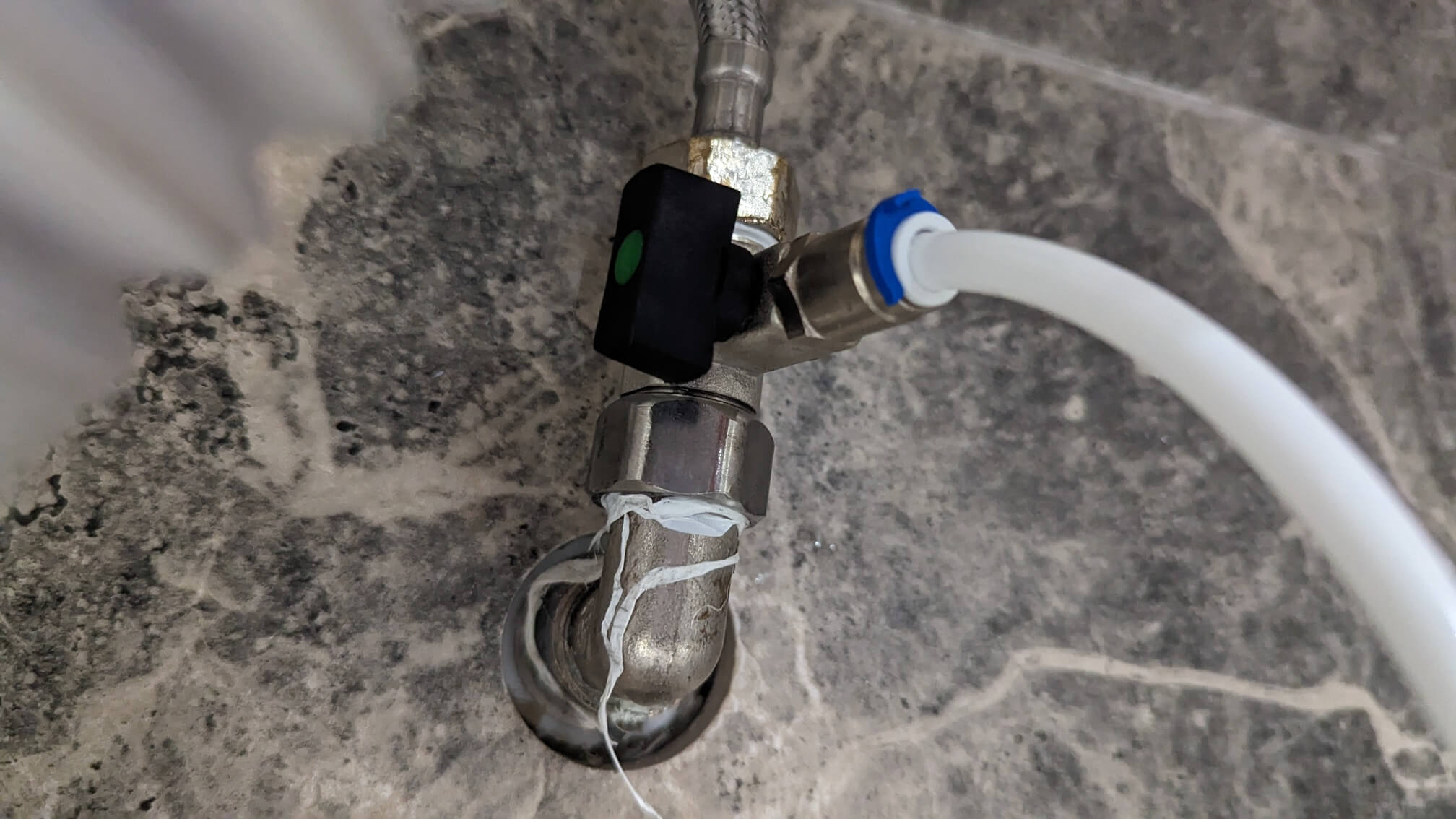
Connecting the station to the water supply
Technical specifications
Key Features of the Xiaomi Mijia Infinite Robot Vacuum-Mop 1S:
Robot vacuum cleaner:
- Li-Ion battery 5200 mAh.
- Suction power up to 4000 Pa.
- Cleaning area up to 200 sq.m.
- Dust collector capacity is 350 ml.
- The water tank capacity is 80 ml.
- Obstacle clearance up to 20 mm.
- Dimensions: 350*97 mm.
Station:
- Power consumption: up to 1000 W.
- Clean water tank: 2.5 l.
- Dirty water tank: 2.5 l.
- Bag in the station: 2.5 l.
- Dimensions: 423*340*568 mm.
The only important thing to check here is the suction power. The rest of the specifications are quite standard and, compared to the Mijia OMNi B101CN, are virtually identical.
Functional capabilities
Speaking of controls, the robot vacuum cleaner is designed for the Chinese market and therefore connects to Mi Home via the China region. However, I can say that the interface is in Russian, and the app itself surprisingly runs smoothly, which is a big plus for the Chinese Xiaomi. The only downside is the lack of a Russian voice pack, but that's not a deal-breaker. There are solutions online for customizing this robot's Russian language using third-party software.
Mijia Omni 1S functions are displayed on the screen:
- Self-cleaning.
- Rinsing napkins at the station.
- Drying napkins with hot air.
- Automatic supply of detergent when rinsing wipes.
- Identifying objects on the floor.
- Saving multiple cleaning maps in memory.
- 3D map of the room.
- Automatic zoning of premises into rooms.
- Selecting areas and rooms for cleaning.
- Virtual walls and no-go zones (and for wet cleaning mode).
- Suction power adjustment.
- Setting the frequency of rinsing wipes (by room, every 20 sq.m.).
- User mode.
- Cleaning log.
- Setting up cleaning according to a schedule.
- Automatic power increase on carpet.
- Carpet cleaning in wet cleaning mode.
- Mi AI voice assistant.
Again, the functionality is identical to its predecessor. The only new additions are automatic detergent dispensing during the wipes' rinse cycle, as well as the proprietary Mi AI voice assistant (the last letter is "i"). However, the latter has not yet been adapted for the Russian audience. Examples of commands in the menu are in Chinese. Ideally, they will be in English.
Overall, there are quite a few options. In my opinion, the wipes' rinse cycle isn't implemented very well. There's no option to select a different area, and 20 square meters is quite a large range. Even 15 square meters would have been a better solution.
This model doesn't have remote home monitoring. It only features automatic object detection. You can disable this feature if needed, but it's not completely disabled; the 3D sensors still work. So, if the robot starts acting up on fluffy carpets, disabling the object detection system won't solve the problem, unfortunately.
Testing
A detailed video review of the Xiaomi Mijia Omni 1S has already been prepared and published on the channel. I recommend watching the video:
Navigation
And finally, let's move on to the tests. First, we'll test the Mijia Omni 1S's navigation in a room with obstacles. The robot vacuum first moves around the perimeter of the room, then cleans the entire accessible area in a serpentine pattern. It detected the feet of the dryer and carefully navigated around them. It also swept around the box and chair legs separately, then returned to the station. The test was successful.
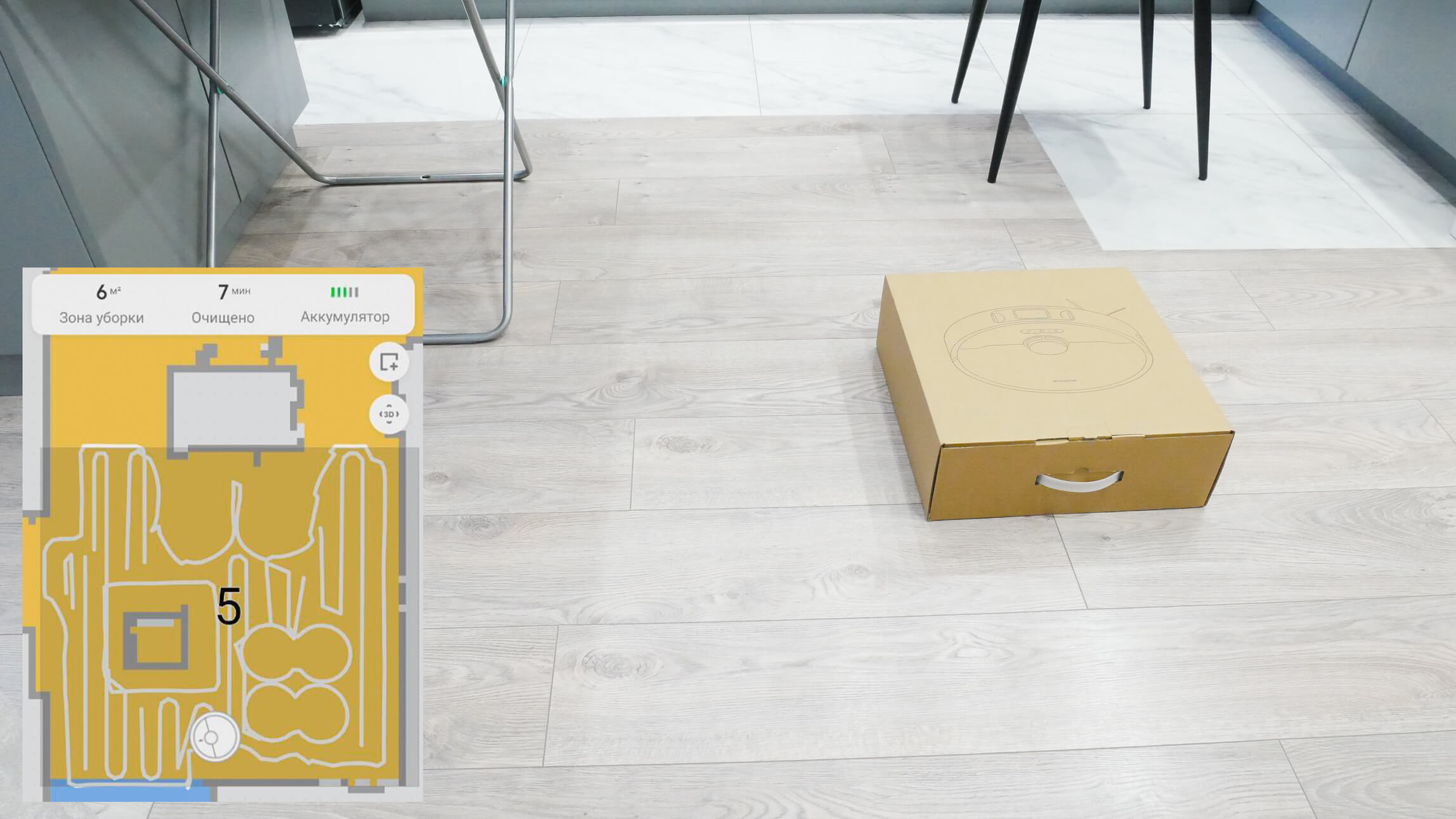
Navigating an Obstacle Room
Speaking of navigation within the house, the robot vacuum cleaner cleans room by room, following the perimeter, then in a serpentine pattern. Every 20 square meters, as I determined, it returns to the station and rinses its cleaning cloths, then resumes cleaning from where it left off. Ultimately, the apartment was cleaned with two intermediate trips to the station. There were no uncleaned areas, and this model's navigation is as good as its predecessor's.
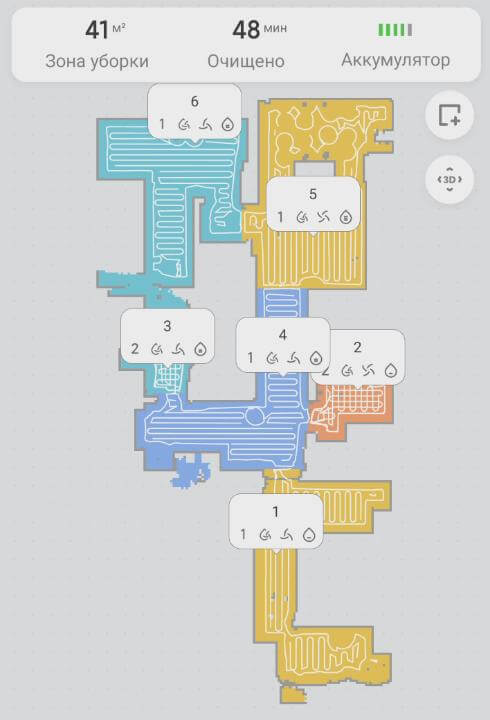
Navigation within the home
Recognizing objects on the floor
The object detection system is good, but not perfect. It accurately avoided five of the six objects on the floor. It only ran over a fake pet surprise, which was the smallest object. The Mijia OMNI B101CN didn't fall for this trap, but I think that's just a coincidence; the navigation is the same. It's worth noting that certain objects aren't marked with corresponding icons on the map. Therefore, there's doubt that the robot vacuum actually recognizes them. At least, there's no confirmation of this, compared to, say, the Dreame. It's also worth noting that the object detection system becomes blind in complete darkness, and the robot is even less able to detect objects lying on the floor. This is worth keeping in mind.
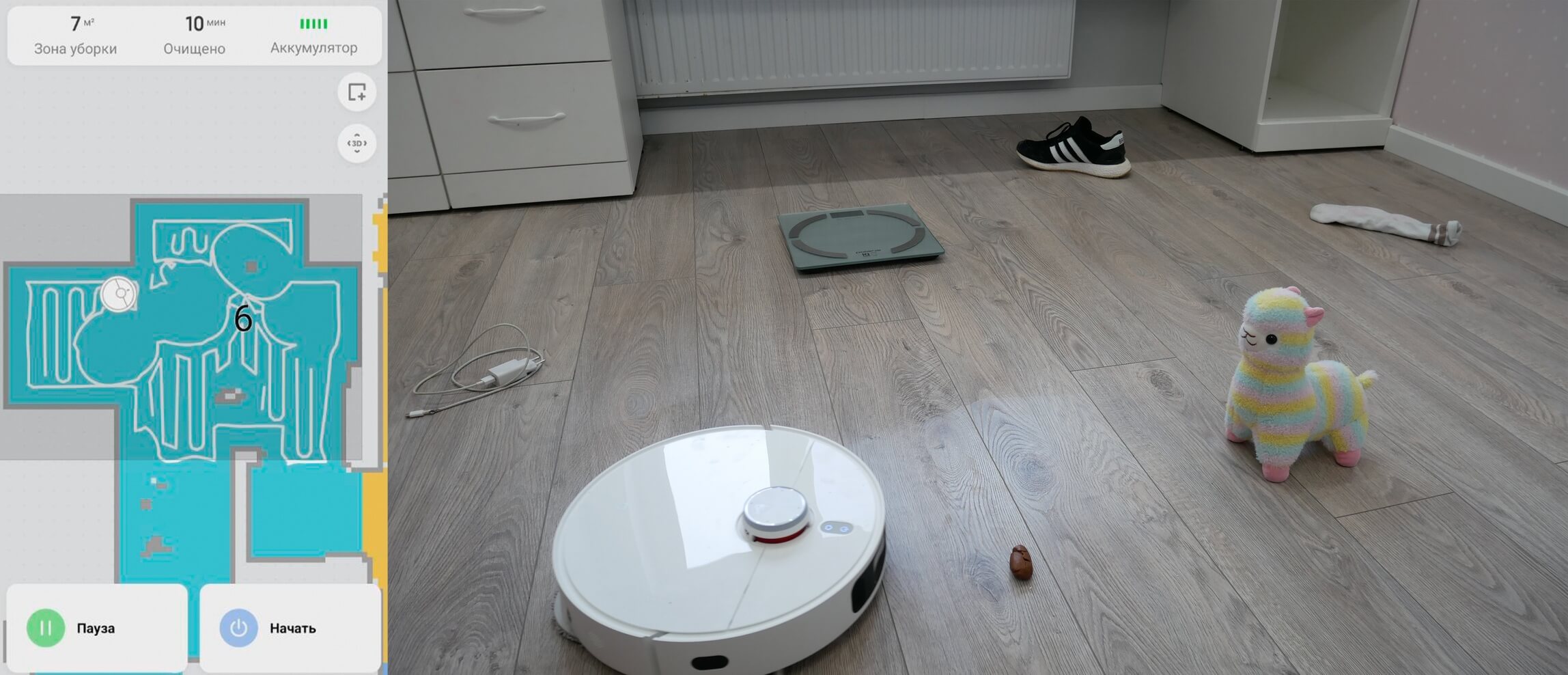
Recognizing objects on the floor
Suction power
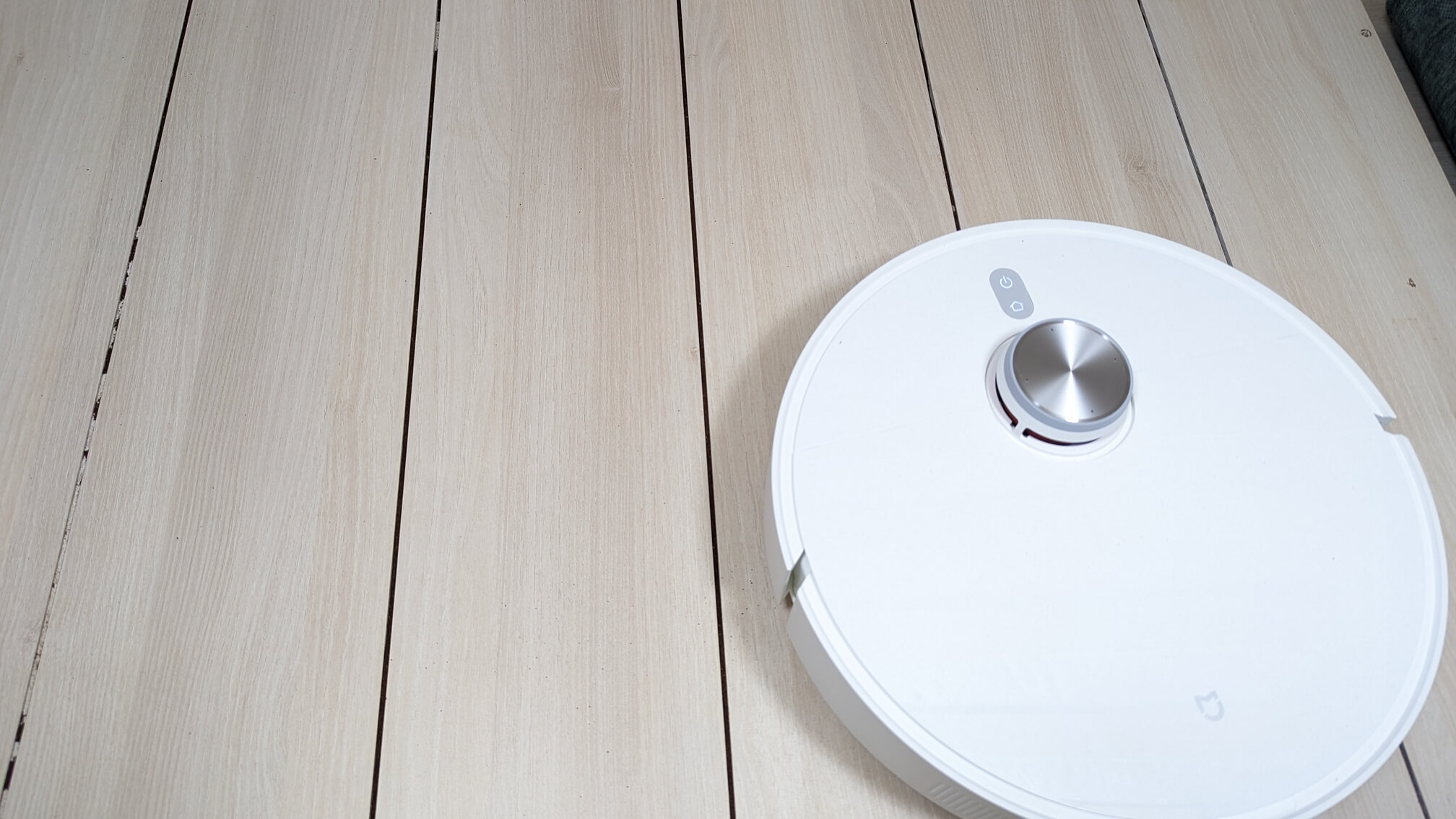
Regarding suction power, here's an interesting point: the Xiaomi Mijia Infinite Robot Vacuum-Mop 1S was only able to suck up debris from crevices 2 and 4 mm deep. While powerful, it's not overwhelming.
Suction power
For comparison, the Mijia OMNI B101CN was able to suck up debris from a 10 mm gap. Here I'll share my own speculation as to why this happened. I ran this test several times to rule out a fluke. Either I had an abnormal B101CN, or Mijia engineers at the factory decided to reduce the power to extend the motor's life. This is at least logical, since the Dreame Bot L10s Ultra, its twin, and even the L10s Pro, also 4 mm in power. Given this, I suspect there may have been complaints or motor issues with the predecessor, which they addressed by reducing the intake motor speed. Overall, it's not critical; it's still powerful, but not as powerful as the B101CN.
Dry cleaning
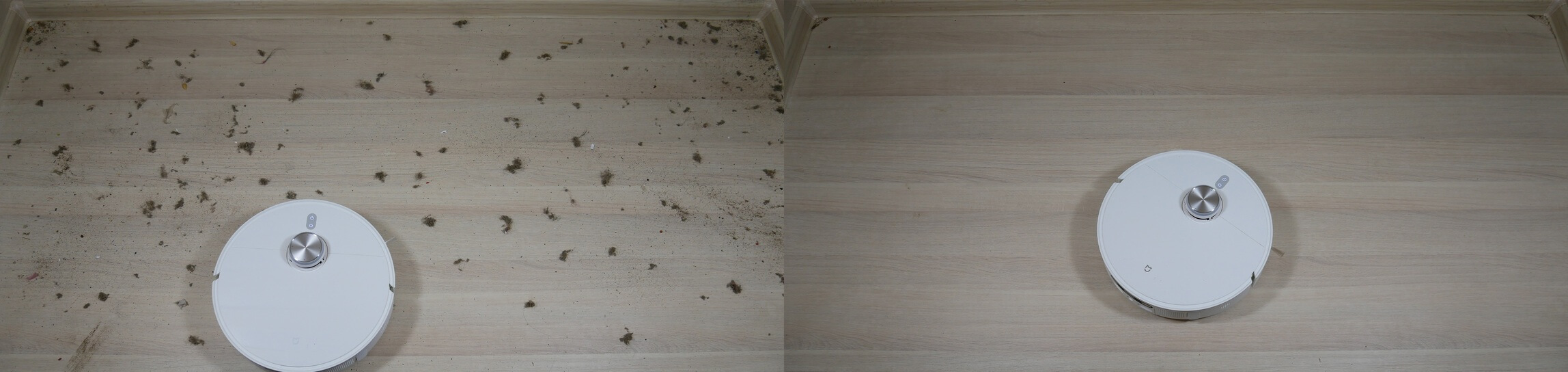
The collection performance of various types of debris on laminate floors is good. Only a small amount of debris remains in corners, where round robotic vacuums can't reach. The central brush caught some hair and fur. However, the majority of the debris was collected in the dust bin. Test passed!
Dry cleaning
Carpet cleaning
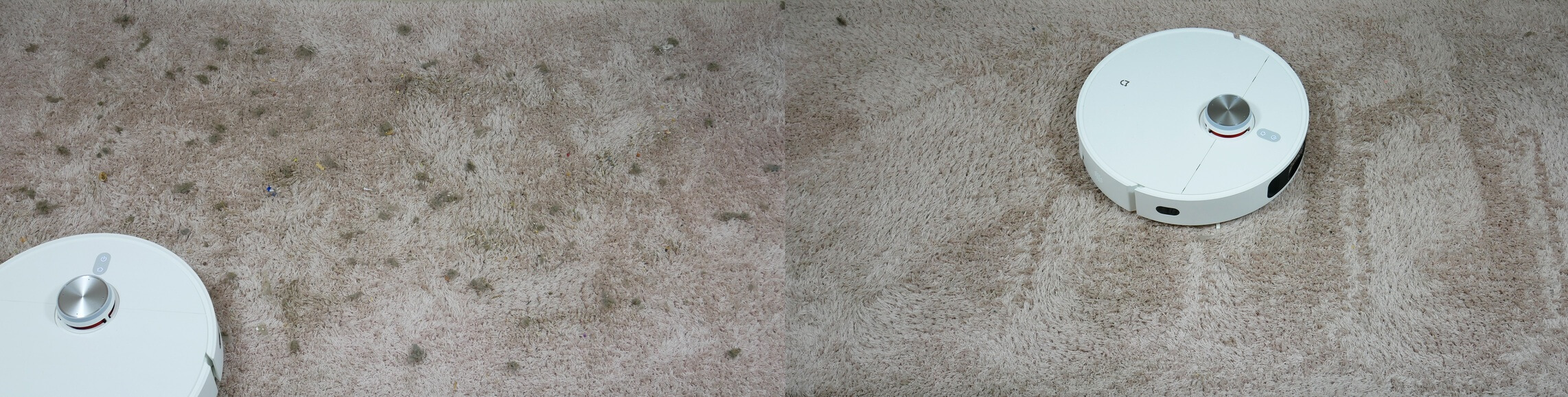
The same debris was scattered on the carpet, and the Mijia Omni did a good job. A few clumps of hair remained, but this was largely due to the object detection system preventing the robot from entering certain areas of the carpet, identifying them as obstacles. As mentioned, this system can't be completely disabled, which is not a good thing. However, the carpet cleaning performance itself was good.
Carpet cleaning
Wet cleaning and carpets
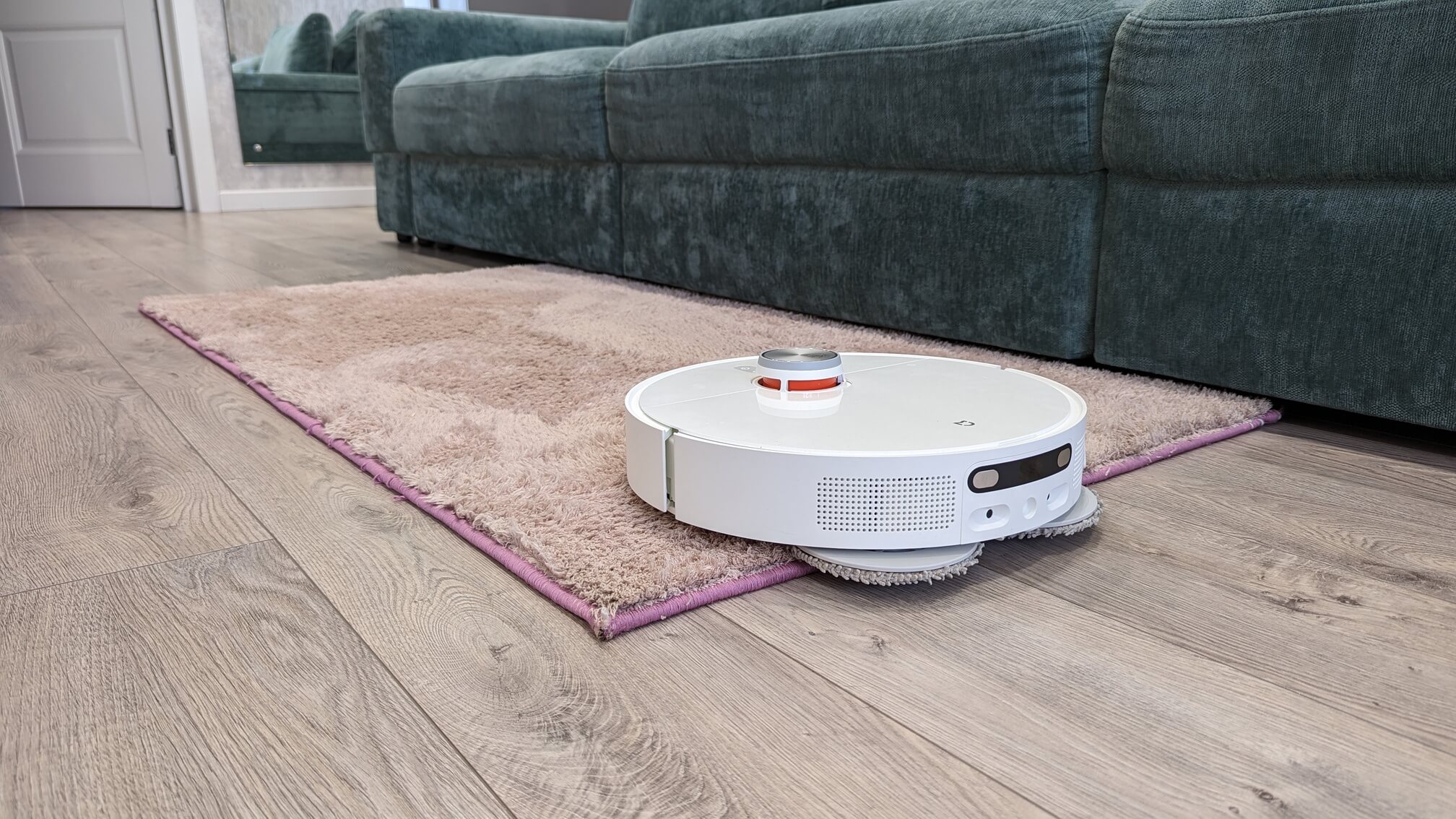
When wet cleaning on carpeted floors, you can choose between two robot behaviors. The first is to automatically lift the pads when entering carpets, allowing the robot to simultaneously vacuum and mop, leaving the carpets dry and clean. The second option is to enable automatic carpet avoidance in wet cleaning mode. This is especially useful for high- and medium-pile carpets, preventing the pad from coming into contact with the carpet if necessary.
Wet cleaning and carpets
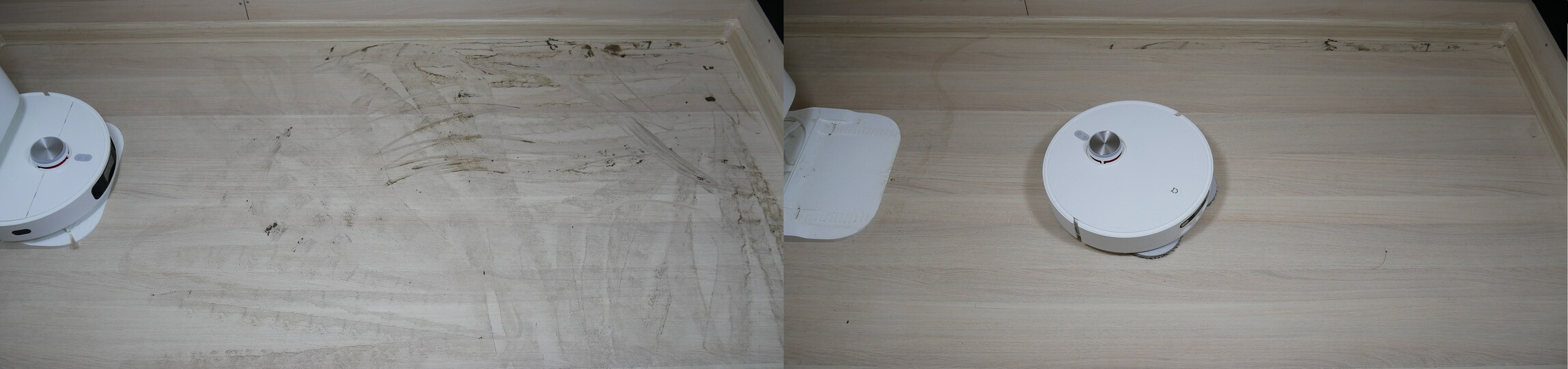
Wiping off dirt
This robot vacuum cleaner removes dirt efficiently, taking into account several intermediate trips to the cleaning station to rinse the cloths. This is the main advantage of such robots. Dirt is not ground into the floor during the entire cleaning process. Consequently, in just a few passes, the robot can actually clean the floor, not just mop it. As expected, a narrow section of the floor along the baseboard remained unwashed because the cloths don't extend to the edges. This is a problem with all the robot vacuum cleaners tested.
Wiping off dirt
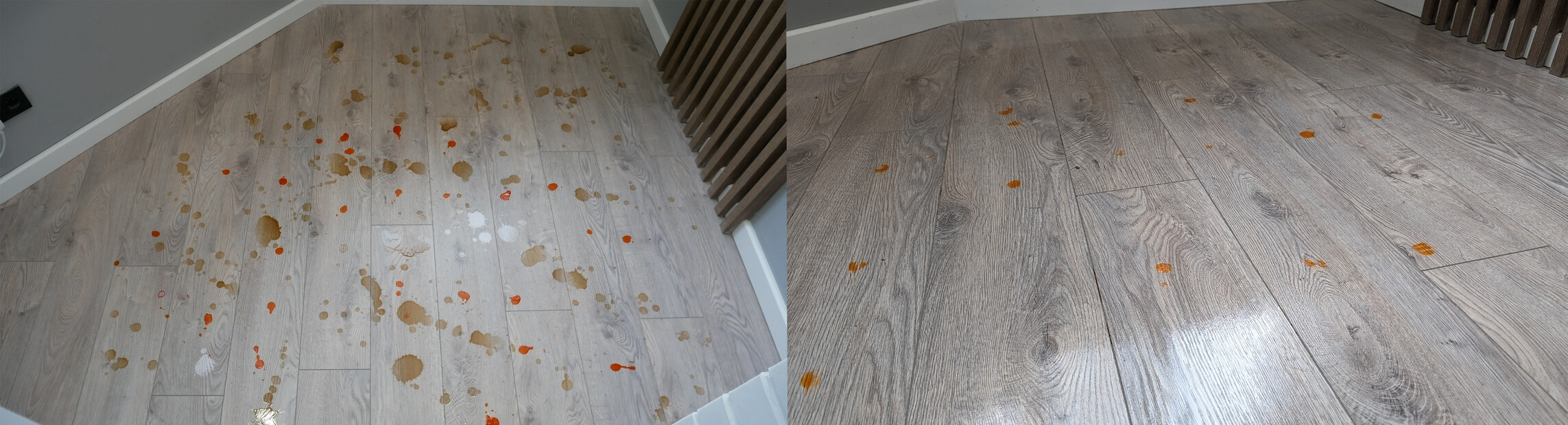
Removing difficult stains
The Xiaomi Mijia OMNI 1S struggles with tough, dried-in stains, just like its competitors. The pressure it exerts on the floor isn't as strong as that of dedicated robotic floor cleaners. In any case, it's not practical for this type of cleaning, so I just wanted to demonstrate this.
Removing difficult stains
Rinsing the wipes
Now, I'd like to test the effectiveness of the station itself. Let's start with the rinsing quality of the wipes. In everyday use, after washing the floor, the wipes aren't in too bad a condition. And after rinsing, I can say they're actually clean. A minimal amount of dirt is removed under the pressure of warm water. That's a plus!
If you perform a test after a difficult cleaning with a dirty floor, the cleaning pads on the station don't clean perfectly. But then again, the robot isn't designed for such conditions.
By the way, here's the platform's condition after extensive testing. Cleaning it isn't difficult.
Self-cleaning quality
The dust bin's self-cleaning performance is near perfect. I ran the robot vacuum in a room with a lot of debris. It cleaned everything perfectly, and we saw that the dust bin was completely full. We returned the robot vacuum to the docking station and saw that the dust bin was completely empty after self-cleaning. This robot's self-cleaning performance is excellent!
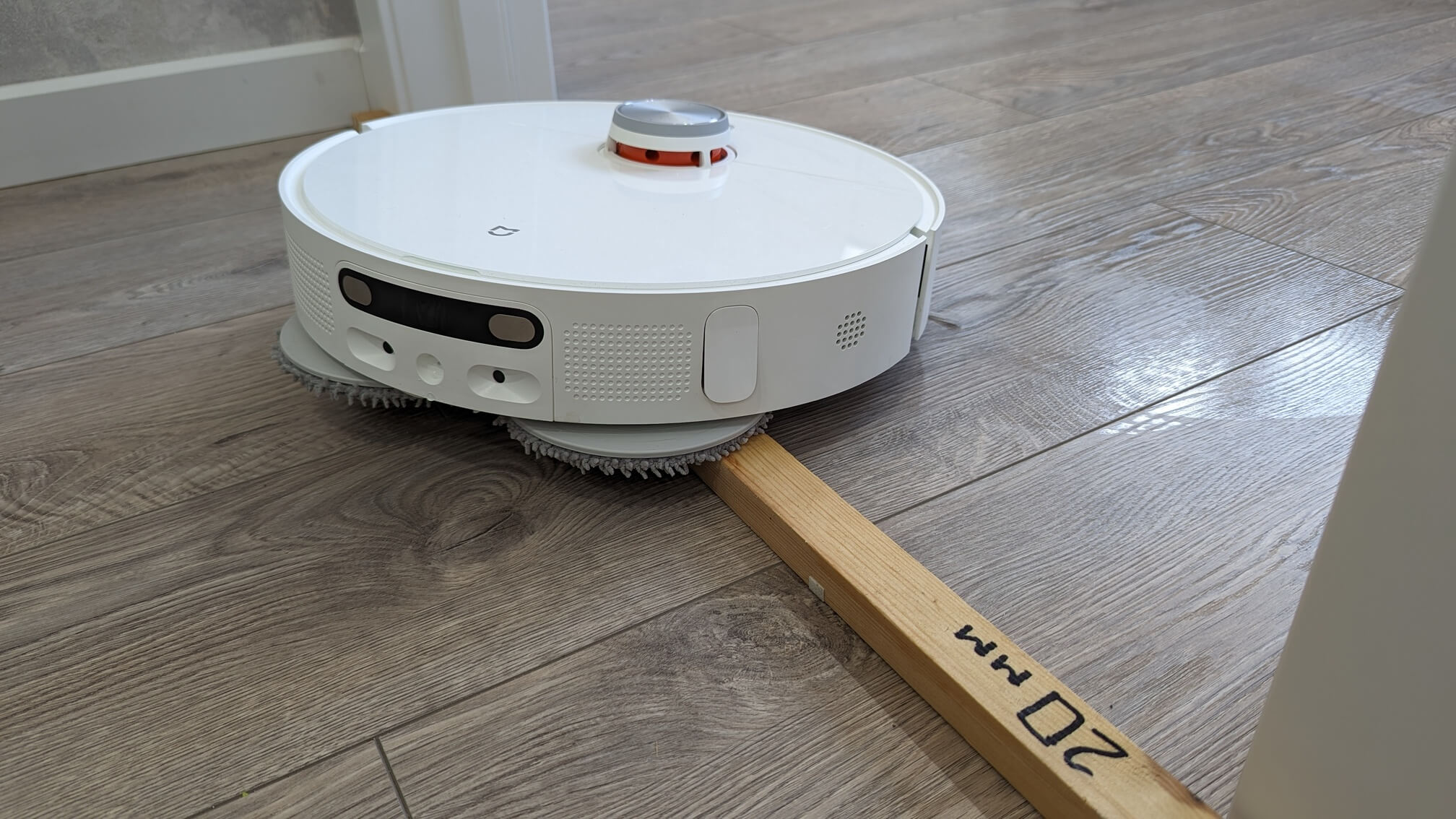
Obstacle clearance
The Mijia OMNI 1S easily navigates the 2cm-high thresholds, lifting the napkins along the way. That's a plus!
Obstacle clearance
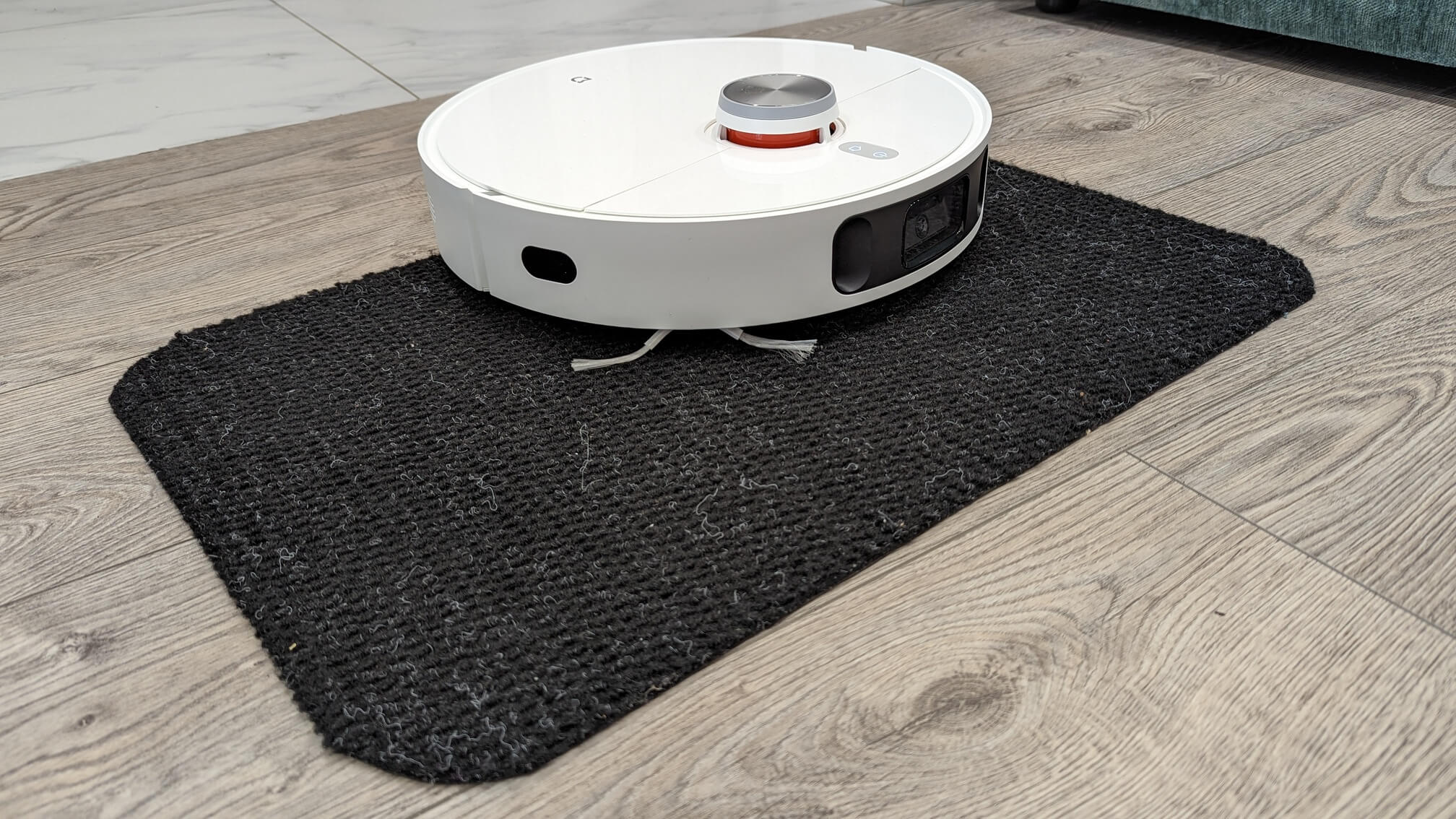
Driving on black surfaces
It's also resistant to black surfaces, easily navigating a completely black carpet, just like the Mijia OMNI B101CN. This is another advantage of the robot!
Driving on black surfaces
Noise level
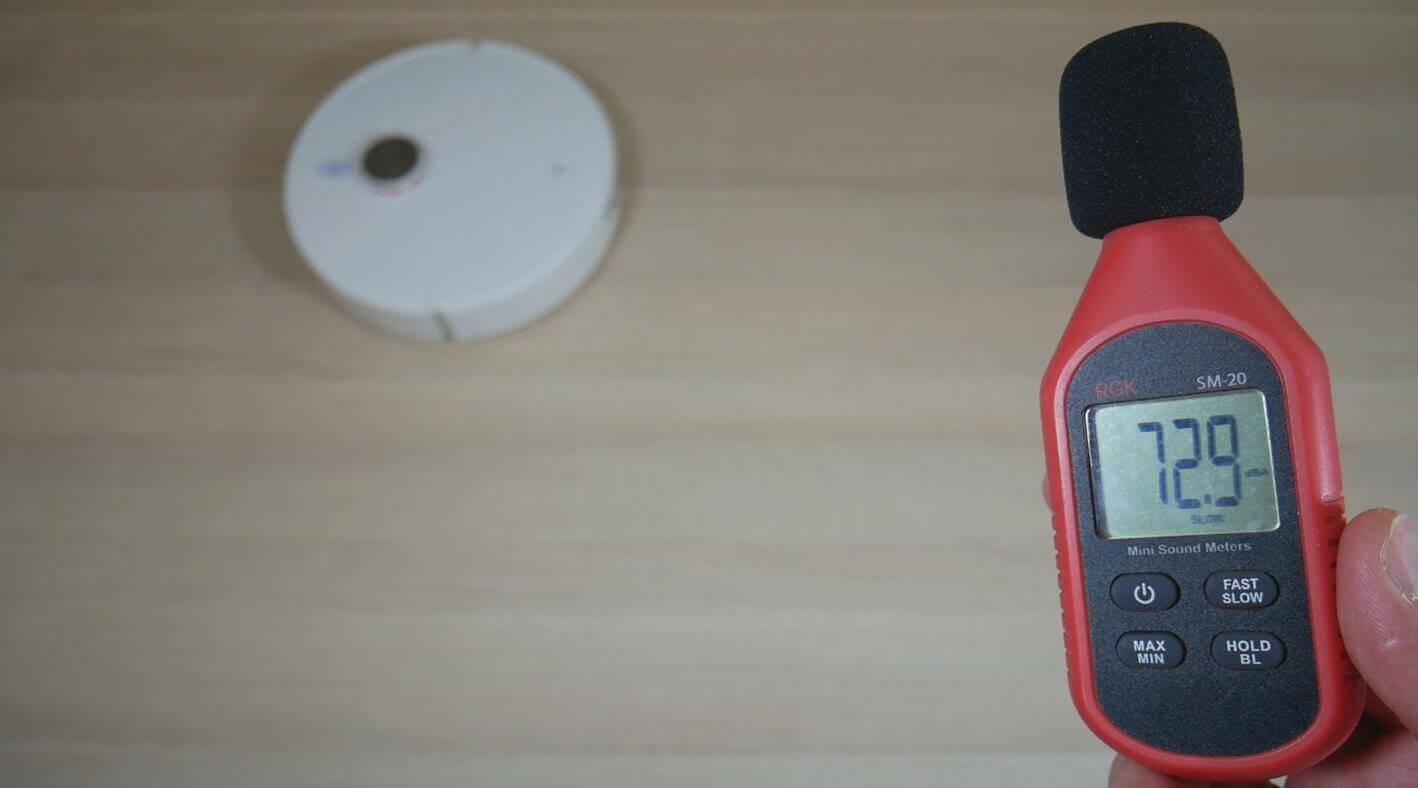
As for the noise level, with the suction off, it ranges from 57.5 to 59 dB. At standard power, the noise level rises to 60-61 dB. In "Strong" mode, the noise level rises to 63-64 dB, and at maximum power, the peak was 73 dB. The noise level is the same as its predecessor, which was actually more powerful.
Noise level
Observations and recommendations
All tests are complete. All that's left is to discuss some of the nuances discovered during testing of this robot, answer questions asked in the comments, and then move on to its evaluation.
Well, the first thing worth noting is that, like with the Mijia OMNI B101CN and Dreame Bot L10s Ultra, this robot has an issue with the water supply from the tank to the cleaning pads during cleaning. I even removed the cleaning pads to check if water was dripping from the holders, but no water was being supplied. I tried pumping the system with a syringe, as suggested on forums, but it didn't help.
Another problem was discovered with this particular model. With the utility module installed, the wastewater after rinsing the wipes didn't drain from the tray into the station and, consequently, into the sewer. Water remained in the tray, no matter how much I pumped the system with a syringe. I solved the problem the following way. I installed regular tanks for clean and dirty water in the station, turned on the wipe rinse function several times, and the station sucked the water from the tray into the dirty water tank without a problem. Only then did I install the special module, and the problem hasn't recurred. Some kind of factory-installed problem.
The next thing I already mentioned is that the object detection system can't be completely disabled. The robot can still move away from certain objects on the floor or the edges of carpets.
That seems to be all the problems, now for the details and answers to your questions. Keep in mind that the corner convectors prevent the station from being flush against the wall. The minimum clearance is 3.5 cm, which is exactly what these connectors occupy.
Several people have asked if this station can be used without a water supply or drain. Yes, it can; standard tanks are included. I'd like to point out again that the detergent cartridge can be installed in both the station with standard tanks and the optional module.
There was a question about how the station would behave if there was no water supply, for example, if it was shut off. In this case, water could be manually added to the appropriate compartment by opening the lid. The main thing is that the water level in that compartment is at the desired level, as indicated by the float.
It is also worth noting that the working water pressure in the water supply system should be in the range from 0.14 to 1 MPa (megapascal), as indicated in the instructions.
People also asked if it's possible to connect the drain directly, bypassing the compartment. I think you could connect the top hole, through which water drains from the tray, to the bottom hole, through which waste water goes into the drain. But I don't see any need for that. Residual dirty water won't accumulate, the lid is sealed, and odor won't spread through it, so I think occasionally rinsing the compartment and the mesh filter is sufficient.
I'd also add that I'd install some kind of filter before the through pipe to purify the water. Otherwise, I think the control unit and other components will deteriorate faster, given the condition of the water supply. It wouldn't hurt to be on the safe side and protect the area around the station with a leak protection system. Xiaomi isn't exactly the epitome of reliability, and who knows how this station will perform over time. I think there's a chance of flooding your downstairs neighbors with this robot. If you're considering such a robot during your renovation, it would be a good idea to waterproof the floor in the area where the station is installed.
Well, for those who want to go all out, you can set up a hot water connection to the station. I've left a link in the description. Based on my experience testing the Lydsto W2, which has a station that heats the water itself, I can say that I didn't notice any difference in the quality of the floor cleaning or rinsing of the wipes, but in theory, the efficiency should be slightly higher.
And finally, the detergent reservoir can't be disassembled or refilled normally. It must be replaced entirely, as a consumable. Although in my Dreame, I plan to fill it with detergent using a syringe and a needle, and then simply seal the hole with tape.
I've covered the main questions. If you have any more, please let me know in the comments, and we'll look into them.
Personal opinion
The Xiaomi Mijia Infinite Robot Vacuum-Mop 1S has been thoroughly reviewed and tested. our evaluation system he was able to dial 166 points and enter the top three leaders, displacing its predecessor, the Mijia OMNI B101CN, which scored one point lower. The previously released model clearly has the advantage of higher suction power, which is significantly assessed by our algorithm. Meanwhile, the 1S model has the advantage of a detergent tank and an optional module for connecting to utility lines. And this is a more important advantage, in my opinion. Otherwise, the robots are identical when compared. I'll share my opinion on the best Xiaomi robot vacuum cleaner of 2022.
I liked the following:
- Accurately identifies objects on the floor during the daytime.
- Combined station for self-cleaning and rinsing of wipes.
- Possibility of connection to drain and water supply.
- Automatic supply of detergent when rinsing wipes.
- Effective drying of napkins with hot air.
- High-quality self-cleaning and rinsing of wipes.
- High-quality dry and wet cleaning on any surface.
- Increased suction power.
- The robot vacuum cleaner is capable of vacuuming and washing the floor at the same time.
- Two rotating cloths remove dirt better.
- Automatic lifting of napkins when driving onto carpets.
- Convenient station maintenance.
- A large number of functions for flexible adjustment of cleaning parameters.
- Good cross-country ability.
- The robot vacuum cleaner is not afraid of black floor coverings.
- If necessary, you can purchase and install a silicone turbo brush instead of the bristle-petal one.
- Optimal price considering the possibilities.
Speaking of drawbacks, the main one is, of course, the dampness of the product itself. There are many negative reviews about water issues, both in the station and in the robot's reservoir. I personally encountered this with both the Mijia OMNI and this model. And that's not good. It's clear they rushed the release to compete with other brands, but didn't properly test the product before launching. Now everyone is struggling. Fortunately, most issues can be resolved on their own. Of the other, less significant, concerns, I'd like to highlight:
- In complete darkness, the object recognition system becomes blind.
- The robot vacuum cleaner does not sweep out debris in the corners.
- Doesn't scrub the narrow area along the baseboard.
- There is no local warranty or service.
Overall, the option to connect to the sewer and water supply is certainly interesting and convenient, but it's more practical if you're considering purchasing such a robot during the renovation phase. After the renovation is complete, few people will be able to carefully connect the station to the utilities. Therefore, choose this model after carefully weighing the pros and cons, and deciding whether you need the ability to connect to the drain and water supply. For example, I'm not ready for this solution yet and am quite happy with maintaining the tanks myself. The addition of a compartment for a detergent cartridge is definitely a good thing.
For the price, this robot vacuum cleaner is undoubtedly unrivaled, especially if you have carpeted floors. Its closest competitors, the Roidmi EVA and Lydsto W2, are inferior in design, as they can't pick up linens and lack an object detection system. However, in terms of reliability and build quality, Xiaomi still falls far short of Roborock, Ecovacs, and even its Dreame counterpart in some respects. These robots are also almost twice as expensive, so it's important to consider this. So, it's up to you to decide whether to pay the extra money.
On that note, I'd like to end this review. If you have any questions, please ask them in the comments. Happy shopping. Bye!
Hello, is it possible to buy this vacuum cleaner from the review?
Sold)
Thanks for the reviews!
You mentioned trying to inject detergent into the cartridge with a syringe and then seal the hole with tape. Please share your experience. Does this combination work? Also, could you recommend a suitable detergent and the correct ratio?
Another question: is it possible to connect it to Google Assistant? I can't, and other devices in the house don't work with Mi Home :(..
Good afternoon.
Were you able to add detergent to the tank using a syringe? Could you describe this procedure in more detail? Please advise which detergent works best and what proportions to dilute it in. I have a similar robot and wouldn't want to spend money on cartridges either.
Thanks for the reviews!
I haven't tried it yet, I just haven't gotten around to it, I'm still researching the issue.
Hello, have you done any research on refilling? What's the right product? I found ag47. I'm wondering if it's suitable.
It would be very interesting to know, I am also interested in this question!
Hello, you didn't mention the cleaning solution reservoir in your review. Is it disposable or refillable? I can't decide between this model and the Dreame Bot W10.
The reservoir is disposable. I think you could try injecting new cleaning fluid into it with a syringe if you want, pierce the hole with a needle, and then seal it with tape, for example.
We took this one, the only downside since we have iPhones is that it is in the China region. Are there any methods? I know about the methods for Android, they don’t help, I’m specifically talking about flashing the region
Tell me, is it worth waiting for the Russian version? Or should I look at a different vacuum cleaner?
I don't think it's worth waiting.
Hello. If I order the Dreame Bot L10s Ultra silicone brush, do I need to replace the frame? You mentioned this in the b101cn review, but nothing about the omni 1s.
Could you tell me which one to choose, this one or the B101CN? There are no plans to connect it to the water supply.
I still think this one is better.
Hello. What would you recommend? I'm considering this robot vacuum cleaner and the Dreame Bot W10 Pro.
Good afternoon, I bought a vacuum cleaner based on your review. Could you please tell me how to solve the problem with the water supply to the wipes? After rinsing, it only travels 5 meters and then drags the dry ones across the floor. I've searched the forums but haven't found anything useful. I'd appreciate any advice. Thank you.
Good afternoon. I spent the whole day watching your reviews, thank you! I just don't understand—in all your reviews, you have a high station, but after following the links provided, it's not included anywhere. Did you purchase it separately? I can't find one for this model.
I followed the link, there are stations
Hello. Can you recommend a robot vacuum cleaner with a self-cleaning station for a three-room apartment (with a cat and a couple of rugs), under $600, that's currently on sale?
This is how much the Dreame Bot L10 Ultra costs during the sales period.
Good afternoon! Thank you for the reviews! We chose an assistant based on your videos.
Is there a manual or forum thread for this vacuum cleaner? Also, can you tell me how to change the voiceover to Russian? I can't find detailed instructions and don't know how to do it.
It's on 4pda, Google it.
I really liked this vacuum cleaner, but ordering from AliExpress or any other country isn't cost-effective due to taxation. Parcels over $100 are subject to a 33% customs duty. I looked for it in Ukraine but couldn't find it. Maybe I did something wrong during my search. In short, I'm very disappointed, as I spent three months searching for the perfect price/quality ratio.
Can you suggest a similar or better option in Ukraine for under 800 USD?
I really want the trash container to clean itself, have rotating round rags, rinse and dry itself, and ideally have a camera with which I can see what's going on at home, or at least recognize objects.
Well, there won't be one with the same features and price. You can either get the Dreame Bot L10 Ultra (not to be confused with the L10s Ultra) or the Lydsto W2.
Hmm, if there's something suitable in another country, then perhaps ordering through an intermediary rather than directly might help avoid the high tax?
Hello, I bought this vacuum cleaner for a medium-sized one-room apartment (37 square meters). If I fill it to the maximum, it lasts for at least 5 days. Is it worth draining the remaining clean water sooner and refilling it with fresh water? And what is the ideal interval for refreshing the clean water for this vacuum?
Could you tell me if it's possible to pair it with Alice, so that it could, for example, give commands to clean a specific area of the kitchen/living room? (I'm particularly interested in this particular model because it can be connected to a water supply.)
Yes, it seems like they'll connect to Alice, Google it)
Good afternoon!
This question is not really for the author of the site, but for other owners of the device.
I used this robot for six months, then bought a water connection system and connected it (I didn't do it myself; a plumber did it at the same time as the washer and dryer), but the vacuum cleaner doesn't detect it, saying the clean water tank is empty or missing. The station buzzes but doesn't fill with water. I poured water in a mug, and at some point the water filled the tray, but the station keeps saying there's no clean water tank, and the robot won't start cleaning. Has anyone else encountered this? Were you able to overcome it?
Hello. I'm looking for a vacuum cleaner. I'm happy with this model, but I'm concerned about the water supply issues. Can you recommend any similar models worth considering?
Dreame Bot L10 Ultra and Lydsto W2 Edge. Reviews available on the website.