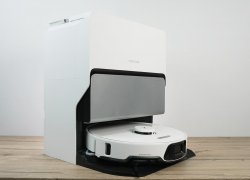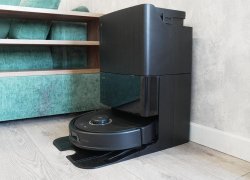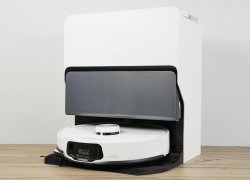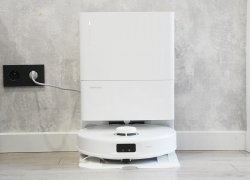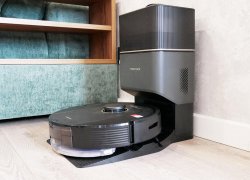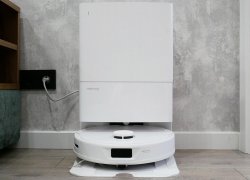
Roborock Qrevo MASTER: two turbo brushes, side brush and mop, 10,000 Pa, scrapers
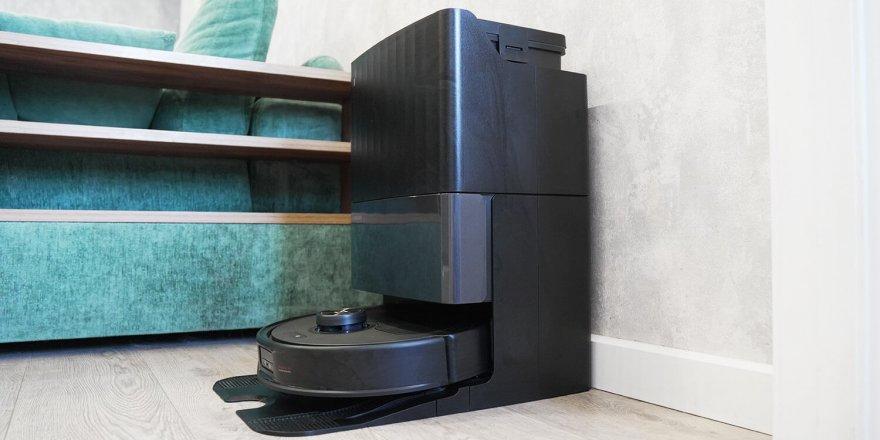
The Roborock Qrevo Master robot vacuum cleaner is a 2024 innovation that's undeservedly under-reported. And that's a shame. Compared to the popular Roborock Qrevo MaxV, the robot has received a number of design and feature updates, which should improve its efficiency and cleaning performance. These include an updated cloth tray in the station, two round cloths like the other Qrevo robots, two central turbo brushes like the S8 series, and even a hair-cutting system for the outer turbo brushes. Additionally, it features a retractable side brush, an object recognition system with backlighting, remote home monitoring, and an all-in-one station. Overall, it offers a top-of-the-line solution at a reasonable price, ranging from $850 to $1,100. So, below, I'll be thoroughly testing the Roborock Qrevo Master, highlighting the pros and cons based on my test results, and then expressing my personal opinion of the robot. So, let's get started!
Regionalism
The first thing I'll start with is the robot's regional availability. The Roborock Qrevo Master is the ONLY global version at the time of production. And the global Roborock version doesn't have Russian voice prompts, so it's important to keep this in mind. Plus, the robot has a proprietary assistant, Hello Rocky, which understands phrases in English, not Russian. Another nuance. Official Roborock representatives stated that they don't plan to bring this model to a Russian version. This means, apparently, there will be no official warranty either. This is something you should know before purchasing. Now, on to the robot itself!
Equipment
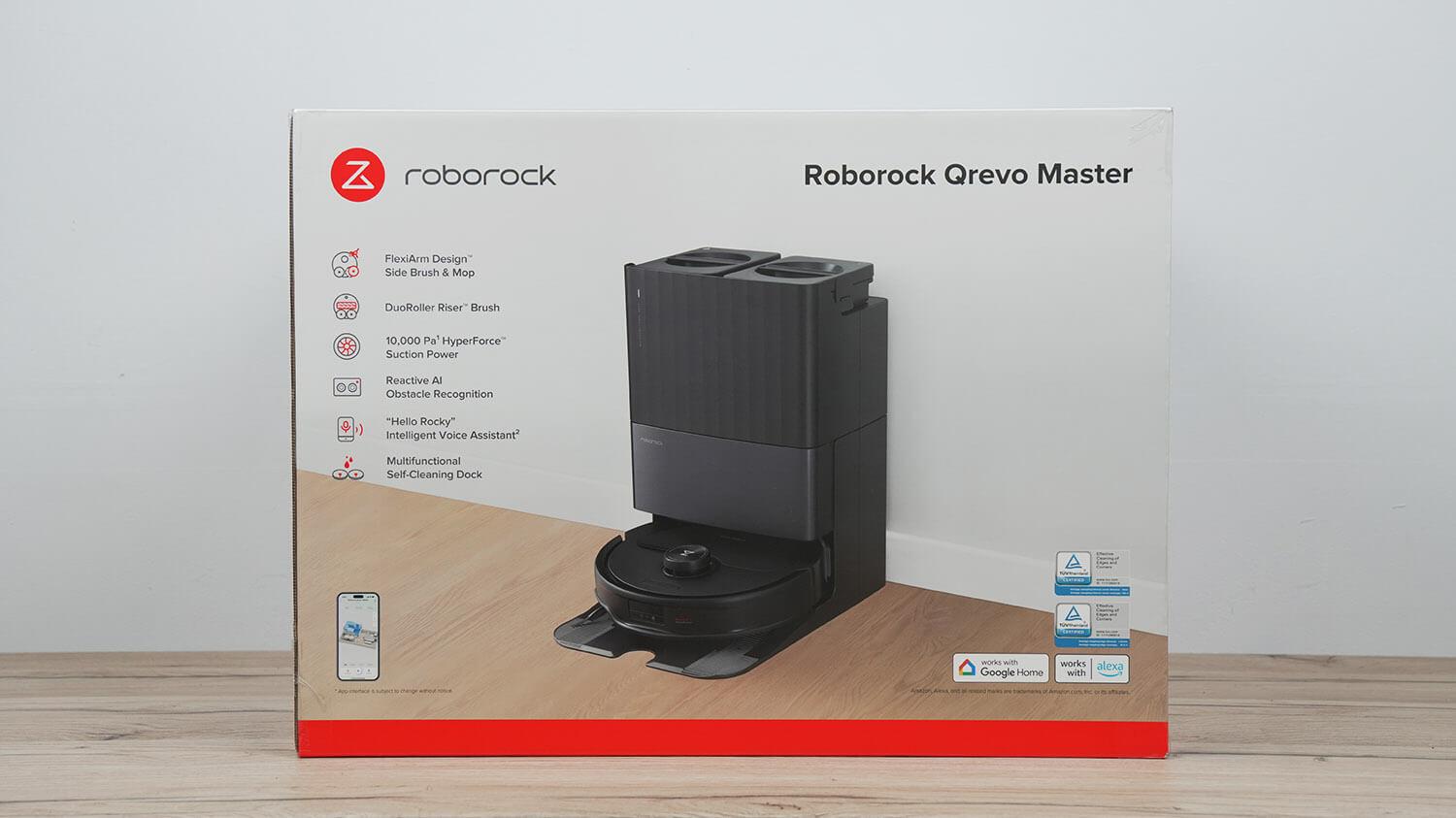
The Roborock Qrevo Master arrived in this branded box:
Box
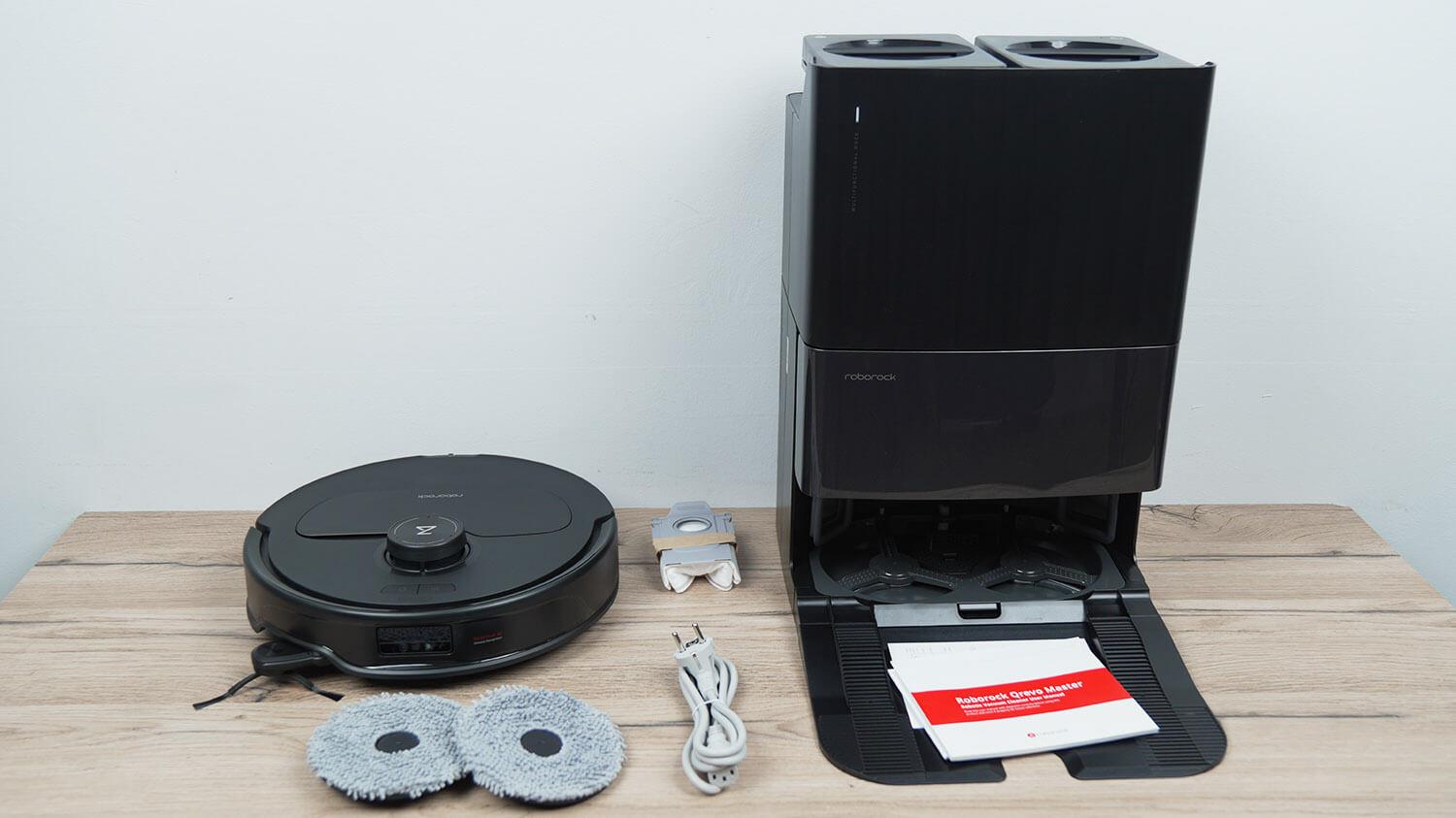
The package includes:
- The robot itself with the station.
- Power adapter.
- Two napkin holders.
- Spare bag for the station.
- Documentation in English.
Equipment
Appearance
Now let's take a look at how the device is designed. Let's start with the robot vacuum cleaner itself. It comes in both white and black. The body is round and measures 103 mm in height.
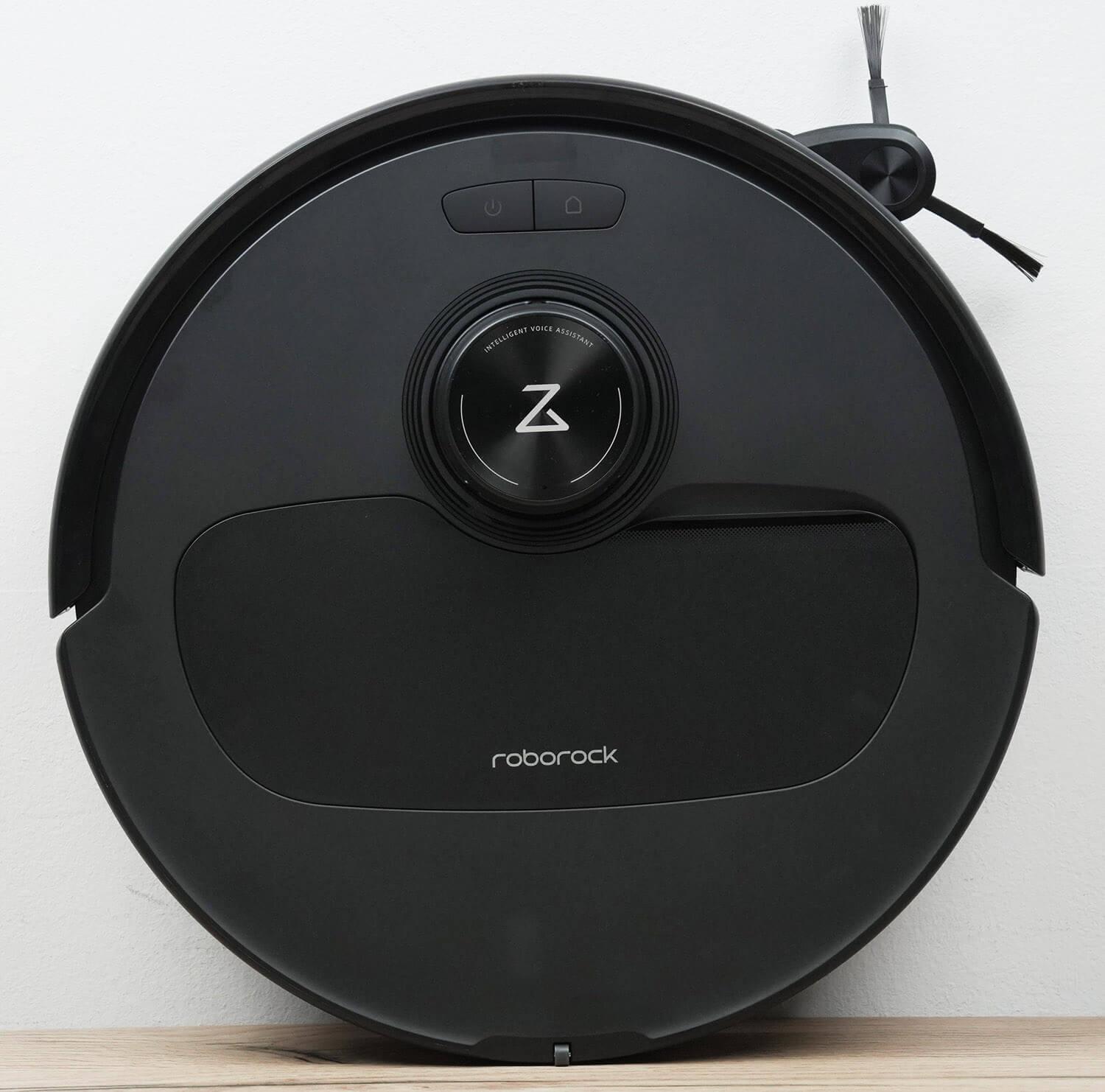
Top view
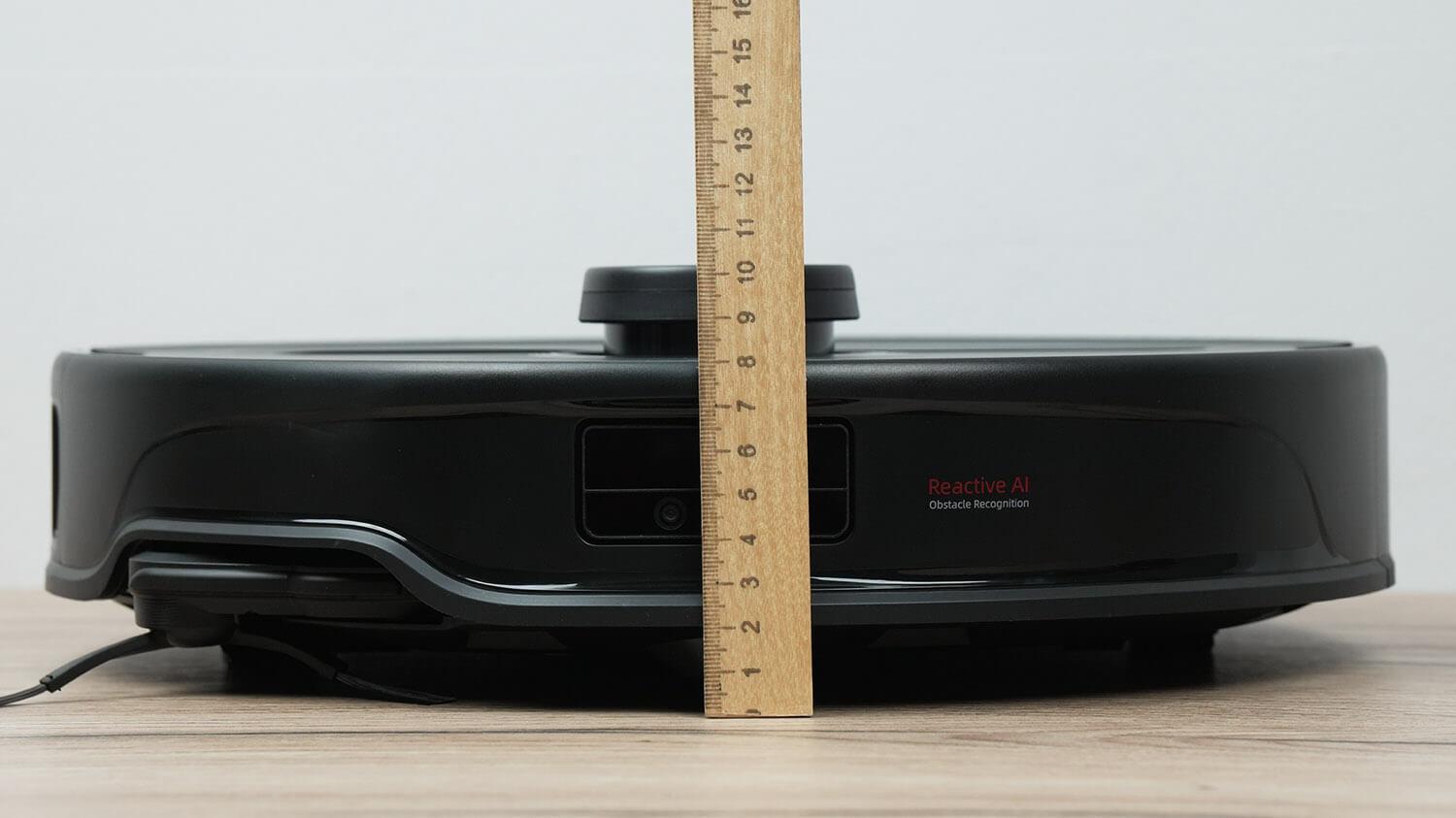
Body height
A wall sensor is mounted on the right side of the bumper. A system of sensors is located in the center to detect and accurately avoid objects on the floor.
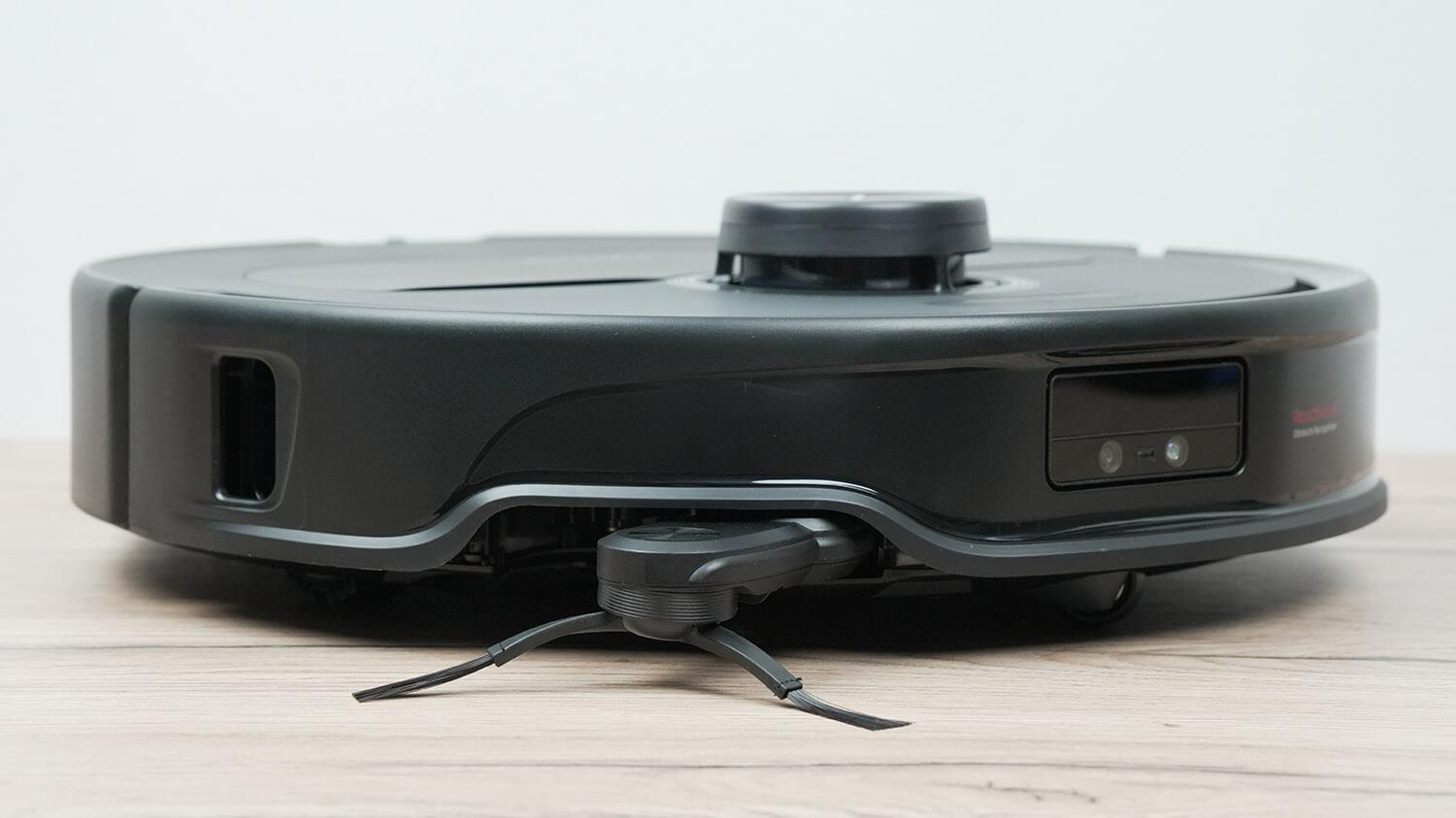
Side view
The technology is called Reactive AI Obstacle Recognition, like its siblings Roborock S8 MaxV Ultra and Qrevo MaxV.
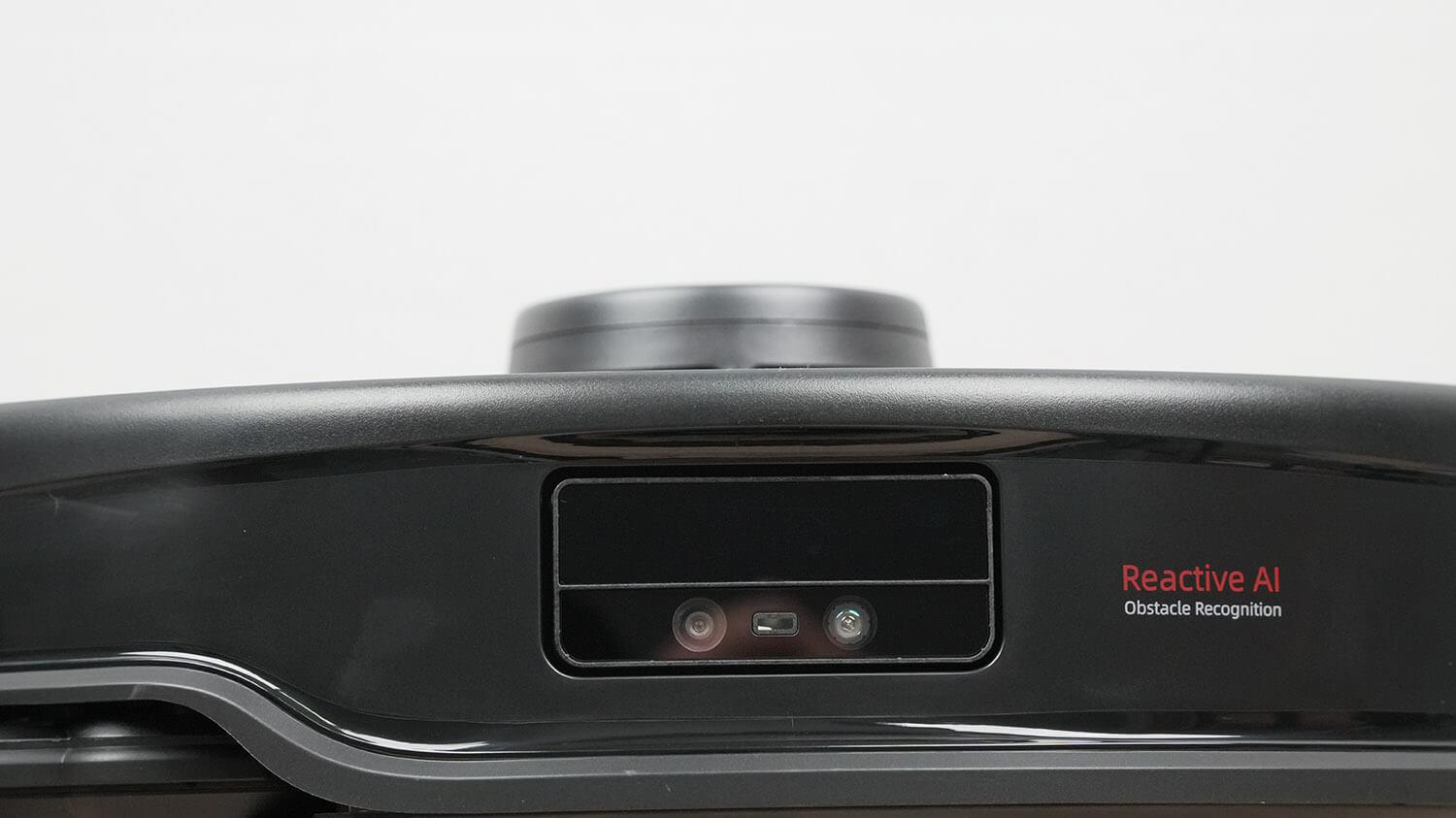
Object recognition system
LED lighting is located next to the cameras, improving the detection of objects lying on the floor in complete darkness. The lighting turns on automatically.
You can use the camera to remotely monitor your home using your smartphone. Here's how it works:
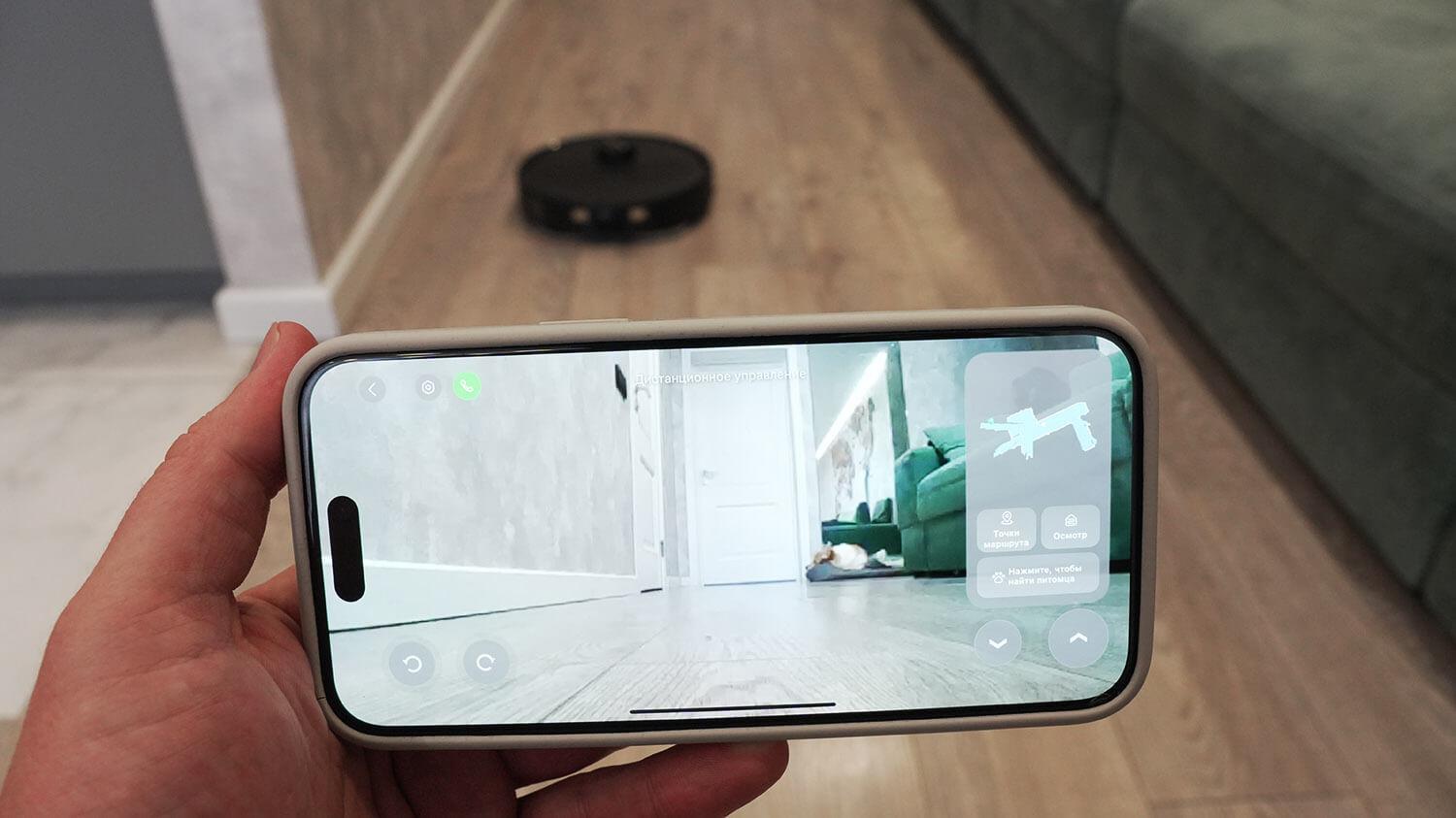
Remote home monitoring
The main navigation device is the lidar, which is equipped with a spring-loaded button to prevent it from getting stuck under furniture. A control panel with two buttons is located nearby.
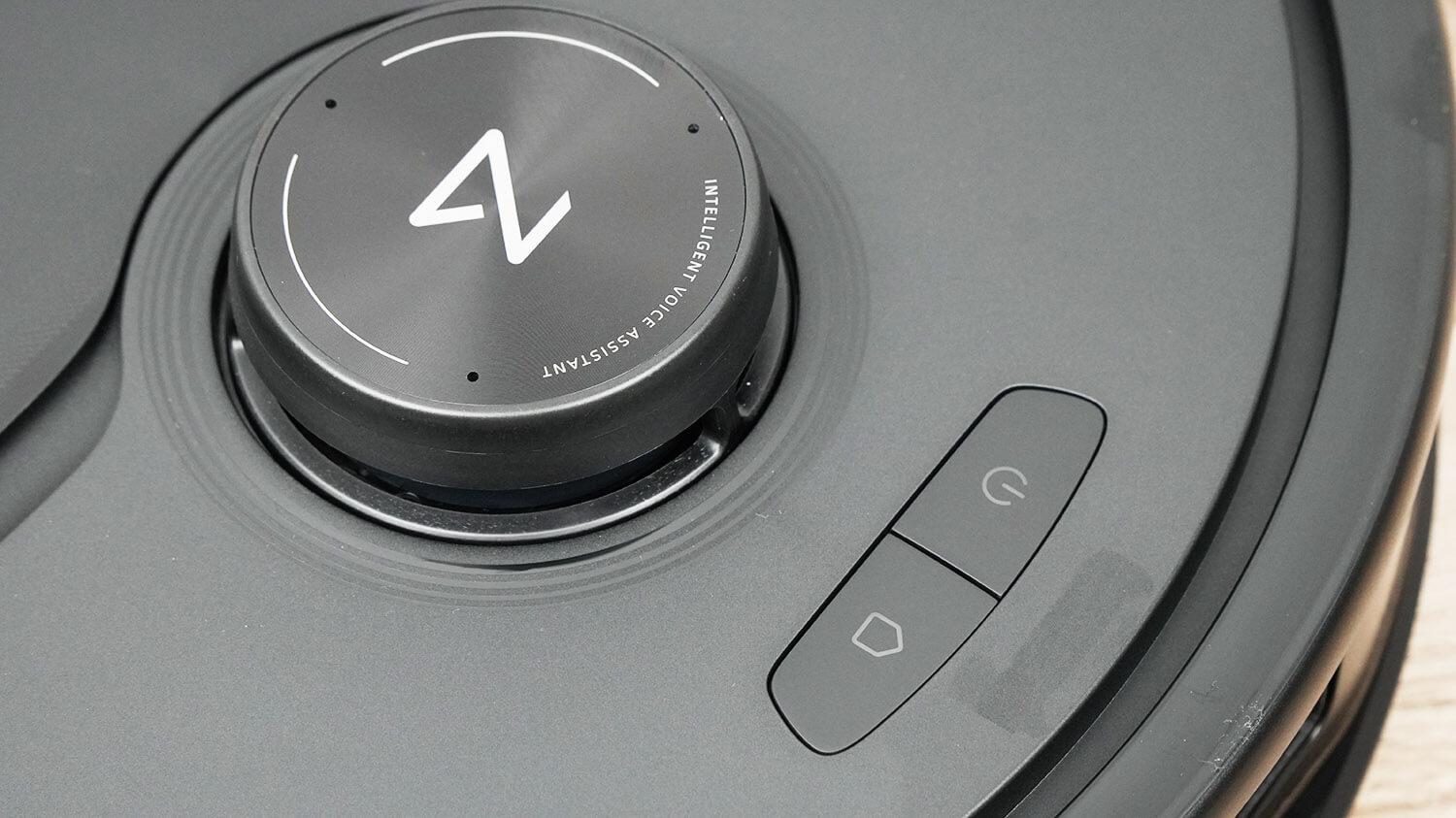
Lidar and control panel
The dust container is located under the magnetically secured top lid. The container's capacity has been reduced to just 220 ml. The filtration system consists exclusively of a HEPA filter.
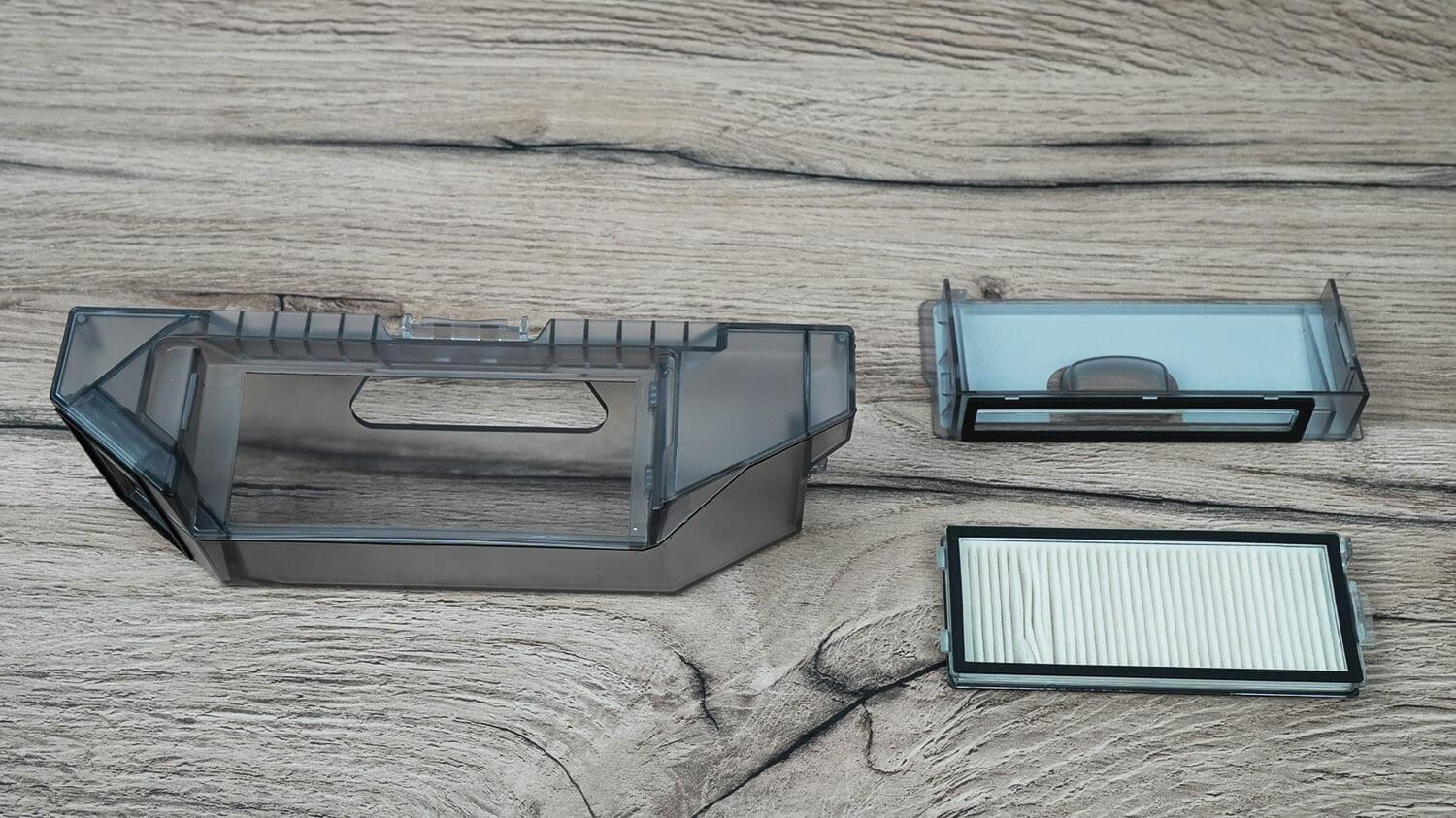
Filtration system
The robot has a water tank installed inside, but it's hidden inside. It holds 80 ml. Water is automatically pumped into the tank at the station.
Five fall protection sensors and a carpet detection sensor are installed underneath. There's a single side brush, a three-beam design, secured with a screw.
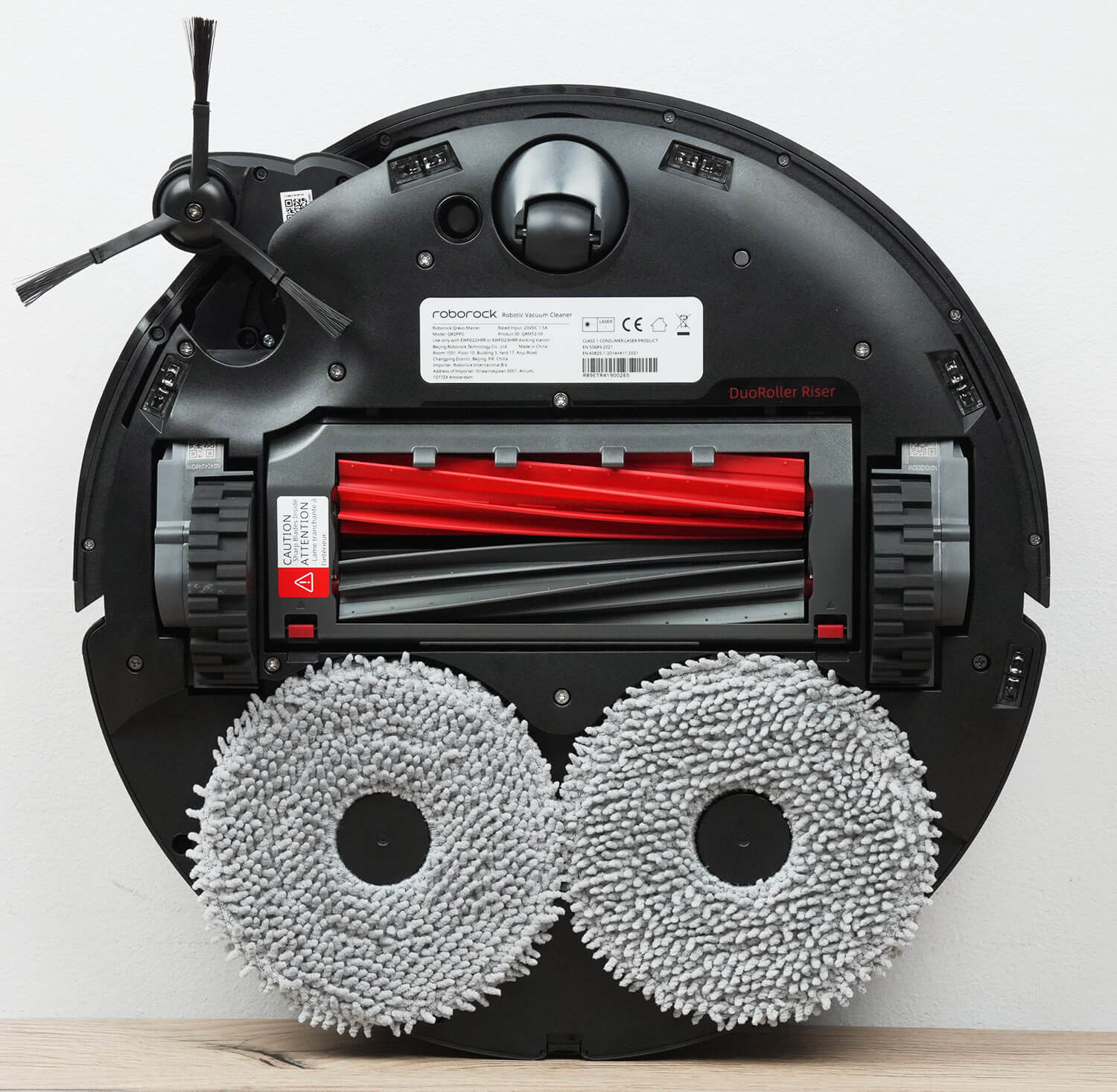
Bottom view
This side brush automatically extends into corners to thoroughly sweep away debris.
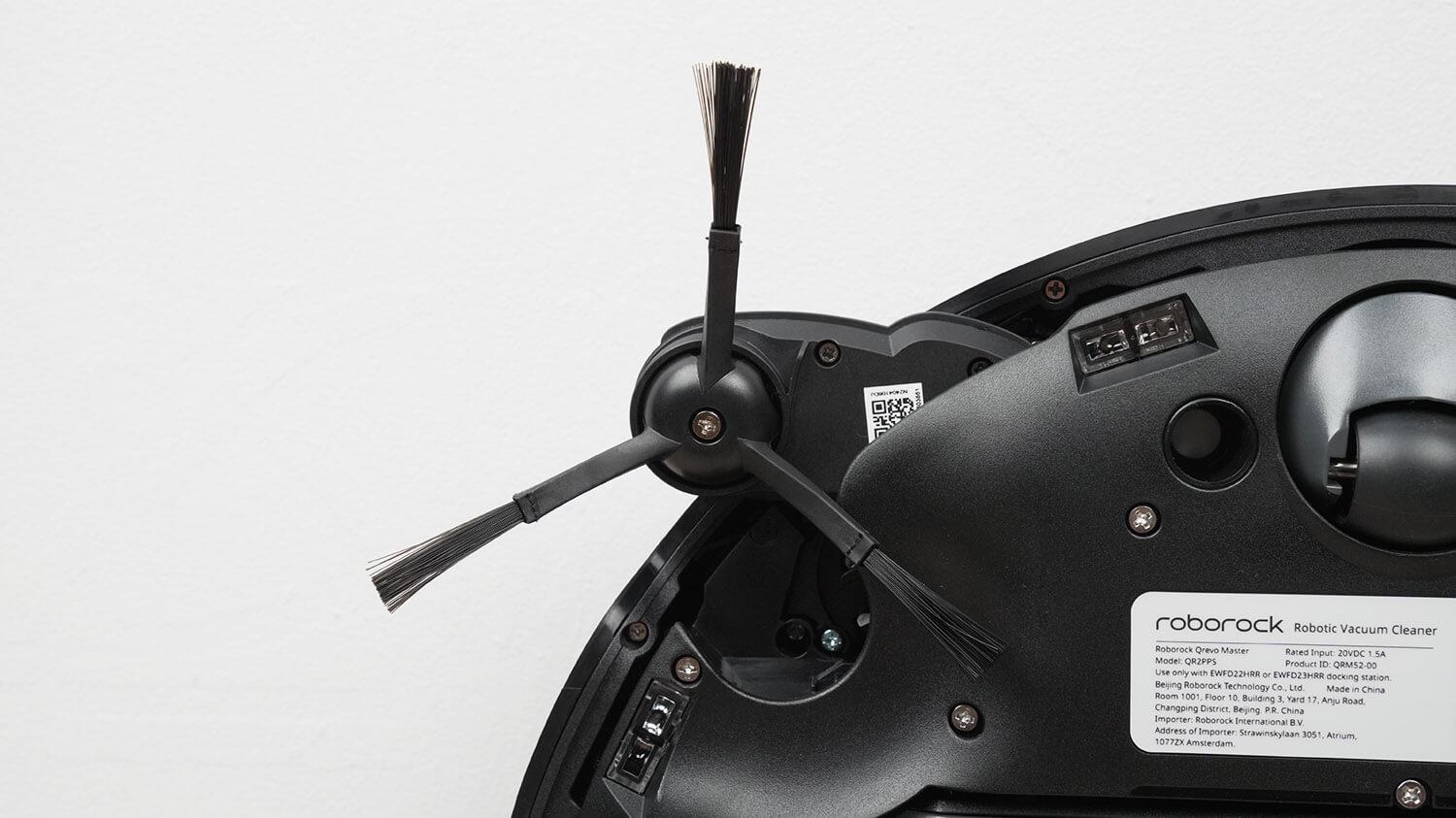
Retractable side brush
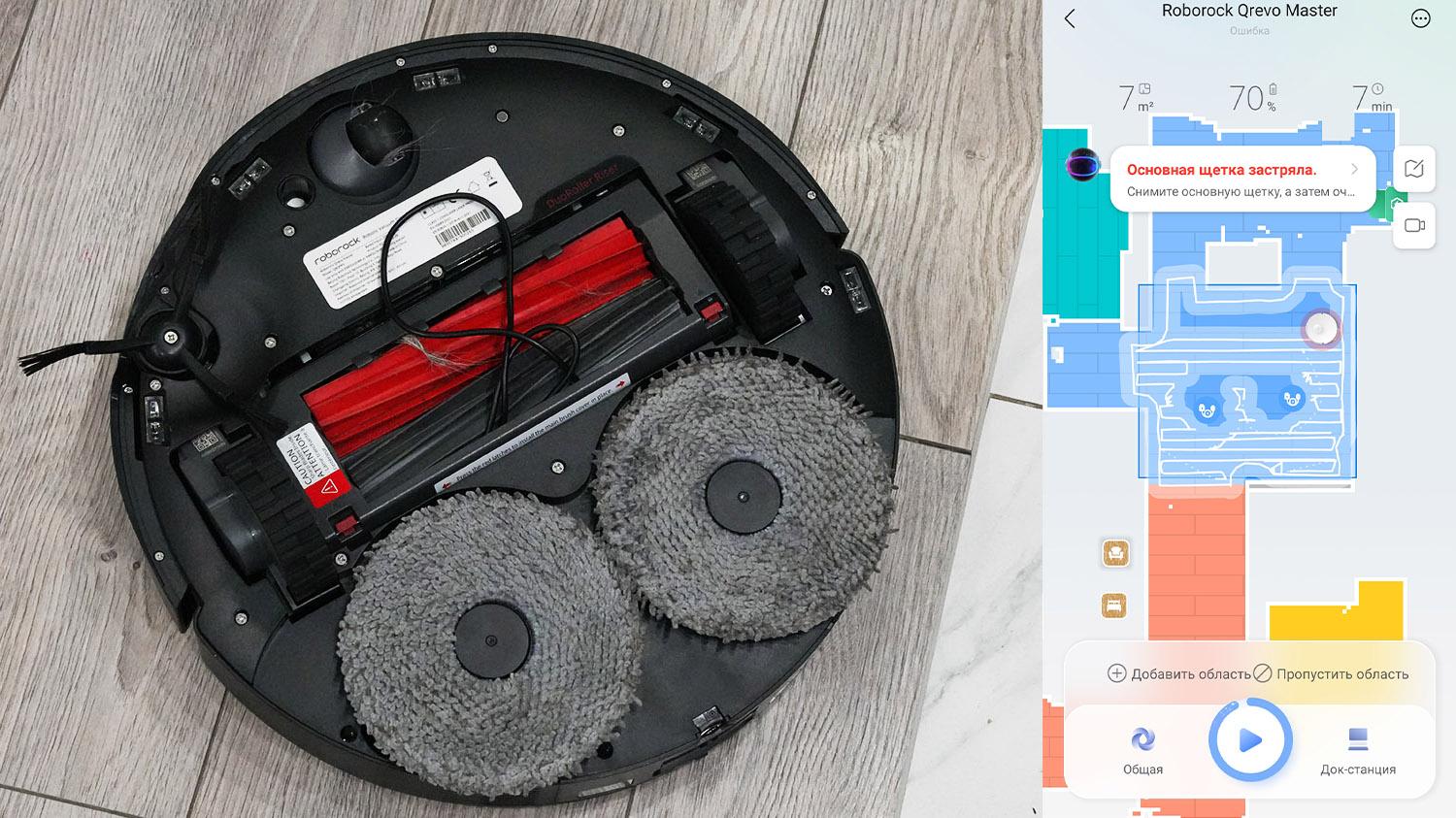
The central brush unit is floating, which is a plus. Dust collection is accomplished by two silicone turbo brushes that rotate toward each other, just like the S8 series. This technology is called DuoRoller Riser. The turbo brushes automatically rise when the robot returns to its station and when mopping. The turbo brush cover contains blades that are designed to cut away tangled hair along the edges. We'll test how they work. Both brushes can be removed from both sides to remove tangled hair and fur. Very convenient.
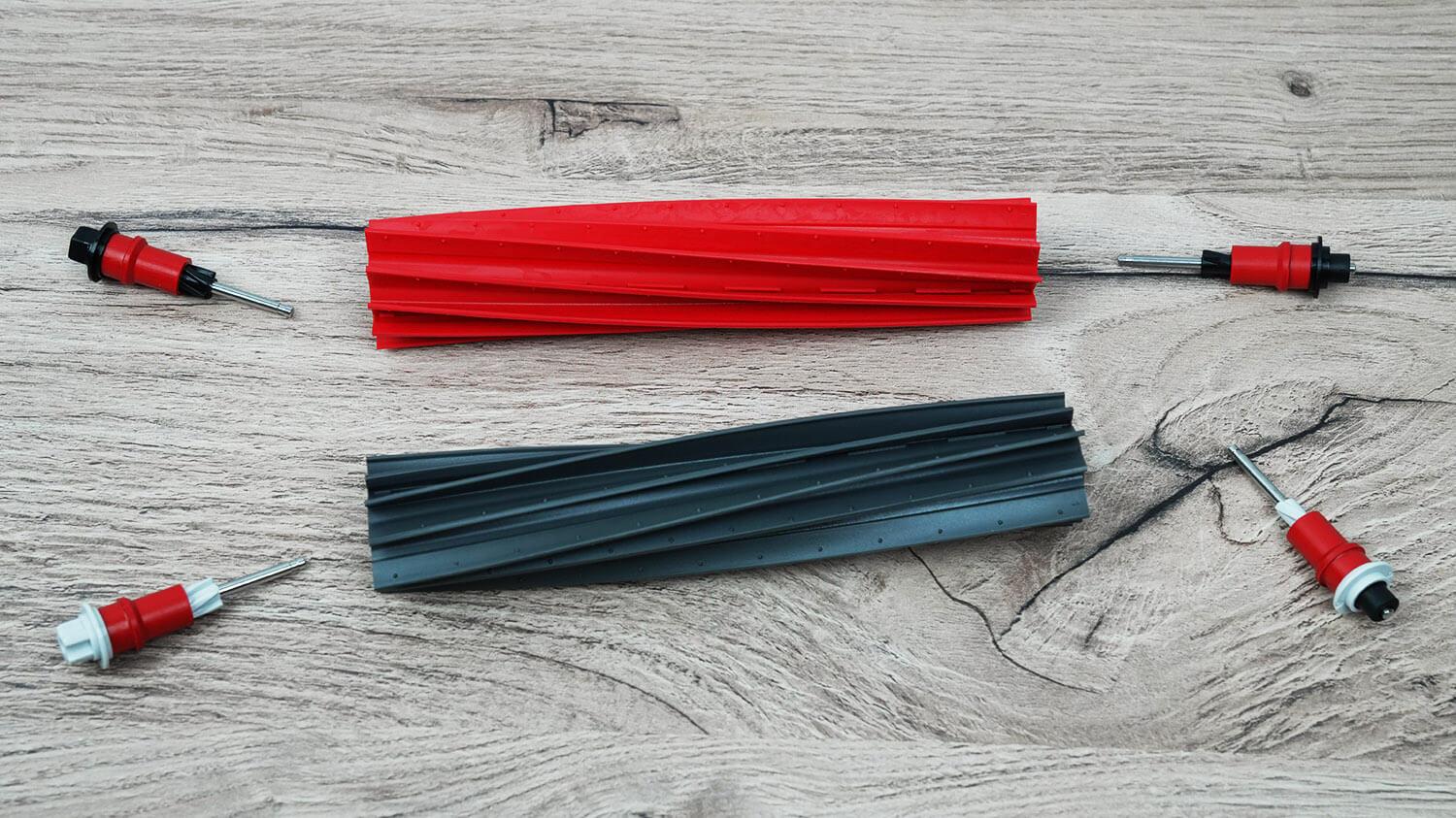
Central brushes
The napkins are round, like those of other robots in the Qrevo line.
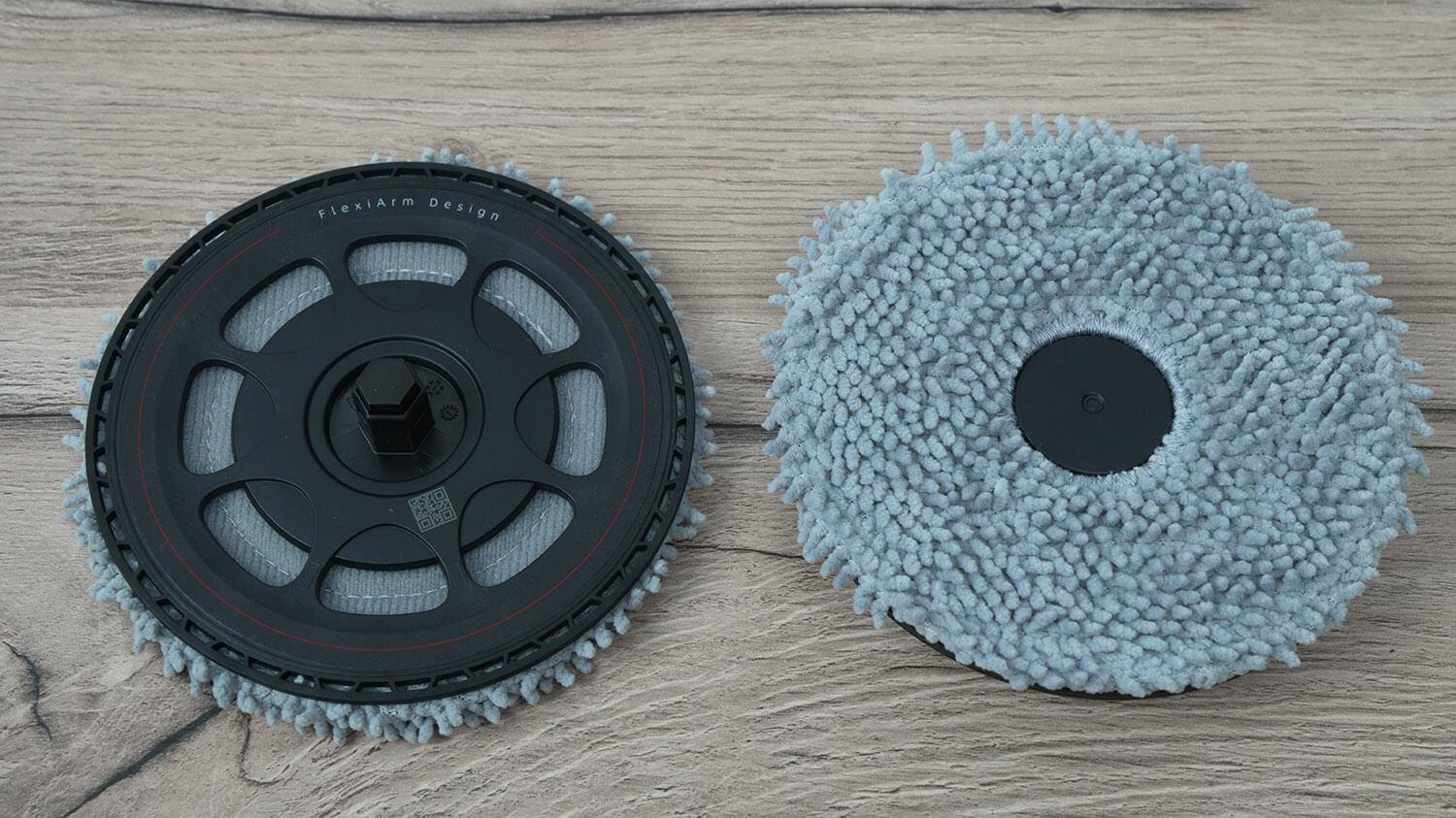
Napkin holders
Behind one of the holders, the one on the right, we see a mechanism that moves the cleaning cloth to the edge of the body. This eliminates the blind spot between the edge of the cleaning cloth and the baseboard, allowing the robot to better clean along walls and furniture.
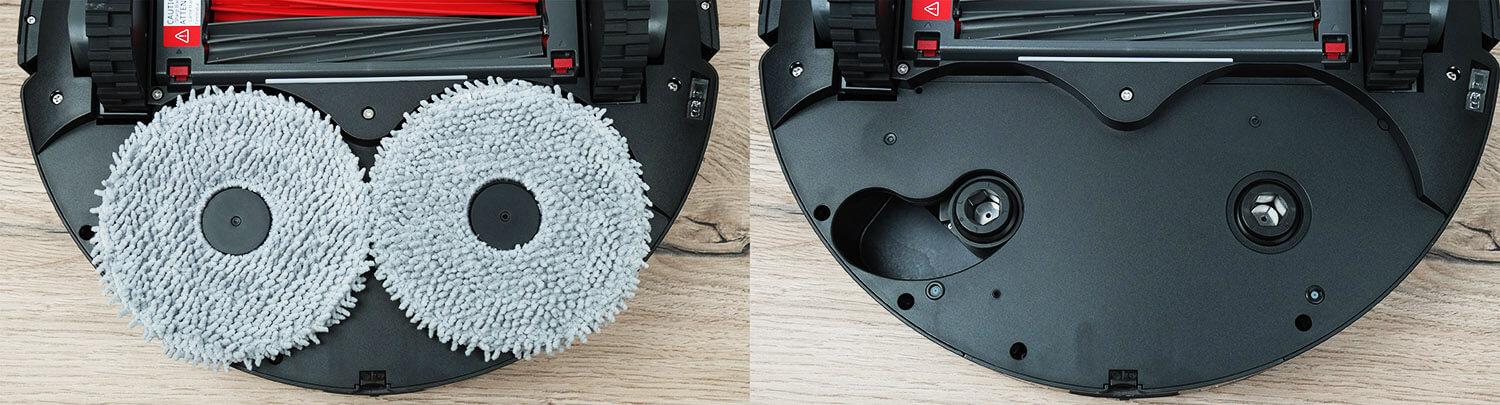
Retractable napkin
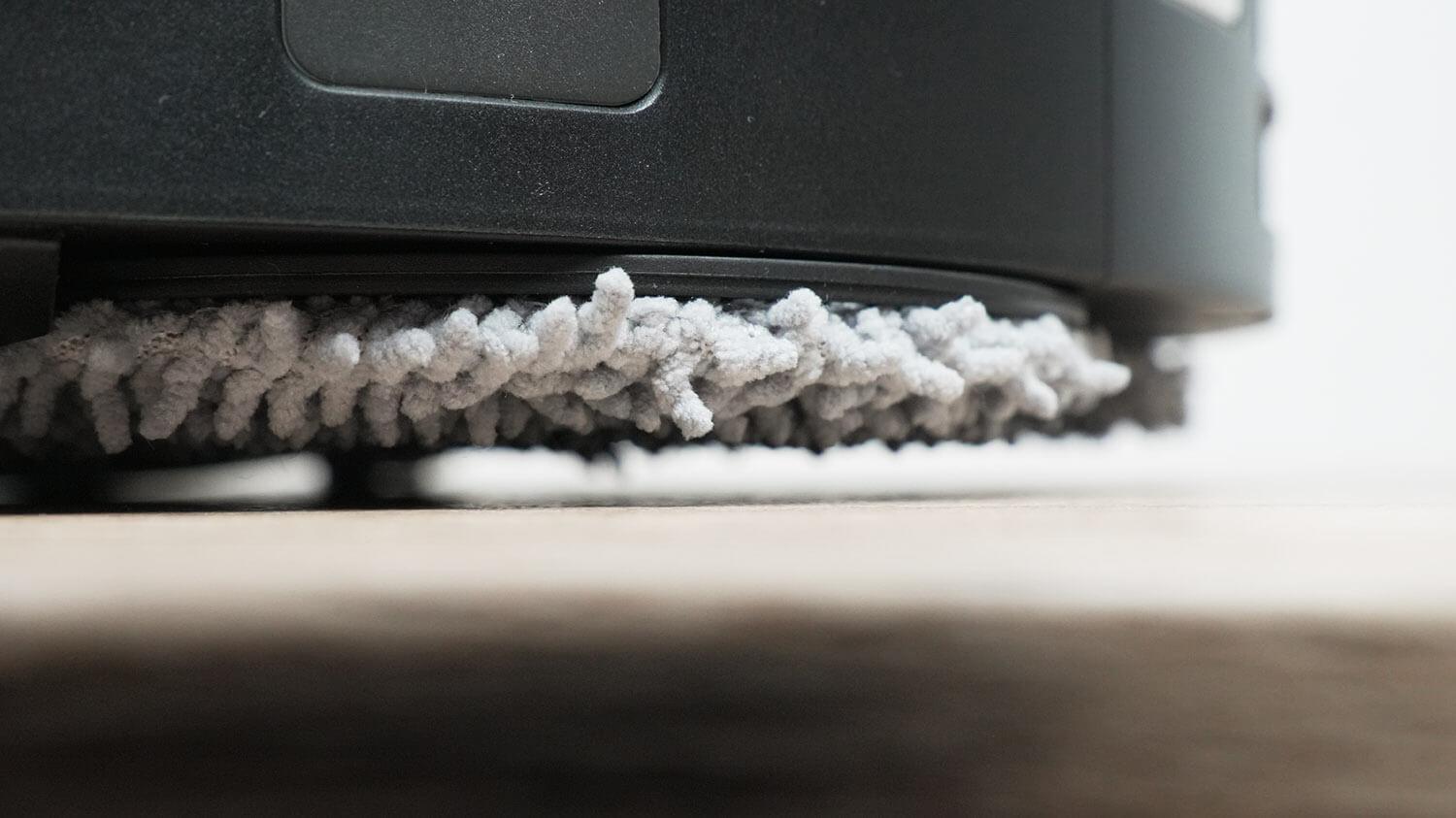
I'd also like to add that the cleaning pads automatically lift when entering carpets, when the robot returns to the station, and when the Roborock Qrevo Master enters a designated room or cleaning area. The cleaning pad lift has been increased to 10 mm.
Automatic napkin lift
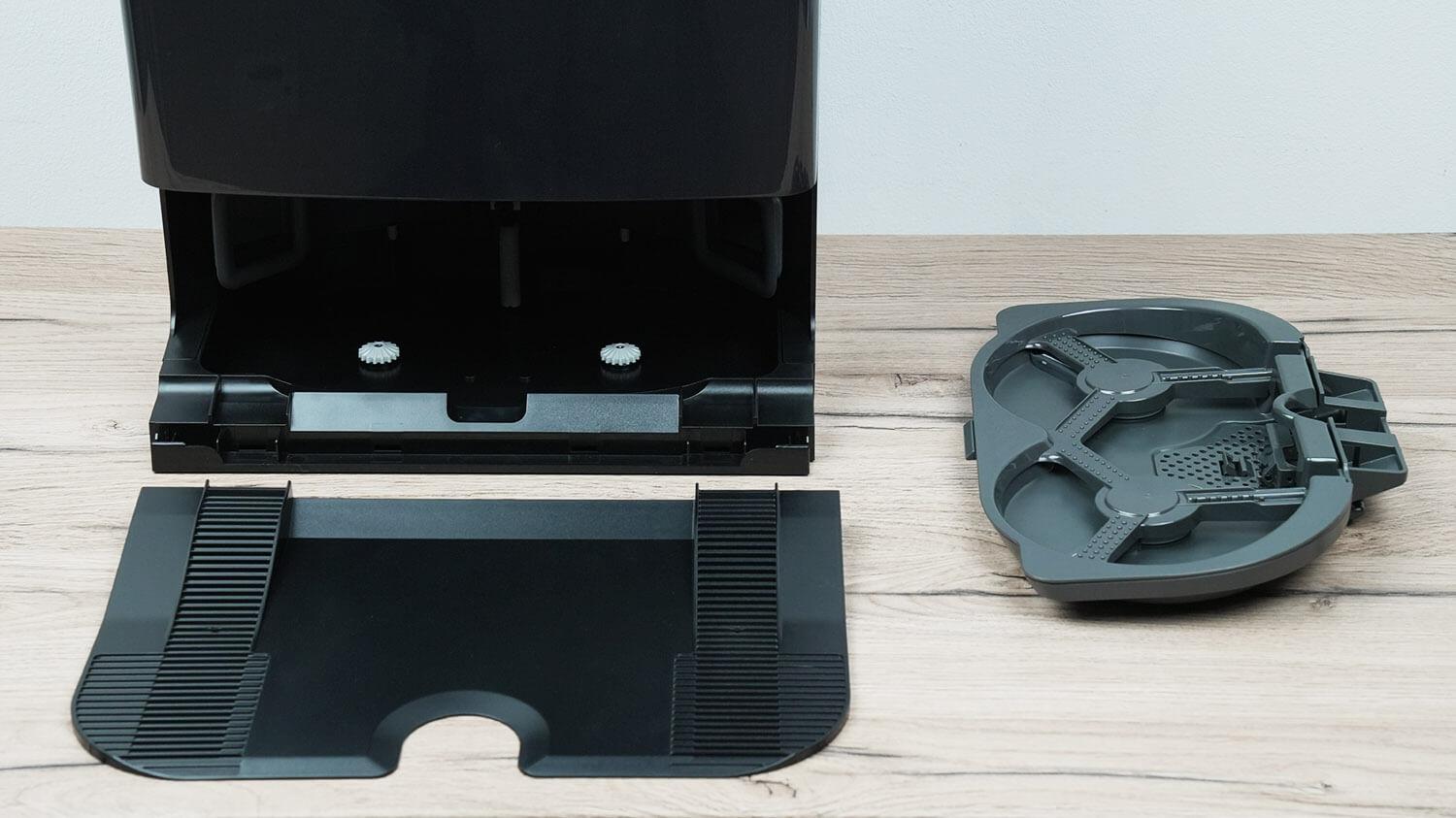
As for the station, work has also been done on it. The ramp for the robot to enter and the tray where the wipes are washed are removable. This is VERY convenient for station maintenance.
Removable tray and drain
The tray has been updated. It consists of two parts: the textured module where the wipes are washed, and a tray with scrapers and a coarse filter.
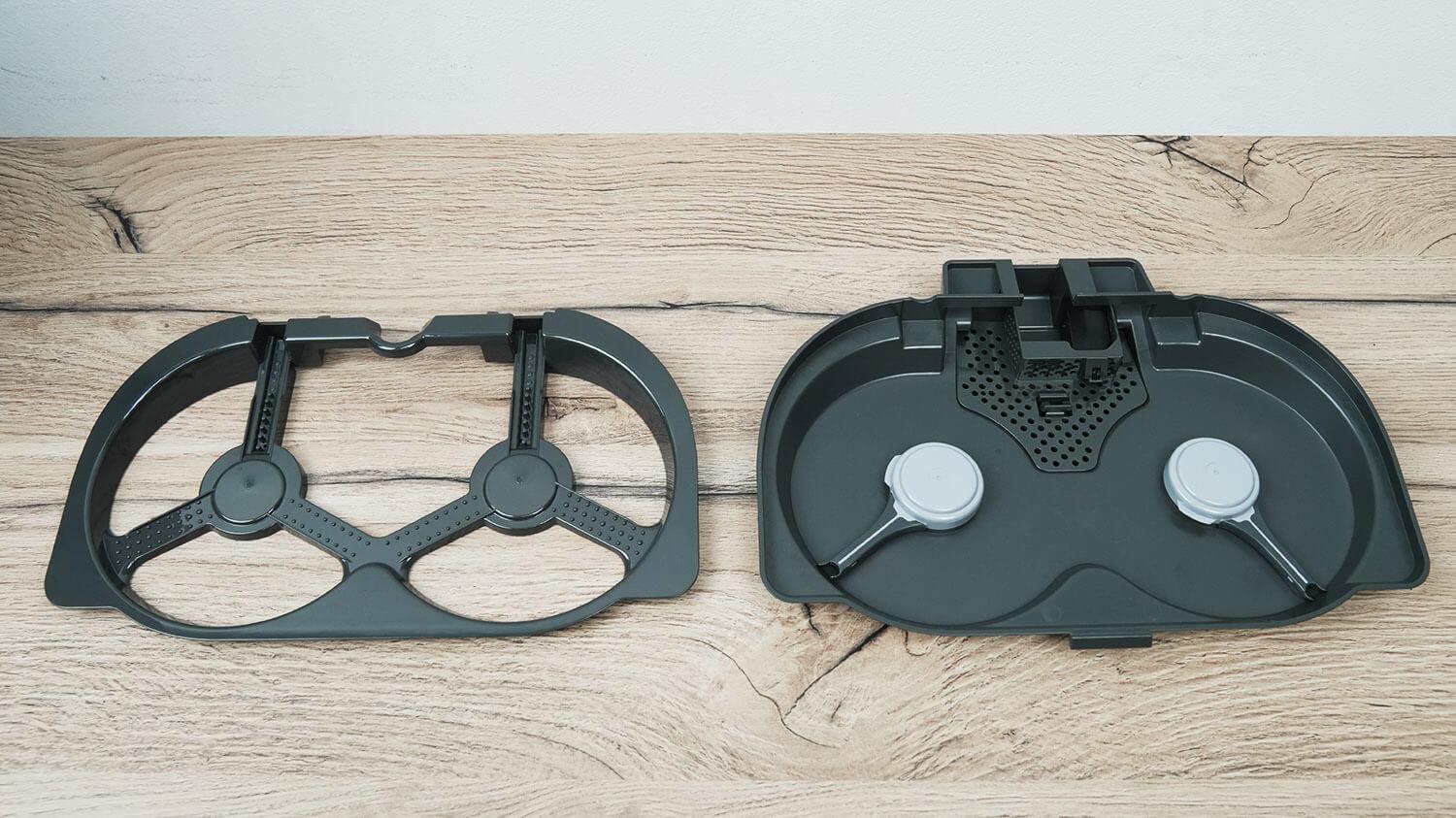
Updated tray with scrapers
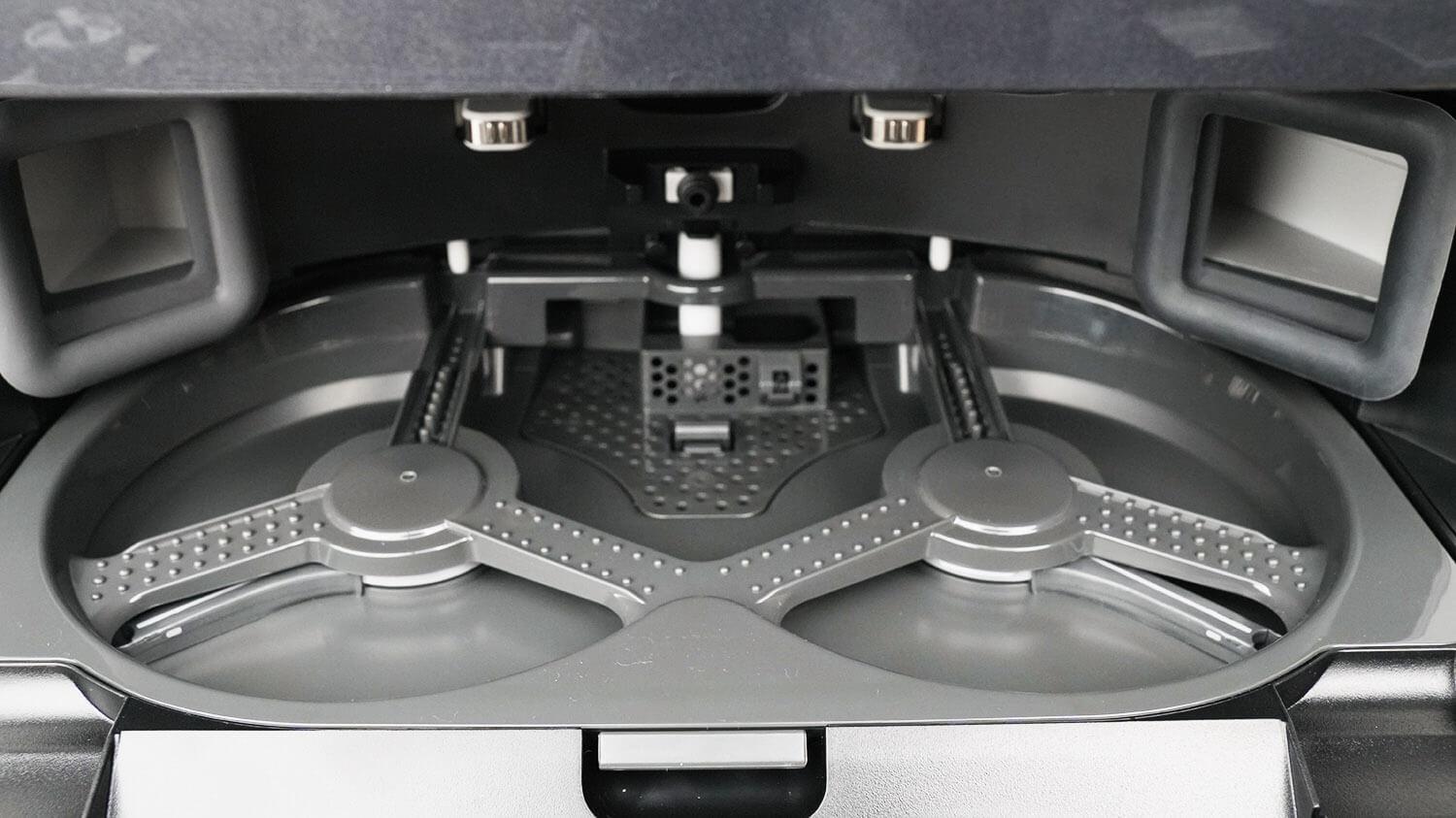
This way, the station's tray automatically cleans itself when washing the wipes. Again, we'll test the effectiveness of this new solution.
Automatic self-cleaning of the bottom
The waste bag is located at the front, behind the lid. There's no detergent reservoir. The bag holds 2.7 liters. Nothing has changed here.
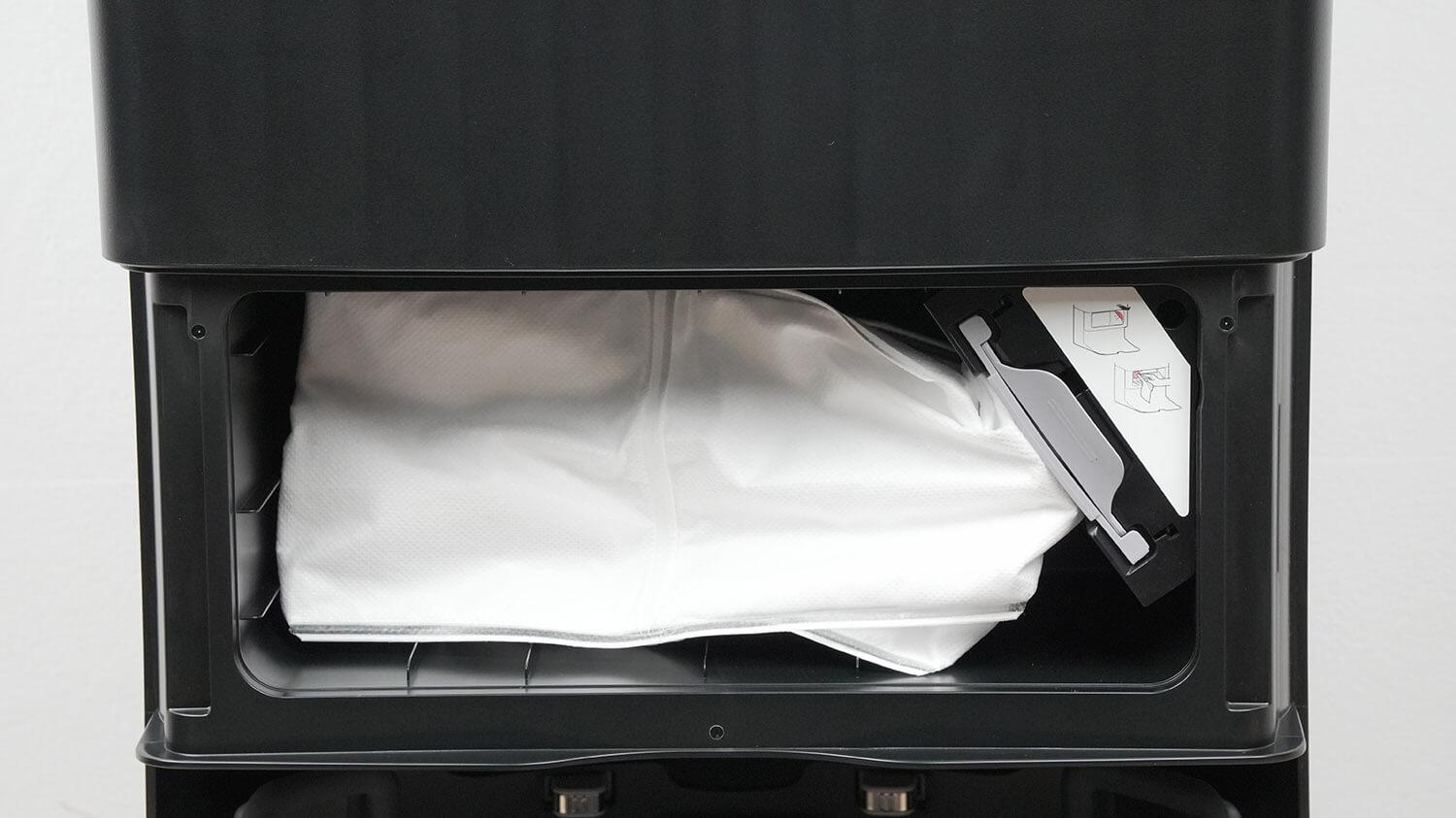
Bag in the station
The tanks are also of the standard design. The clean water tank holds 4 liters, while the dirty water tank holds 3.5 liters.
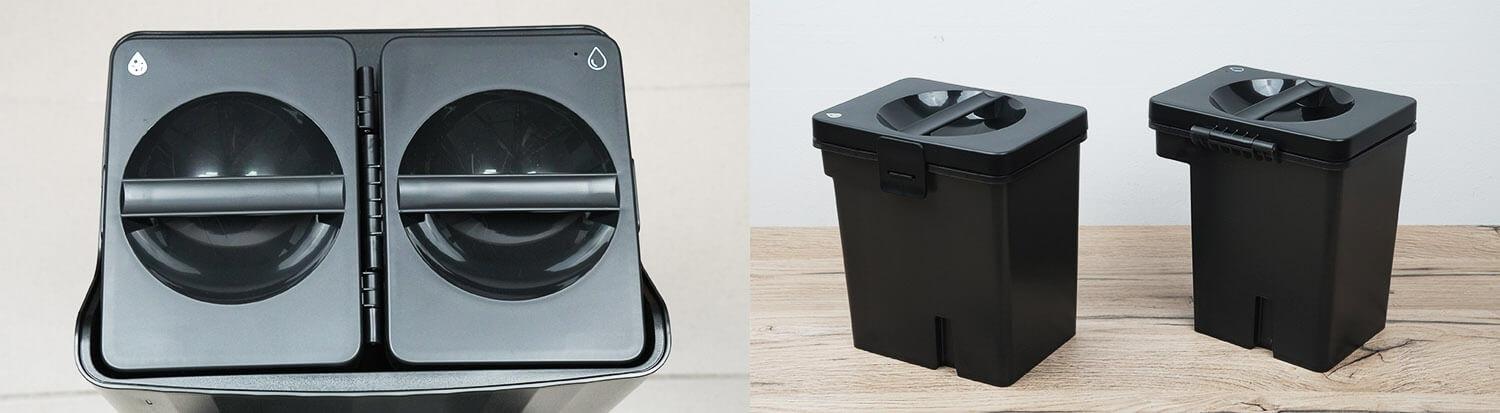
Tanks in the station
It's worth noting that the Roborock Qrevo Master station not only self-cleans and washes the wipes, but also dries them with warm air. What's more, washing occurs in water heated to 60 degrees Celsius (140 degrees Fahrenheit). That's a plus! The drying temperature for the wipes is 45 degrees Celsius (113 degrees Fahrenheit).
And finally, the last important point is connecting to the sewer and water supply. This particular station cannot be connected to utility lines. The official Roborock website shows a separate station for connecting to water and sewer lines, but I was unable to find this version of the robot for sale on the market.
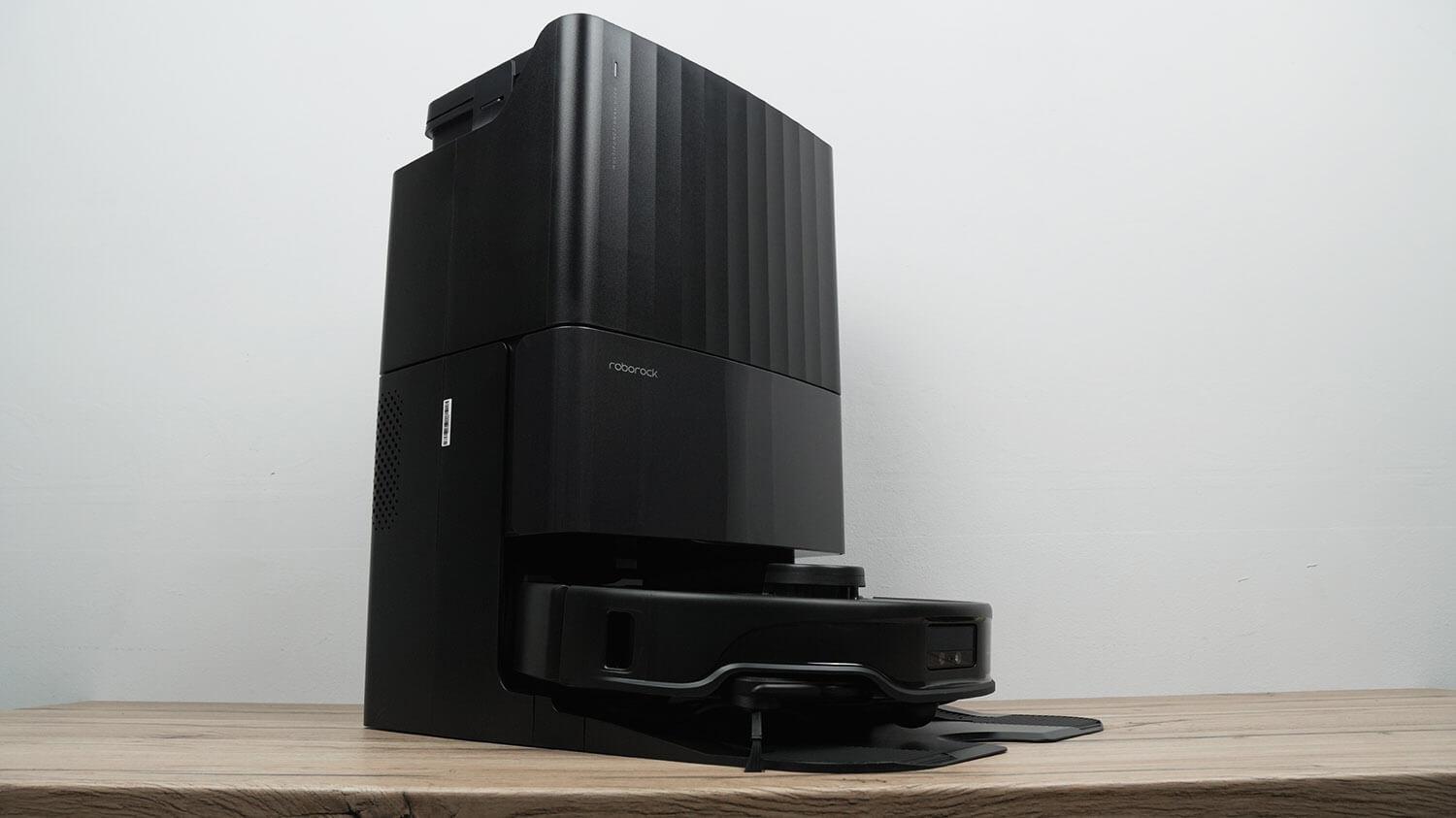
Roborock Qrevo Master
We see several improvements compared to the previously released Qrevo MaxV. The pros and cons of this design will be outlined in the final review.
Technical specifications
The main characteristics of the Roborock Qrevo Master, as stated by the manufacturer, are displayed on the screen:
- Li-Ion battery 5200 mAh.
- Suction power up to 10,000 Pa.
- Operating time up to 180 min.
- Cleaning area up to 300 sq.m.
- Dust collector capacity is 220 ml.
- The water tank capacity is 80 ml.
- Obstacle clearance up to 20 mm.
- Robot dimensions: 353*103 mm.
Station:
- Clean water tank: 4 l.
- Dirty water tank: 3.5 l.
- Bag in the station: 2.7 l.
- Station dimensions: 521*340*487 mm.
The only change here is the suction power, which will be verified in tests. The other parameters remain unchanged.
Functional capabilities
Speaking of functions, the robot vacuum cleaner is controlled via the proprietary Roborock app. If your region is set to Russia, you won't find this model in the list of devices and won't be able to connect via QR code. You'll need to register a new account and select a different country, such as Europe. This is the only way to connect. Otherwise, connecting is simple and easy, and the interface is in Russian.
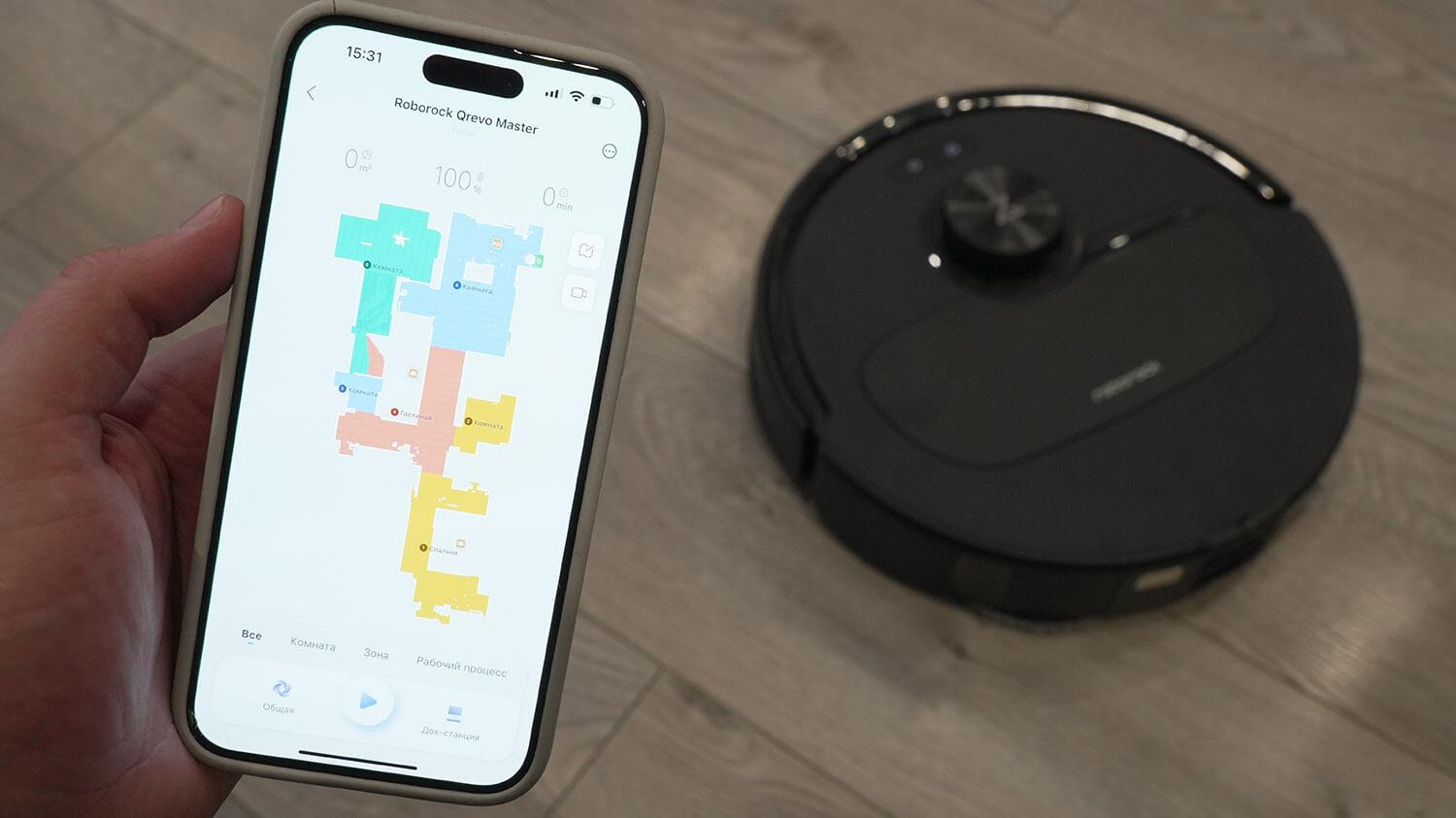
Control via app
The main functions of the Roborock Qrevo Master, as stated by the manufacturer
- Self-cleaning at the station.
- Washing napkins at the station with hot water (60 °C).
- Drying napkins with warm air (45 °C).
- Moving the holder with a napkin to the baseboard.
- Refilling the robot's water tank via the station.
- Recognizing objects on the floor.
- Remote home monitoring via camera.
- Saving multiple cleaning maps in memory.
- Automatic zoning of premises into rooms.
- Selecting areas and rooms for cleaning.
- Virtual walls and no-go zones (and for wet cleaning mode).
- Suction power adjustment.
- Adjusting the degree of wetting of the napkin.
- User mode.
- Cleaning log.
- Setting up cleaning according to a schedule.
- Automatic power increase on carpet.
- Carpet cleaning in wet cleaning mode.
- Lifting napkins when driving onto carpets.
- Raising the turbo brushes in wet cleaning mode.
- Hello Rocky support.
The robot's control via the proprietary "Hello Rocky" voice assistant deserves special attention. You simply give the robot a command by voice, and it carries it out. No third-party devices are required. Very cool! However, the commands are only in English, which isn't very convenient.
And overall, we've implemented a wide range of features to allow you to flexibly customize cleaning parameters to your specific needs. That's a plus!
Testing
A detailed video review of the Roborock Qrevo Master:
Navigation
And finally, let's move on to the tests! First, we'll test the Roborock Qrevo Master's navigation in a room with obstacles. The robot vacuum first moves around the perimeter of the room, then cleans the entire accessible area in a serpentine pattern. It detected the feet of the dryer and carefully navigated around them. The mirror added a non-existent zone to the map, as with other lidar robots. The robot also separately swept around the box and the chrome feet, then returned to the station. No unusual maneuvers were detected, so the test was successful.
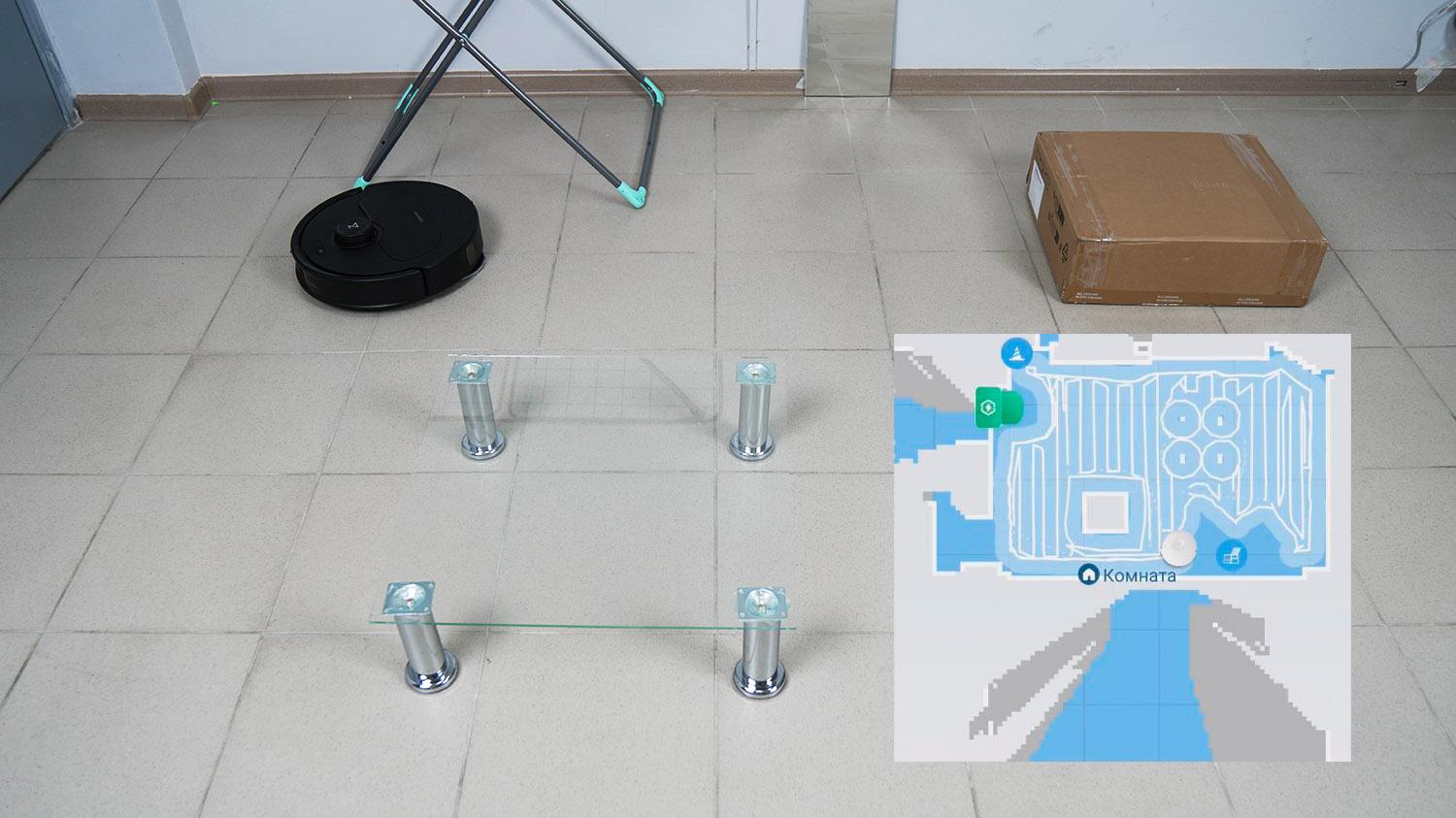
Navigating an Obstacle Room
Speaking of navigation within the house, the robot vacuum cleans room by room, following the perimeter, then in a serpentine pattern. Every 15 minutes, as I've determined, it returns to the station and washes the wipes, then resumes cleaning from where it left off. There are no uncleaned areas left; this model has excellent navigation!
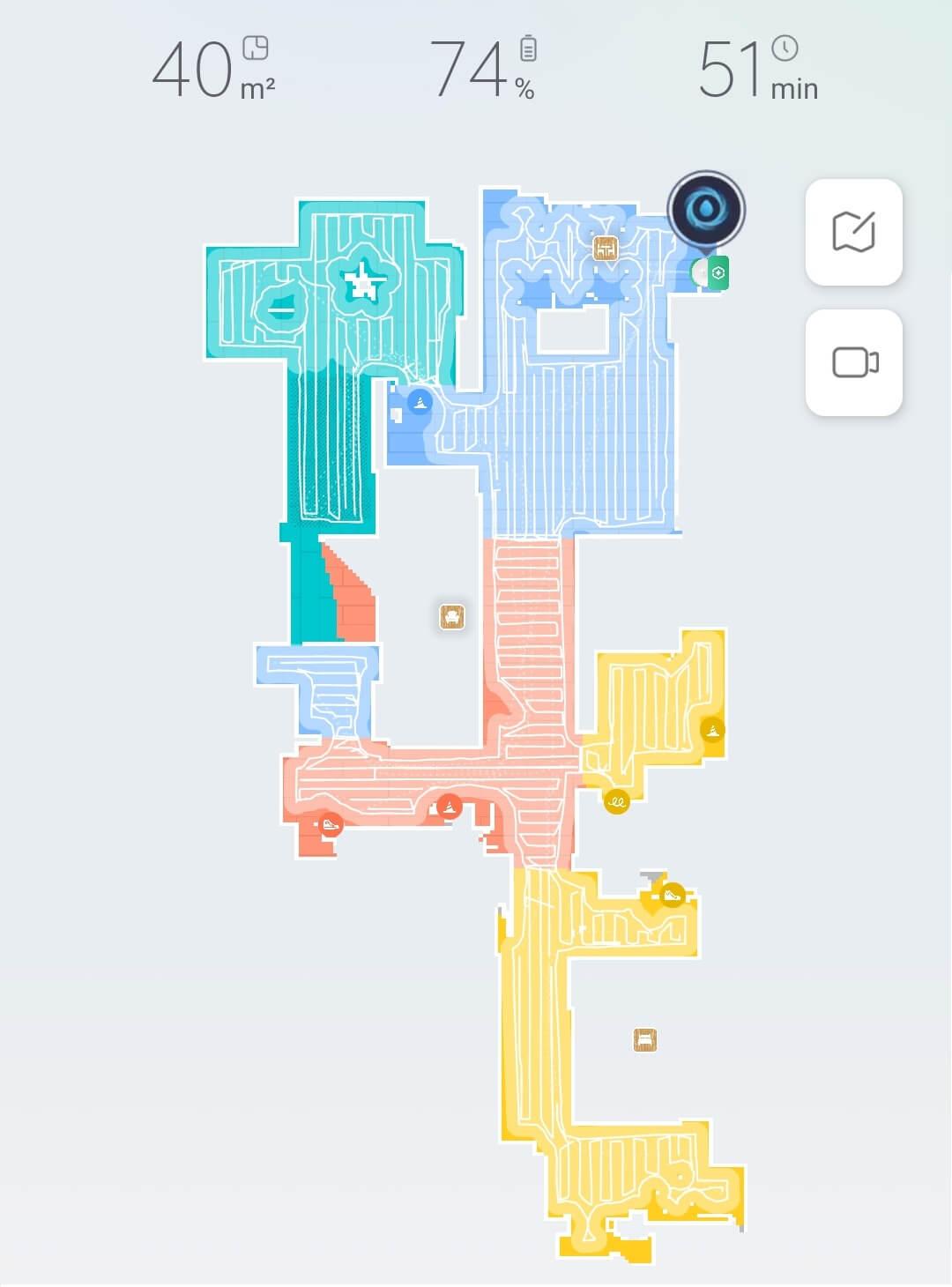
Navigating within a room
Passing under low furniture
The minimum clearance height of the Roborock Qrevo Master was also tested. Since it's 103 mm tall, testing it at the standard 10 cm clearance was pointless. However, it was able to pass at 105 mm clearance, which is good.
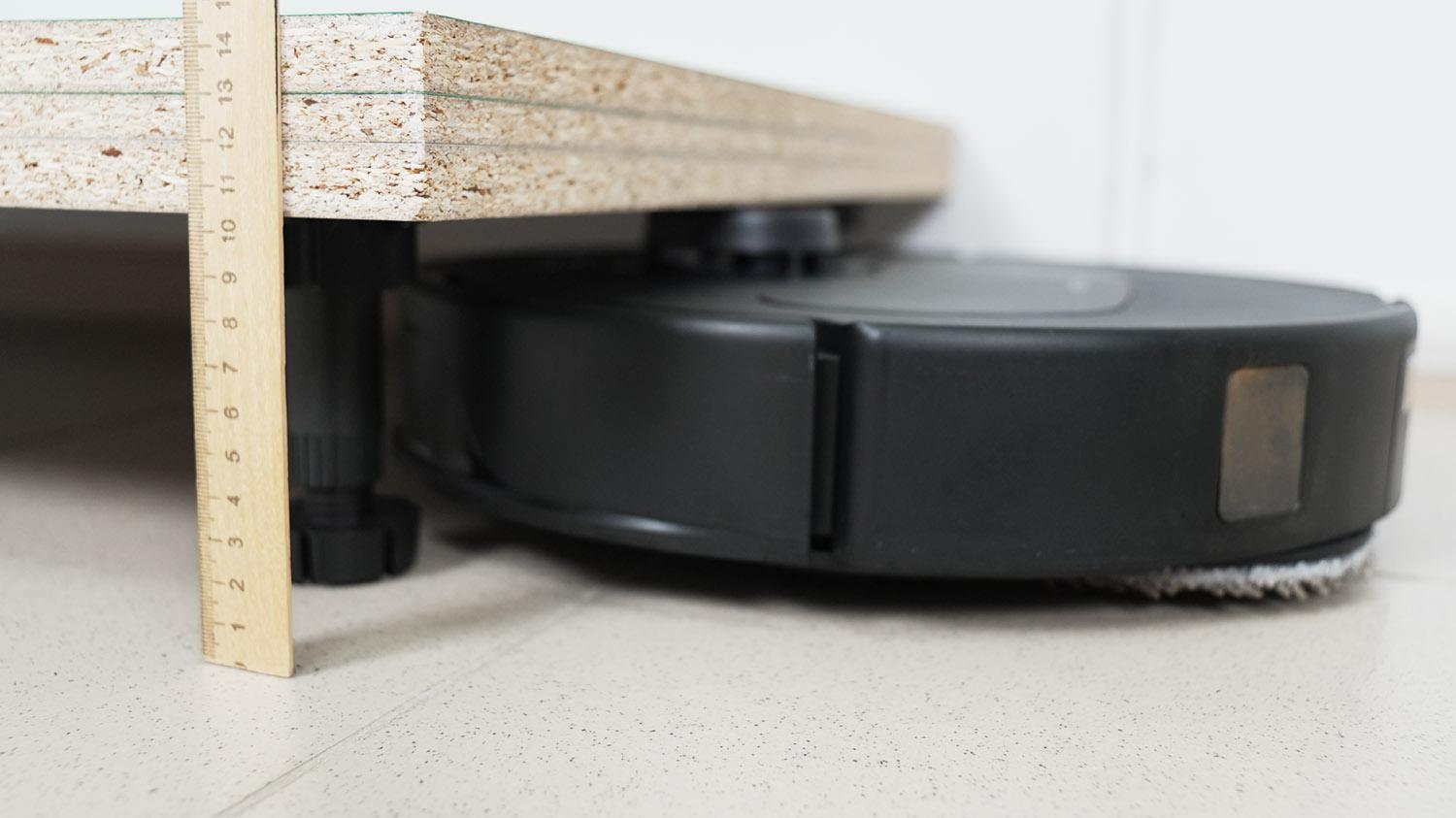
Passing under low furniture
Object recognition
Speaking of the floor object recognition system, it performs well in good lighting. The robot vacuum accurately avoided six out of six objects, displaying corresponding icons on the map for five of them. The toy wasn't in the database, which isn't a big deal. It slightly touched a scale, a sneaker, and a toy, but left the most dangerous objects untouched. Excellent results!
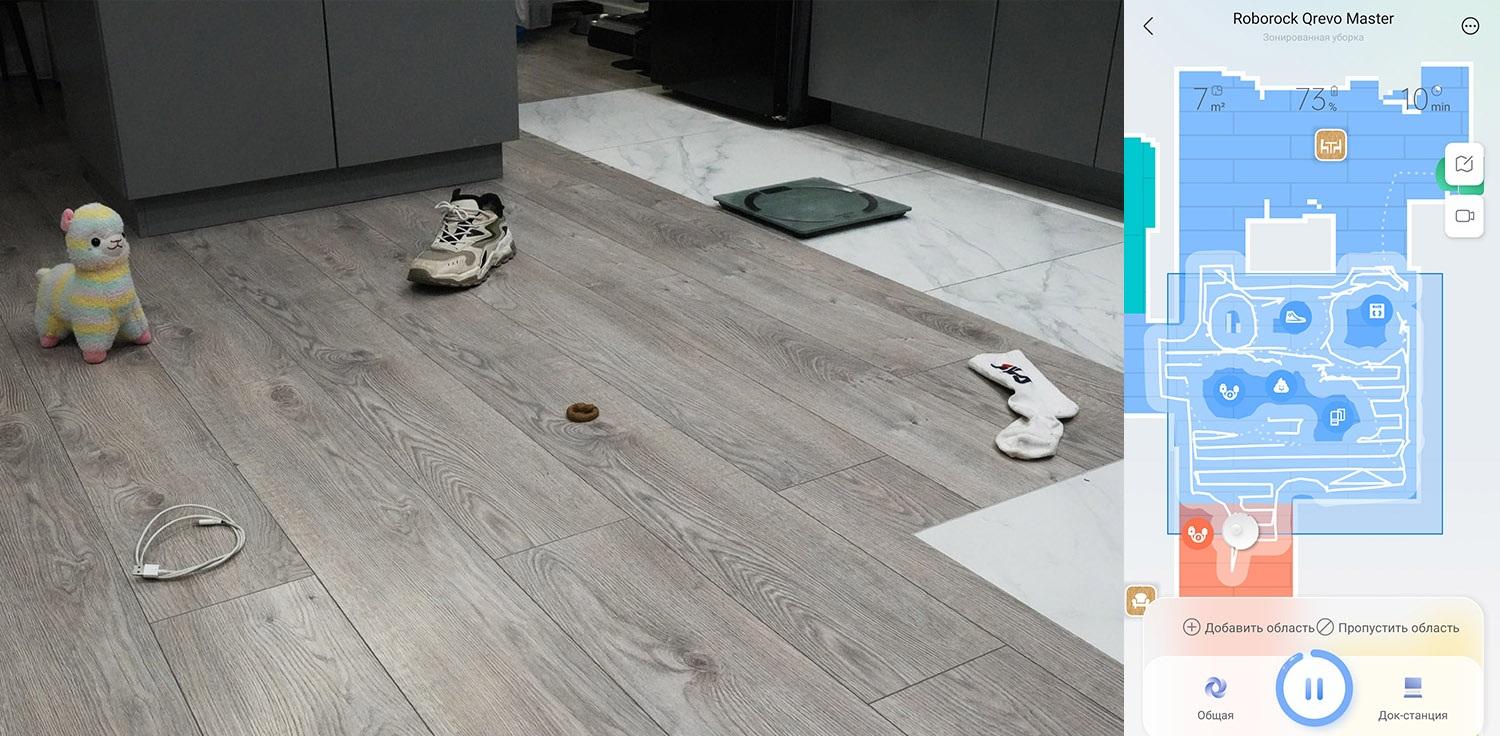
Recognizing objects in good lighting conditions
The robot vacuum performed worse when recognizing objects in complete darkness. A sneaker, cord, and sock were left untouched. It knocked over a scale and a toy, and ran over a fake pet surprise. It correctly identified three of six objects it hadn't actually touched.
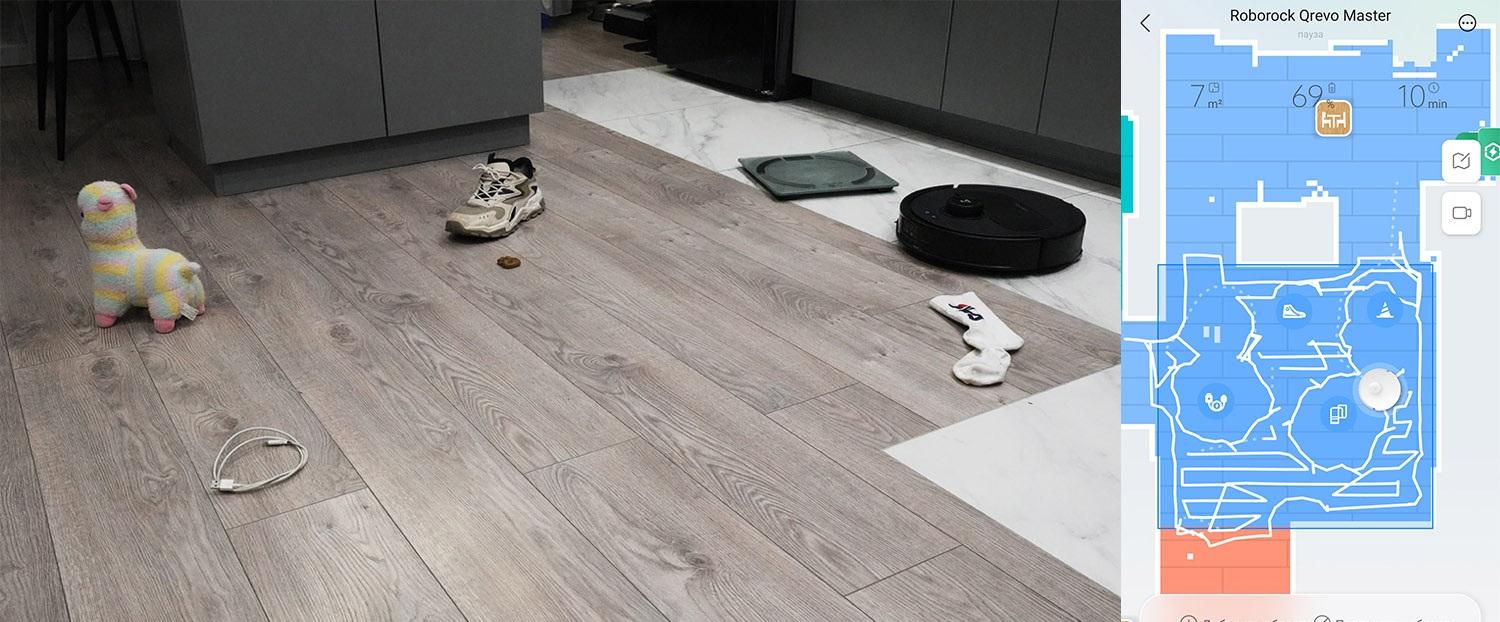
Recognizing objects in complete darkness
I've made the object recognition test more challenging to make it more accurate. The new test is a minefield. I don't think I need to explain it. In good lighting, the robot avoided three of the six traps, ran over one, and decided not to reach two more, even though it had the physical ability to do so.
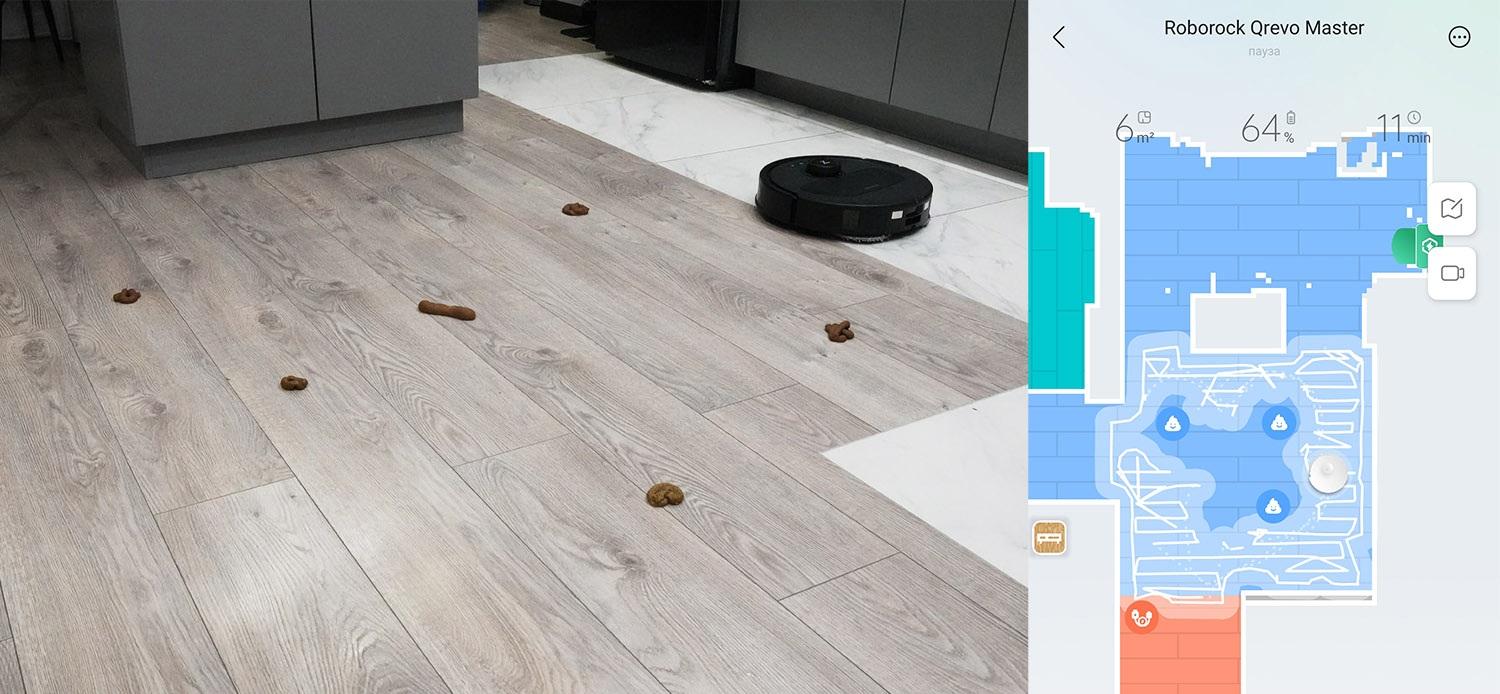
Minefield (light)
In complete darkness, the robot moved through all 6 traps, later recognizing one of them and simply displaying the second as an obstacle.
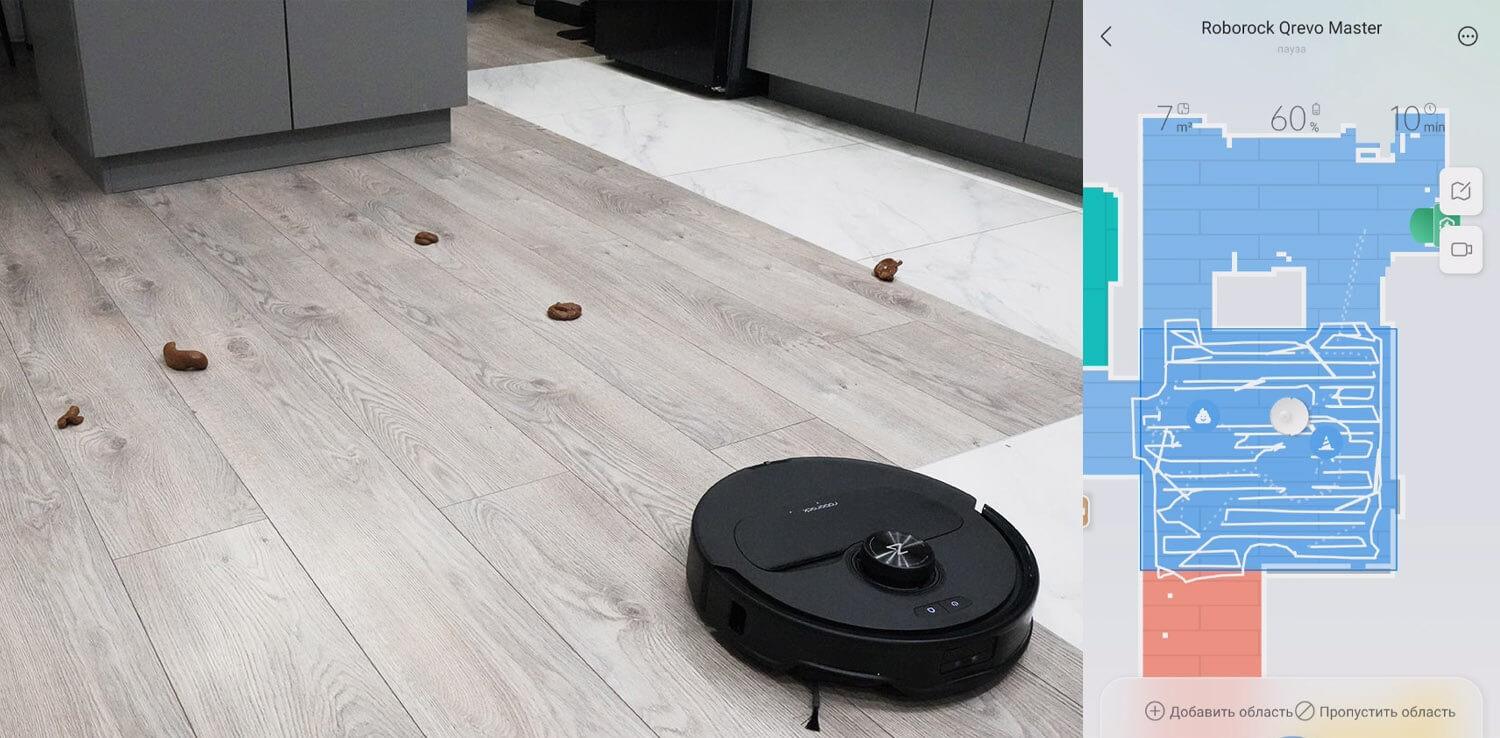
Minefield (in complete darkness)
Moving on, we checked wires of different colors and sizes in the same way. In good lighting, I circled all four wires and correctly displayed them as icons on the map.
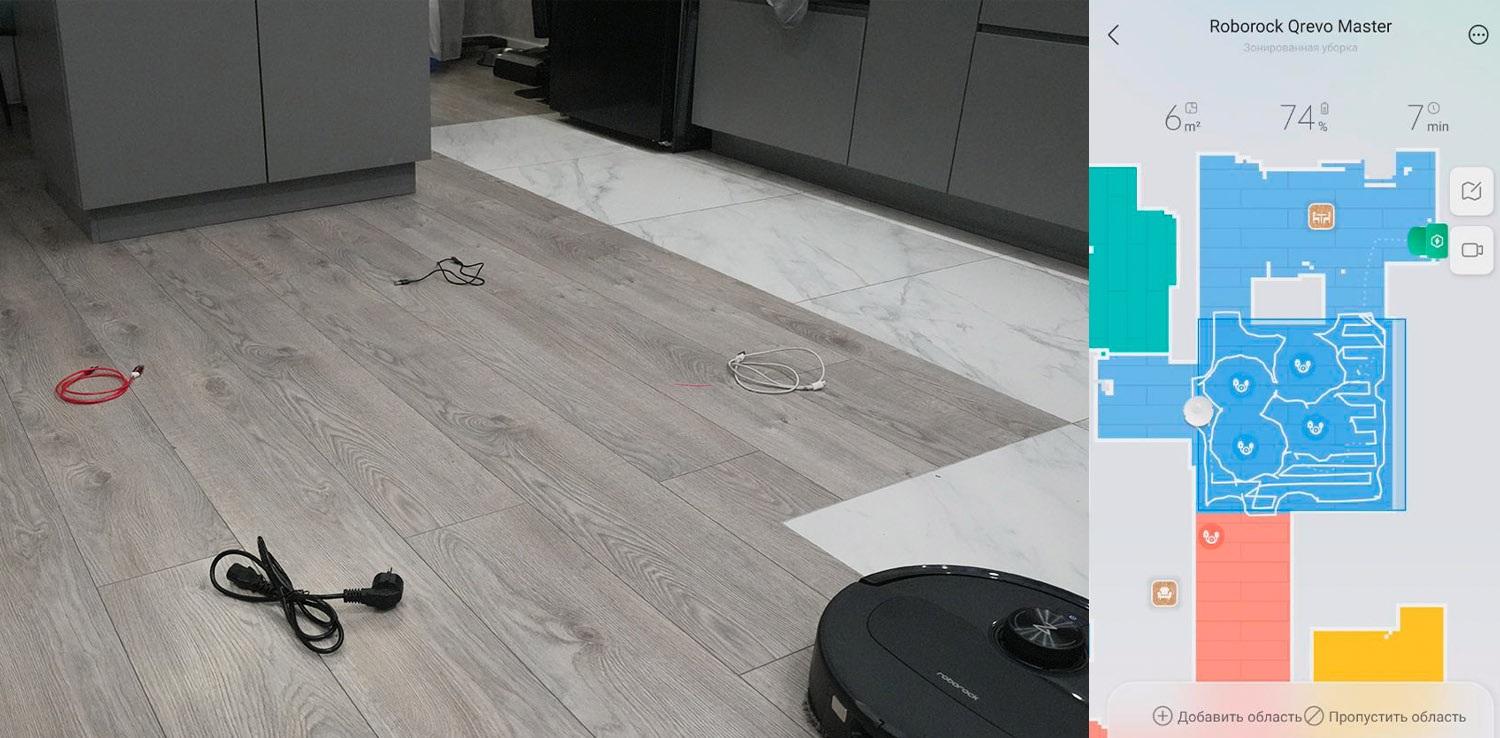
Wire recognition (light)
In complete darkness, two wires were jammed, one was pushed, and the other remained intact. Consequently, two of the four were successfully recognized.
Wire detection (in the dark)
Another typical robot problem is socks on the floor. Again, I used different colors. In good lighting, it chewed a black sock, pushed a red and white one, but didn't get caught in the traps. Moreover, all three objects were recognized correctly initially.
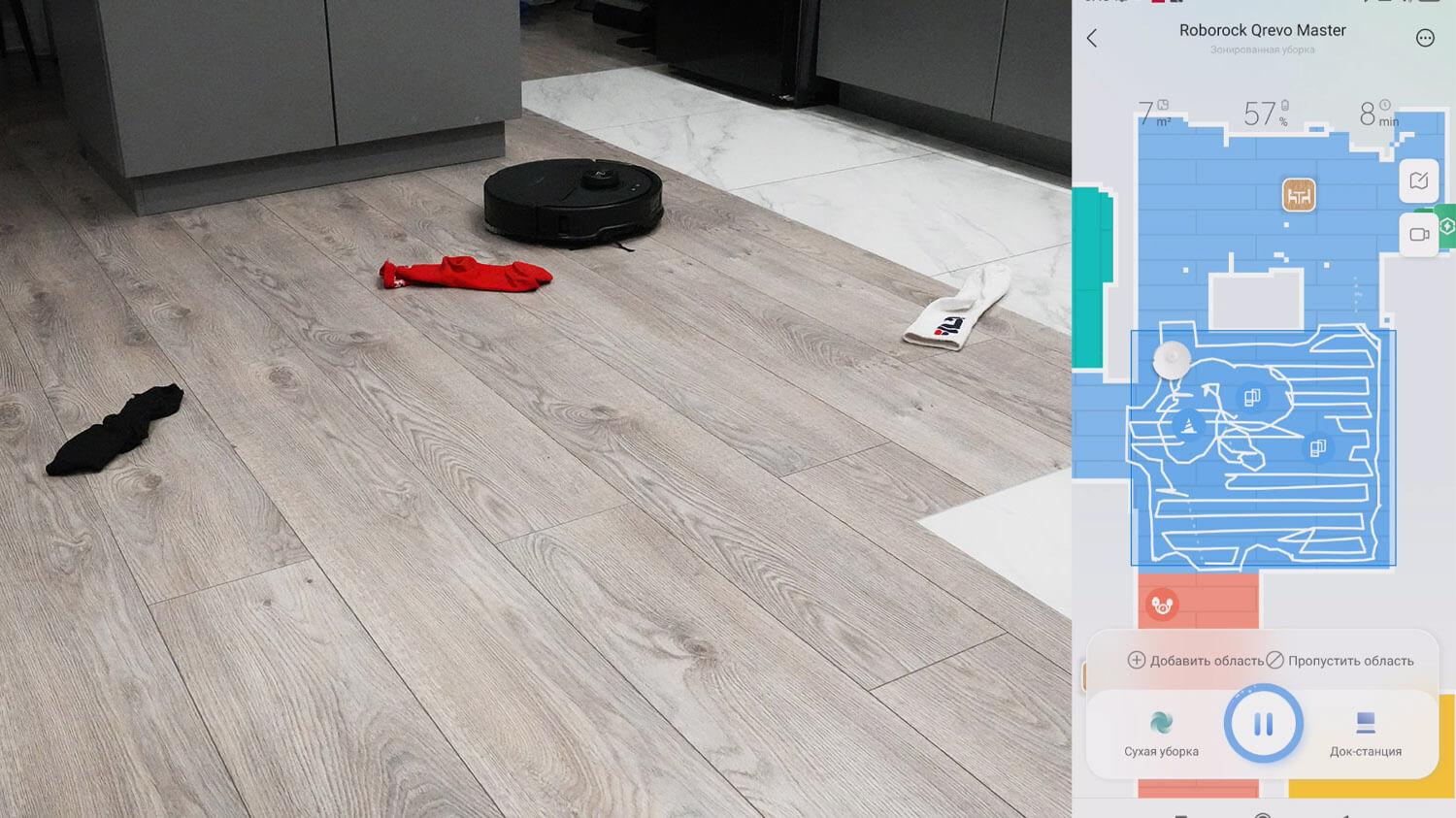
Wear recognition (light)
In complete darkness, only one of the three socks (the black one) was recognized as fabric; the others were obstacles. He moved all three socks but didn't chew them.
Ultimately, I can say that the Roborock Qrevo Master goes blind in complete darkness, and Roborock engineers need to address this. In good lighting, I liked the object recognition system.
Suction power
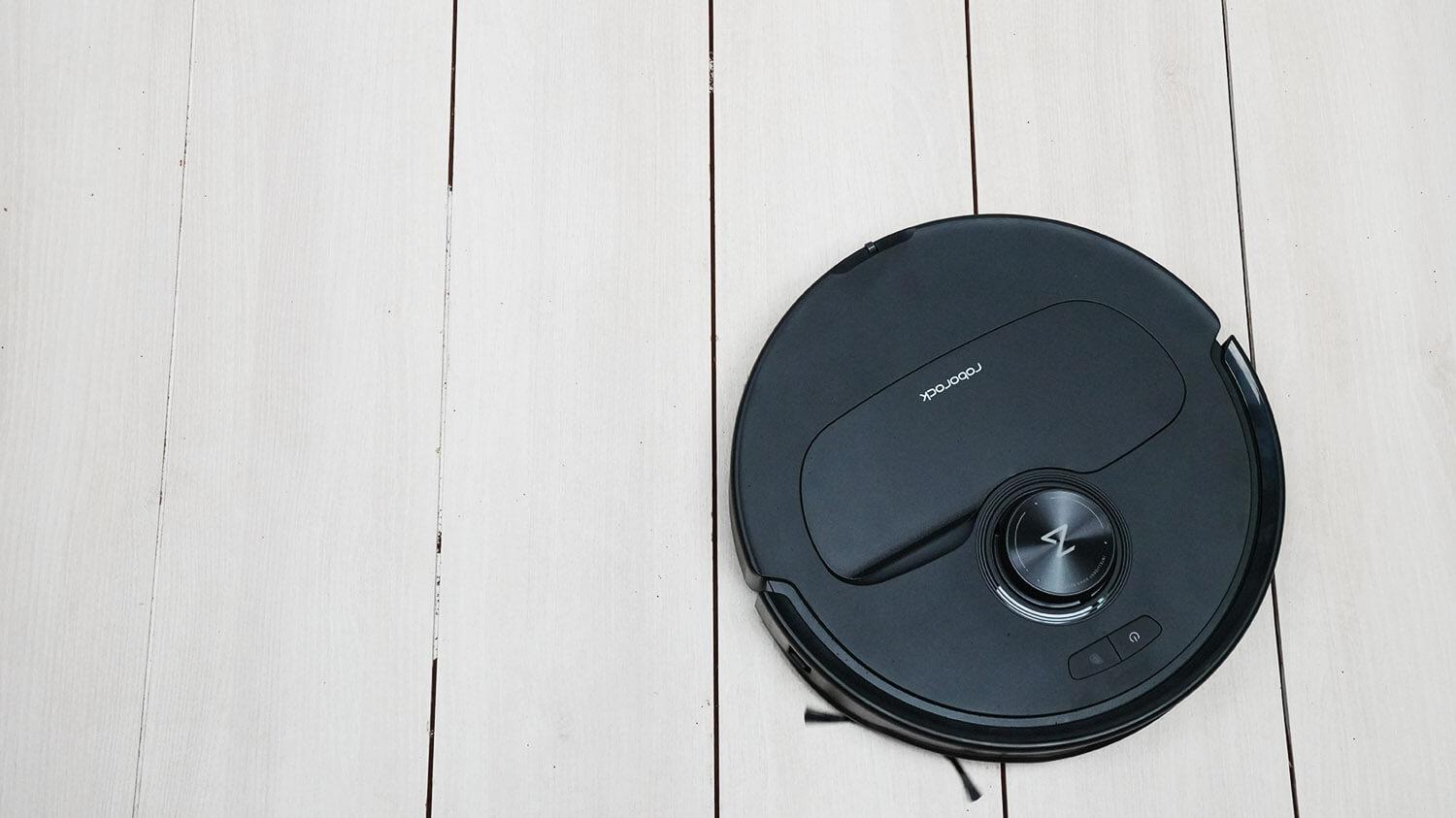
The power test that interested me most was the following: In Silent mode, the Roborock Qrevo Master was only able to clean debris from a 2 mm gap, and only partially. In Balance mode, it cleaned 2 mm better. In Turbo and Maximum modes, the result was the same as in Balance mode – 2 mm. But in Maximum Power, the robot managed to partially clean 4 and even 6 mm. For example, the more expensive Roborock S8 MaxV Ultra with the same double brushes and 10,000 Pascals showed a result of 4 mm partially, and Roborock Qrevo MaxV I was able to clean an 8 mm gap with one turbo brush at 7,000 Pascals.
Suction power
So, aerodynamic losses remain an unresolved issue for Roborock engineers, but at least the results have improved slightly. Apparently, the redesigned dust collector and filter helped.
Dry cleaning
The quality of debris collection on laminate floors is good, but there's a catch: a small amount of debris remains in the corners even after two passes.
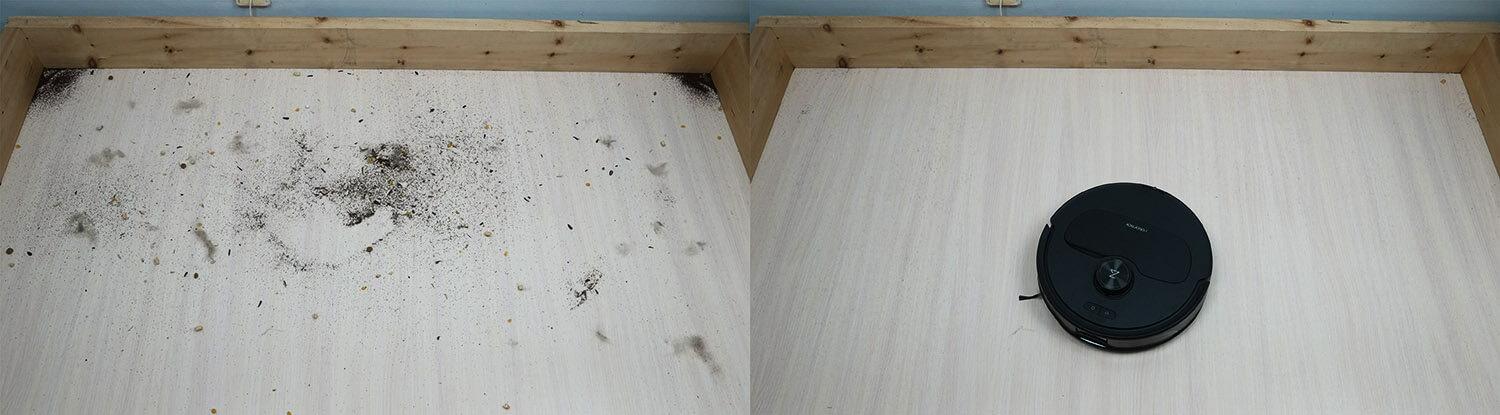
Dry cleaning
There's an obvious problem with the algorithm of the side brush's retractable mechanism. The robot needs to linger longer in the corner, and the brush itself needs to extend into the corner exactly when the robot stops. As it is, it pops out at the entrance, leaving a bit of debris near the corner, and the robot quickly leaves the area before it can effectively sweep everything. Overall, the idea is good, but it still hasn't been perfected. The same issue was observed in tests of both the S8 MaxV Ultra and the Qrevo MaxV. I'm sure this will be fixed. The only question is when.
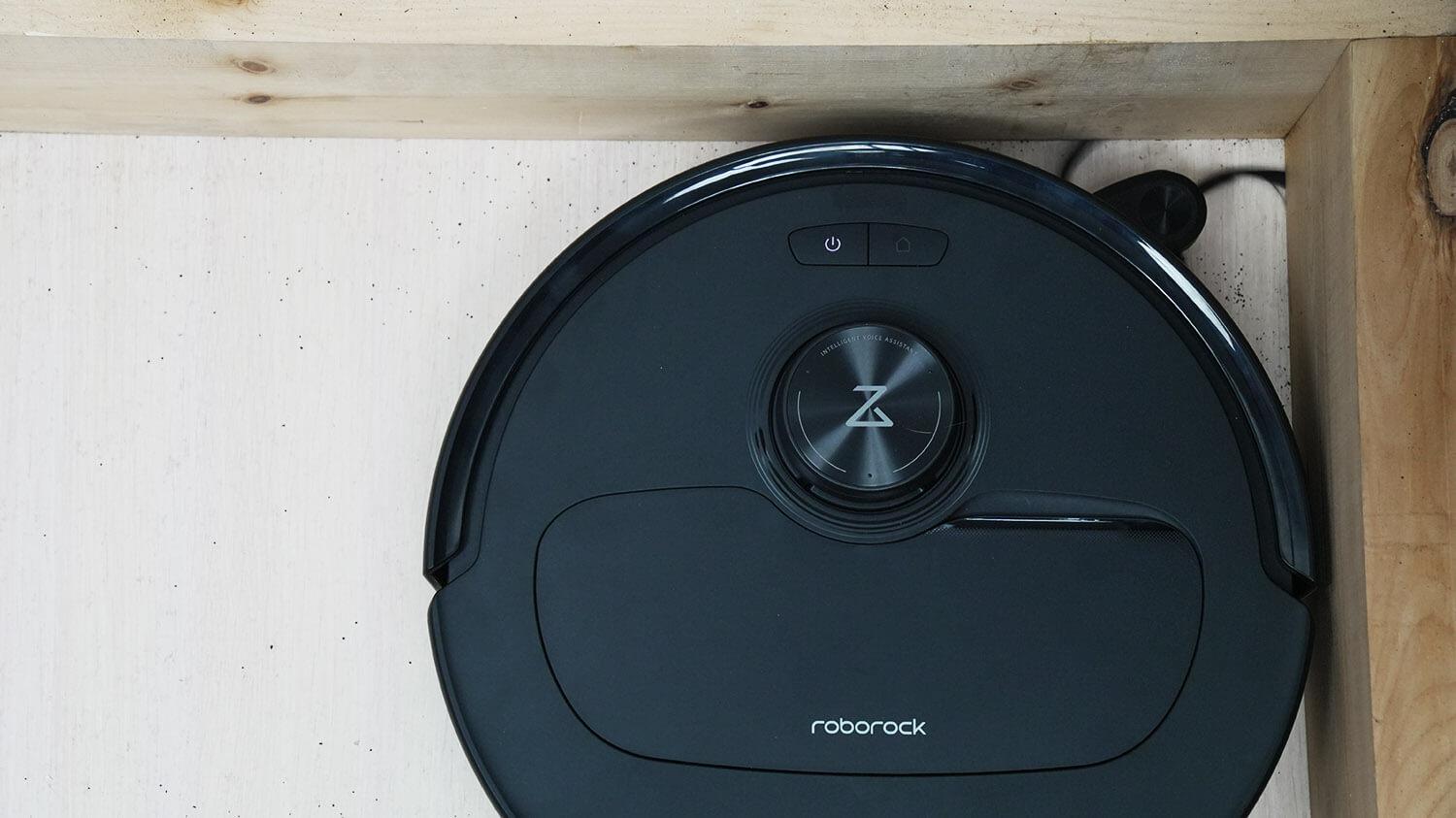
Sweeping in the corners
Regarding the cleaning module's condition, the side brush took a beating from hair and fur, but the center brushes are clean. The next thing the engineers will likely work on is the automatic detangling of the side brushes.
As for everyday use, I can say that the turbo brushes don't really tangle hair and fur in the center, but I haven't noticed the blades cutting through the tangled hair at the edges. Perhaps it needs more time and more frequent use, but so far I haven't seen any visible improvement in the blades' effectiveness.
Carpet cleaning
The Roborock Qrevo Master cleans low-pile carpets well. It can also clean medium-pile carpets in just a few passes. Silicone turbo brushes are less effective on carpets, but the cleaning performance demonstrated is sufficient for everyday use.
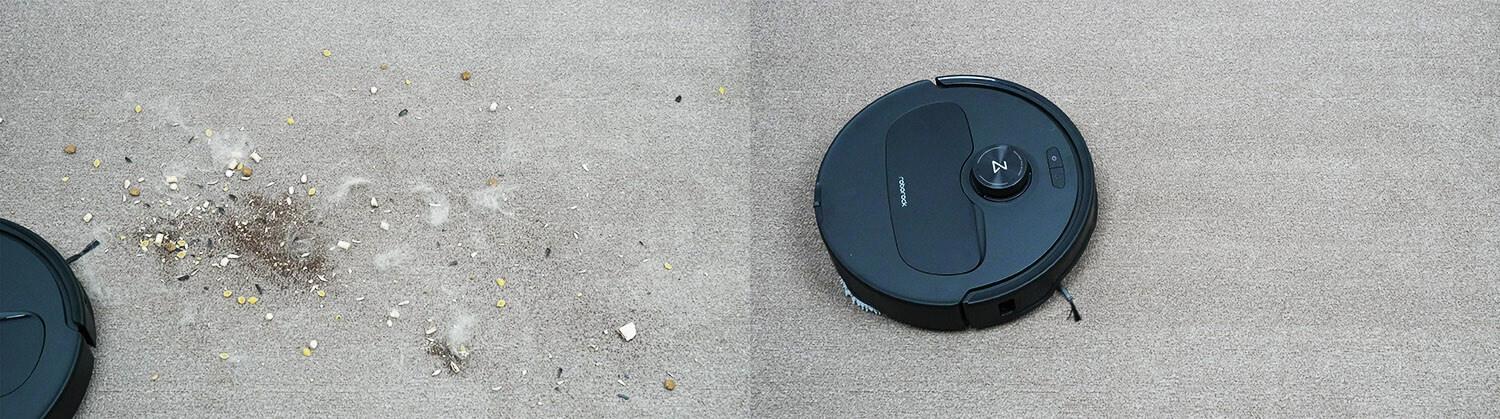
Cleaning a low pile carpet
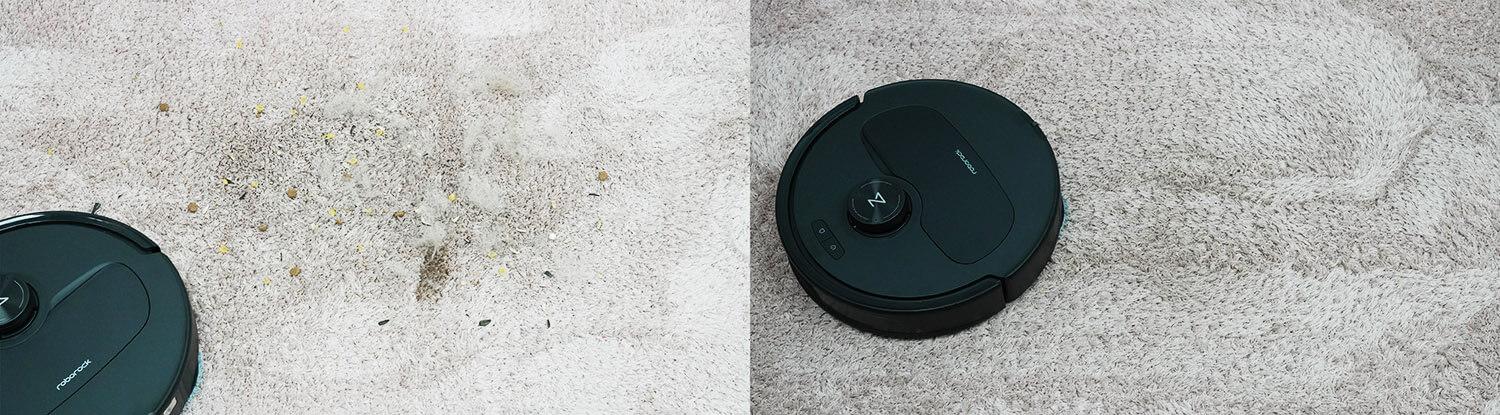
Cleaning a medium pile carpet
Self-cleaning
Immediately after the "dirty tests," I'll check how well the robot vacuum cleaner self-cleans. We see that the dust bin is completely clogged. We return the robot to the station and start self-cleaning. The result is good. The dust bin is completely empty. But we see the condition of the HEPA filter after cleaning. Its pockets are tightly packed with debris. This is not good. The HEPA filter quickly clogs without a screen installed in front of it.
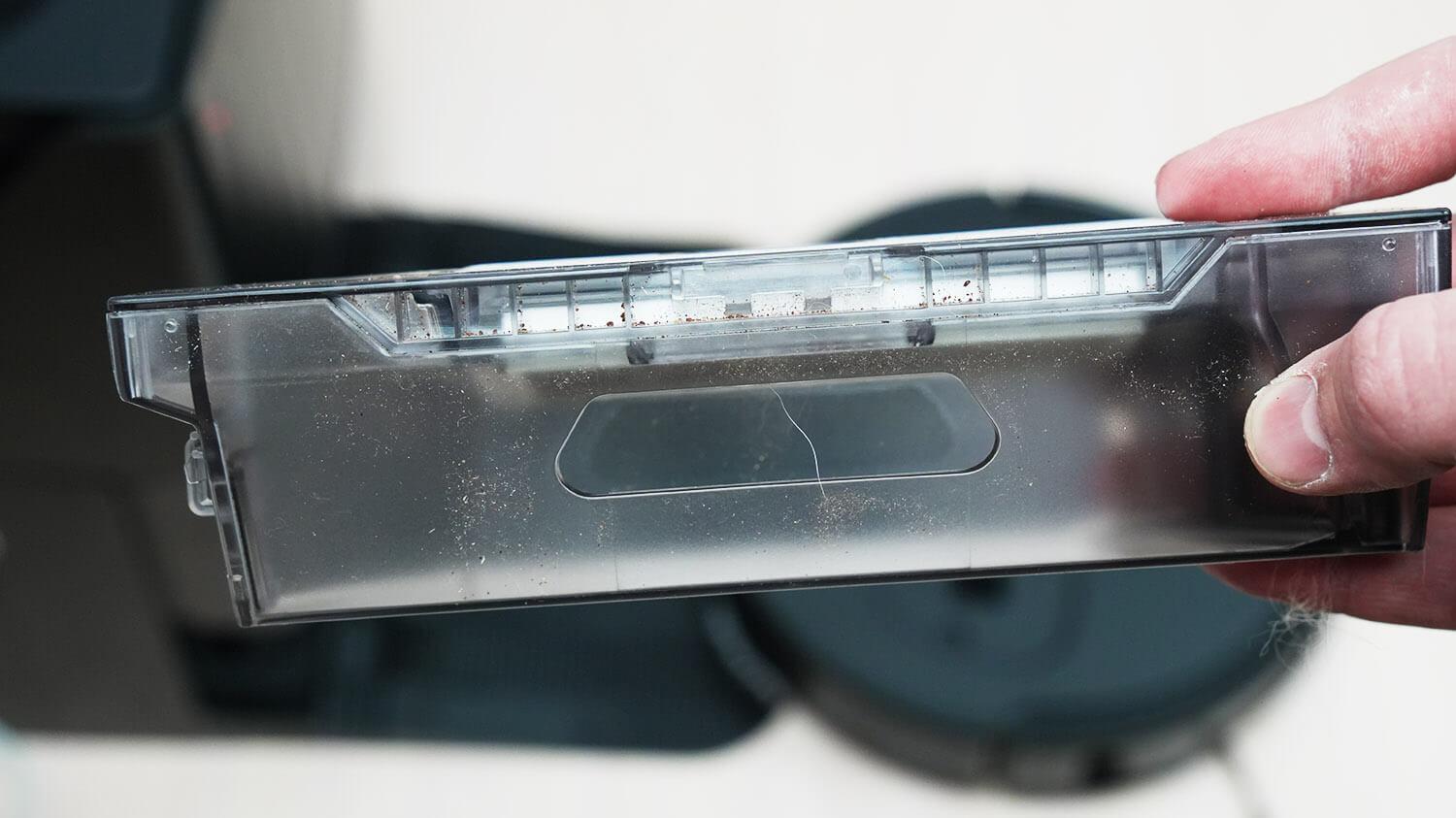
Self-cleaning
Wet cleaning and carpets
When it comes to wet cleaning on carpeted floors, the robot offers several different modes of interaction. It can carefully navigate around the carpet during wet cleaning, or it can enter and touch the carpet with its cleaning pad if you want to clean it with the robot. It can also clean carpets during wet cleaning, automatically lifting the cleaning pads when entering the carpet. The latter option is the most efficient.
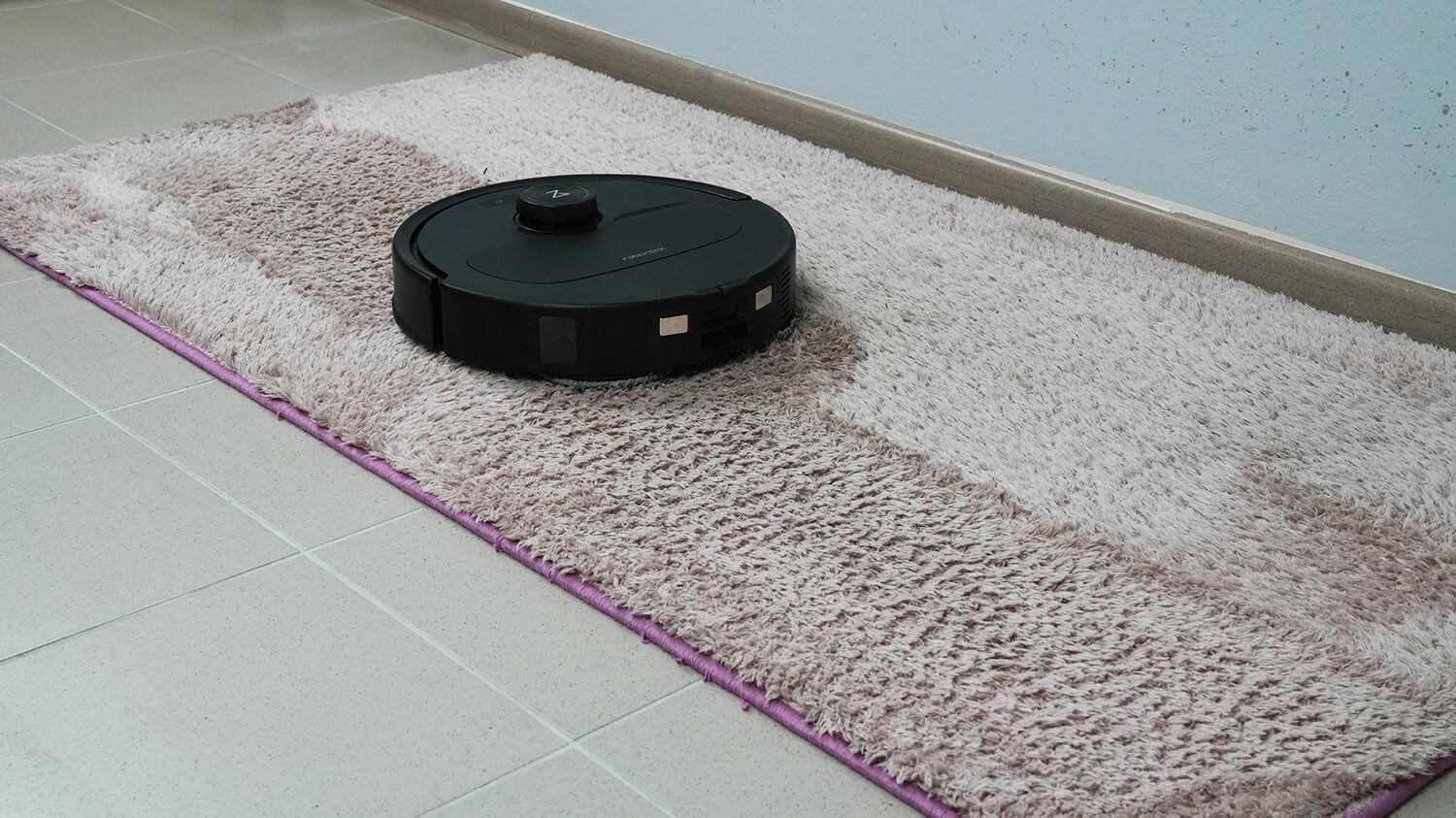
Wet cleaning and carpets
Wet cleaning
The cleaning performance is excellent. The wipes press firmly against the floor and absorb dirt. There's no narrow area along the baseboard, thanks to the wipes extending up to the baseboard. That's a plus!
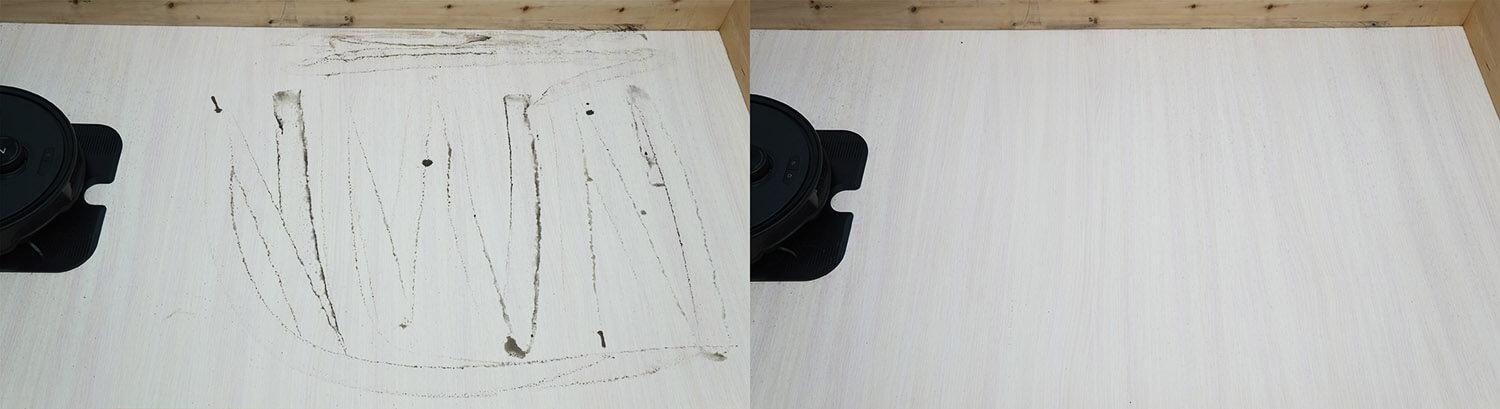
Wiping off dirt
Removing difficult stains
When it came to scrubbing tough stains, the robot even managed to remove dried-on coffee and sauce stains. Granted, it didn't do so on the first try. To be precise, it took ten tries, just like the Roborock Qrevo MaxV. But it was still up to the task. Many similar and predecessor models in the line couldn't even achieve this level of performance.
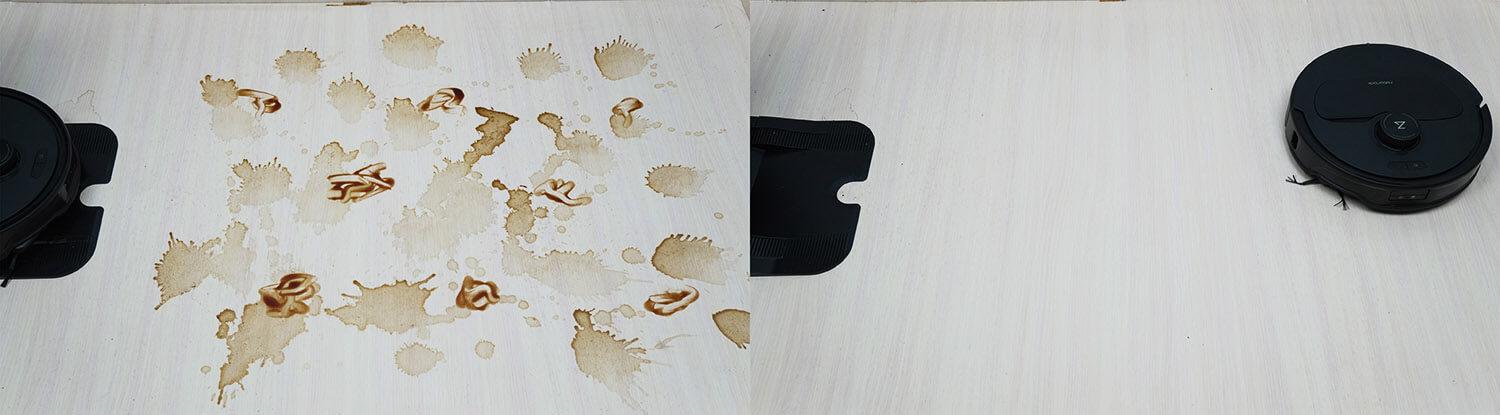
Removing difficult stains
Washing quality of napkins
I'd like to immediately talk about the effectiveness of the station itself. Let's start with the cleaning quality of the wipes. Even after extensive testing, the wipes look significantly better after washing at the station. The water heating feature certainly improves the cleaning efficiency. In a domestic setting, after washing the floor, the wipes are thoroughly rinsed at the station. Dirt isn't washed away by the pressure of warm water. That's a plus.
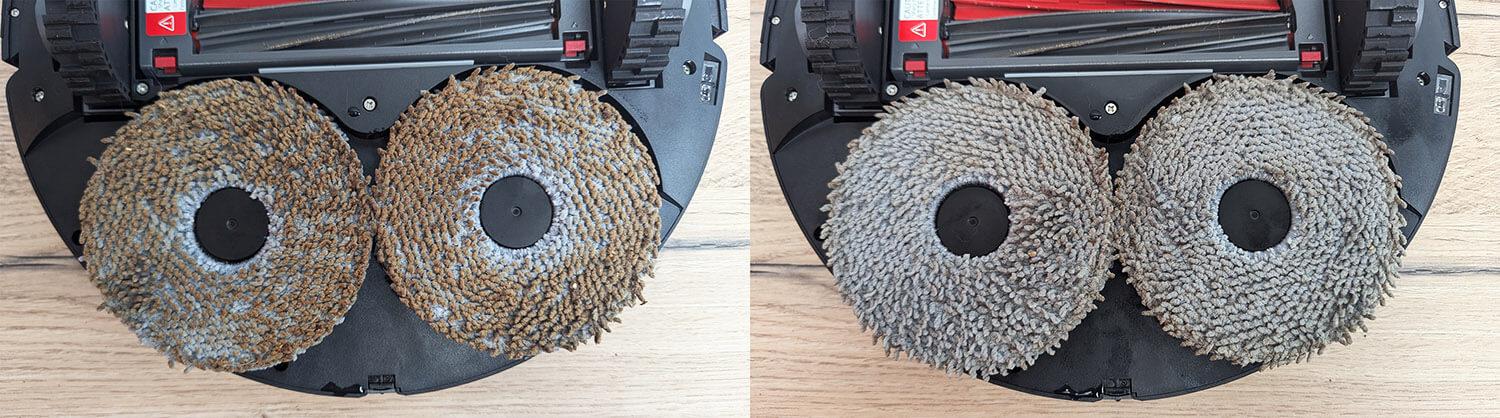
Washing quality of napkins
Station maintenance
Even with new scrapers in the tray, the station will still need to be washed manually periodically. But it's not difficult.
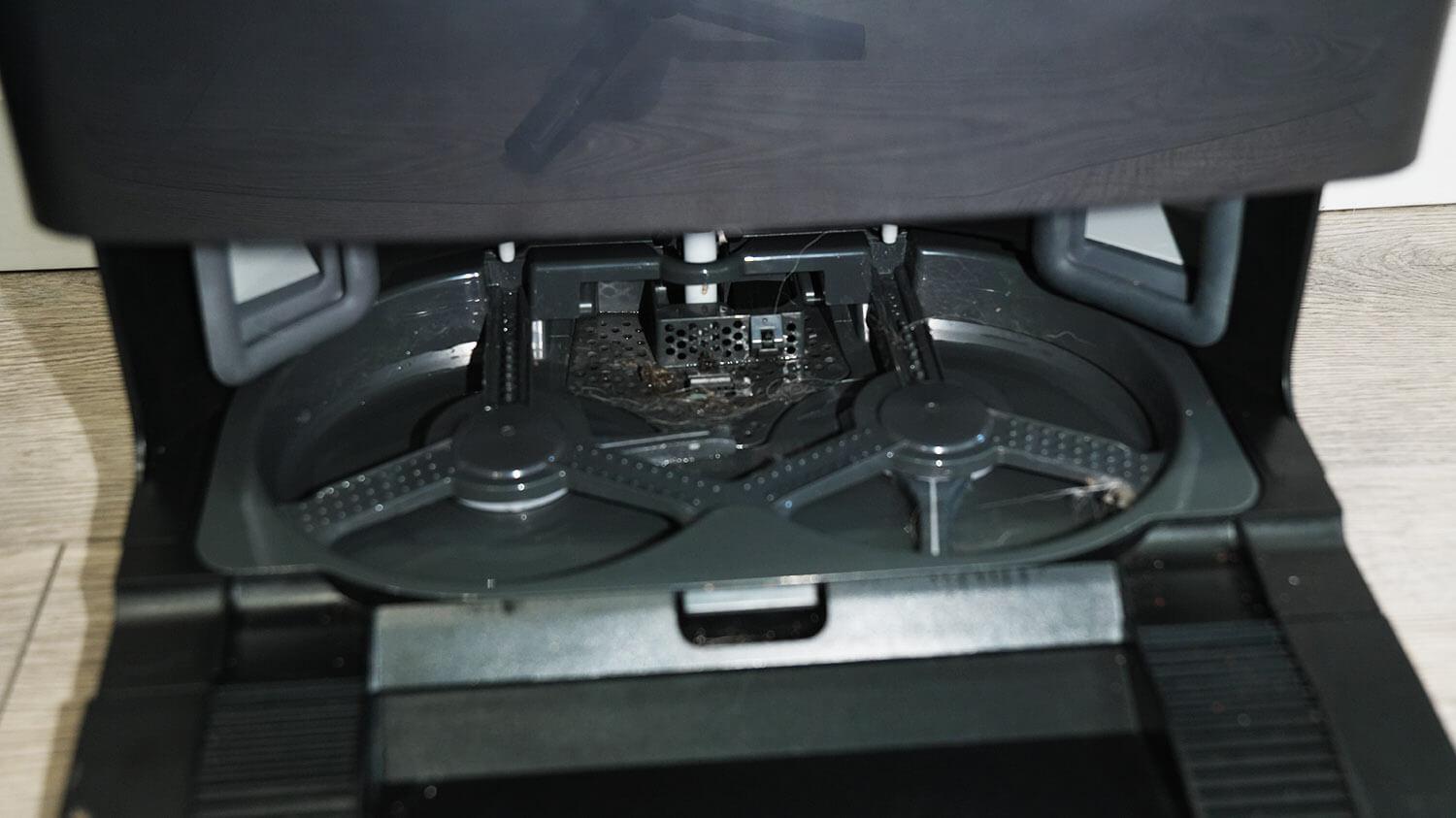
The station's condition after tests
First, we start the "automatic cleaning, tray wash" mode when the robot vacuum is at the station. The station will clean itself with its scrapers. Then we take the robot out, and you'll see that pet hair and fur are still stuck on both the comb and the scrapers in the tray. The coarse filter is also dirty. We remove all of this and rinse it in the sink, then return the clean modules to the station. While convenient, scrapers don't completely solve the problem of cleaning the station.
Obstacle clearance
The robot has excellent maneuverability. It can easily cross a 2 cm threshold!
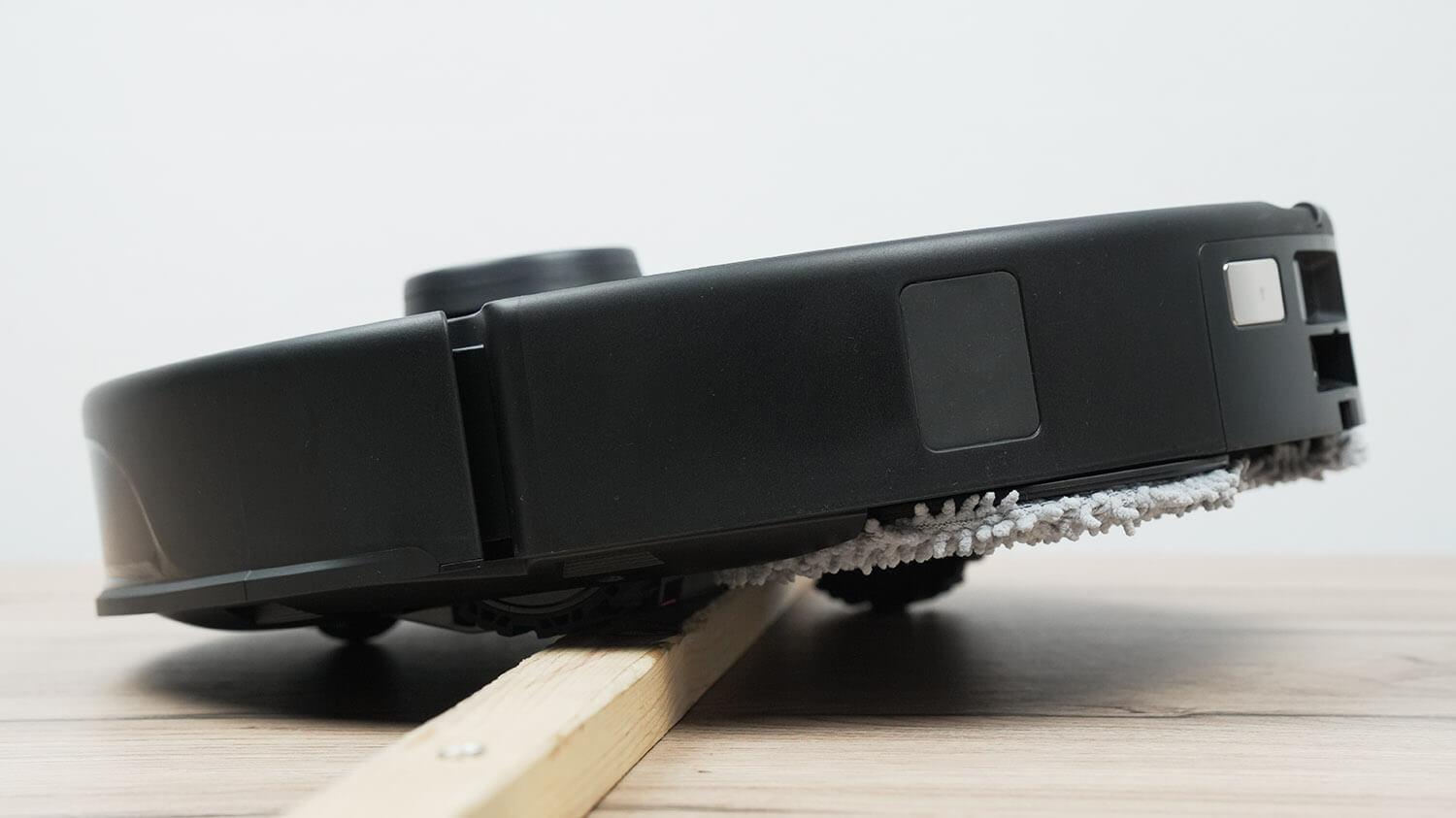
Obstacle clearance
Driving on black surfaces
Driving over black carpets is no problem. The robot glides over the black carpet as if nothing had happened.
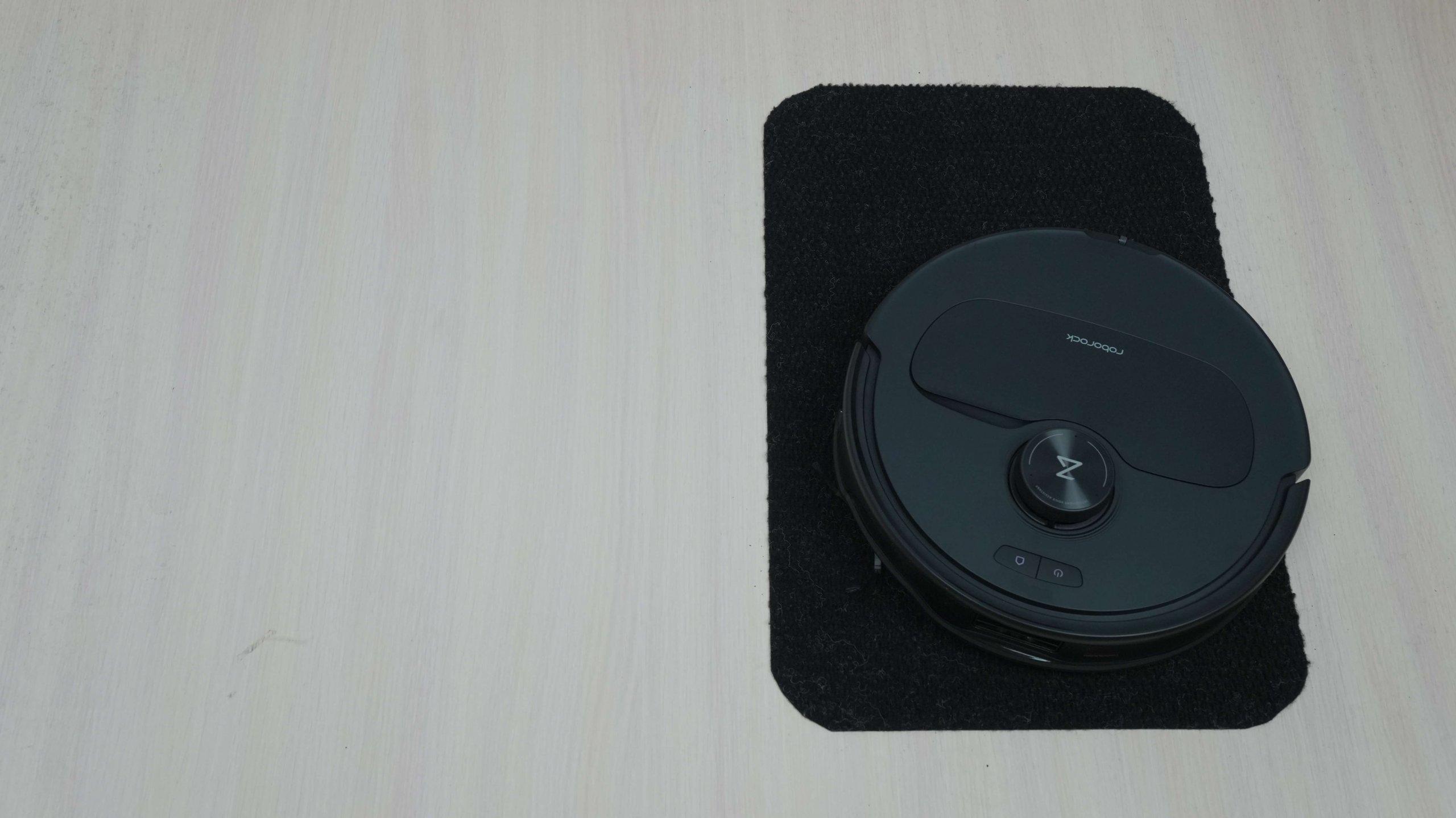
Driving on black surfaces
Noise level
As for noise levels, they range from 62 to 69 dB, depending on the selected operating mode. The noise level is slightly higher than that of the Qrevo MaxV, as two turbo brushes produce more noise than one. However, compared to similar products, the noise level is on par with them, if not lower. The station's noise level during self-cleaning is around 73 dB, which is also average.
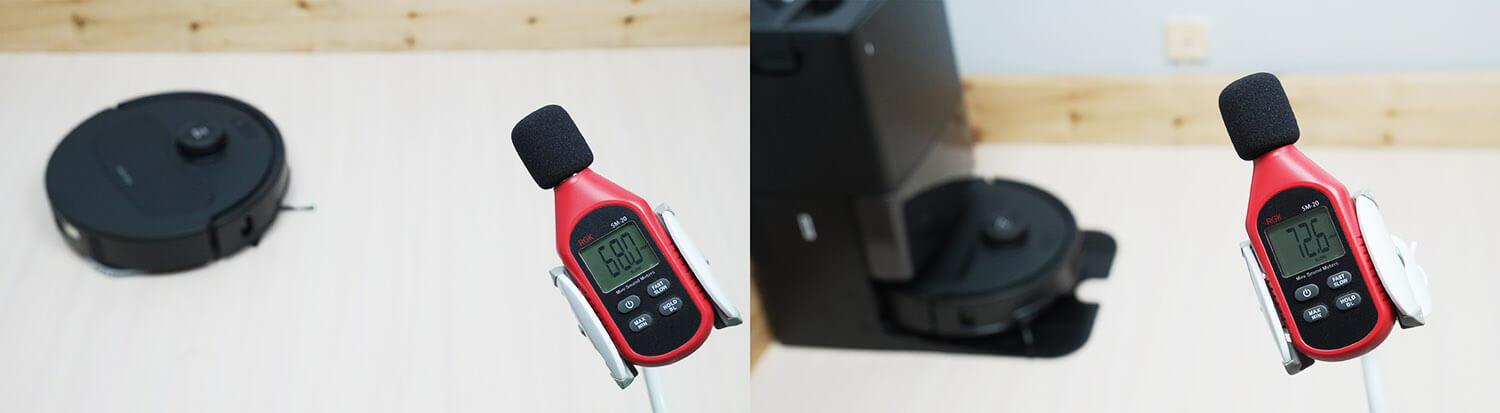
Noise level
Personal opinion
The Roborock Qrevo Master robot vacuum cleaner has been thoroughly reviewed and tested. our evaluation system he managed to gain 209 points and enter the top five the best robot vacuum cleaners ever tested, and there were already more than 170 of them. If not for a number of comments, he would have confidently been able to compete for the title of best, but alas.
First, I'll highlight the pros and cons of the Roborock Qrevo Master, and then I'll share my opinion about it.
I liked the following:
- The presence of a combined station for self-cleaning the dust collector, washing and drying napkins.
- The station is highly efficient. It features high-quality self-cleaning, hot water washing, full-fledged hot-air drying of napkins, scrapers in the tray that make maintenance a little easier, and spacious tanks. In short, it has a lot going for it, and the entire system does its job.
- An illuminated object recognition system that works effectively in good lighting conditions and performs better in dark environments than similar systems found in robots without illumination.
- Good navigation.
- A retractable side brush, which, with the refinement of the algorithm, completely solves the problem of sweeping out debris in corners.
- Silicone turbo brushes are easier to clean from hair and pet hair, as hair is less likely to tangle around the shaft. They also have blades to trim hair along the edges.
- The napkin is pulled out close to the baseboard.
- Lifting napkins when driving onto carpets.
- Raising the turbo brushes in wet cleaning mode.
- Increased suction power.
- High-quality dry and wet cleaning on various surfaces.
- Capable of removing even the most difficult stains.
- A large number of functions in the application.
- Remote home monitoring by connecting to the robot's camera via a smartphone.
- Controlled via the proprietary Hello Rocky voice assistant. Although in English, you can control the robot without a smartphone.
- The robot vacuum cleaner is not afraid of black surfaces.
- Good cross-country ability.
- High-quality assembly and high brand authority.
There are many positives, but what about the negatives? There are also quite a few comments. I'll start from the most important ones, moving on to the less significant ones, which are still worth addressing.
- This model is not intended for the Russian market. There's no Russian voice pack, the proprietary assistant doesn't understand Russian, and, most importantly, there's no official warranty.
- The version of the station I received for review cannot be connected to sewer or water lines. I couldn't find a version with a different station designed for connection to utility lines—that model was not available for sale.
- There is no automatic mixing of detergent from a separate tank.
- Power losses are still observed, but they are now smaller.
- The algorithm for sweeping out trash in corners requires improvement.
- The object recognition system is partially blinded in the dark and therefore requires improvement.
- Small dust collector capacity.
- The HEPA filter quickly becomes clogged with debris.
So, we see that what seemed like an excellent robot vacuum throughout the review is far from perfect. And even just considering the rating, if it were at least adapted for the Russian market, with a warranty and a Russian language option, it would score 7 points, bringing the total to 216 points, placing it higher than the flagship Roborock S8 MaxV Ultra, placing it fourth in the overall ranking. Adding a detergent tank and the ability to connect this station to a drain would boost the score to 6 points, bringing it to 222 points and a silver medal in the overall ranking. And with more work on its power, object recognition system, design, and additional unique features, we could have a new #1 on the channel. But we have what we have.
Ultimately, I can say that the robot vacuum is truly excellent – it cleans well on a variety of surfaces, washes floors efficiently, is autonomous, reliable, and stylish. I've also highlighted a lot of positives. But it's not the best, and that's a fact. For the price, if you're looking closer to $850, this is the optimal feature set and corresponding cleaning quality. A good alternative to an equally optimal one. Dreame Bot L10s Pro Ultra Heat, even slightly better, judging by the rating. And in my opinion, this is the best robot vacuum in the Roborock lineup, until the new ones come out. Curv and Slim. Therefore, it definitely deserves attention and is recommended for purchase.
On that note, I'd like to end this review. If you have any questions, please ask them in the comments. Happy shopping, everyone. Bye!