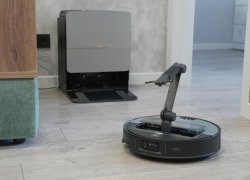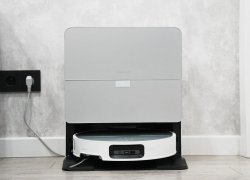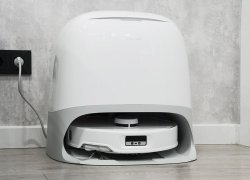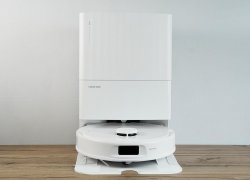
Roborock Qrevo CurvX: a tandem of the Curv and S9 MaxV versions! What's the result?
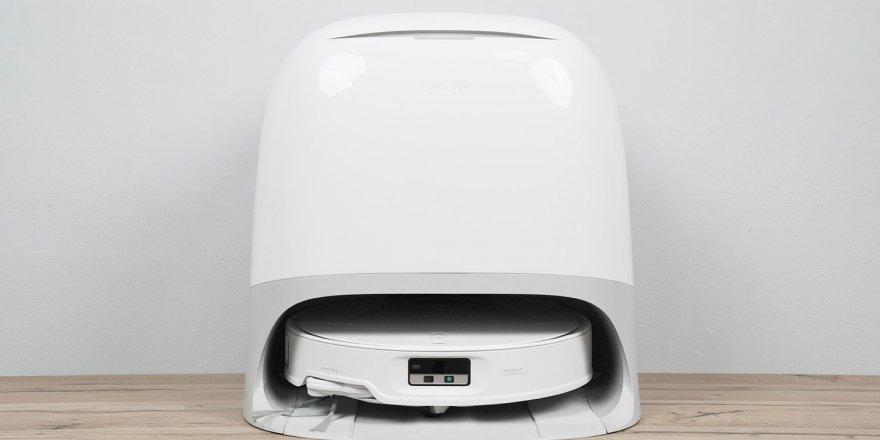
The new Roborock Qrevo CurvX robot vacuum cleaner is a tandem of previously released Roborock Qrevo Curv And Roborock S9 MaxV UltraThe first one took the station, its design and capabilities, as well as the cleaning module. The second one took the lidar, which retracts into the body, and the suction power increased to 22,000 Pa. The result is a unique set of solutions in the Roborock line, which will certainly be optimal for certain conditions. The official price at launch is $1,100, which, again, is halfway between the Curv and S9 MaxV versions. So, below, I'll test the Roborock Qrevo CurvX in detail, highlight the pros and cons based on the test results, and then express my own opinion. So, let's go!
Equipment
The robot vacuum cleaner arrived in a branded box like this:
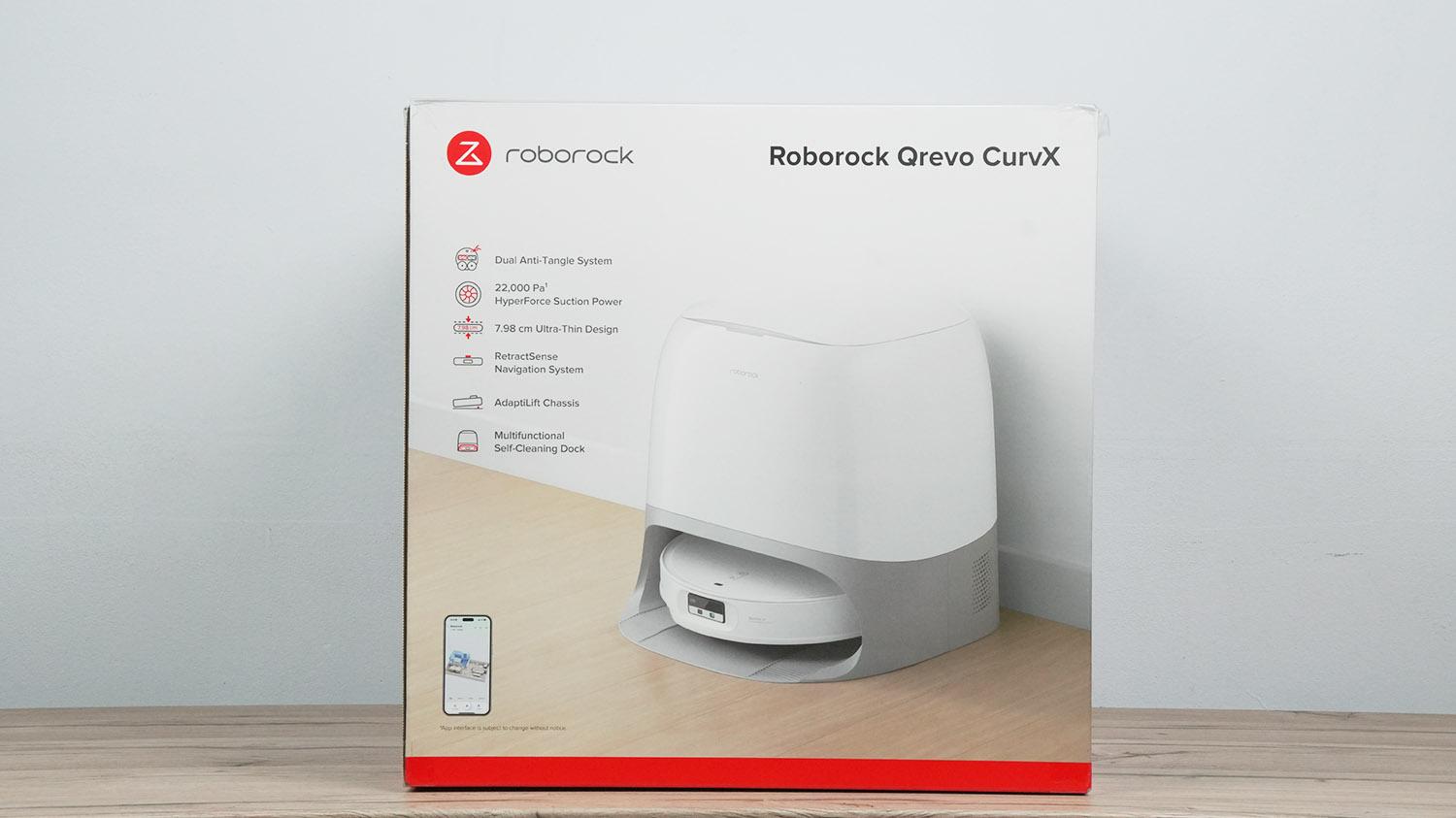
Box
The package includes the robot itself and its station, two wipe holders, a power adapter, and a Russian-language instruction manual. Surprisingly, a spare dust bag was not included in the box.
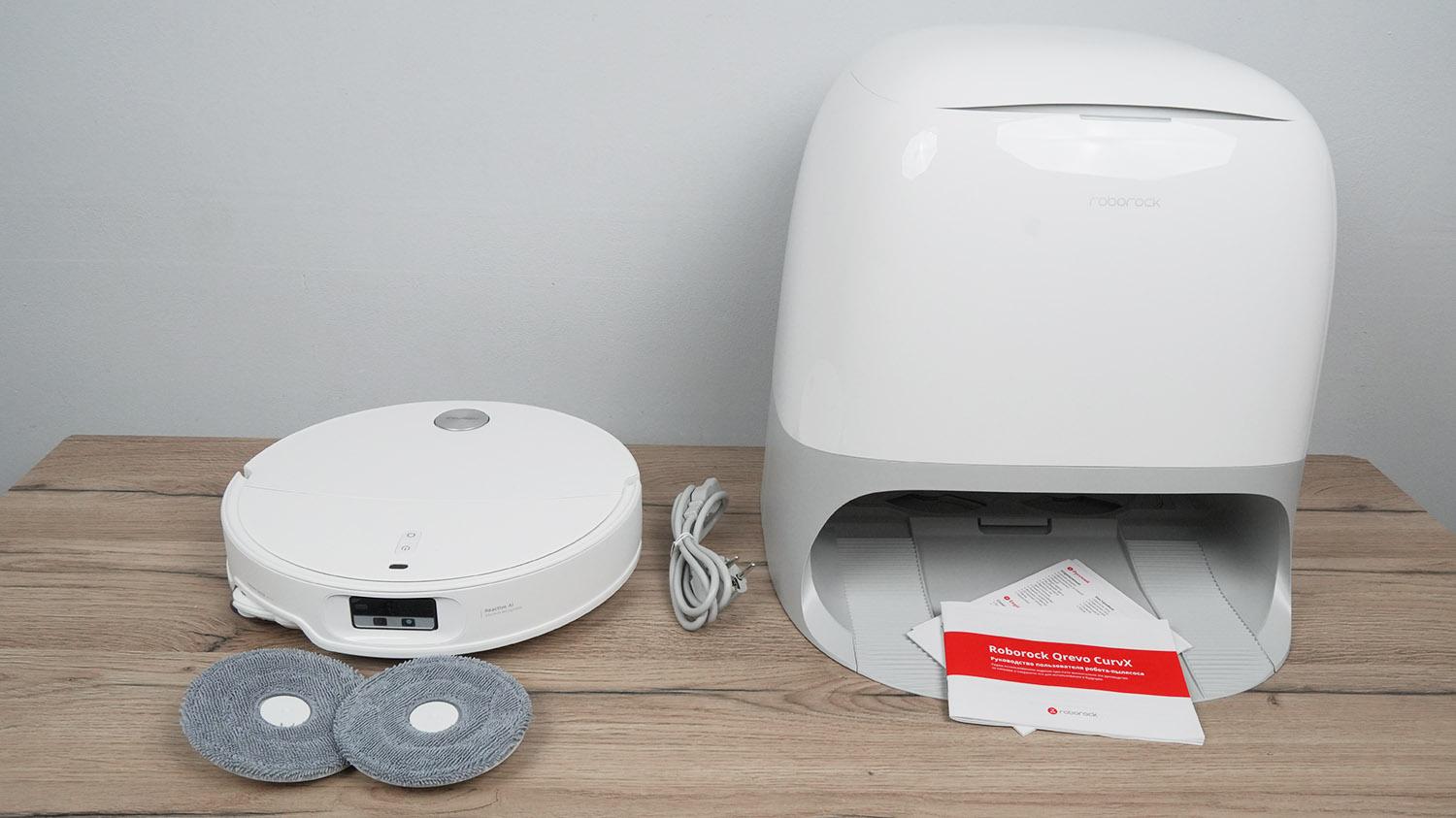
Equipment
Appearance
Now let's take a look at the Roborock Qrevo CurvX's design. Let's start with the robot vacuum itself. It comes in white and has a round body.
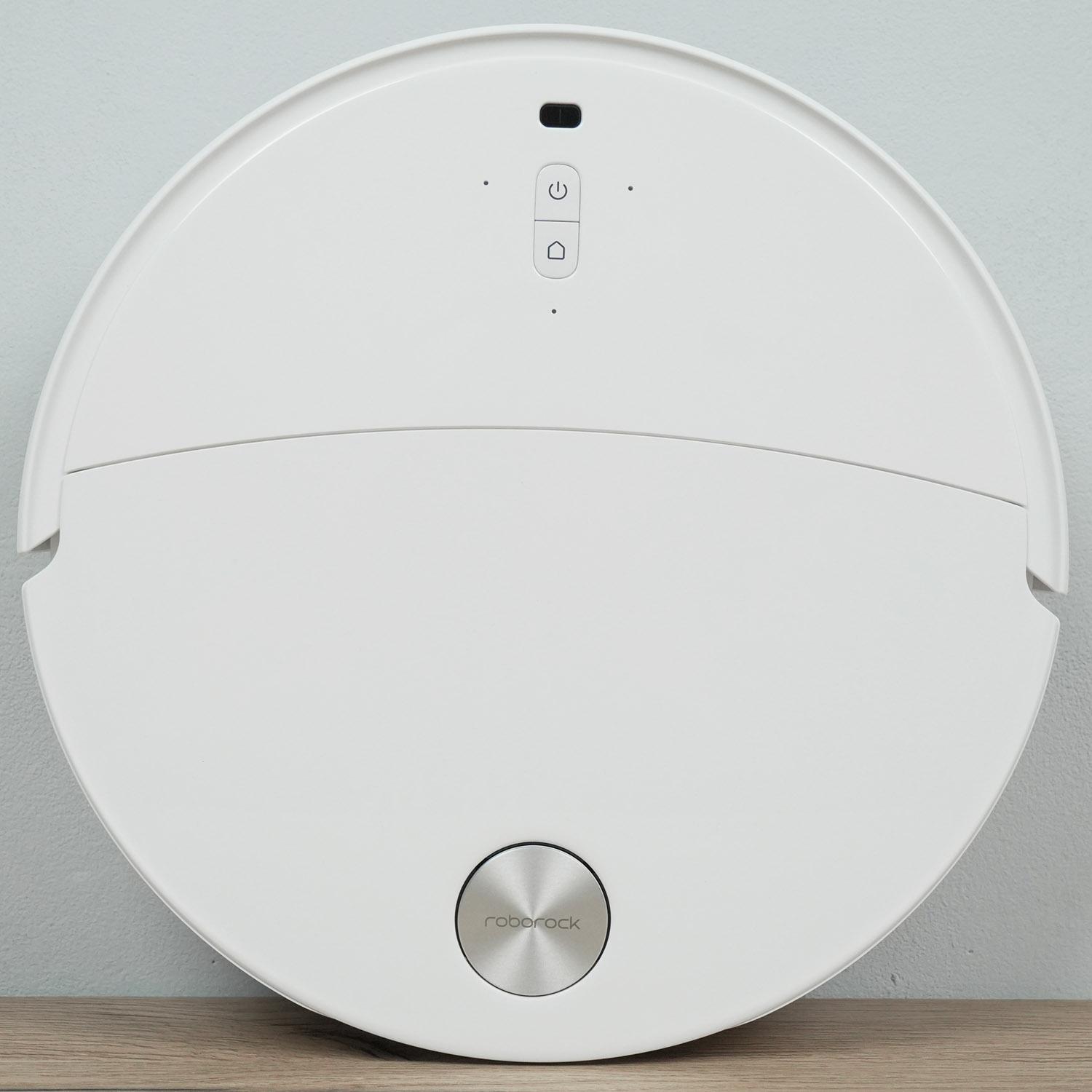
Top view
The height is stated as 79.8 mm, although in fact I measured 75 mm with the lidar folded and about 90 mm with it raised, which is also lower than lidar analogues.
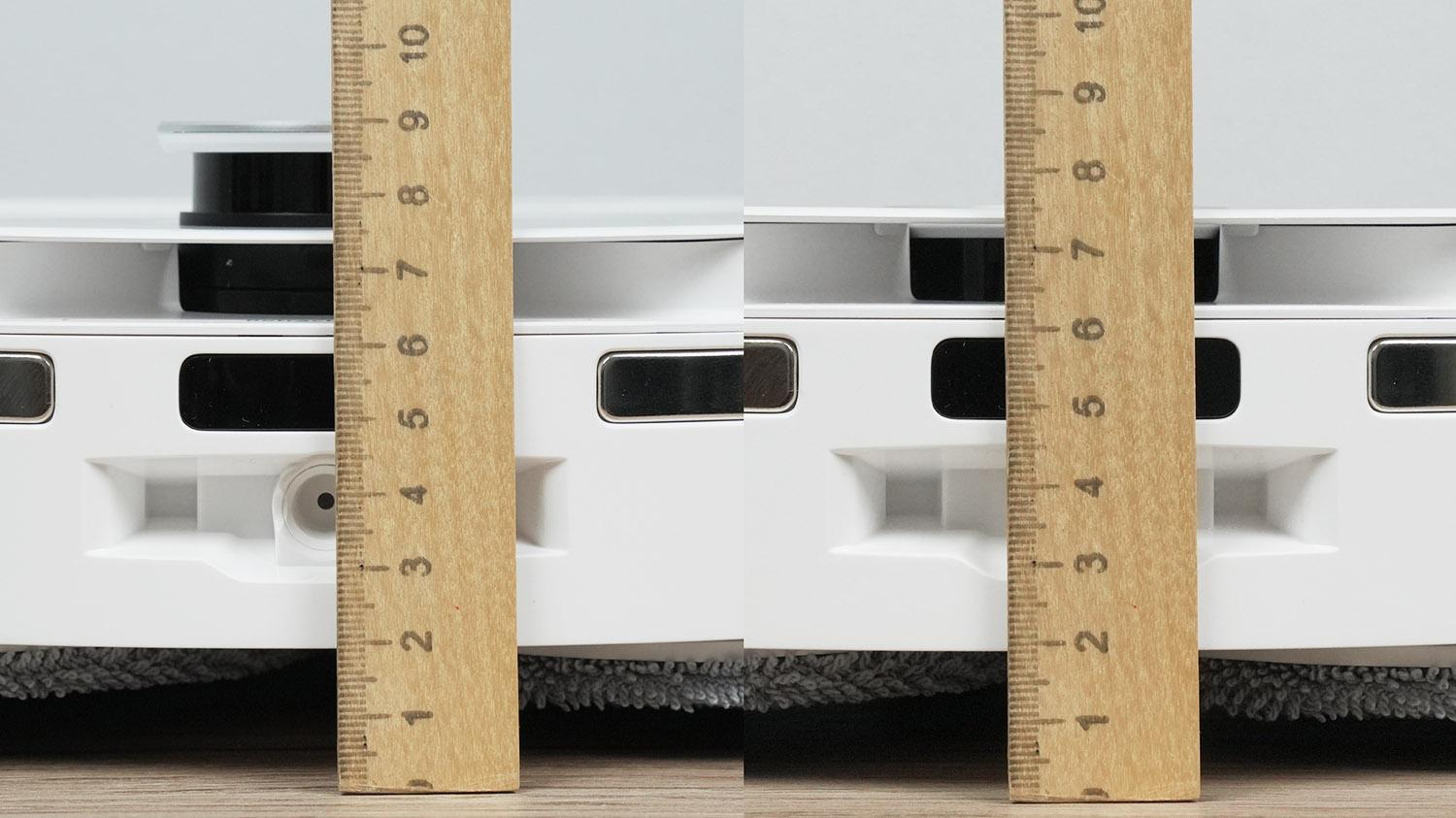
Body height
A wall sensor is installed on the right, and a system of sensors and illuminated cameras is located in the center to recognize and accurately navigate objects on the floor. The technology is called Reactive AI Obstacle Recognition.
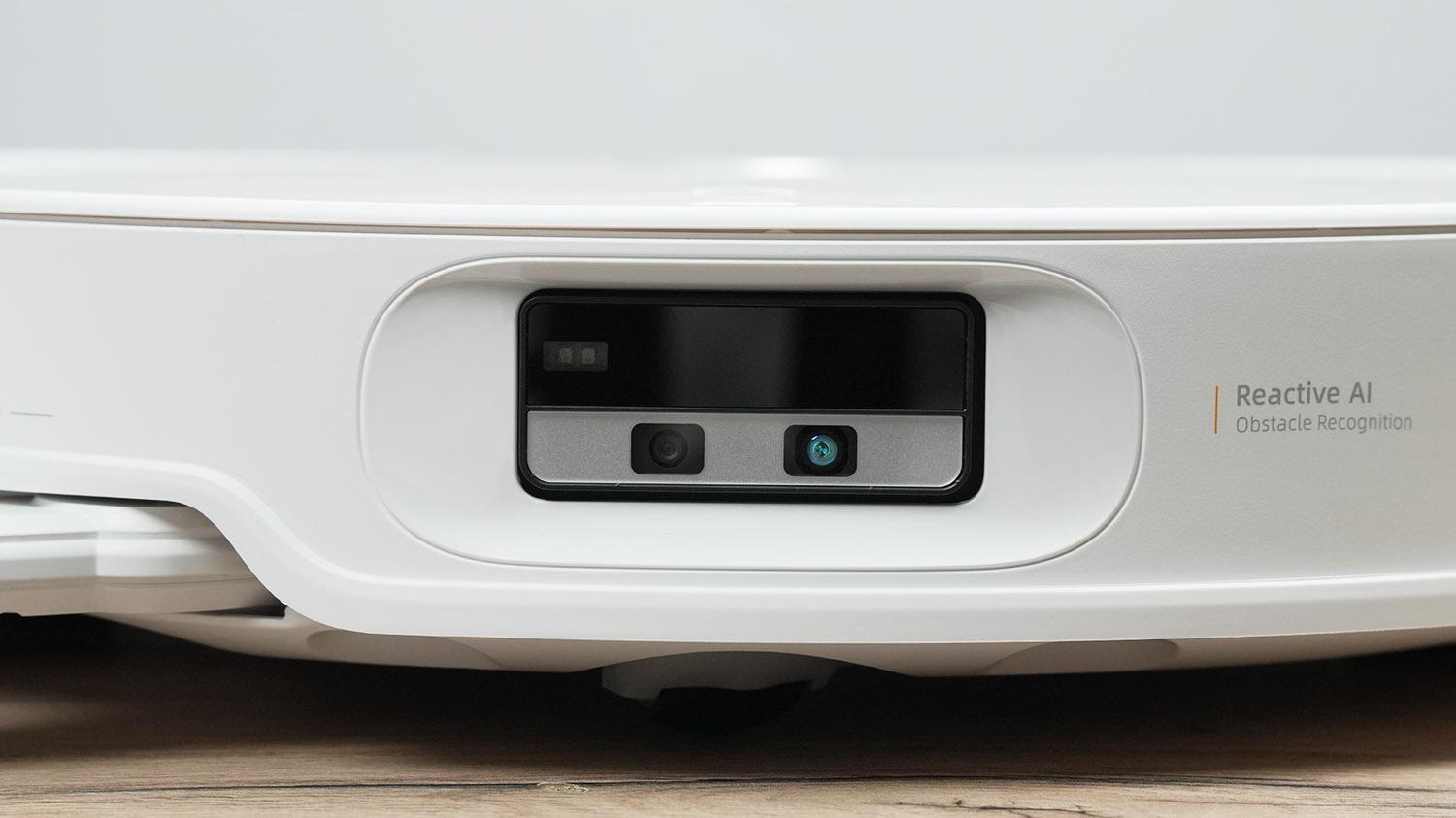
Object recognition system
The remote home monitoring function is implemented in this model:
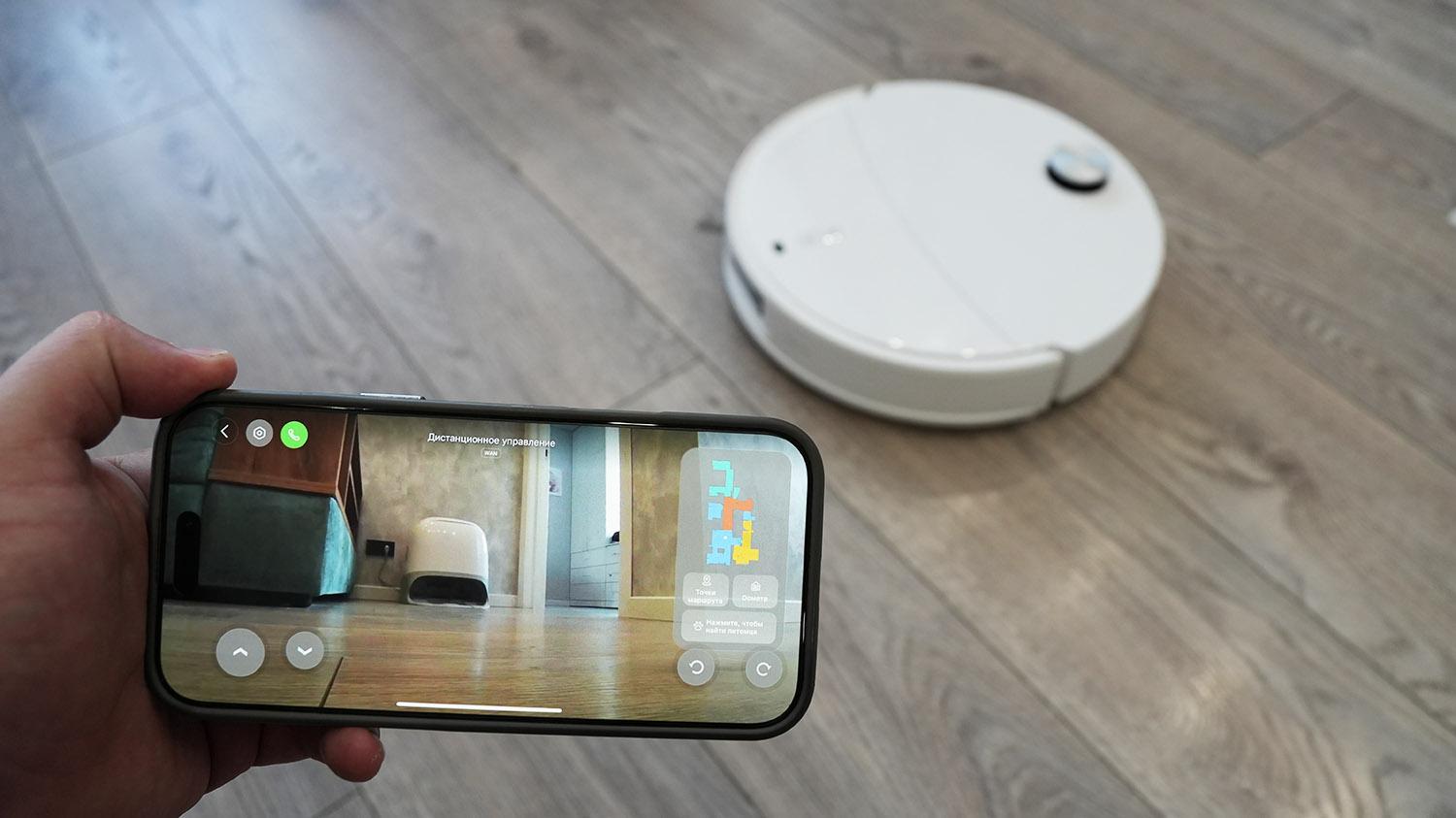
Remote home monitoring
The lidar is equipped with a spring-loaded cover that prevents the robot from getting stuck under furniture. It extends when cleaning begins and retracts into narrow spaces, as well as when the robot returns to its station after cleaning. The control panel features two mechanical control buttons, an upper height sensor, and microphone openings for voice control.
The dust collector is located under the top cover, which is held in place by magnets. The filtration system, as usual, is exclusively HEPA-based. A water tank is located inside the robot, but it's hidden within the body. Water is automatically pumped into the tank at the station.
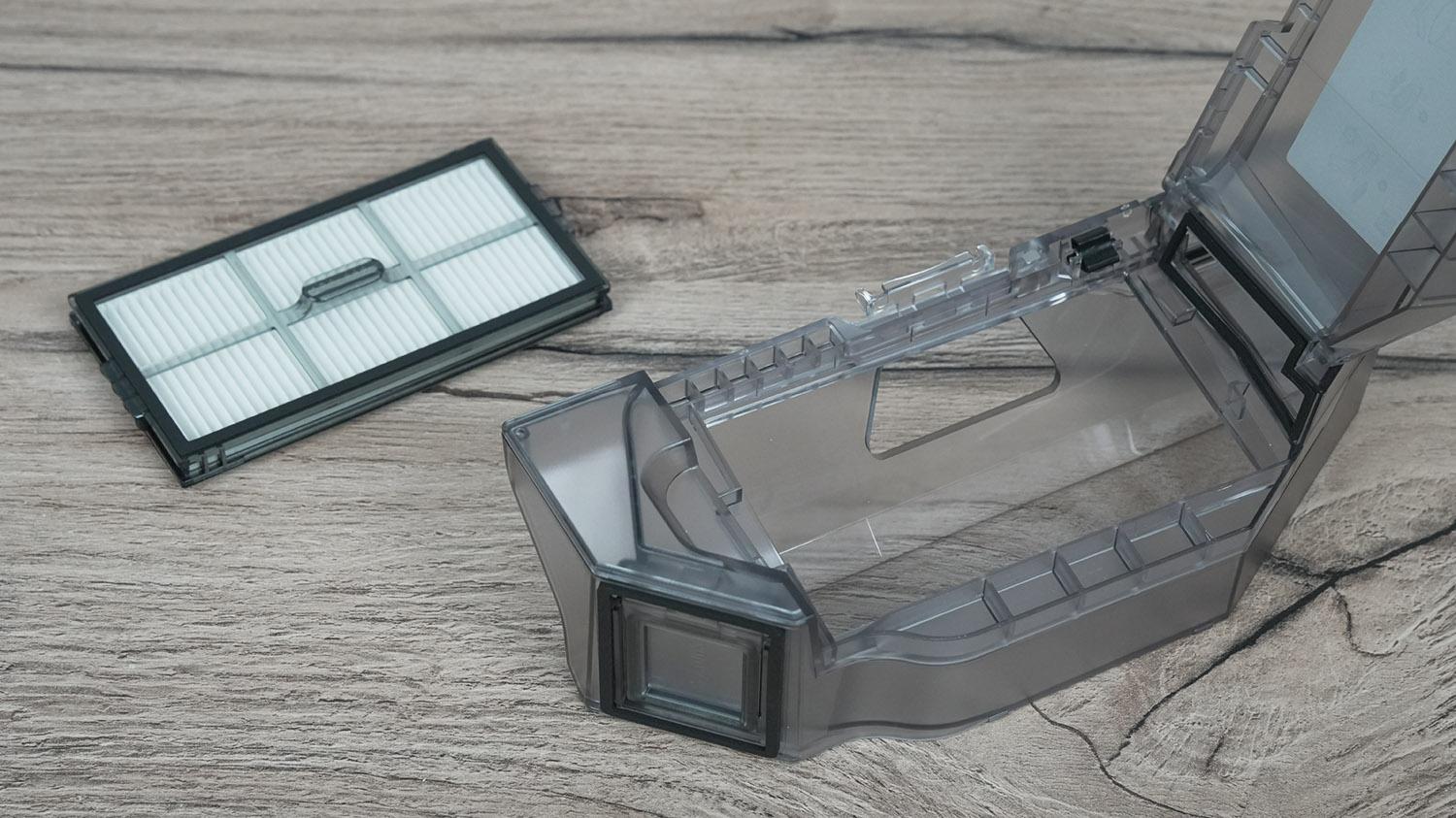
Dust collector
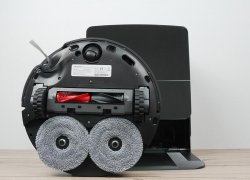
There are five fall protection sensors. There's also a carpet detection sensor. The side brush is dual-beam and secured with a screw.
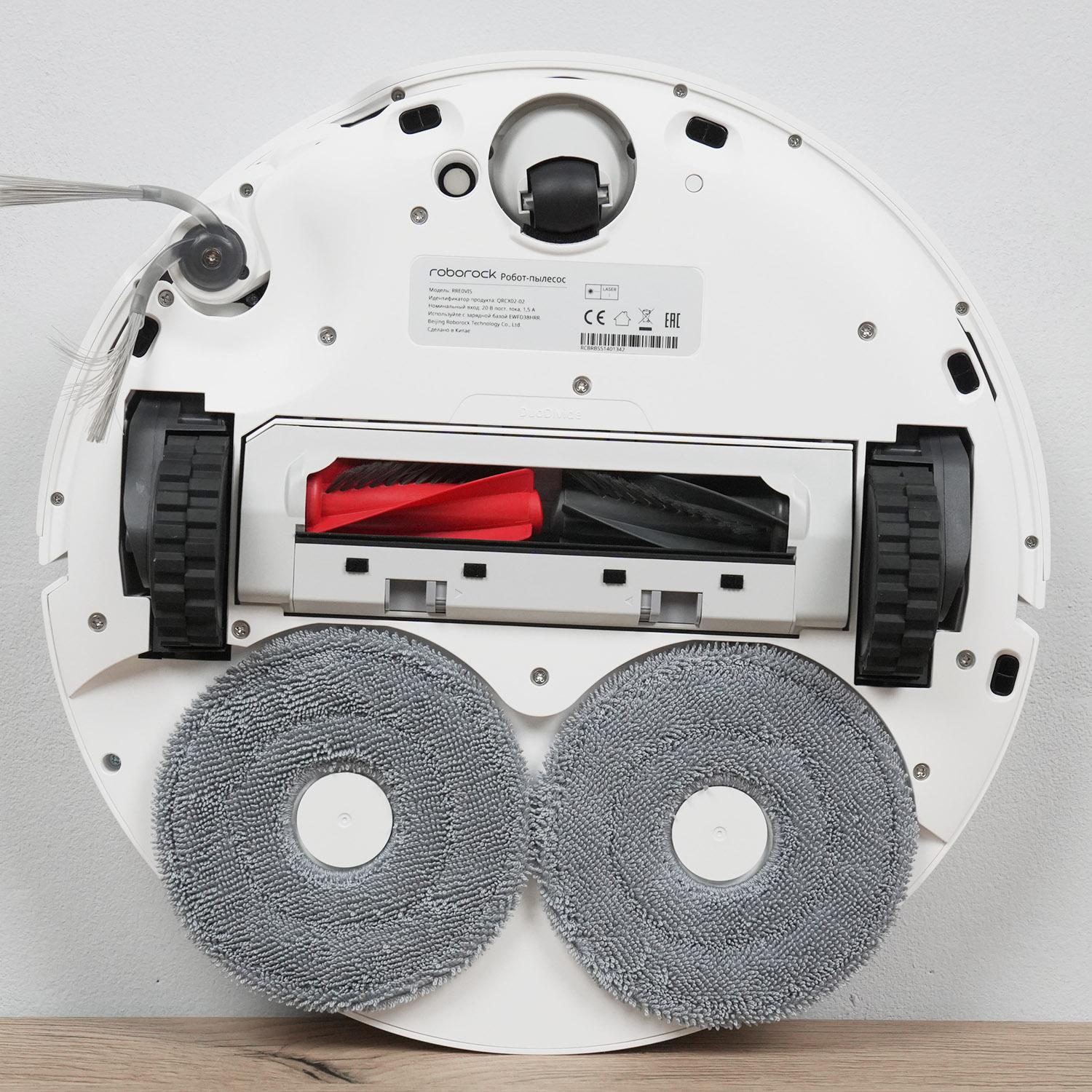
Bottom view
In corners and under furniture, the side brush extends for more efficient debris collection.
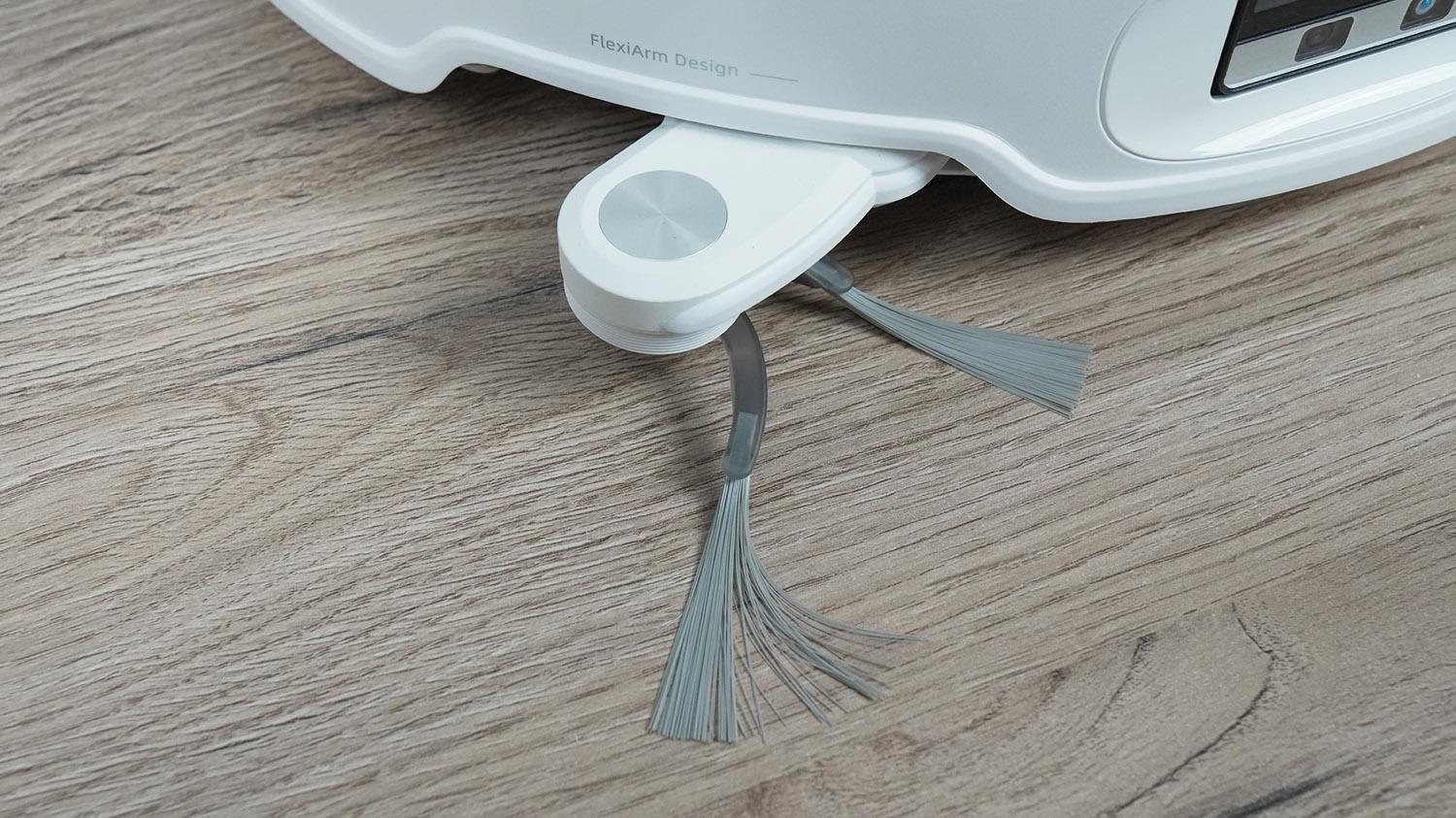
Retractable side brush
The central brush unit is floating. The brush itself is a DuoDivide design. These are the proven two bristle half brushes with a gap in the center between them. Each half brush can be disassembled. The gap itself collects wound hair and fur. I should also note that the turbo brush rises during floor cleaning mode and when the robot returns to the station.
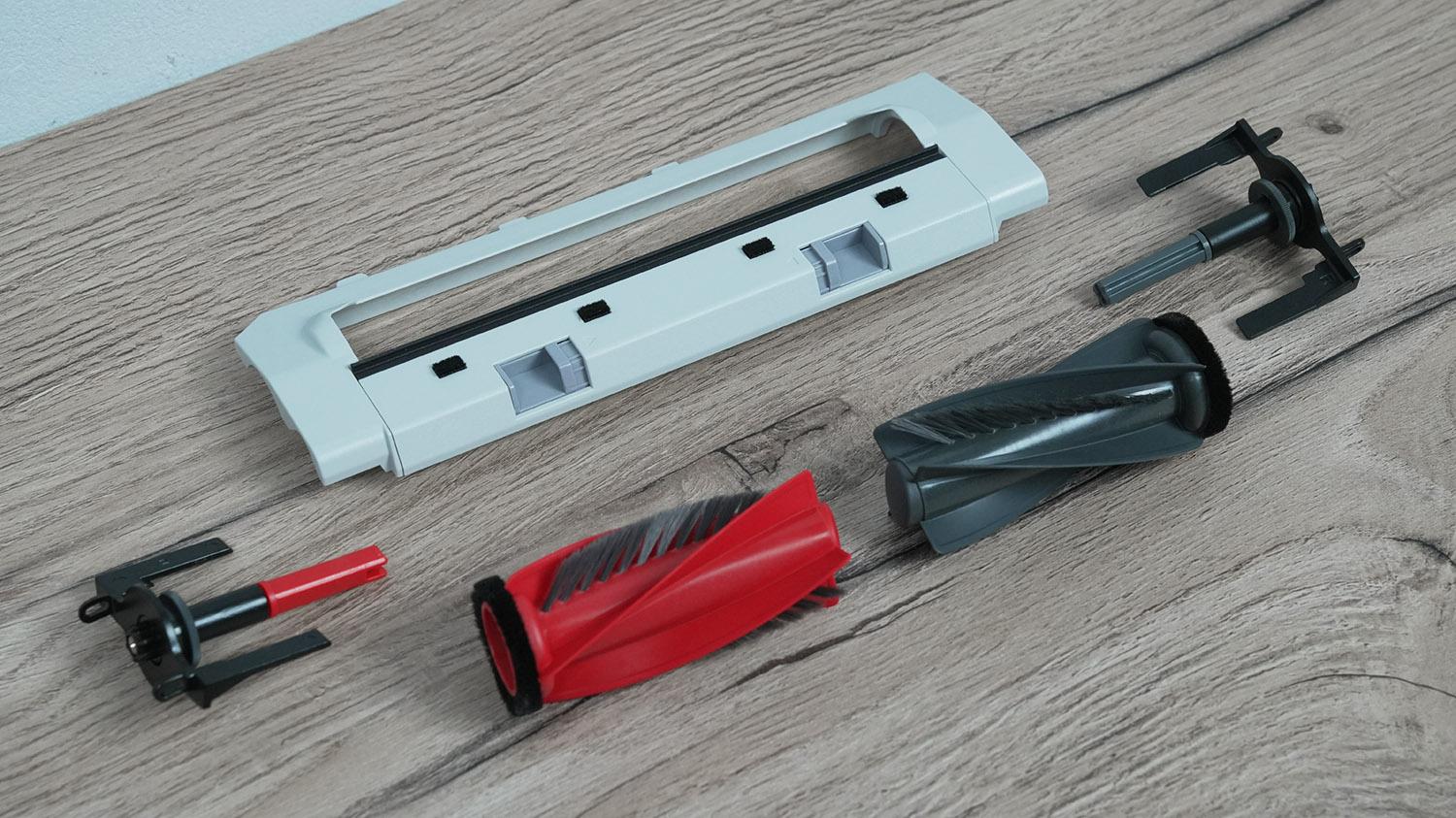
Central brush
The cleaning pads are round, like those of other robots in the Qrevo line. Behind the right holder, you can see a mechanism that extends the pad to the edge of the body. This eliminates the blind spot between the edge of the pad and the baseboard, allowing the robot to better clean along walls and furniture.
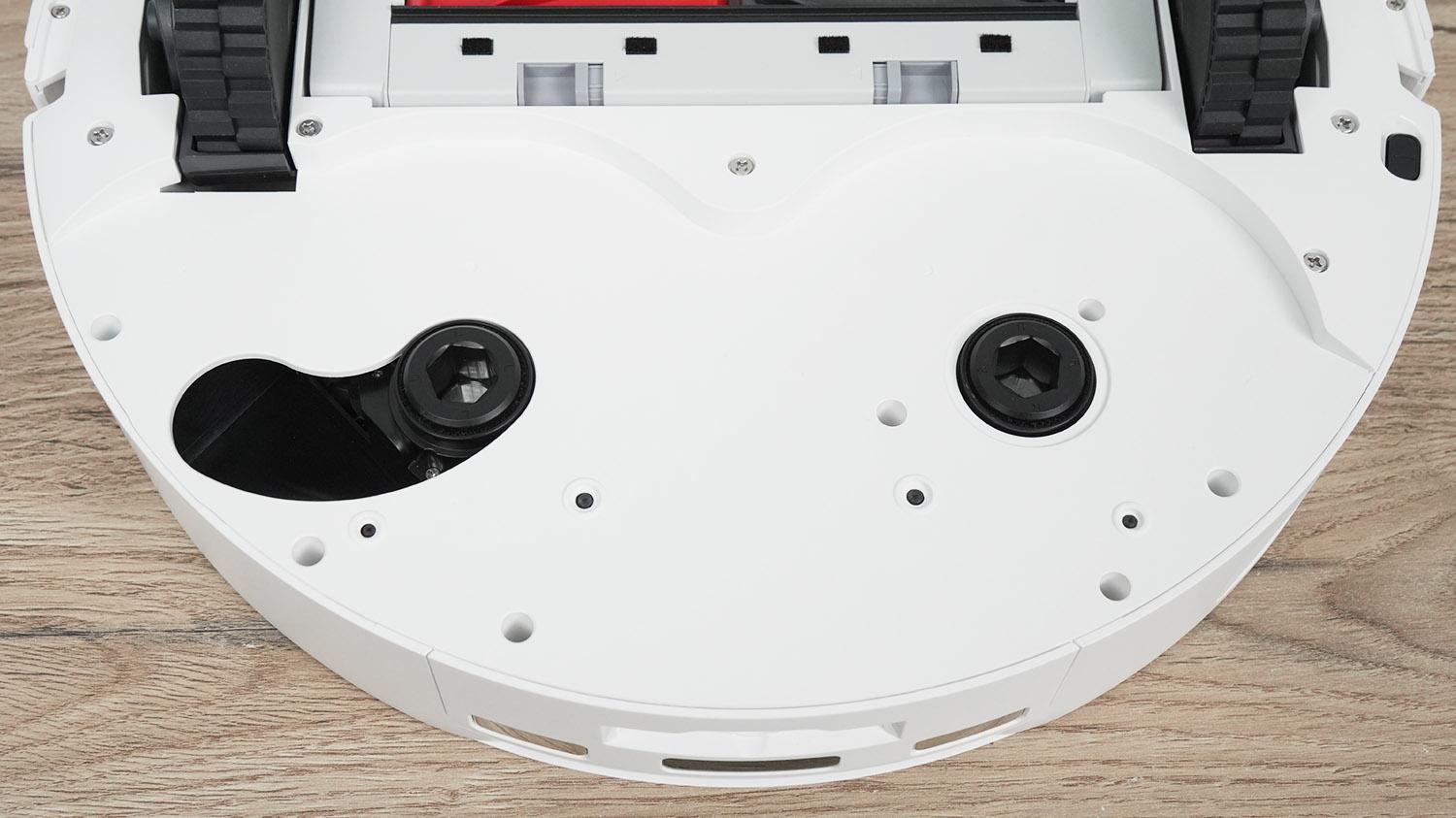
Napkin release mechanism
I'd also like to add that the cleaning pads automatically lift when entering carpets, when the robot returns to the station, and when the robot enters a designated room or cleaning area. The cleaning pad lift height has been increased to 17 mm. It's also important to note that the cleaning pad's floor pressure has been improved to 12N.
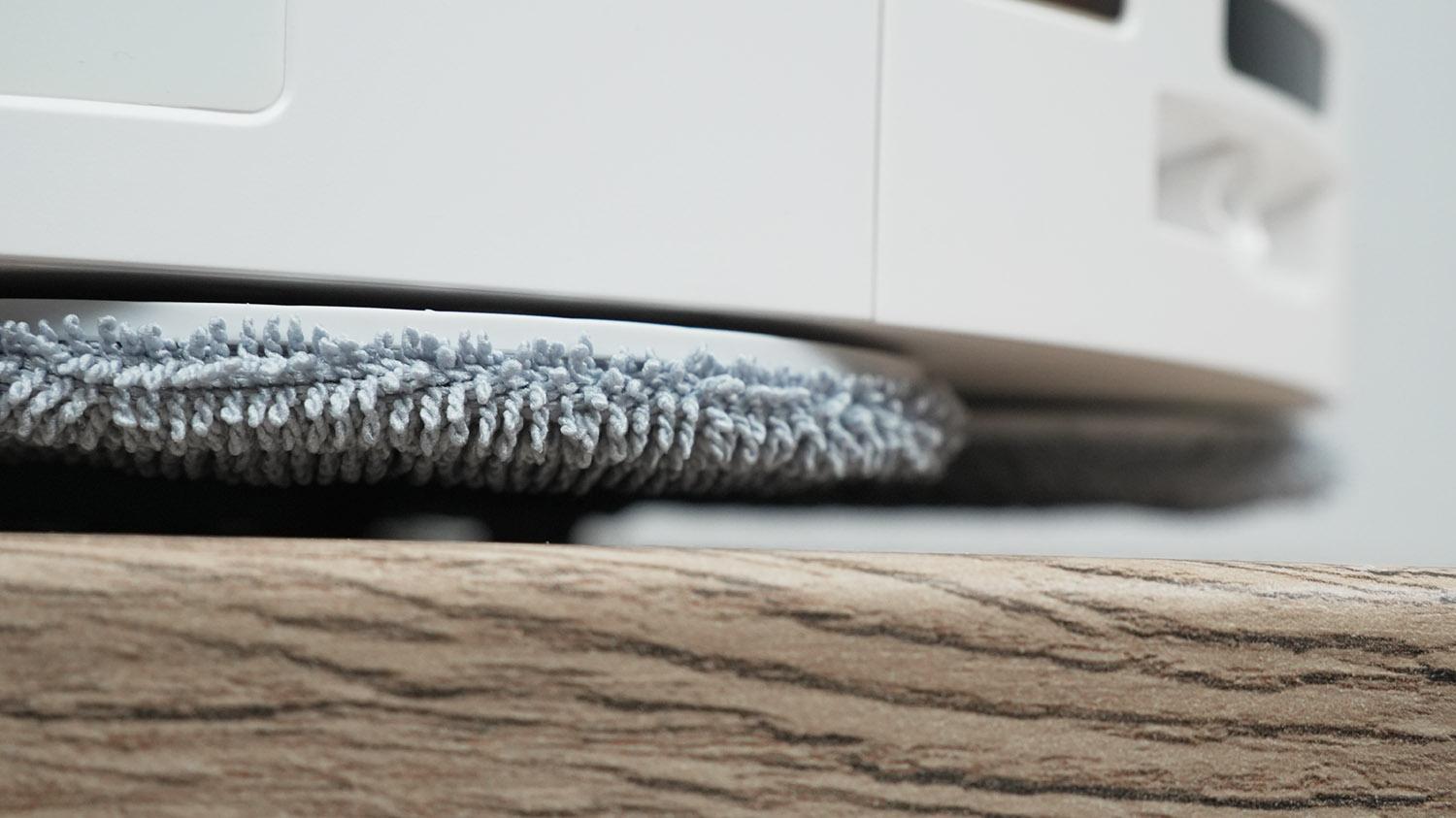
Height of lifting napkins
A few words about the body lift. The entire body automatically rises when the robot detects tall obstacles or medium-pile carpets. This allows the robot vacuum to navigate two-level thresholds up to 4 cm high. This technology is called AdaptLift.
As for the station, it's like the regular Curv version—with rounded corners in the style of Darth Vader's helmet. I liked that design better.
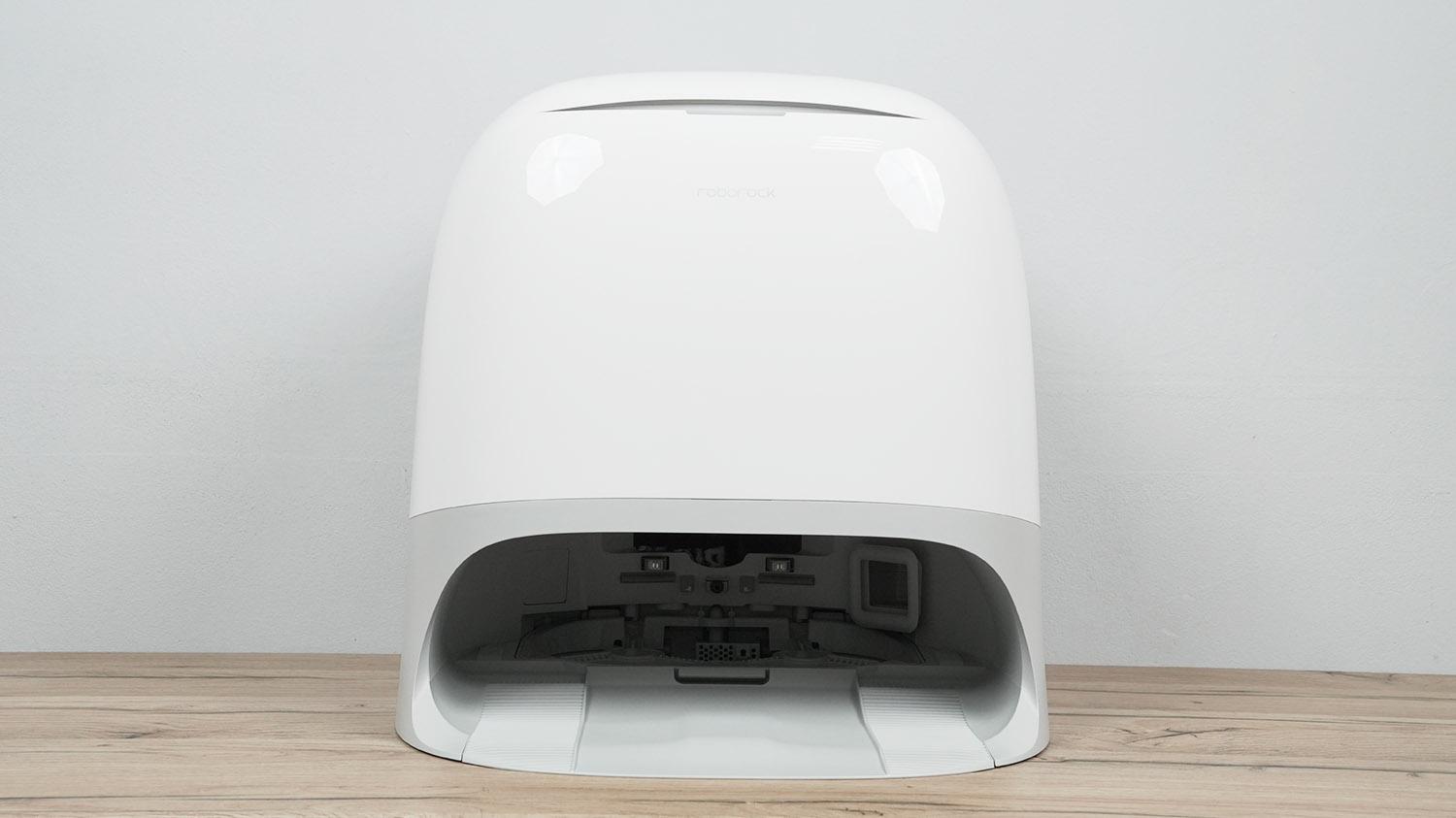
Station
However, this version of the station has some nuances. For example, the ramp for the robot's entry is no longer removable. Only the napkin washing tray is removable. It consists of two parts: the textured module itself, where the napkins are washed, and a tray with scrapers and a coarse filter. This ensures that the station's tray automatically cleans itself when washing the napkins.
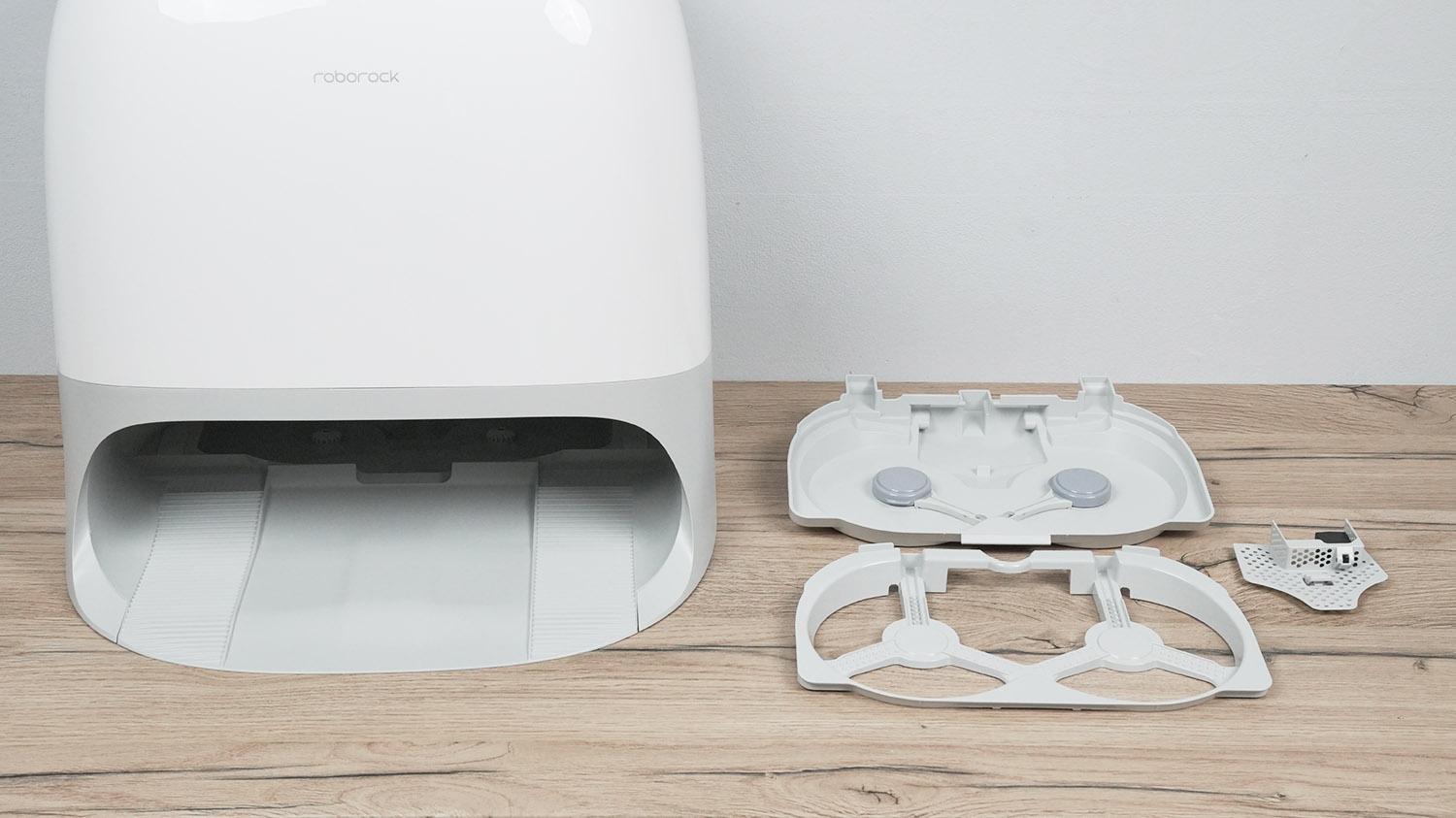
Removable tray
The cloths are washed with hot water at 80 degrees Celsius and dried with warm air at 45 degrees Celsius. The station can automatically detect the degree of soiling of the cloths and re-clean them. However, the station lacks a detachable cloth for a full dry cleaning, unlike flagship models such as the S9 MaxV Ultra, Saros 10R, and Saros Z70.
Under the top cover of the station are water tanks and a waste bag. Each tank holds 4 liters. A disinfection module is installed inside the clean water tank. The waste bag is standard. Unfortunately, there is no automatic detergent dispenser.
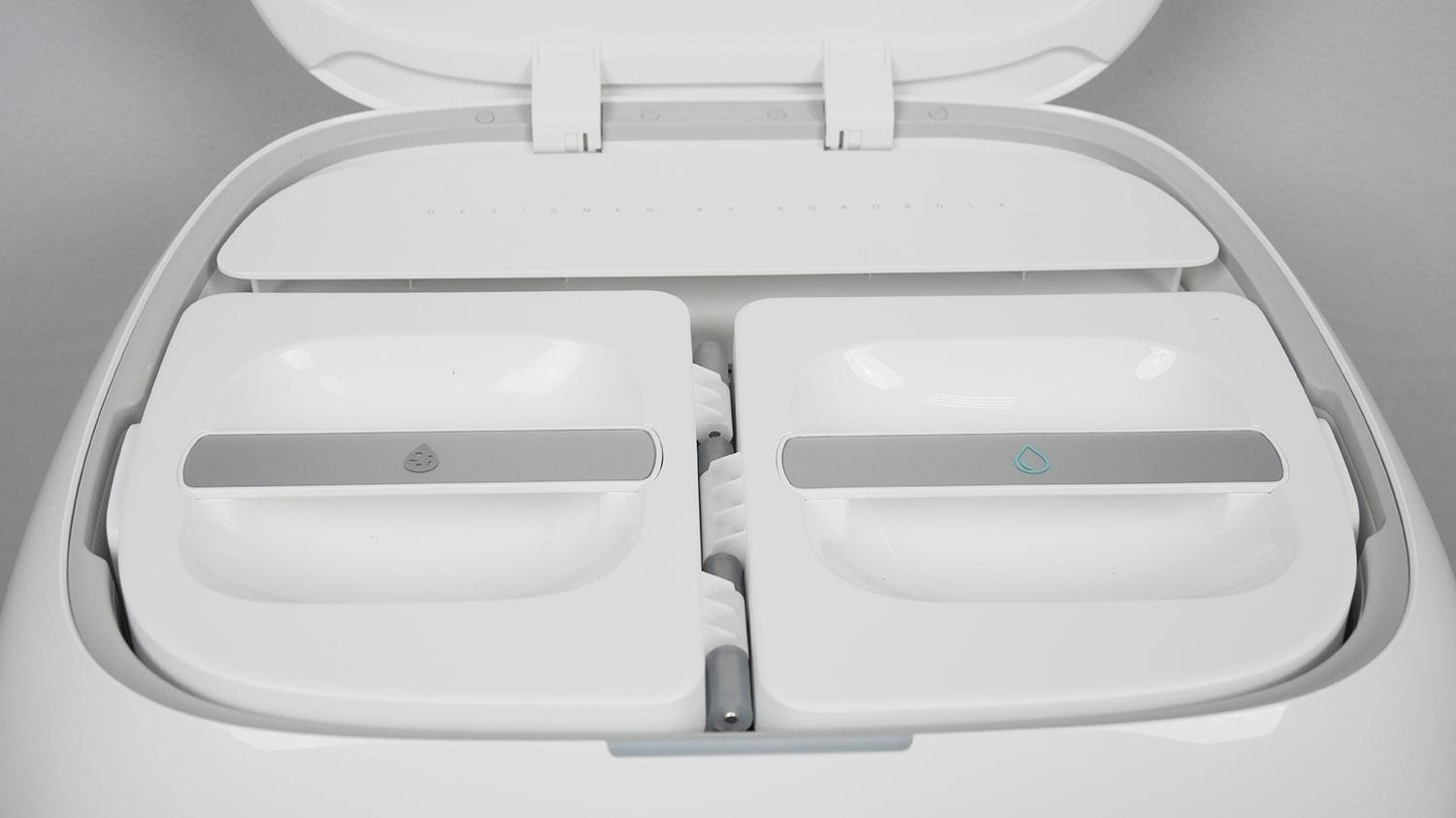
Location of tanks
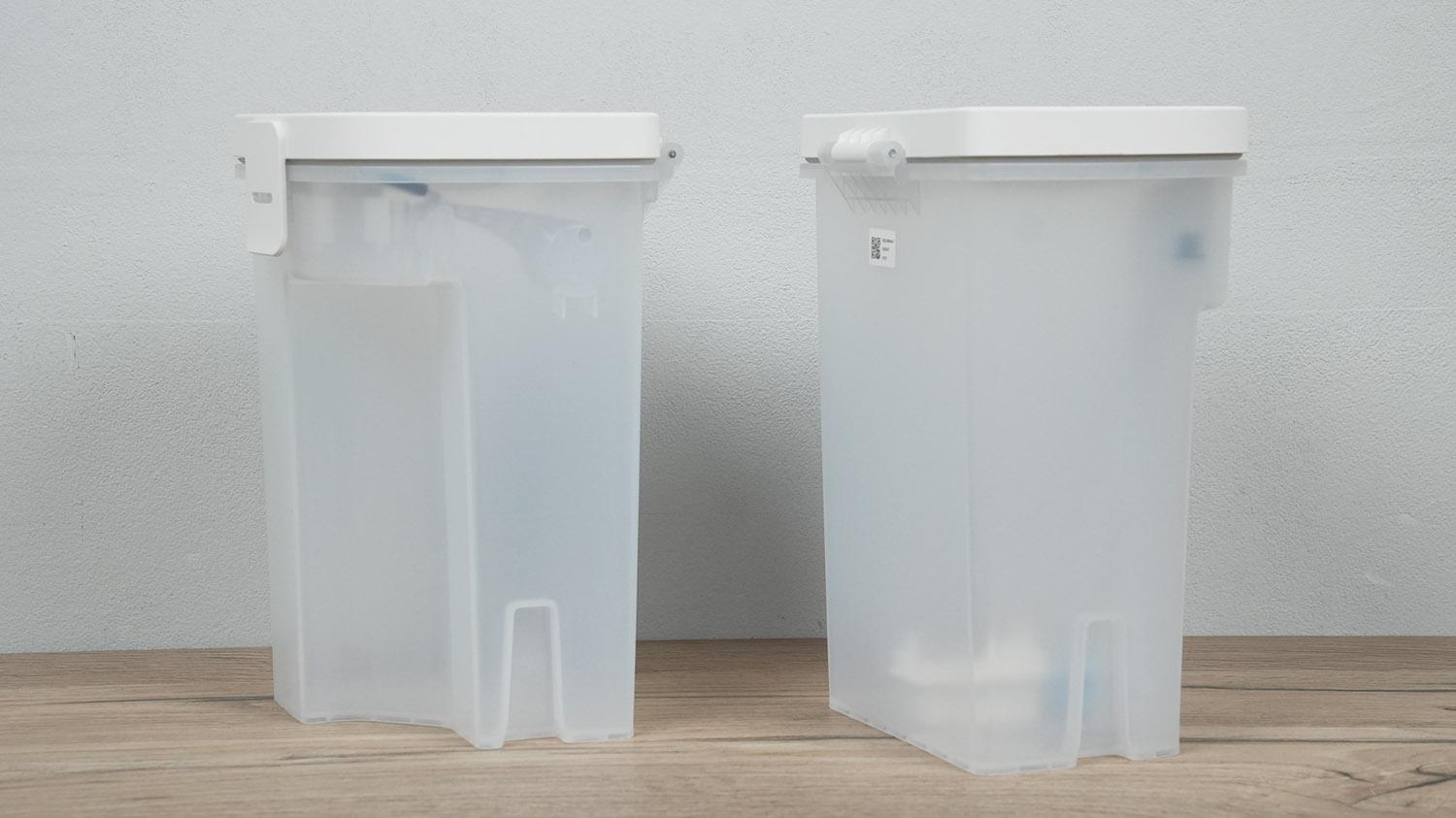
Water tanks
Speaking about connecting to the sewer and water supply, this particular station cannot be connected to utility networks.
All the pros and cons of the robot's design will be outlined in the final analysis. Let's move on!
Technical specifications
The main characteristics of the Roborock Qrevo CurvX, as stated by the manufacturer:
- Li-Ion battery 6400 mAh.
- Suction power up to 22,000 Pa.
- Dust collector capacity: 300 ml.
- Water tank capacity: 70 ml.
- Obstacle clearance up to 40 mm.
- Robot dimensions: 353*79.8 mm.
Station:
- Clean water tank: 4 l.
- Dirty water tank: 3.5 l.
- Bag in the station: 2.7 l.
- Station dimensions: 450*450*450 mm.
High suction power and improved maneuverability are prominent features here. These parameters will be verified in tests.
Functional capabilities
Let's move on to an overview of the Roborock Qrevo CurvX's features. The robot vacuum is controlled via the proprietary Roborock mobile app. Connecting to the network is straightforward; follow the manufacturer's prompts. My version is Russian-language, so the voice prompts are in Russian. The global version is in English, as is control via the proprietary assistant. Keep this in mind.
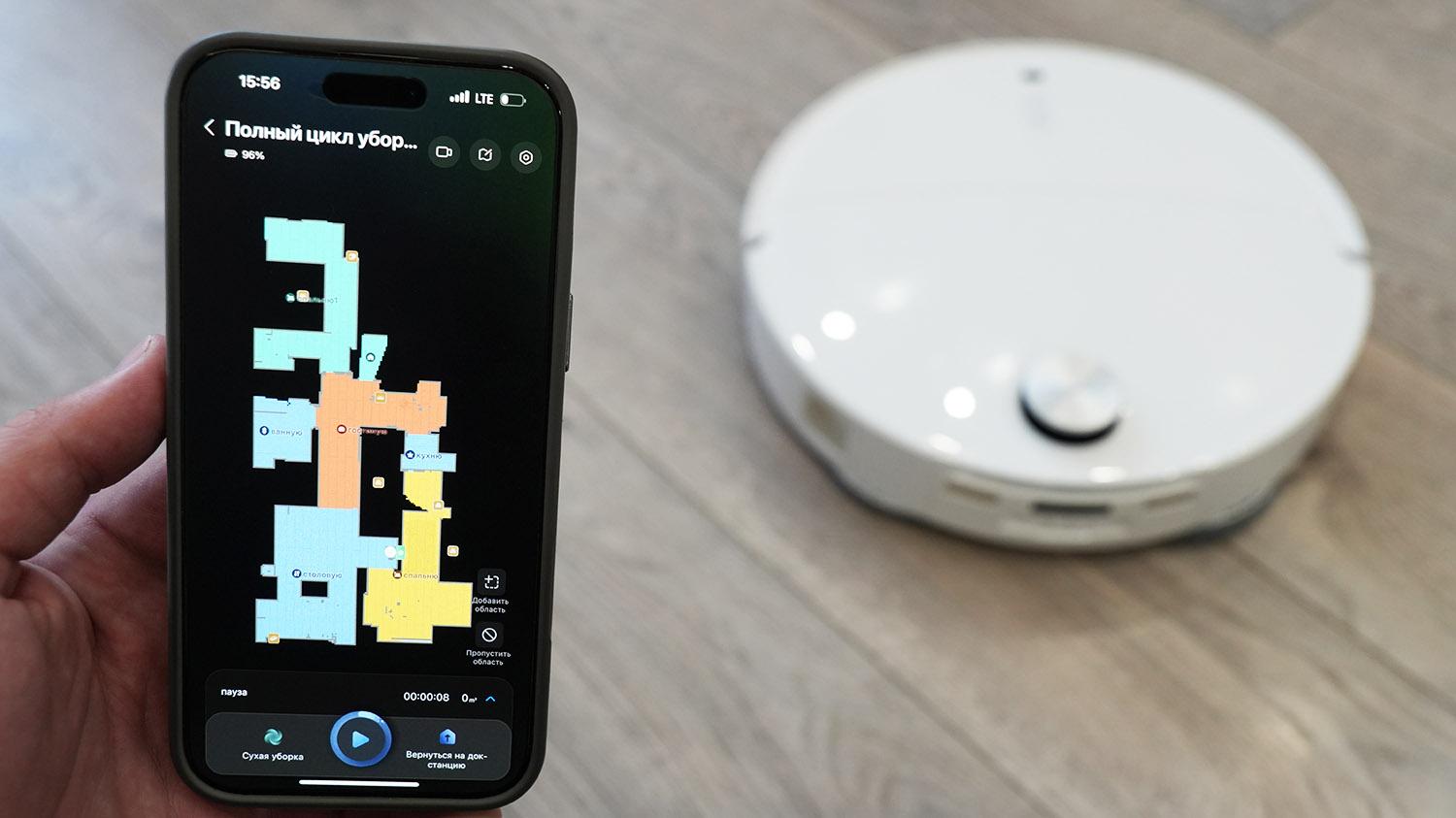
Control via app
The main functions are displayed on the screen:
- Wash napkins with hot water (80 °C).
- Drying napkins with warm air (45 °C).
- Self-cleaning of the dust collector at the station.
- Refilling the tank in the robot through the station.
- Recognizing objects on the floor.
- Automatic recognition of puddles and stains.
- Remote monitoring via camera.
- Saving multiple cleaning maps in memory.
- 3D map of the room.
- Automatic zoning of premises into rooms.
- Selecting areas and rooms for cleaning.
- Virtual walls and no-go zones (and for wet cleaning mode).
- Suction power adjustment.
- Adjusting the degree of wetting of the napkin.
- Intensive wet cleaning mode.
- User mode.
- Setting the frequency of washing napkins.
- SmartPlan smart cleaning planning.
- Cleaning log.
- Setting up cleaning according to a schedule.
- Automatic power increase on carpet
- Carpet cleaning in wet cleaning mode.
- Lifting napkins when driving onto carpets.
- Raising the body when overcoming obstacles.
- Increased pressure on wipes when contamination is detected.
- Improved cleaning under furniture.
- Side brush extension in corners.
- Moving the napkin to the baseboard.
- Lidar entering the body.
- Intelligent detection of the degree of contamination of napkins at the station.
- Raising the brushes in floor washing mode and when returning to the station.
- Yandex.Alice support.
- Support for the "Hello, Rocky" voice assistant.
As you can see, we've implemented a wide range of features to allow you to flexibly customize cleaning parameters to your needs. There's support for the proprietary assistant, remote home monitoring, and various smart modes. That's a plus!
Testing
A detailed video review with all tests has already been prepared and published on the channel:
Navigation
And finally, let's move on to the tests. First, we'll test navigation in a room with obstacles. Upon entering the room, the robot vacuum first swept around one table leg, then walked the perimeter, and finally cleaned the entire accessible area in a serpentine pattern. The mirror introduced an error in the map, which is normal for lidar robots. The robot got stuck on the legs of a dryer when moving, but was able to free itself. It swept the table legs and then returned to its base.
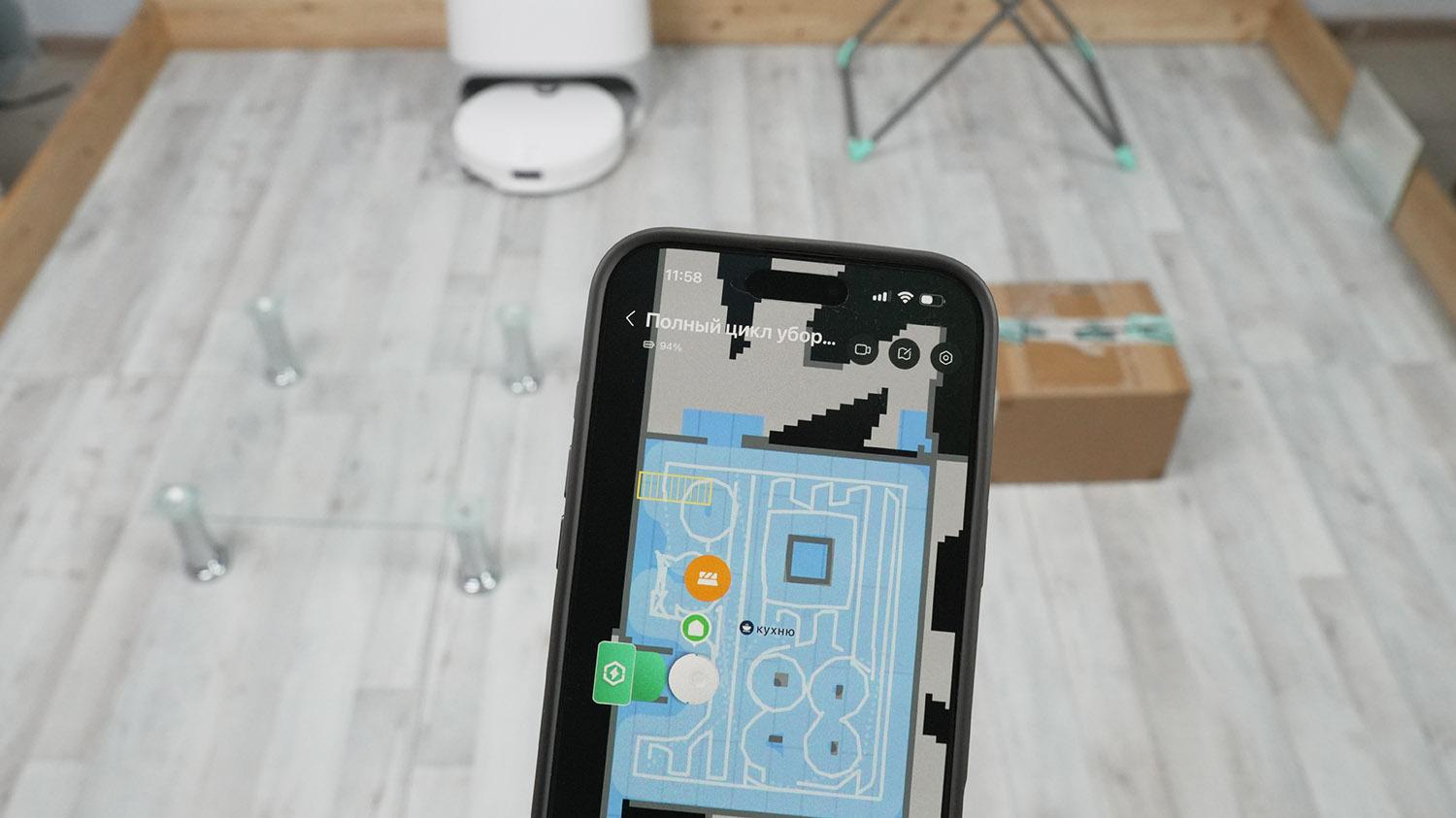
Navigating within a room
Speaking of navigation within the home, the Roborock Qrevo CurvX cleans room by room, first along the perimeter, then in a serpentine pattern. After each room, as specified in the settings, the robot vacuum returns to the station and washes the cleaning pads, then returns to clean from where it left off. When returning to the station and back to the cleaning point, the robot picks up not only the cleaning pads but also the brushes. This is a plus. There are no uncleaned areas, the cleaning speed is high, and this model has excellent navigation!
Passing under low furniture
The minimum height at which the robot can pass was also tested. I was able to create a clearance of 78 mm, and it drove there without any problem. That's a plus.
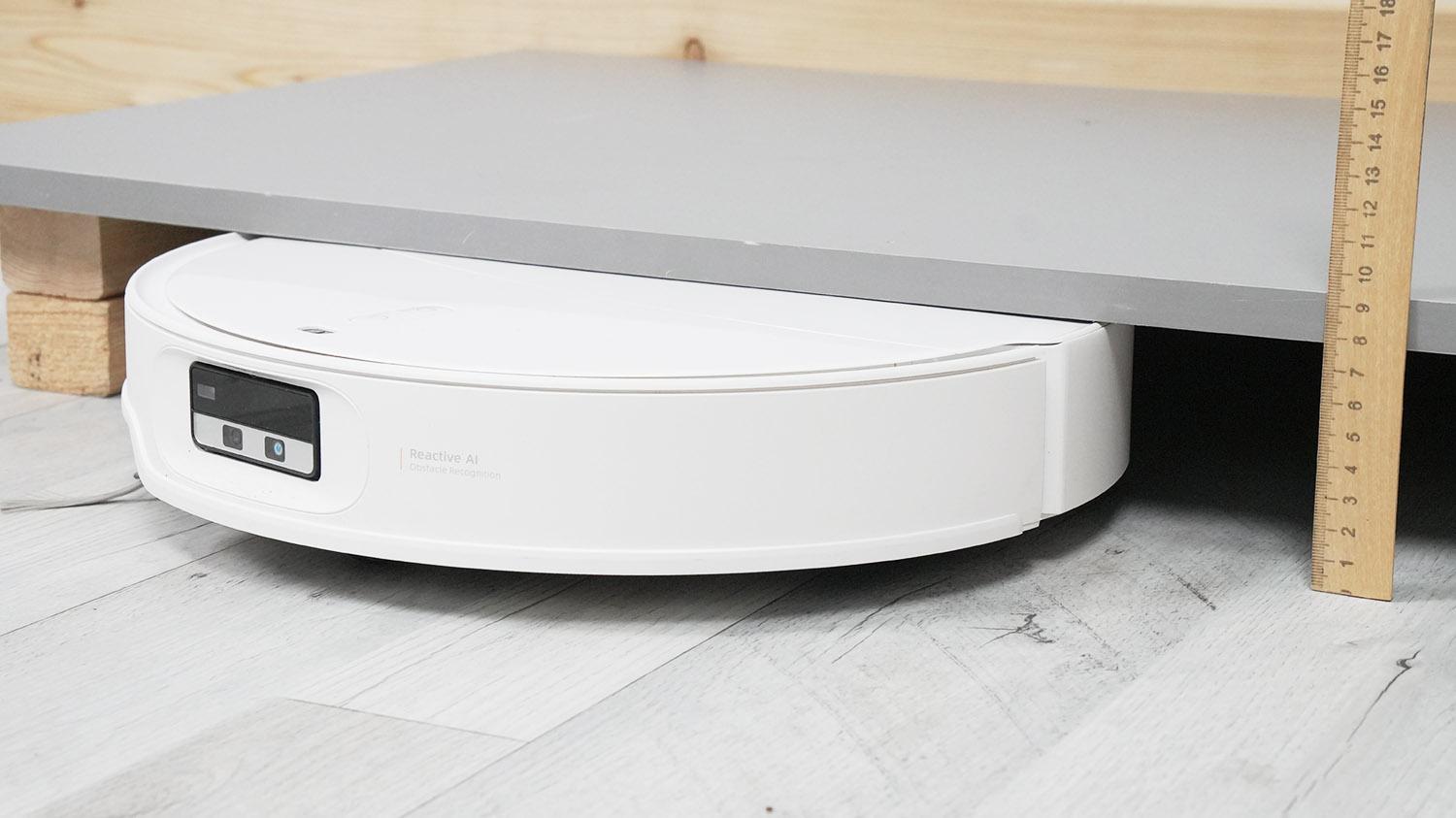
Passing under low furniture
Autonomy
I also tested the battery life when running the robot at maximum power with wet cleaning enabled. It lasted 107 minutes, cleaning 83 square meters of usable space. In reality, that's just over two full cleanings of a 70 square meter two-bedroom apartment. It also features a resume cleaning mode after recharging at the charging station, so this model is capable of cleaning larger areas.
Recognizing objects on the floor
Regarding the object avoidance system, in good lighting, the robot was able to correctly recognize and carefully avoid 6 out of 6 objects on the floor, slightly hitting a toy and a bathroom scale. It was also able to correctly recognize and avoid 3 out of 3 socks, slightly snagging a black one. Of the 4 wires, it recognized two, but carefully avoided three, chewing one. Regarding avoidance of imitations of pet surprises, the Roborock Qrevo CurvX was able to accurately avoid 4 traps, identifying 3 of them. It ran over the other two.
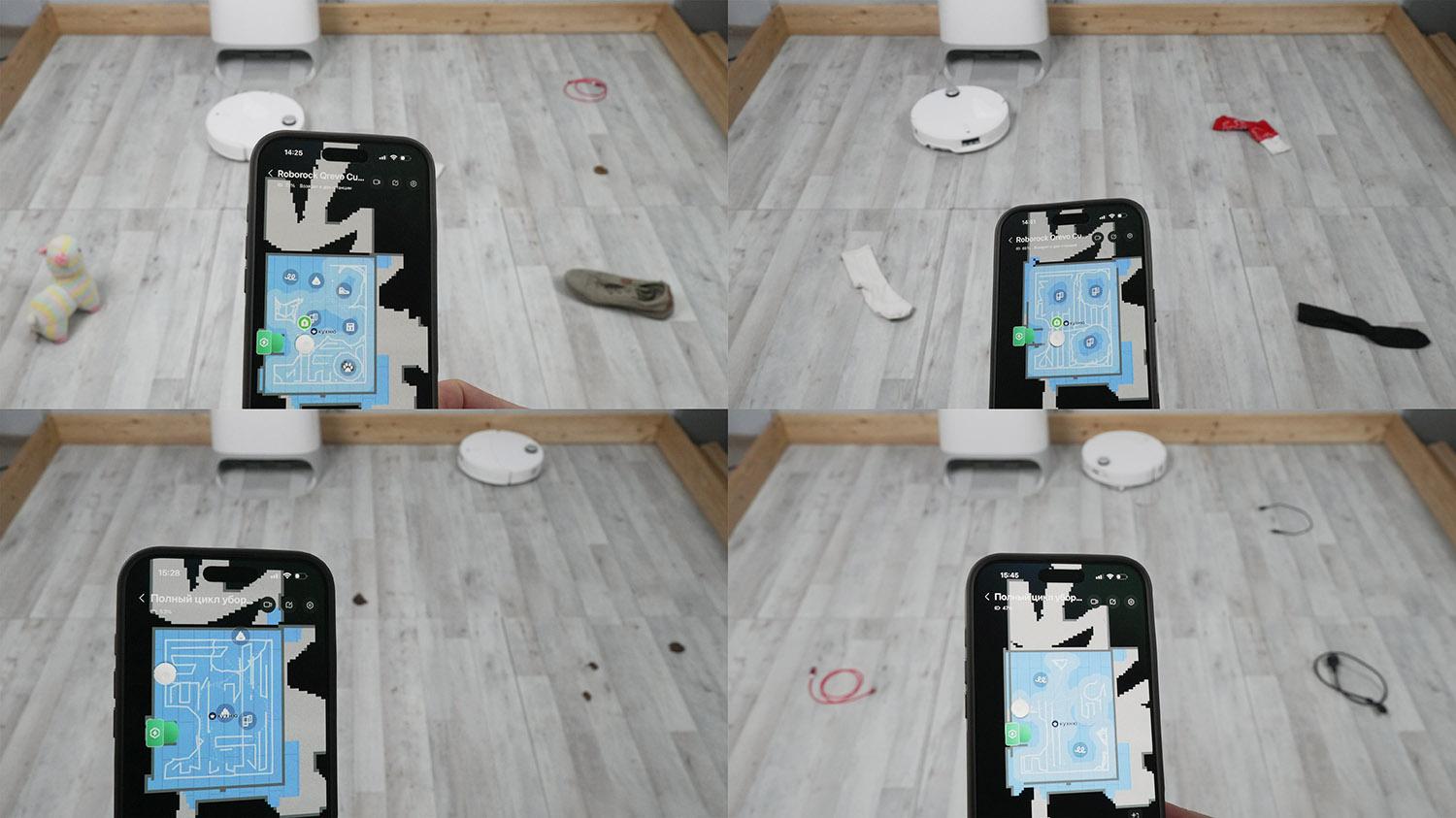
Recognizing objects on the floor
In complete darkness, the object recognition system is somewhat impaired. Of six standard household objects tested, the robot recognized and avoided five, only passing over a simulated pet surprise. Of three socks, it correctly recognized none, though it managed to avoid one, but chewed the other two, resulting in an error. It was able to avoid all four wires, but only recognized two. The robot failed the "Minefield" test, avoiding only one of the six traps in complete darkness, while recognizing two simulated ones.
In general, the brand’s engineers still have a lot of work to do.
The stain detection feature deserves special attention. The robot vacuum cleaner initially cleans as usual, but when it detects a stain, it turns off suction and makes a crisscross pattern in that area. On the second pass, it presses its rear end harder against the floor. Afterward, it returns to the station, wipes off the cleaning pads, and resumes cleaning as usual, even though the stain hasn't been removed.
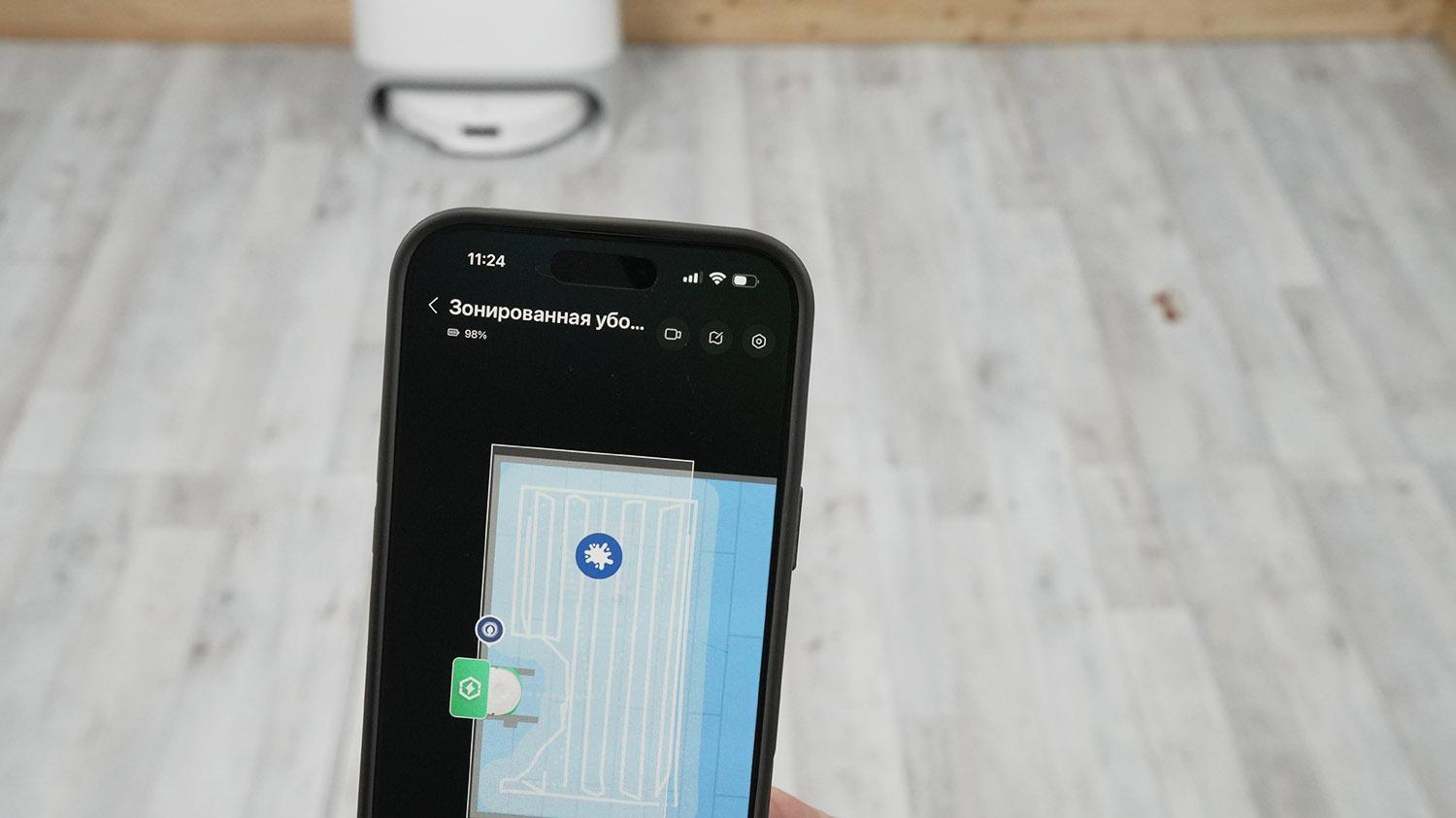
Spot recognition
It would be good to implement an algorithm here so that after each local pass the robot would evaluate the condition of the contaminated area and decide whether to continue rinsing it locally or remove the stain.
Cleaning behind the curtains
I also checked whether the new navigation system can clean behind curtains and drapes, something most lidar robots can't do. No, this robot, like its siblings in the line, doesn't clean behind curtains.
Suction power
The power test was one of the most interesting on the project. In Silent mode, the Roborock Qrevo CurvX was only able to clean debris from a 2mm gap. The results were unchanged in Balance and Turbo modes. In Maximum and Max+ modes, the robot managed to clean a 4mm gap. The result is the same as the Roborock S9 MaxV Ultra. So, the power is slightly higher, but it doesn't reach 22,000 Pascal.
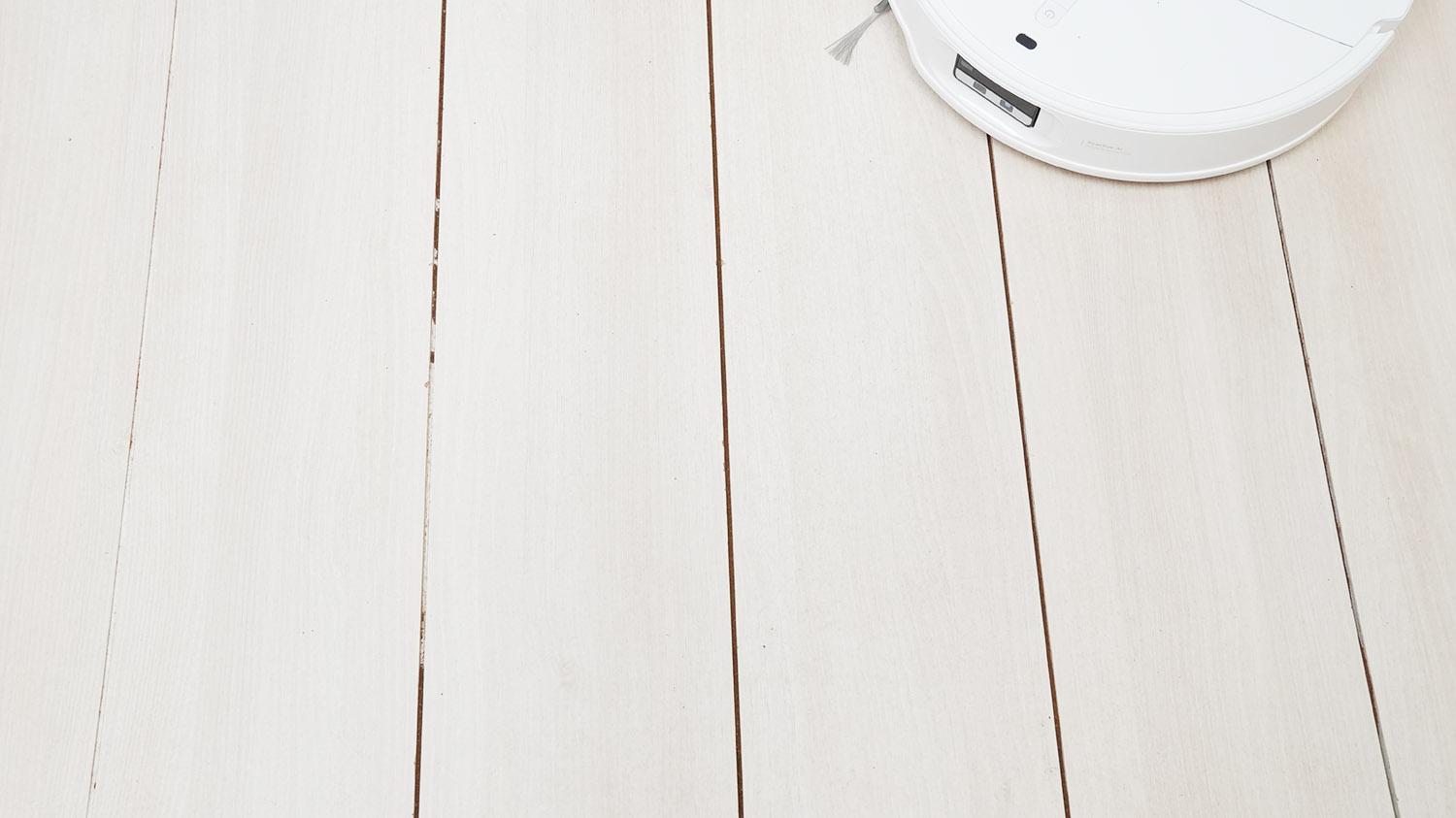
Suction power
ABOUT reasons for power drop I wrote a separate review on the website about this. It's not all that bad, actually; I recommend checking it out.
Dry cleaning
The quality of debris collection on laminate floors is good. Various debris was collected from the rack, including cat litter pellets, which often clog the turbo brush. It's important to note that this robot vacuum cleaned the inner corners well, leaving no debris behind. The side brush algorithm has finally been refined, and there are now no blind spots. This is good! However, the outer corners still need some work, as there is a small blind spot.
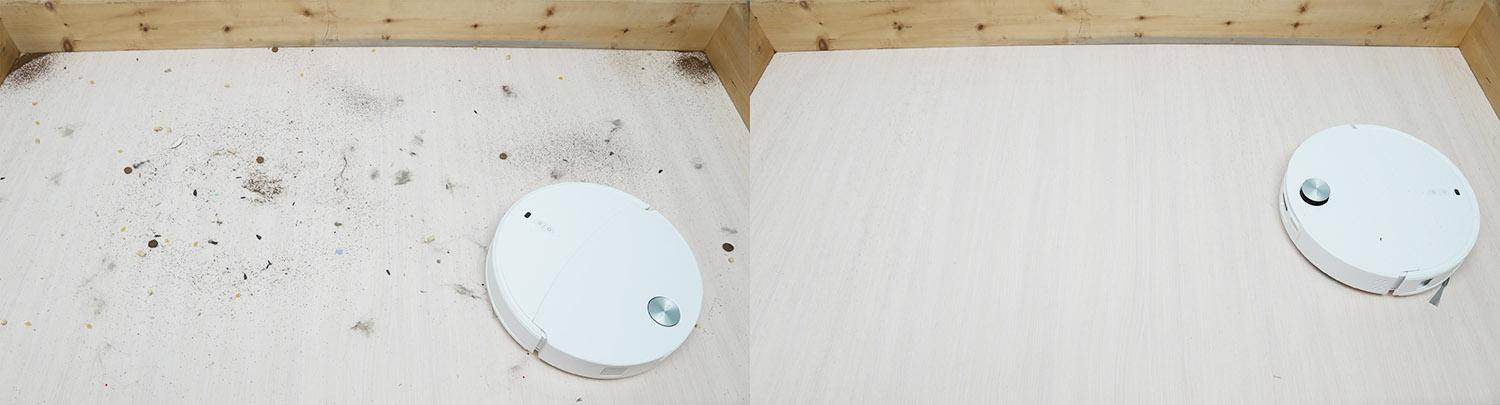
Dry cleaning
The side brush is clean after testing, but the center brush only picked up a small amount of hair. I'll test the anti-tangle protection separately next.
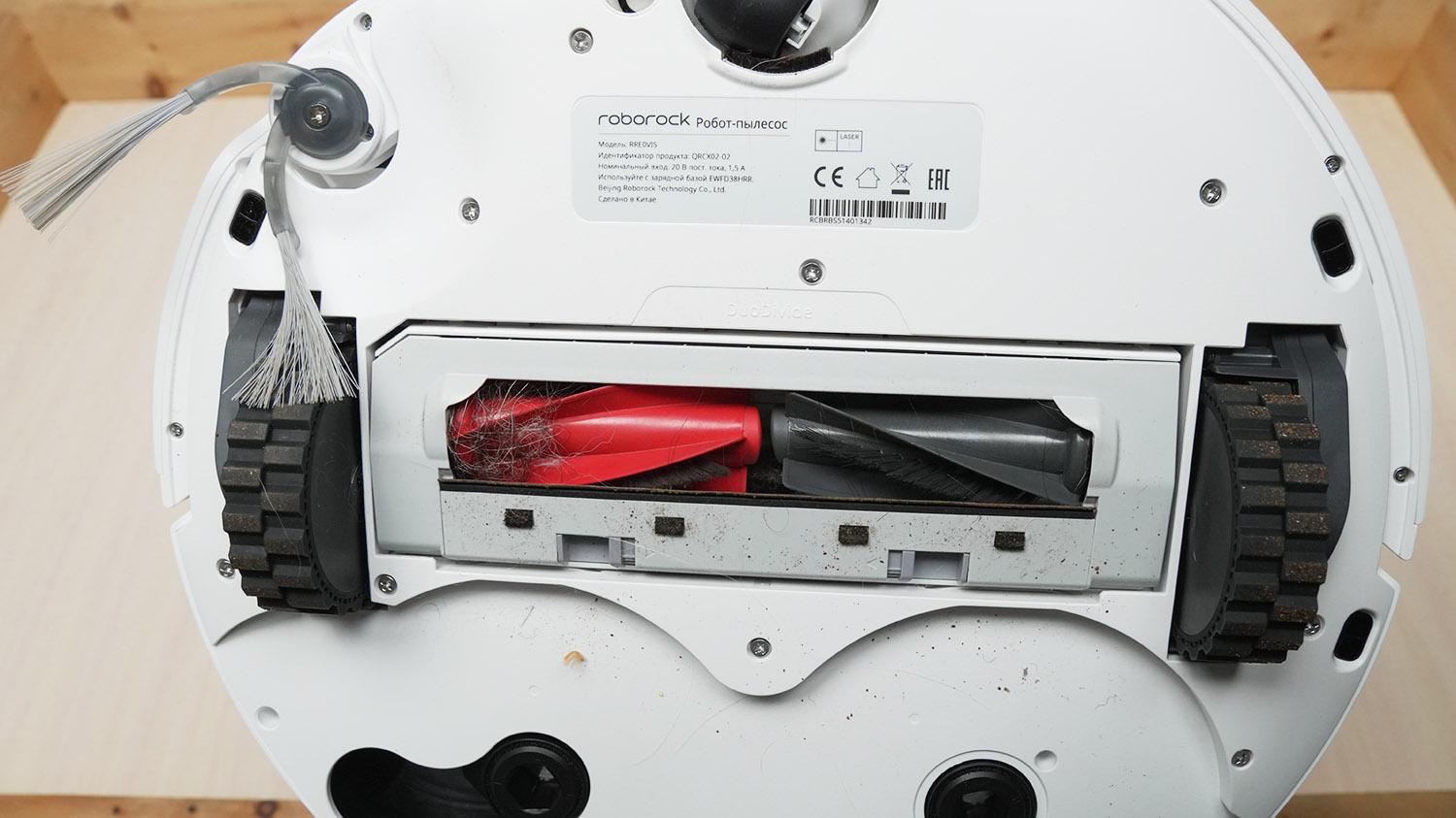
Cleaning module status
Anti-tangle Hair Protection
I also tested how the proprietary turbo brush handles self-cleaning hair and pet hair thanks to its special design. I laid hair of varying lengths on the floor. The robot collected them, and both the turbo brush and the side brush were clean. Some hair remained in the spaces between the brushes, but all of it eventually ended up in the dust bin. Bravo, Roborock engineers!
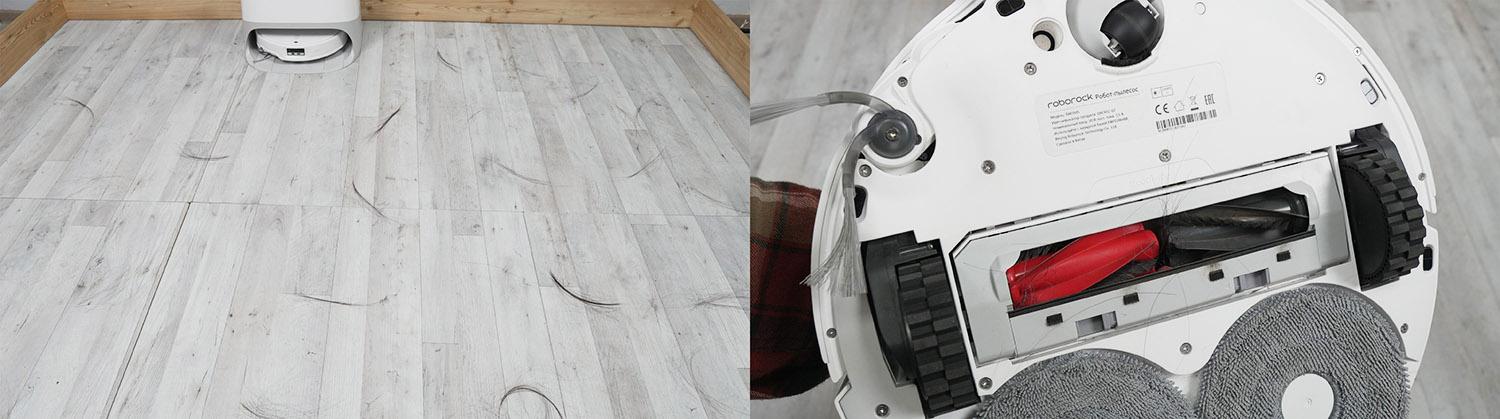
Anti-tangle Hair Protection
Carpet cleaning
Additionally, debris was scattered on the low-pile carpet. I can say the robot cleaned the carpet thoroughly. It can also clean medium-pile carpet, but not as well. A minimal amount of debris remained in the pile.
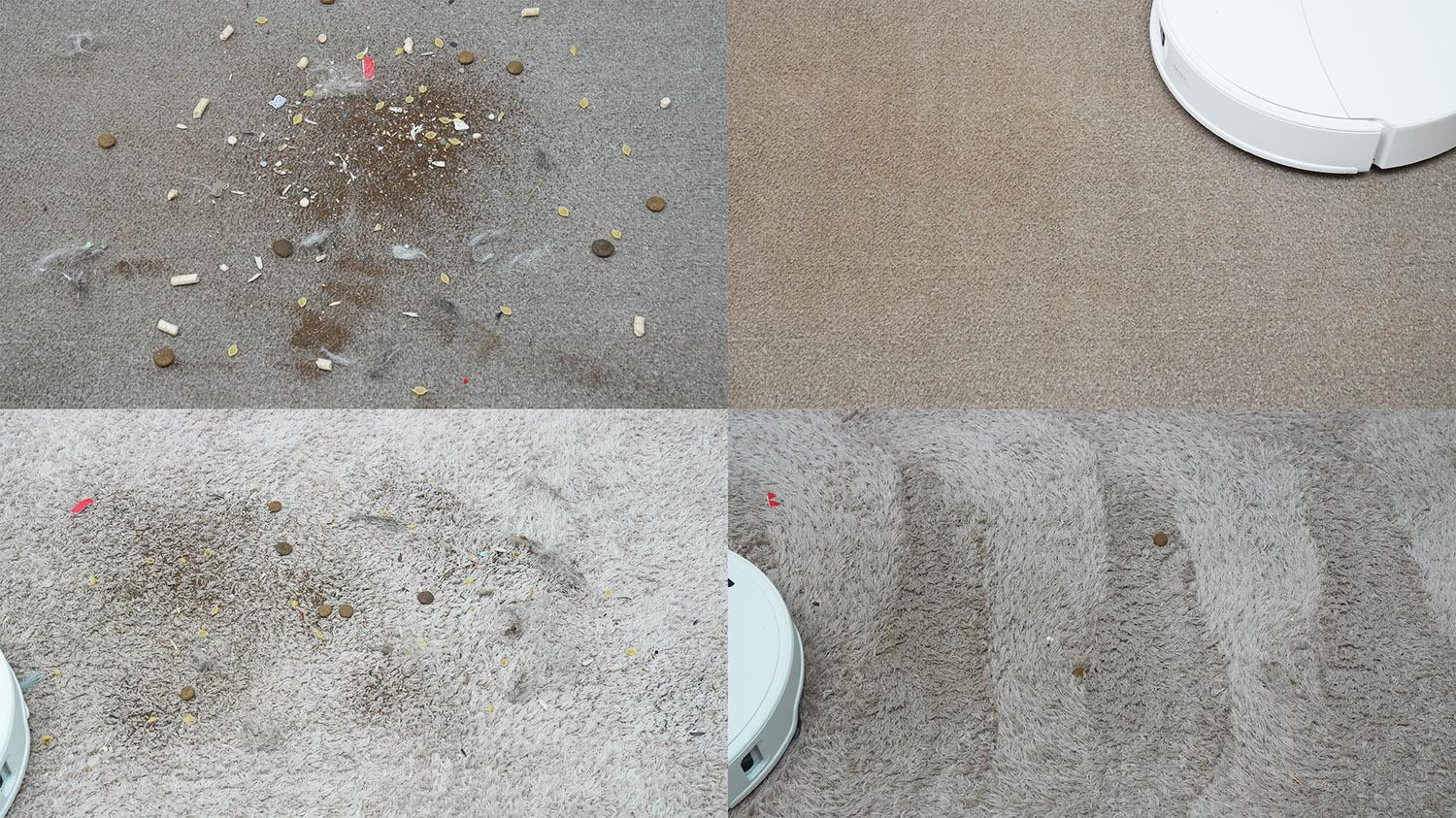
Roborock Qrevo CurvX: Carpet Cleaning
Self-cleaning
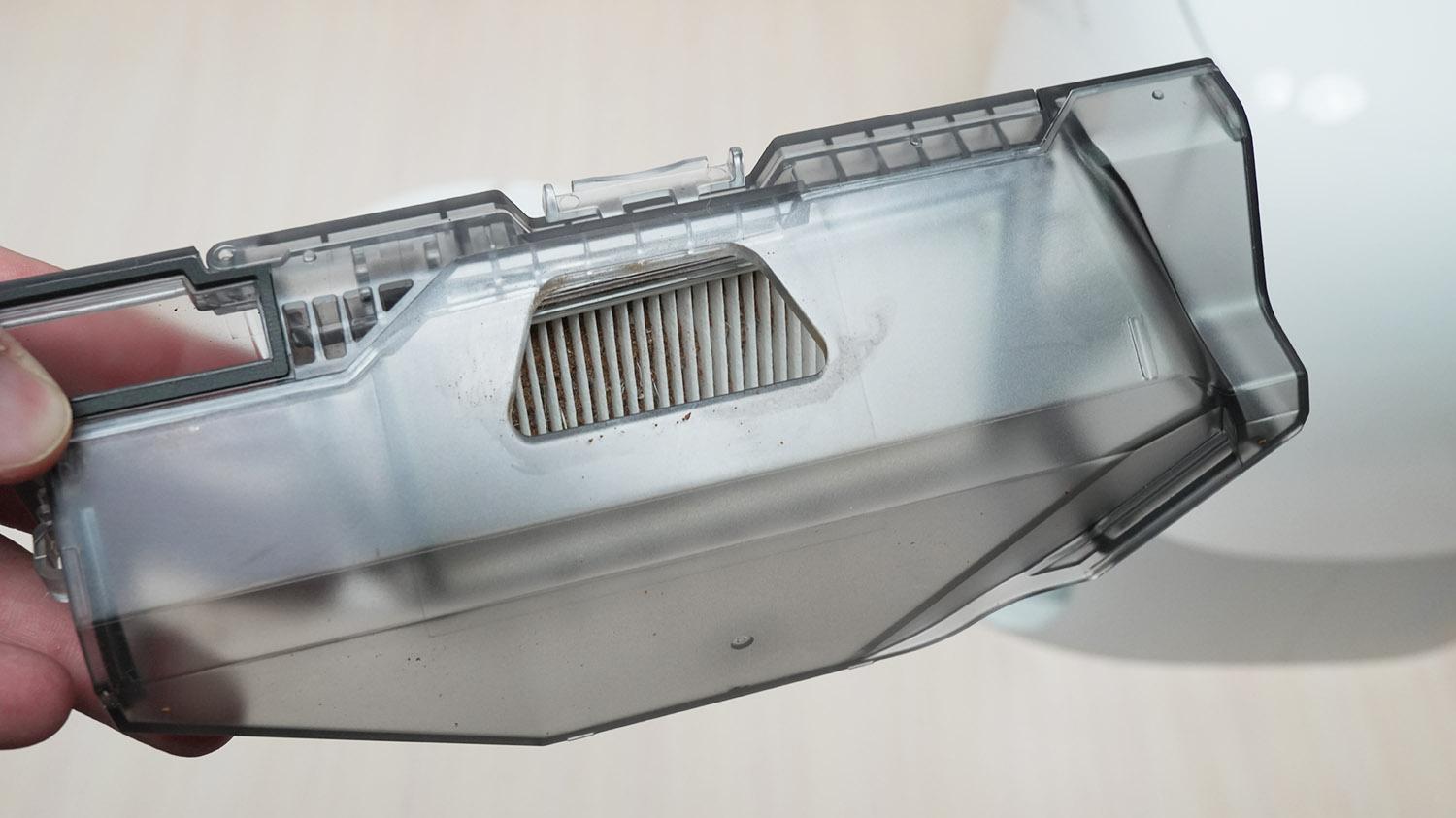
Immediately after the "dirty tests," I checked the robot vacuum's self-cleaning performance. We see that the dust bin is completely full. We return the robot to the station and start self-cleaning. The result is good. The dust bin is completely empty. The test was successful!
Self-cleaning
Wet cleaning and carpets
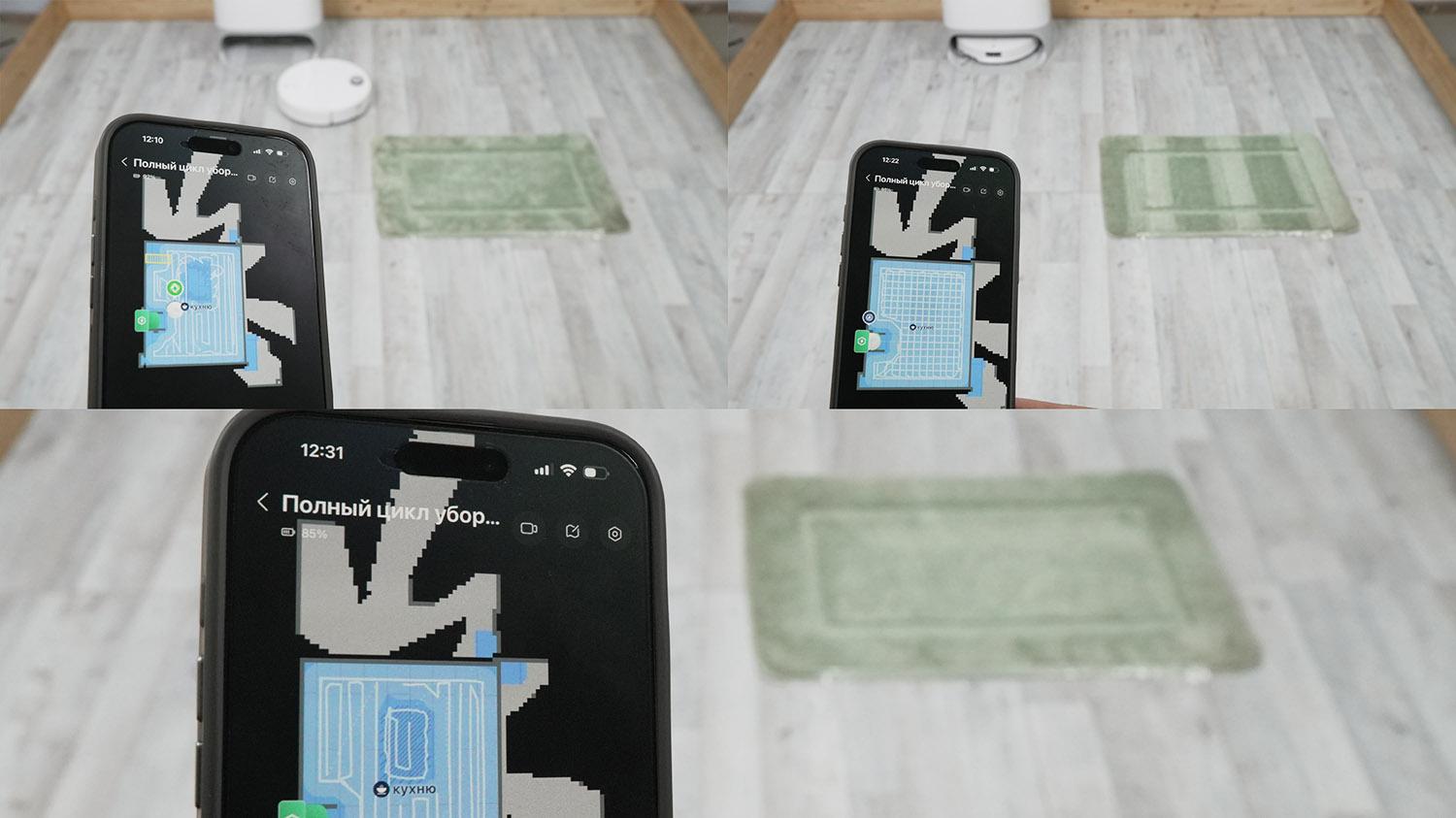
When it comes to wet cleaning on carpeted floors, the robot offers several different modes of interaction. It can carefully navigate around the carpet during wet cleaning, or it can drive onto the carpet and press its cleaning pads against it if you want to clean it with the robot. It can also clean carpets during wet cleaning, automatically lifting the cleaning pads and even the robot body when it enters the carpet. The latter option is the most efficient.
Wet cleaning and carpets
Wiping off dirt
The cleaning performance is excellent. The wipes press firmly against the floor and absorb dirt. There's no unwashed area along the baseboards, thanks to the wiper's extension. That's a plus!
I also checked the blind spots along the outer and inner corners separately. Here, too, we see that the outer corner isn't being cleaned completely, leaving a small blind spot a couple of centimeters wide. In the inner corners, the blind spot is about 5 cm, as the cloth physically can't fit tightly into the corner.
Removing difficult stains
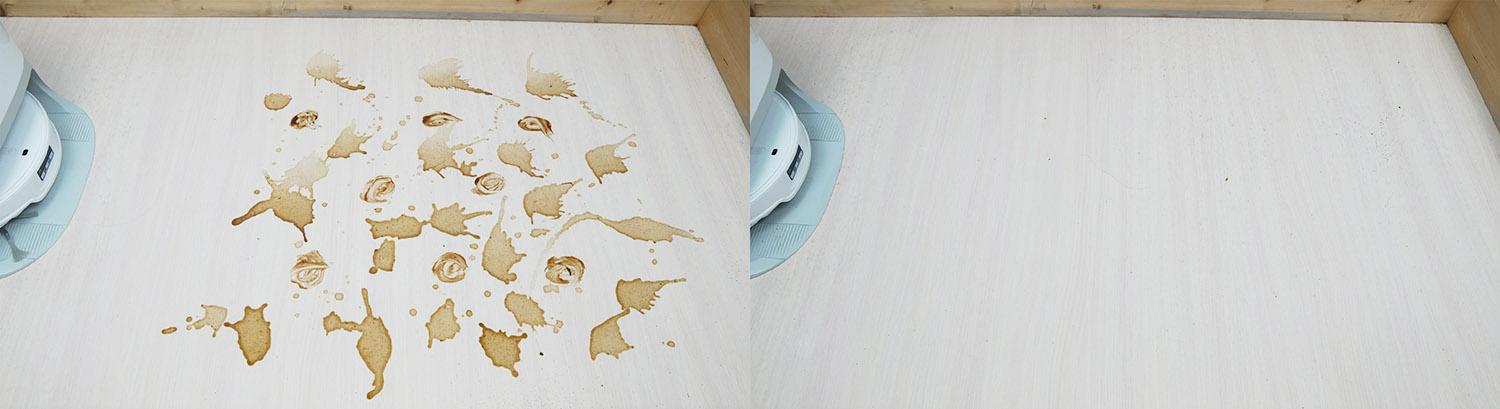
Regarding tough stain removal, I disabled the stain detection system to avoid changing the cleaning algorithm and increasing the number of passes due to spot cleaning of each stain. Unfortunately, the enhanced floor pressure feature can't be manually activated, as it only activates automatically when puddles and stains are detected. As a result, in the standard, tight-snake cleaning mode, the robot was able to remove stains in just six passes. This is also a good result, but with additional pressure, the robot would likely have completed the task even faster.
Removing difficult stains
Washing and drying test of napkins
I'd like to immediately talk about the efficiency of the station itself. Let's start with the quality of the wipes' washing. Even after extensive testing, the wipes look significantly better after washing with the station. The water heating feature undoubtedly improves the washing efficiency here.
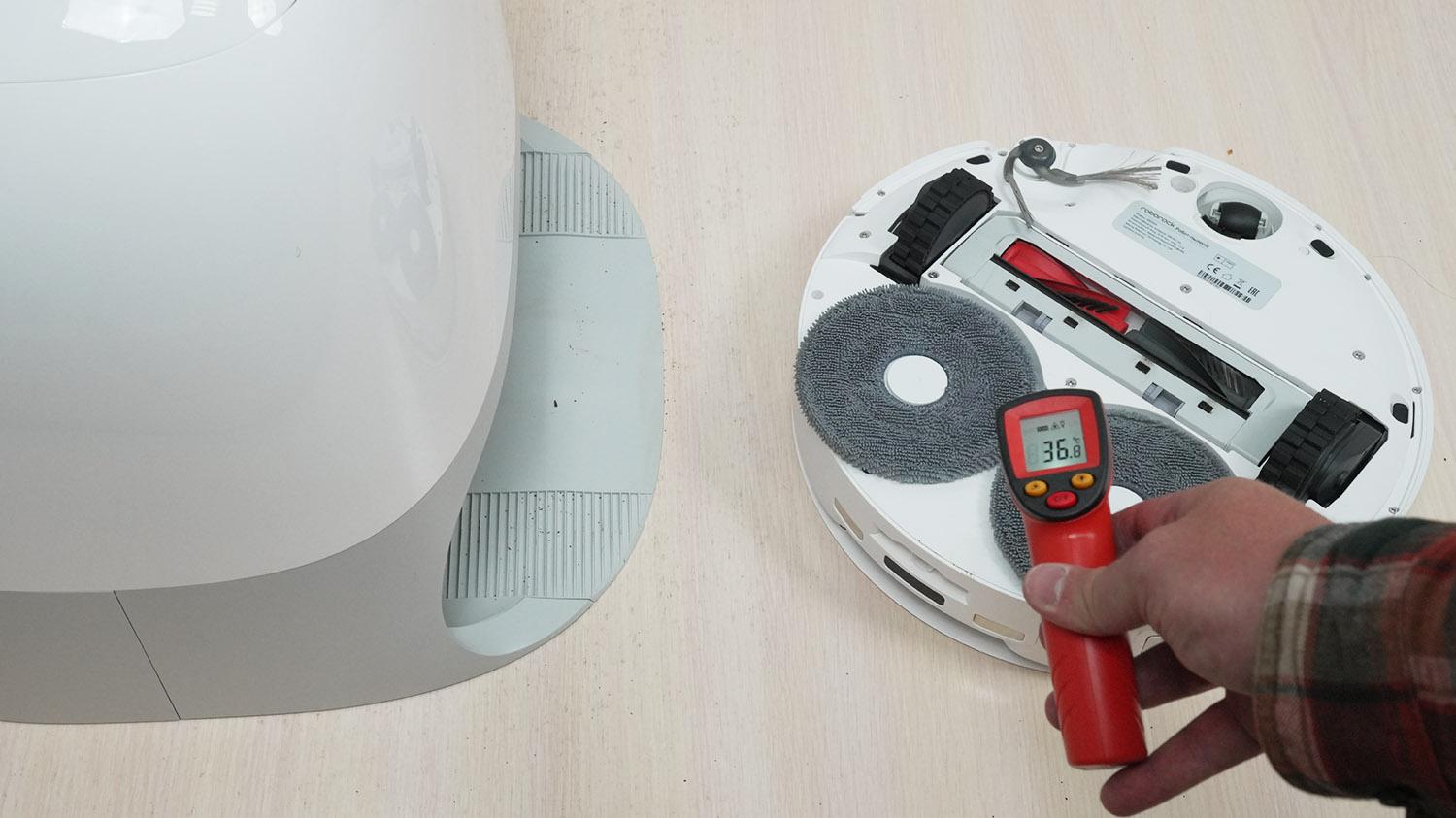
I decided to test the wash temperature myself. In my case, the peak temperature in the drain area was 53.3 degrees. While measurement errors may be possible, depending on the sensor's installation location and the accuracy of the sensor itself, the wipes were indeed warm after washing. The sensor showed a temperature above 37 degrees.
Temperature of napkins after washing
But the drying temperature is high—the sensor showed over 50 degrees, which is a good result! Even higher than stated!
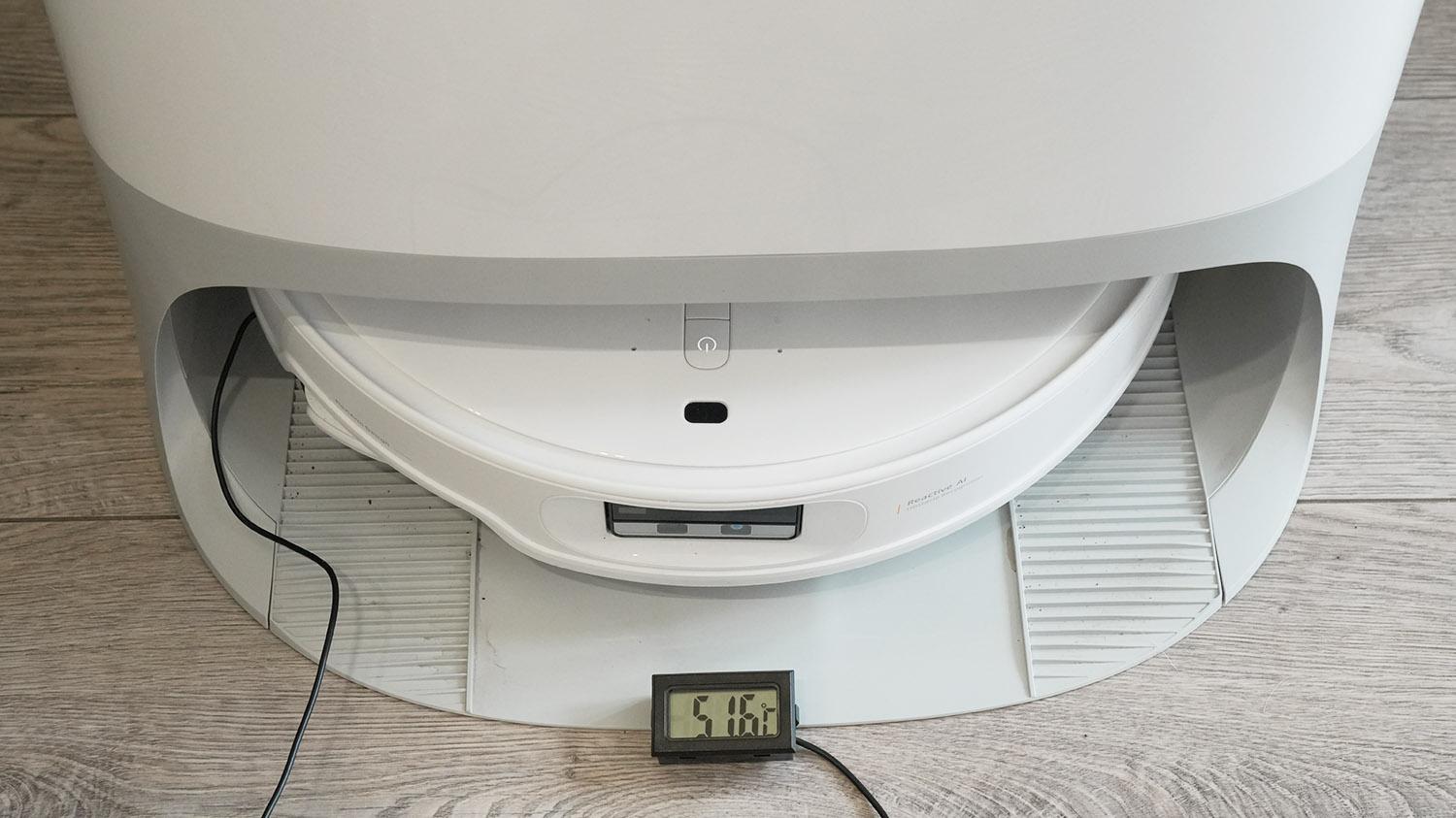
Drying temperature for napkins
Station maintenance
Even with the new scrapers in the tray, the station will still need to be washed by hand periodically. And here's the catch. Yes, you can remove the tray, which, even with the scrapers, will need to be washed by hand occasionally, as hair and large debris clog the filter. But all of this is easy to clean. The drain, however, is non-removable, and it also gets dirty. It's less convenient to clean, and it's strange they didn't make it removable, like many of the previous models in the line.
Obstacle clearance
An interesting point is its ability to navigate thresholds. The Roborock Qrevo CurvX can easily navigate a 2 cm threshold, which seems obvious. However, it struggles to navigate a 3 cm threshold. A single-level 4 cm threshold, or more precisely a 38 mm threshold, was impossible to navigate, no matter how much it raised its body or at what angles. However, with a two-level threshold, 2 cm on each level, in my configuration, the robot managed to navigate the obstacle after several attempts. So, its maneuverability is certainly better than many models on the market.
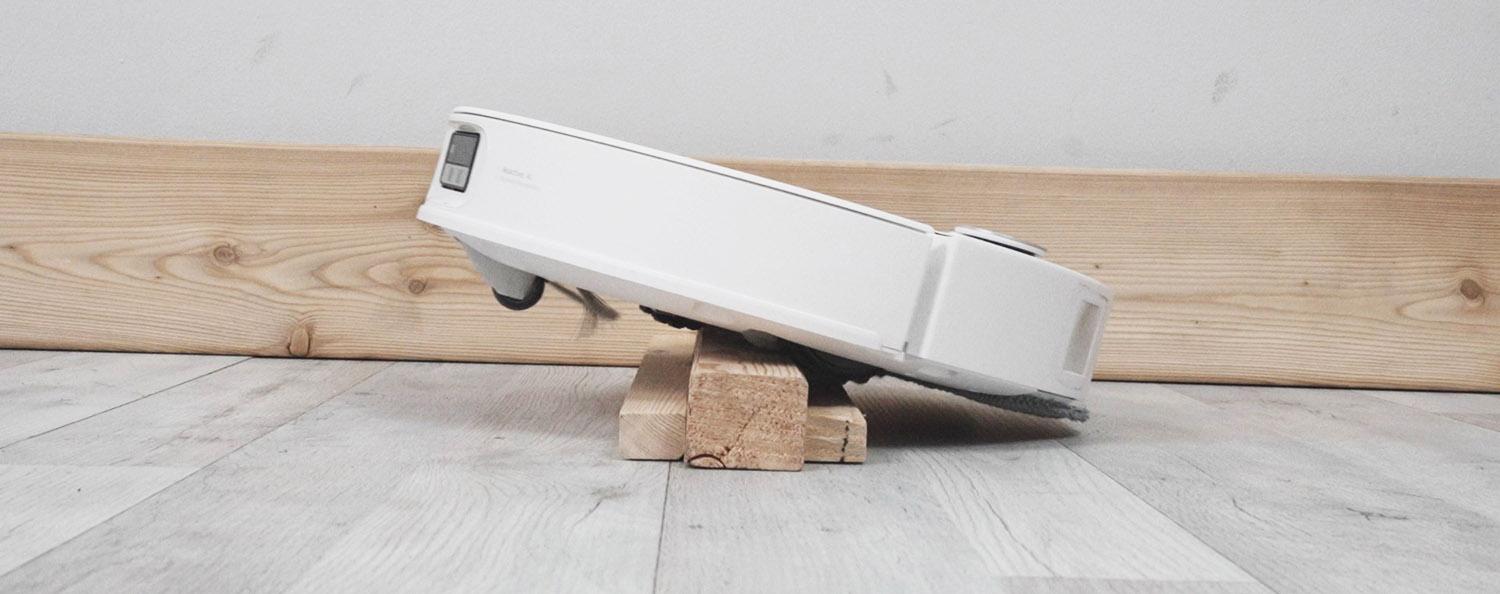
Moving the threshold height of 4 cm
Driving on black surfaces
Driving over black carpets is no problem. The robot glides over the black carpet as if nothing had happened.
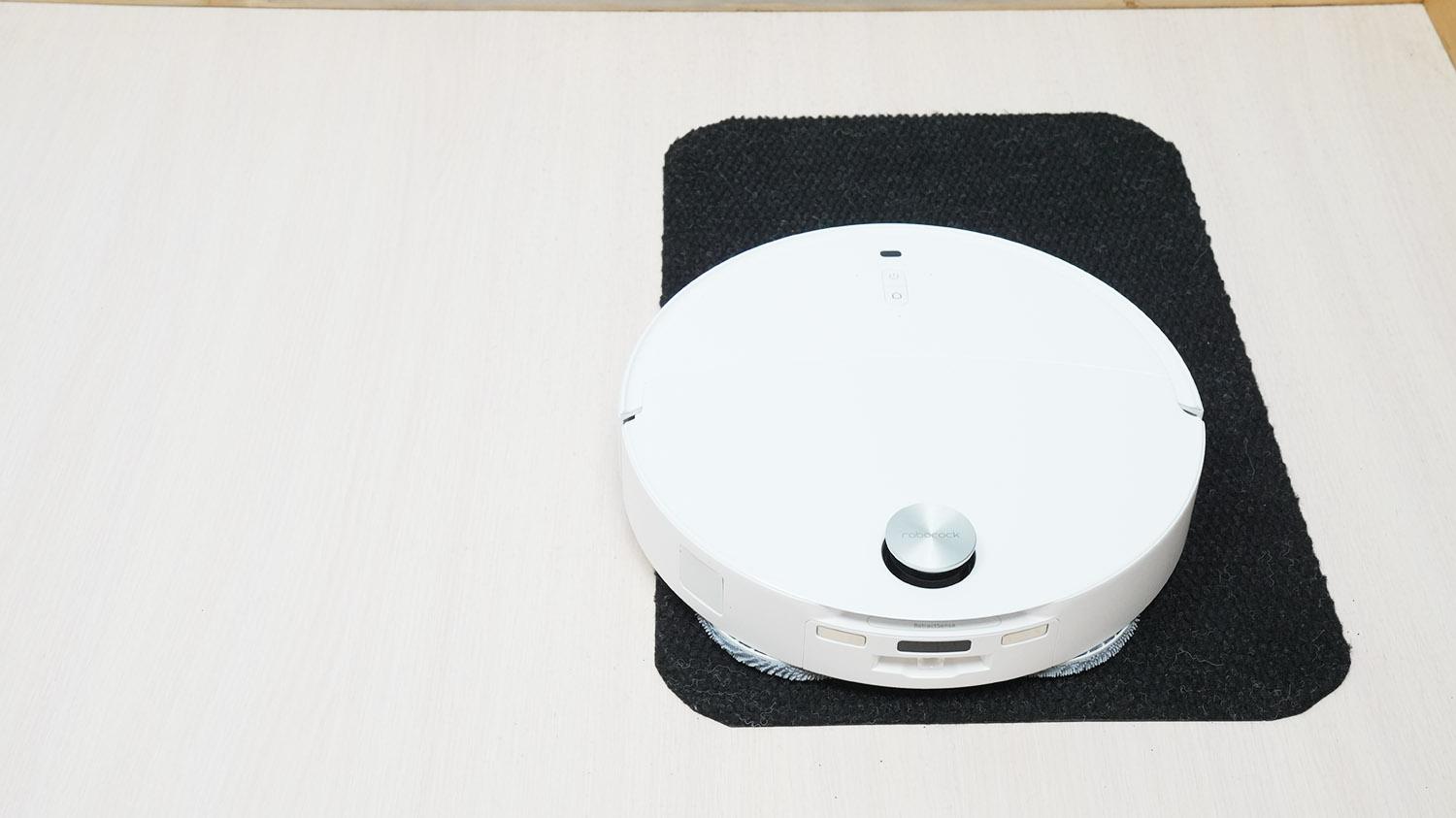
Driving on black surfaces
Noise level
As for noise levels, they range from 57.5 to 69 dB, depending on the selected operating mode. This is slightly lower than most similar units, given their increased power. The station's noise level during self-cleaning is approximately 72.5 dB. This is also a standard result.
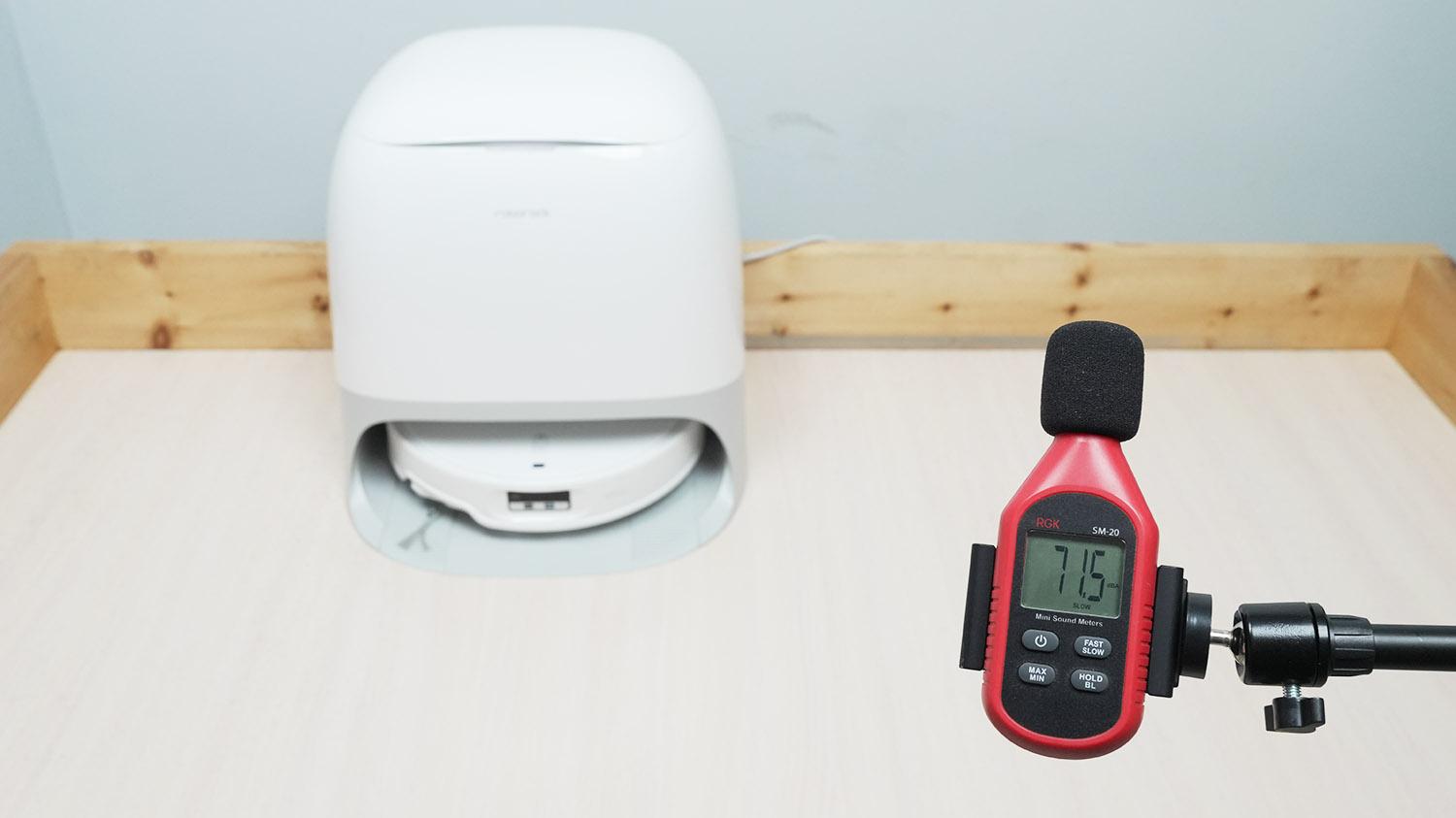
Noise level
Personal opinion
The Roborock Qrevo CurvX robot vacuum cleaner has been thoroughly reviewed and tested. According to our rating system, it scored 225 pointsThe results are exactly the same as those of the previously released Roborock Qrevo Curv. Why is that? I'll explain in the summary, but first, I'll highlight the pros and cons of this model.
Overall rating of tested robot vacuum cleaners: https://robovac.washerhouse.com/en/rejtingi/robovac-obshhij-rejting-robotov-pylesosov-robo.html.
So, I liked the following:
- The lidar is hidden in the body, allowing the robot vacuum cleaner to clean under furniture up to 8 cm high.
- The presence of a combined station for self-cleaning the dust collector, washing and drying napkins.
- The station is highly efficient. It features high-quality self-cleaning, hot water washing, full-fledged warm-air drying, scrapers in the tray that make maintenance a little easier, and spacious tanks. In short, it's a comprehensive system that gets the job done.
- The side and central brushes do not tangle hair and fur thanks to their updated design.
- Improved maneuverability thanks to the raised body. The robot vacuum cleaner can overcome single-level thresholds up to 3 cm high, and can even climb over a two-level threshold of 4 cm, a feat many similar robots cannot.
- The retractable side brush completely sweeps away debris from corners.
- The napkin is pulled out close to the baseboard.
- A backlit object recognition system that works effectively in good lighting conditions.
- Remote home monitoring by connecting to the robot's camera via a smartphone.
- Improved lifting of wipers when driving onto carpets.
- Raising the turbo brush and side brush in wet cleaning mode.
- Slightly increased suction power.
- High-quality dry and wet cleaning on various surfaces.
- Capable of removing even stubborn stains faster than its analogues.
- A large number of functions in the application.
- Full Russification in the version for the Russian market.
- Control via the proprietary voice assistant Hello Rocky.
- The robot vacuum cleaner is not afraid of black surfaces.
- Low noise level of the robot.
- High-quality assembly and high brand authority.
- Availability of warranty and service.
As for the shortcomings, here are the ones that were identified:
- The station cannot be connected to the sewerage and water supply.
- There is no automatic mixing of detergent from a separate tank in the station.
- Power losses are still observed.
- The object recognition system requires improvement.
- A non-removable ramp for the robot to enter the station.
The end result is a combination of solutions that will be optimal for certain owners. But first, let me explain why the rating is the same as the standard Curv version. It demonstrated higher performance on the rig, with a result of 8 mm versus 4 mm, while the new CurvX only had a retractable lidar and exactly the same criticisms leveled at the standard Curv version. Therefore, the choice is between increased performance and a thinner body. The CurvX version is also more expensive.
But overall, the robot vacuum is certainly good. It cleans effectively over large areas, doesn't tangle up fur or hair, is maneuverable, and can fit through 8-cm gaps. So it's definitely worth considering.
On that note, I'd like to end this review. If you have any questions, please ask them in the comments. Happy shopping, everyone. Bye!