KaringBee S7 OMNI: self-cleans, washes and dries napkins, and washes floors efficiently!
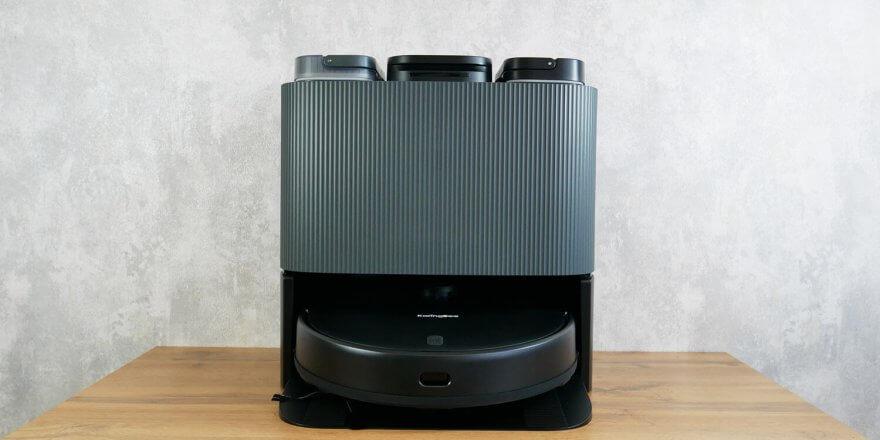
The KaringBee S7 OMNI is a new robot vacuum cleaner priced between $500-600, or $5.35-6.40 at the exchange rate at the time of writing. For this price, the robot vacuum cleaner is equipped with lidar for navigation, is suitable for dry and wet cleaning, and comes with a combined station for self-cleaning, washing, and hot-air drying of the cleaning cloths, and, of course, charging. So, below, I'll show you how this robot vacuum cleaner works, demonstrate its capabilities, and express my opinion on whether it's worth buying based on my test results. So, let's get started!
Equipment
The robot vacuum cleaner arrived in a branded box like this:
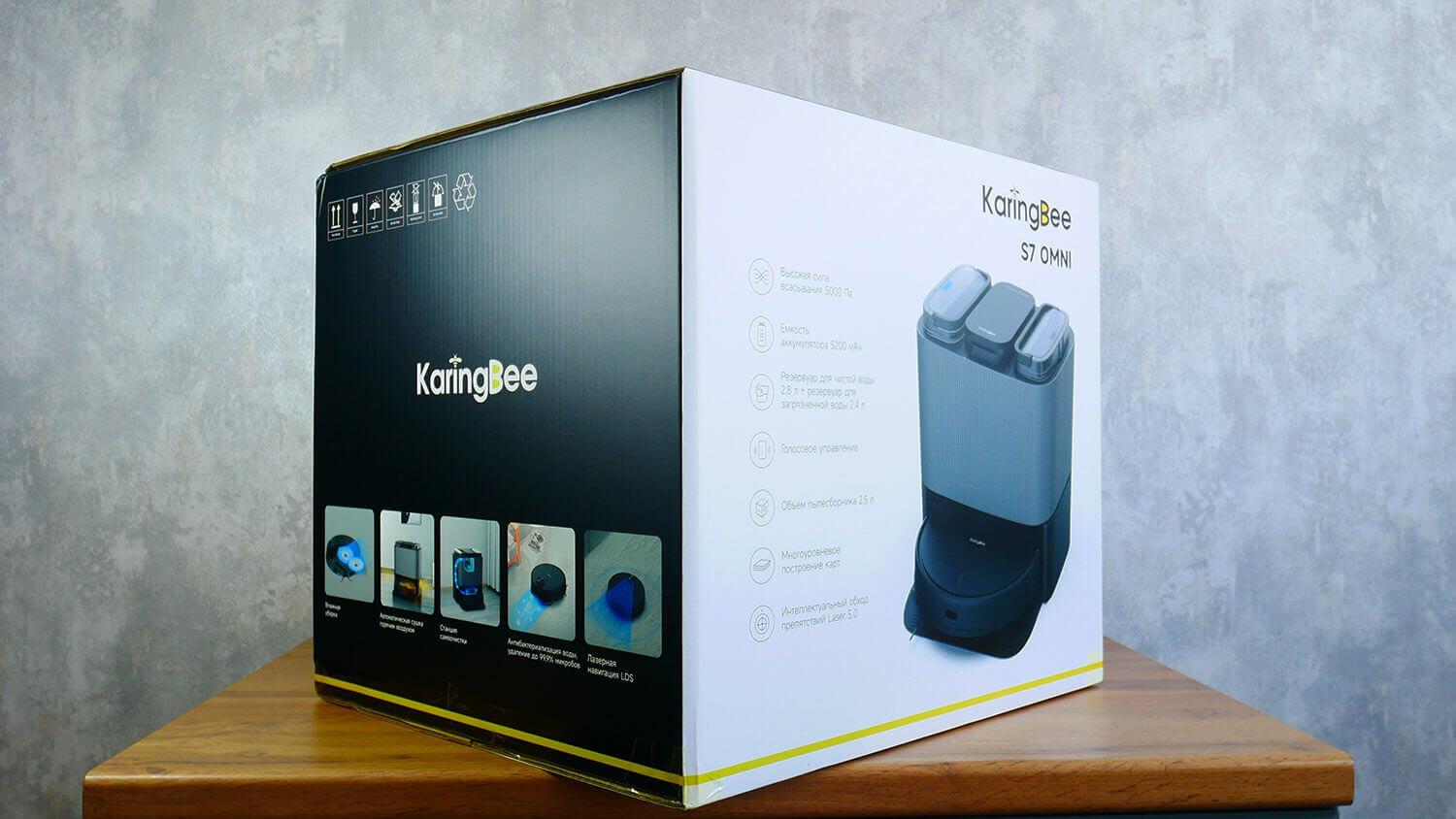
Box
In addition to the robot and station itself, the delivery kit includes:
- Two holders with round napkins.
- Two spare napkins.
- Two spare bags for the station.
- Spare side brush.
- Spare HEPA filter.
- Robot cleaning tool.
- Documentation for the robot in Russian.
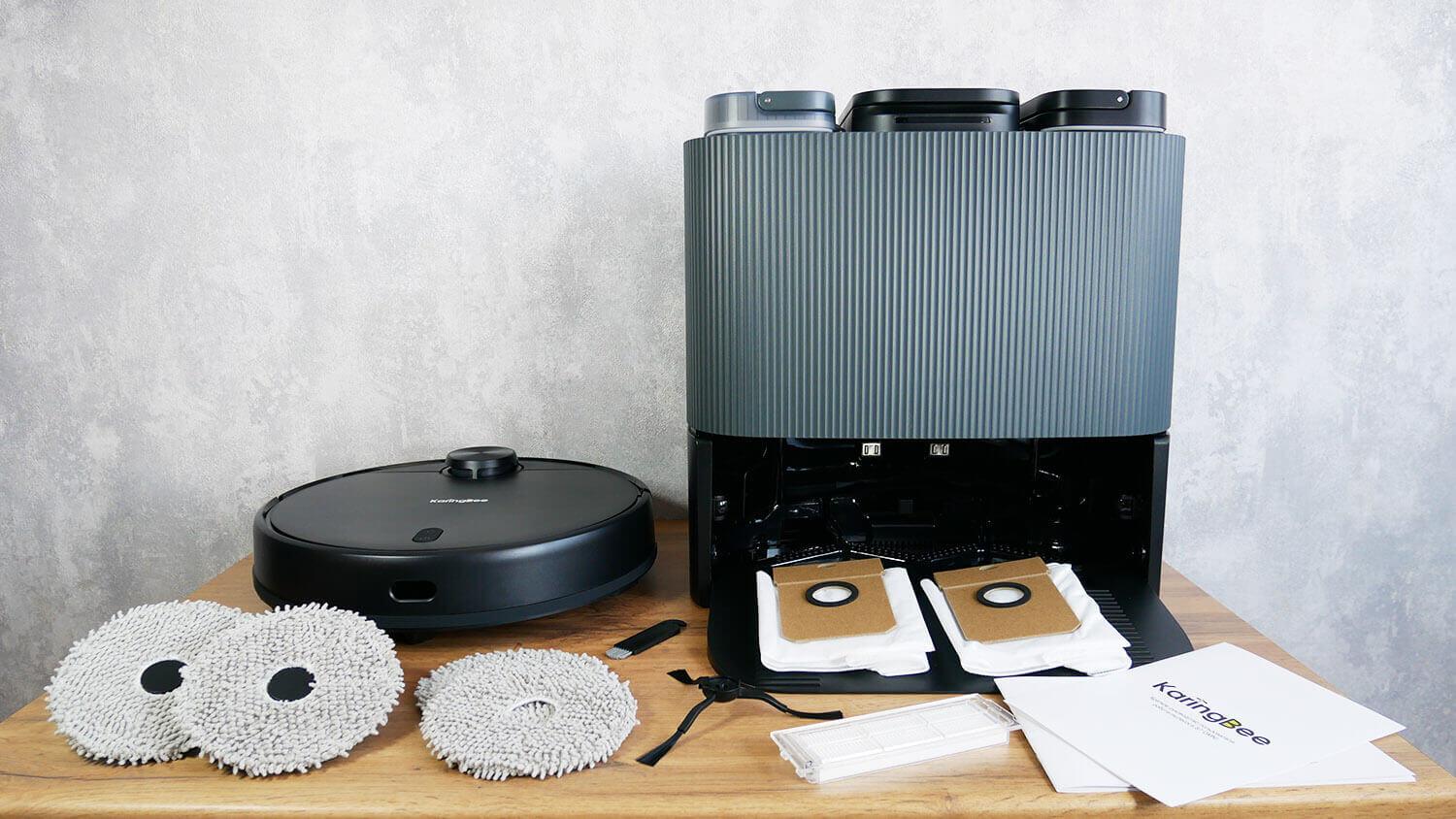
Equipment
The kit is well-equipped! It comes with all the necessary spare parts, which is a plus!
Appearance
Now let's look at the KaringBee S7 OMNI's design. Let's start with the robot vacuum itself. It's round, and the matte plastic is dirt-resistant. That's a plus. This model doesn't have a wall sensor.
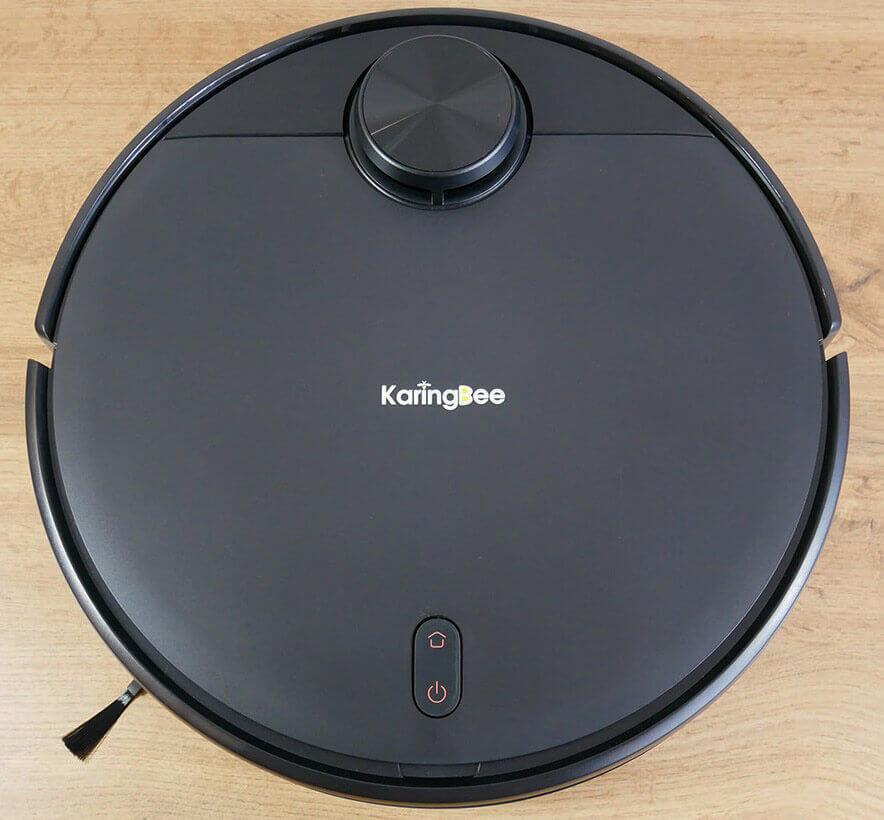
Top view
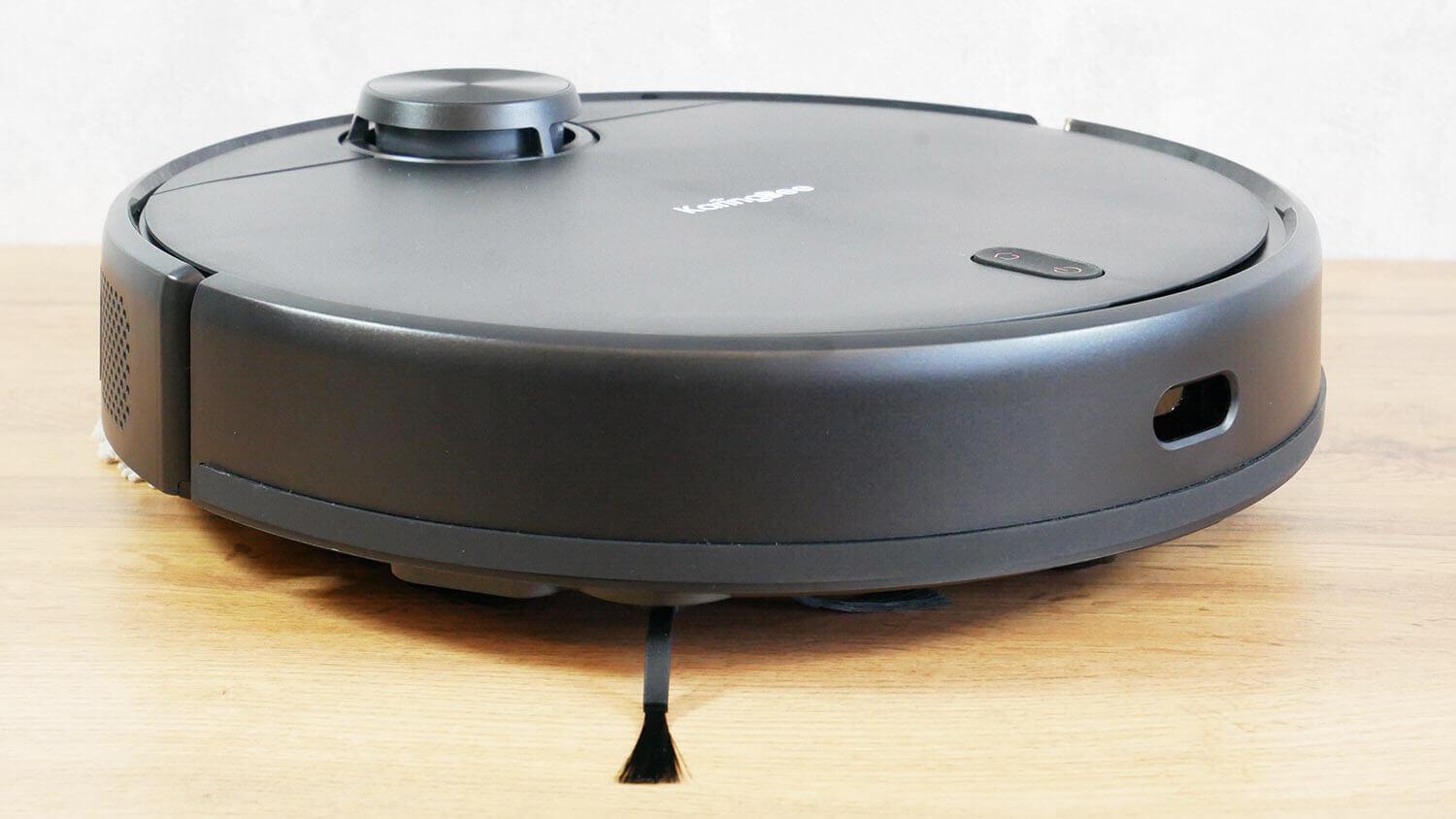
Side view
A sensor for detecting large obstacles in the robot's path is located in the center of the mechanical bumper. Charging terminals and a self-cleaning shutter for the station's dust collector are located at the rear. The robot's body is 10 cm high.
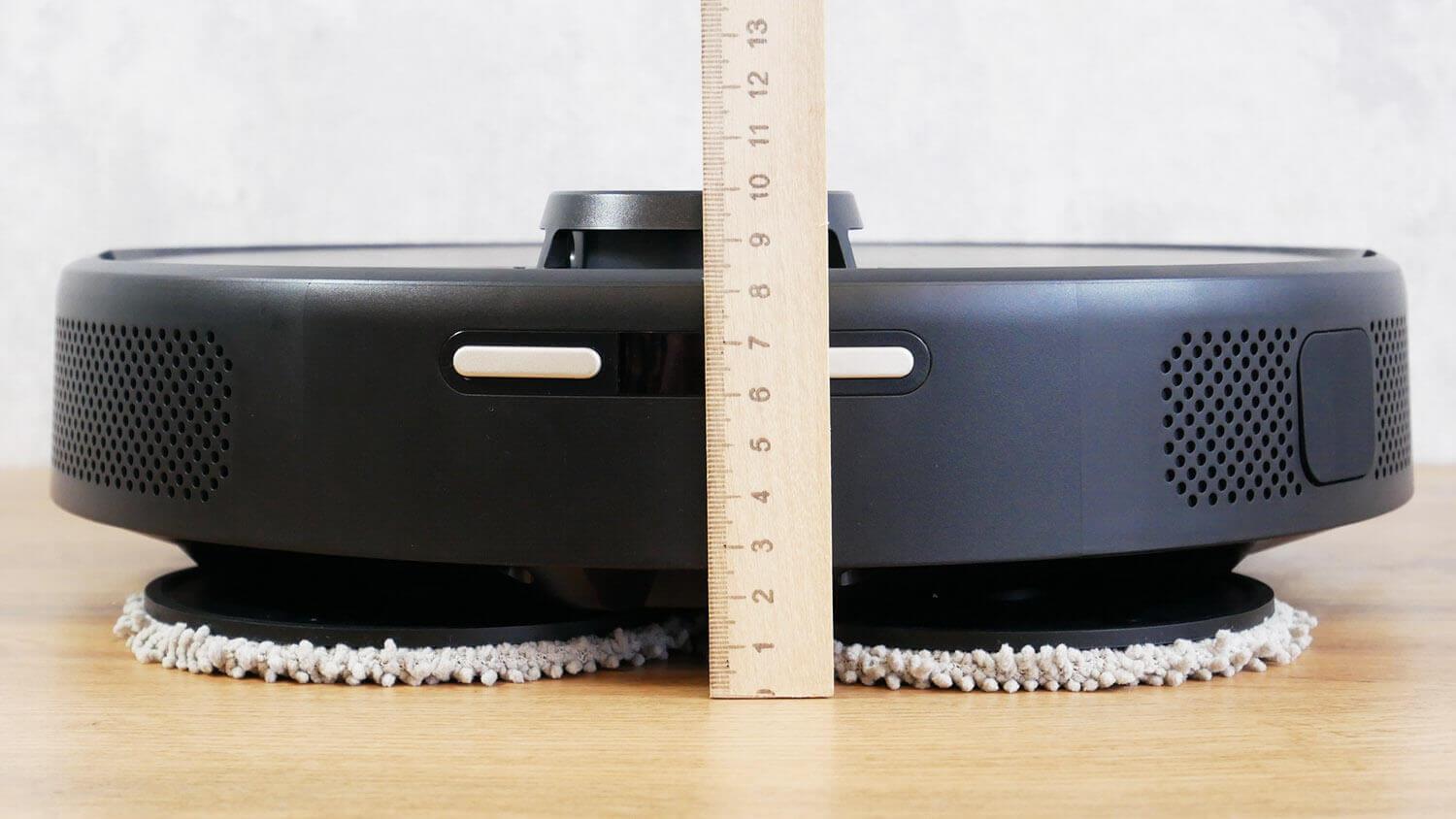
Body height
A lidar sensor is responsible for navigation. The lidar cover is not spring-loaded. The dust collector is located under the top cover. It holds 420 ml. The filtration system is dual: a mesh filter and a HEPA filter. There is no water tank. The wipes are only moistened at the washing station.
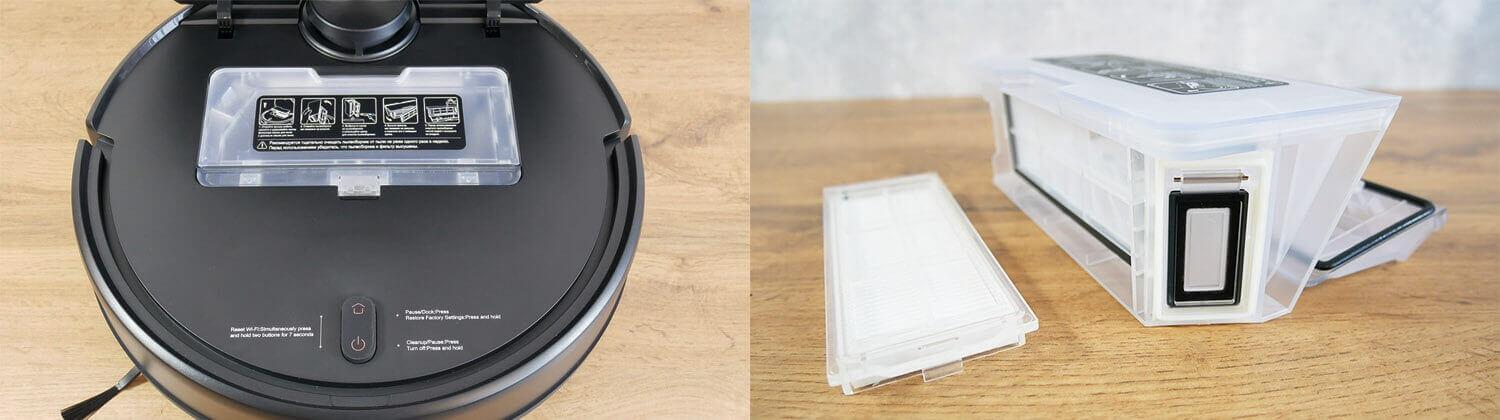
Dust collector
The robot's underside is equipped with three fall protection sensors. It even has a carpet detection sensor. It has a single side brush: a three-beam brush secured with a screw.
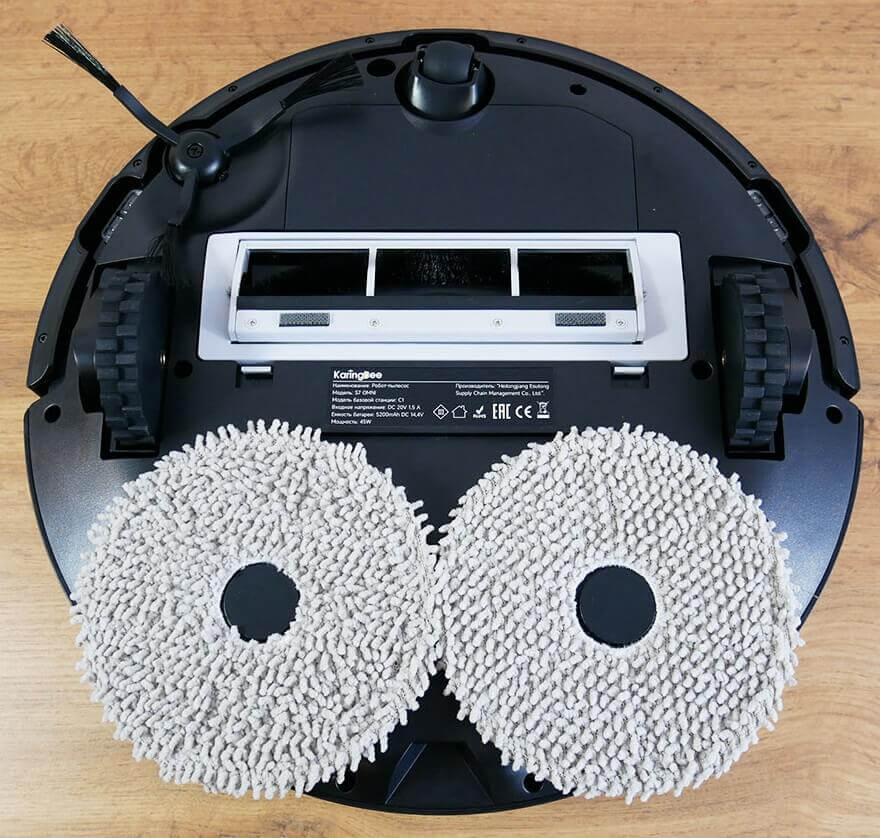
Bottom view
The central brush unit doesn't float; only the frame moves, but that doesn't really make a difference. The central brush is made of bristles and petals and cannot be disassembled. Only the cap on one side can be removed.
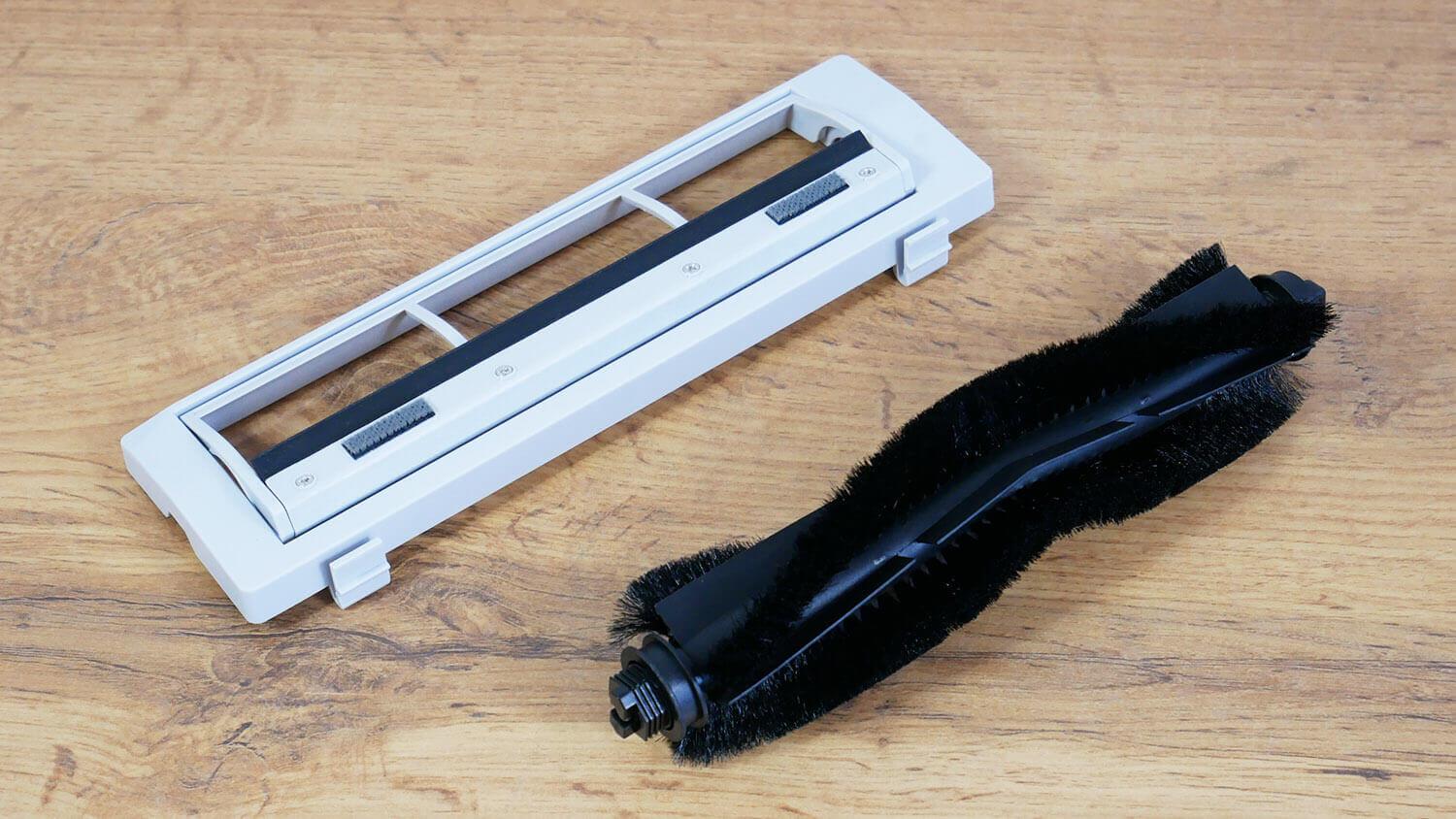
Central brush
The napkins are round. The napkin holders are held in place by magnets. Unfortunately, they don't lift up on carpets.
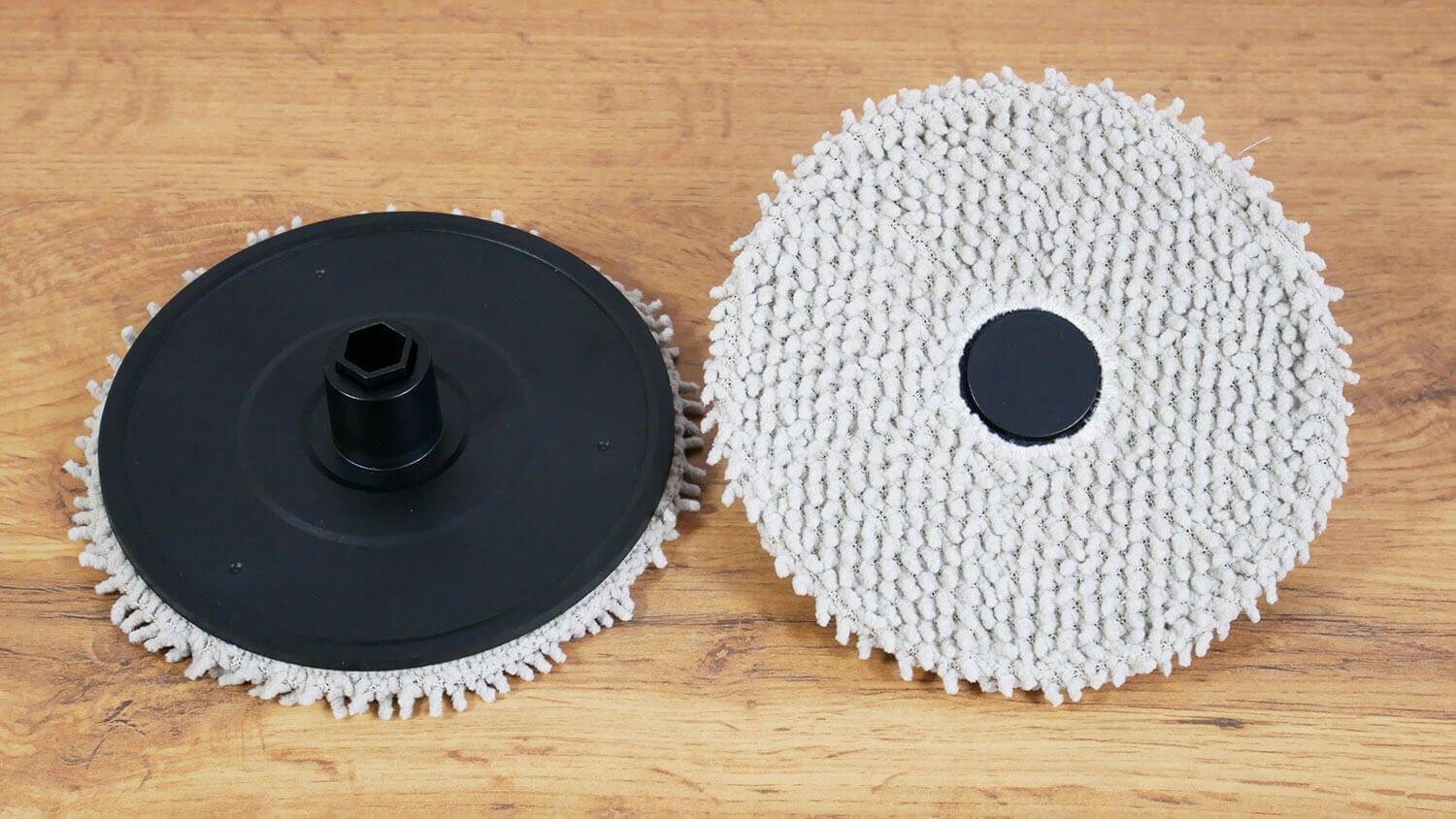
Napkin holders
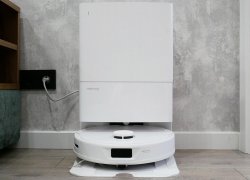
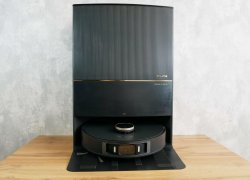
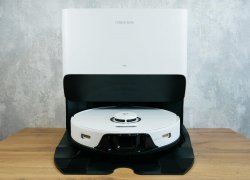
As for the station, the KaringBee S7 OMNI charges, self-cleans the dust bin, washes the cleaning cloths, and dries them with warm air. It also disinfects water using electrolysis, but I can't evaluate the effectiveness of this solution.
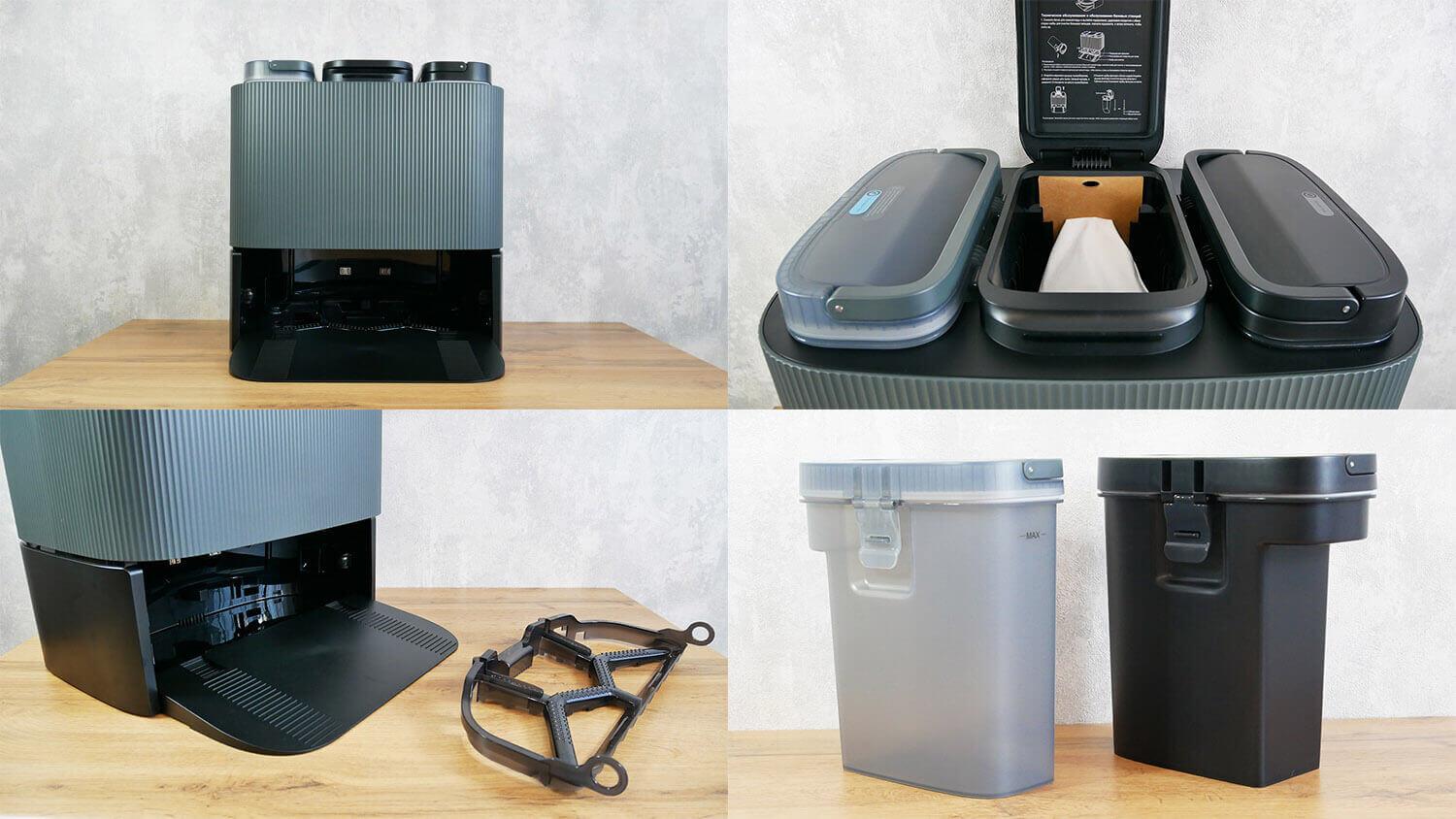
Station
Unfortunately, the tray where the wipes are washed is not removable. Only the module with the cleaning combs is removable, but the bottom itself will have to be washed by hand with a cloth. Not very convenient.
The clean water tank holds 2.8 liters. The dirty water tank holds 2.4 liters. The bag holds 2.5 liters of dry waste.
Overall, the robot's design has both advantages and disadvantages for this price segment. I'll share my thoughts in the conclusion, but for now, let's move on!
Technical specifications
Main features of KaringBee S7 OMNI:
Robot vacuum cleaner:
- Li-Ion battery 5200 mAh.
- Suction power up to 5000 Pa.
- Operating time up to 140 min.
- Dust collector 420 ml.
- Water tank: none.
- Obstacle clearance up to 20 mm.
- Dimensions: 350*100 mm.
Station:
- Clean water tank: 2.8 l.
- Dirty water tank: 2.4 l.
- Bag in the station: 2.5 l.
- Dimensions: 415*430*412 mm.
Of the specifications, the only important thing to highlight is the claimed high suction power, which will be verified in tests. The rest of the parameters are quite standard.
Functional capabilities
Speaking of features, the KaringBee S7 OMNI is controlled via the SmartLife mobile app. Connection is simple, the interface is in Russian, and everything is intuitive.
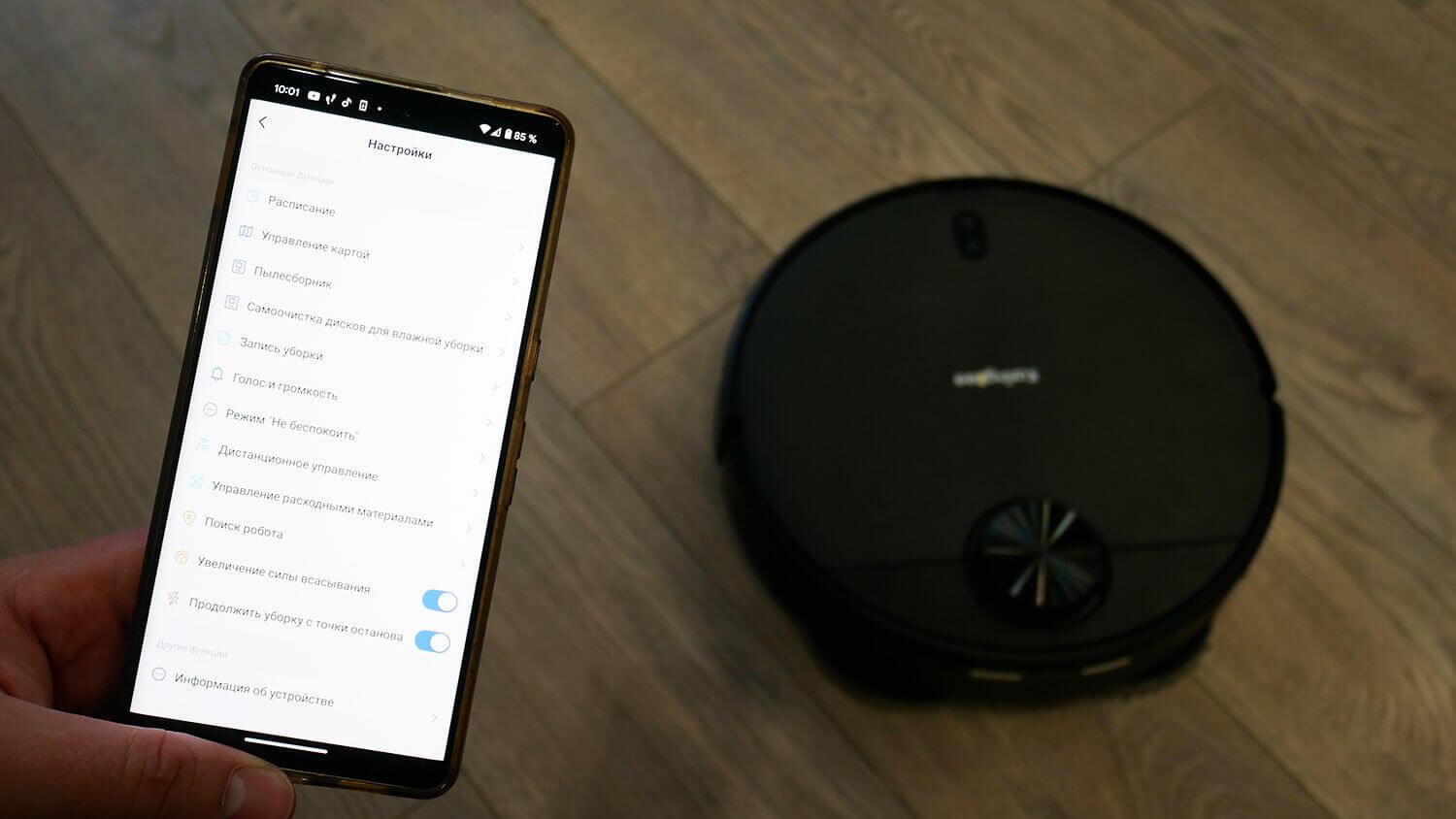
Control via app
The main functions of the robot are displayed on the screen:
- Self-cleaning.
- Rinsing wipes.
- Drying napkins with warm air.
- Saving multiple cleaning maps in memory.
- Automatic zoning of premises into rooms.
- Selecting areas and rooms for cleaning.
- Restricted areas (and for wet cleaning mode).
- Suction power adjustment.
- Setting the frequency of rinsing wipes (8/10/12 sq.m.).
- User mode.
- Cleaning log.
- Setting up cleaning according to a schedule.
- Automatic power increase on carpet.
- Carpet cleaning in wet cleaning mode.
- Y-shaped traffic pattern.
- Voice notifications in Russian.
- Yandex.Alice support.


Functions
And here's where I personally miss some features. First, you can't run the robot vacuum for dry cleaning only. Unless you add water to the tank or manually remove the cleaning pad holders from the robot. In any other situation, the cleaning pad rinse function is always activated upon startup, and it can't be disabled in the app. It's inconvenient. Second, the cleaning pad rinse frequency setting is very limited. You can choose one of three options: after 8 square meters of cleaning, after 10, or after 12. Ideally, it would be possible to return the robot to the cleaning station to wash the pads after each area cleaned. There's no cleaning pad lift function on carpet, which is also inconvenient. Furthermore, there's no way to adjust the wetness of the pads at the cleaning station. There are no settings whatsoever for the amount of water supplied during cleaning or when leaving the cleaning station.
What I liked was that the robot can be controlled via Yandex.Alice and, more importantly, it has a Y-shaped movement pattern. This means the robot not only scrubs the floor with rotating wipes, but also moves in a herringbone pattern. It's a really cool idea, and combining both solutions is something I've never seen in a robot before.
Testing
A detailed video review of the KaringBee S7 OMNI, including all tests, has already been prepared and published on the channel:
Navigation
And finally, let's move on to the tests. First, we'll test the KaringBee S7 OMNI's navigation in a room with obstacles. The robot vacuum first moves around the perimeter of the room, then cleans the entire accessible area in a serpentine pattern. The dryer's legs didn't cause any problems. The robot also swept around the box and chair legs separately, then returned to the station. The test was successful.
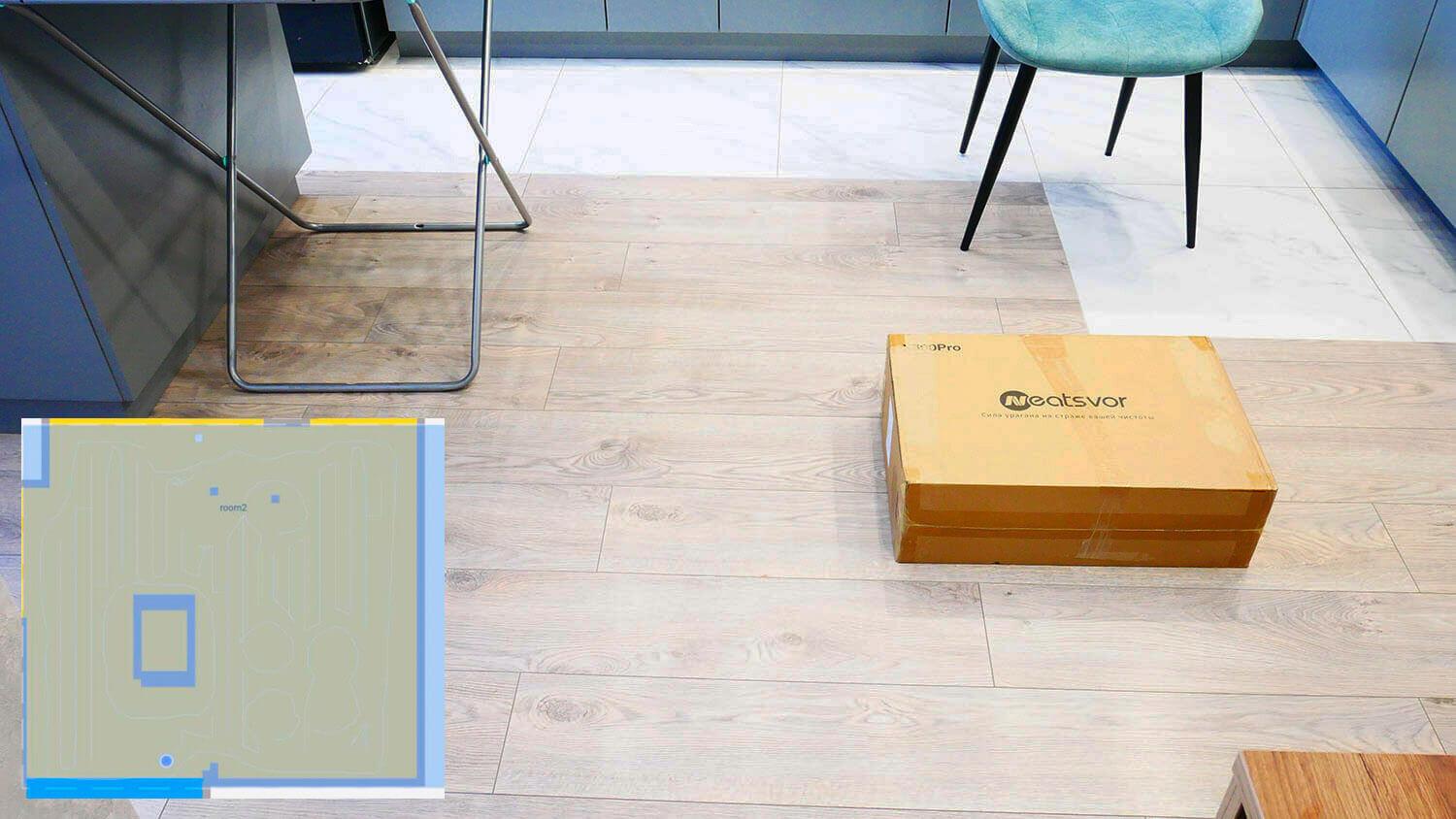
Navigating an Obstacle Room
Speaking of navigation within the house, the robot vacuum cleaner cleans room by room, following the perimeter, then in a serpentine pattern. Every 10 square meters, as I've determined, it returns to the station and rinses the cloths, then resumes cleaning from where it left off. There are no uncleaned areas left; this model has excellent navigation!
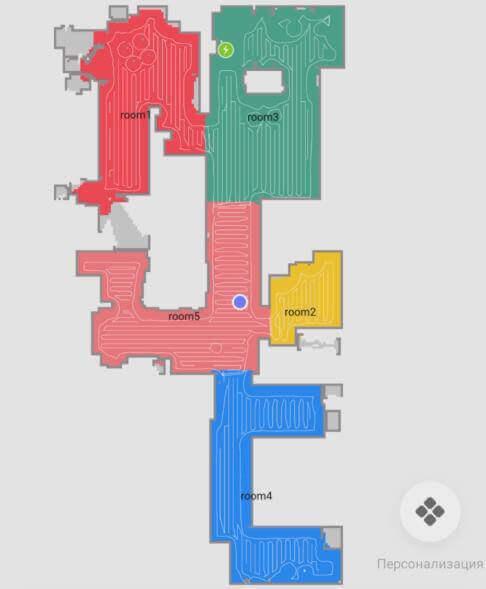
Navigation within the home
Suction power
As for suction power, it was quite average. The KaringBee S7 OMNI was only able to suck up debris from a 2 mm deep gap. This is sufficient for cleaning hard surfaces in a home environment, but I still think the claimed power is significantly overstated.
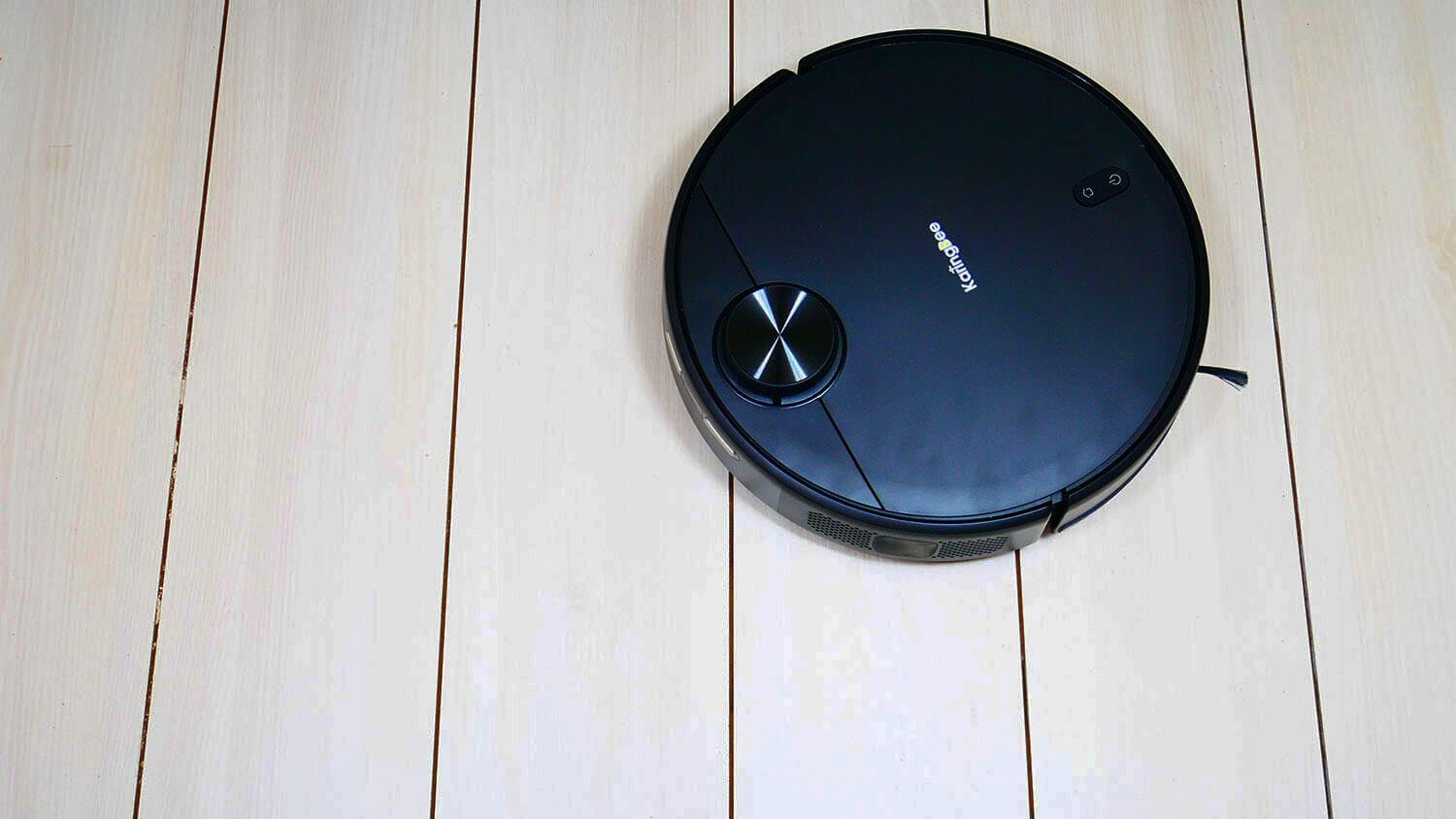
Suction power
Dry cleaning
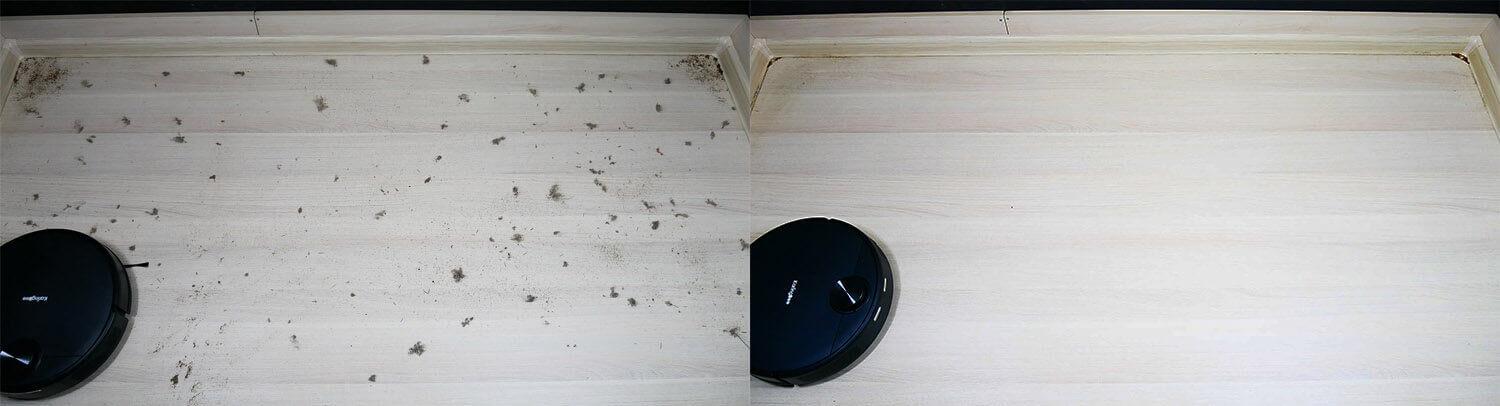
The collection quality of various types of debris on laminate floors is good. Only a small amount of debris remains in corners, where round robotic vacuums can't sweep. All debris is collected in the dust bin. The central brush picked up some fur and hair, but the bulk of the debris is still in the dust bin.
Dry cleaning
Carpet cleaning
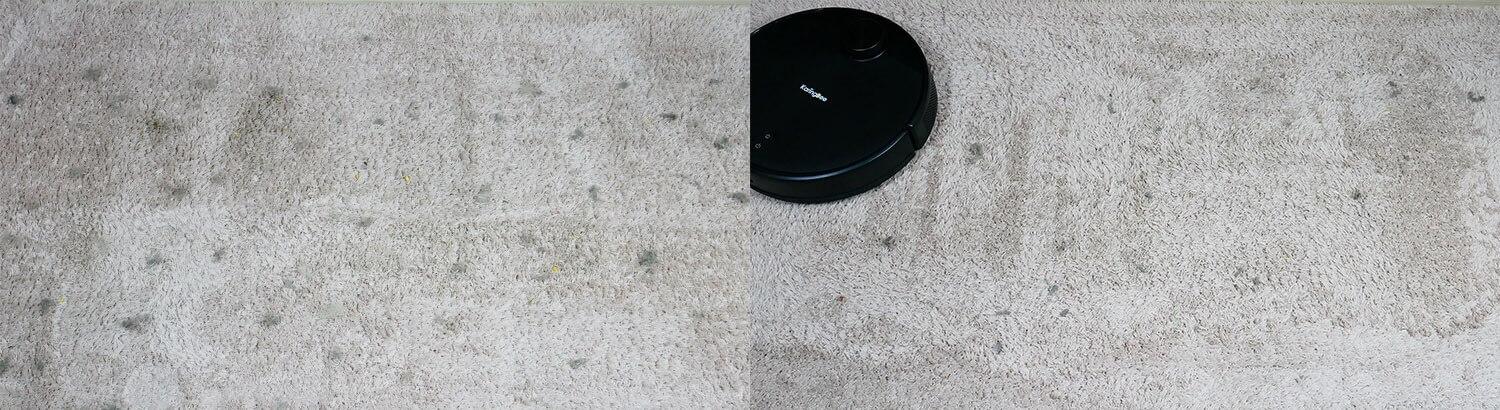
This model has some issues with carpet cleaning, however. It's unable to clean medium-pile carpets. In my opinion, this is due to its rather limited suction power and the fact that the central brush unit doesn't float. So, cleaning carpets with the KaringBee S7 OMNI isn't the best idea.
Carpet cleaning
Wet cleaning and carpets
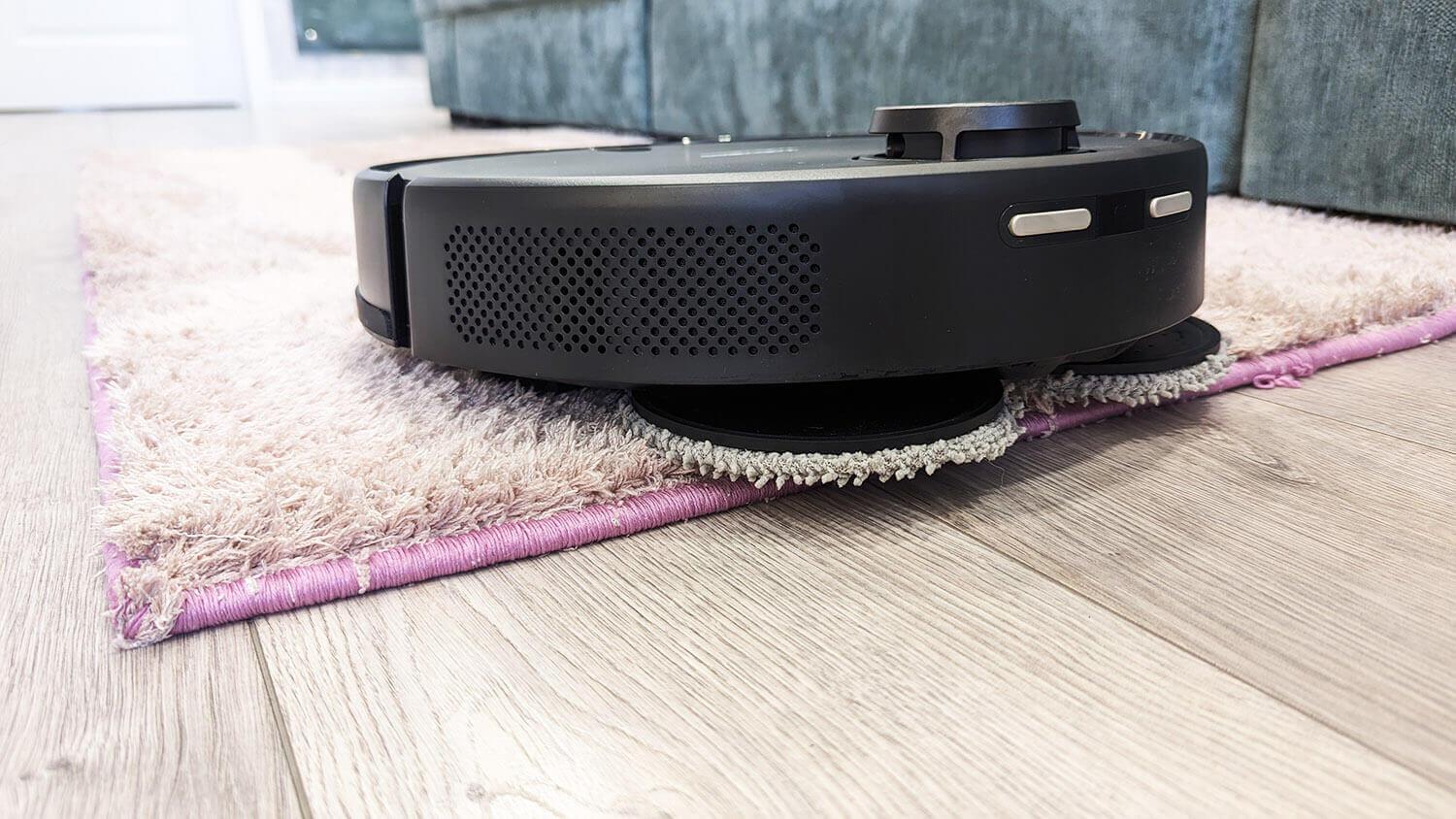
When wet cleaning carpets, you have two options for the robot's behavior. Enable automatic carpet avoidance in wet cleaning mode, which is more logical. Alternatively, disable carpet avoidance, which means the robot will drive onto the carpet with its cleaning pads, disabling the rotating discs. This will inevitably result in wet cleaning pads coming into contact with the carpet, which is not ideal.
Wet cleaning and carpets
Wiping off dirt
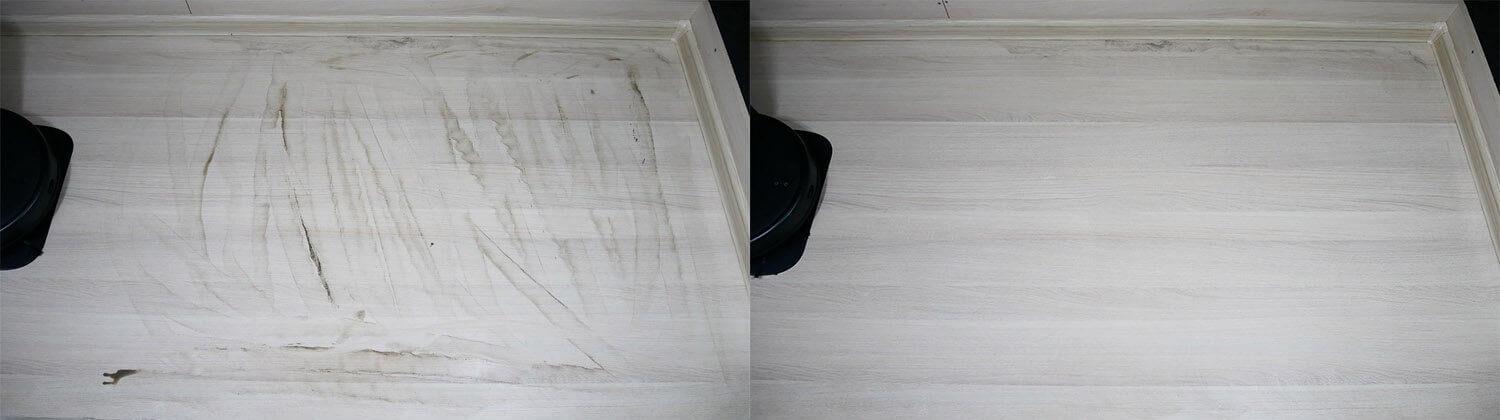
The KaringBee S7 OMNI does a good job of removing light dirt and grime. It removes dirt without leaving streaks or marks. The cloths absorb dirt well. The only issue is that a narrow section of the floor along the baseboard was left unwashed because the cloths don't extend to the edges. This is a problem with most robotic vacuum cleaners tested.
Wiping off dirt
Removing difficult stains
As for removing tough stains like dried-on coffee and sauce stains, the robot can handle coffee stains, but dried-on sauce is beyond its capabilities. However, to be fair, even specialized wet/dry vacuum cleaners struggle to remove these stains, making this a challenging task for a household robot and not designed for such conditions.
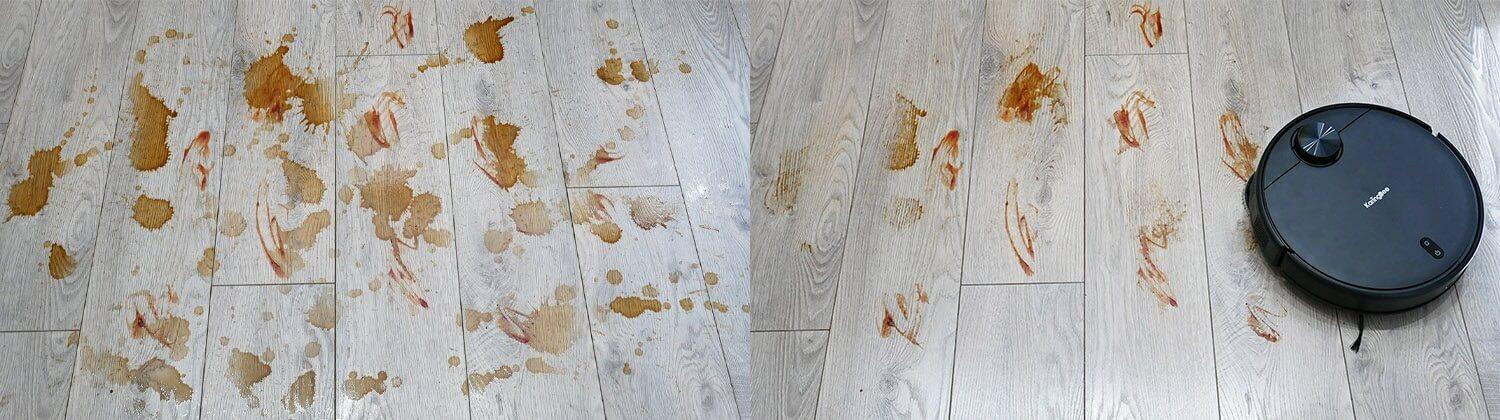
Removing difficult stains
Rinsing quality of wipes
Now, I'd like to test the effectiveness of the station itself. Let's start with the rinsing quality of the wipes. Under normal household conditions, after washing the floor, the wipes aren't in particularly bad condition. And after rinsing, I can say they're actually clean. A minimal amount of dirt is removed under the pressure of warm water.
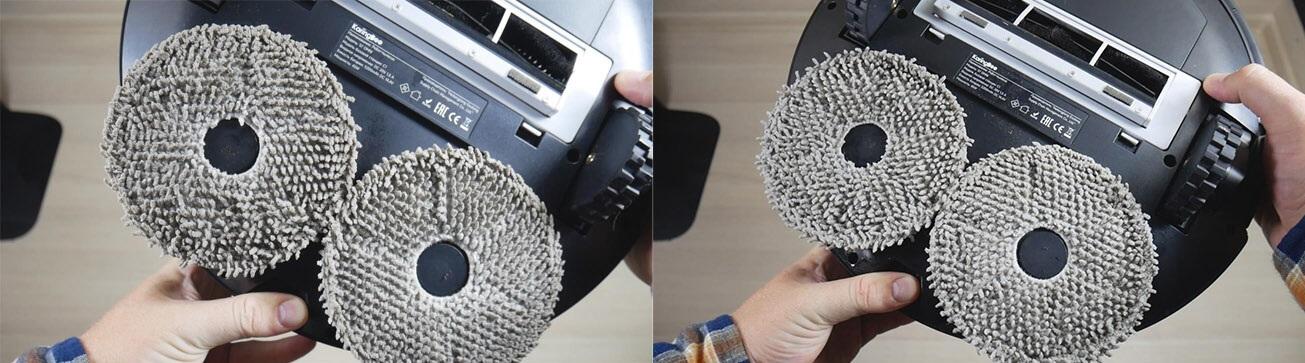
Rinsing quality of wipes
That's a plus! However, if I test it after heavy-duty cleaning with a dirty floor, the wipes aren't perfectly cleaned at the station. But then again, the robot isn't designed for such conditions. I should also note that the wipes dry effectively, taking three hours. I ran tests until evening, then returned the robot to the station, where it self-cleaned and began charging. By morning, the wipes were completely dry, so I can say the station really does dry the wipes.
As for servicing the station, it's not the most convenient, as I've already mentioned. The ramp for the robot to enter is not removable, nor is the tray. Therefore, you need to remove the module to clean the wipes, manually wipe the bottom of the tray with a cloth, and then replace the module.
Self-cleaning quality
The dust bin's self-cleaning performance is near perfect. I ran the robot vacuum in a room with a lot of debris. After cleaning, we saw that the dust bin was full. We returned the robot vacuum to the docking station and saw that the dust bin was completely empty after self-cleaning. Self-cleaning is well implemented.
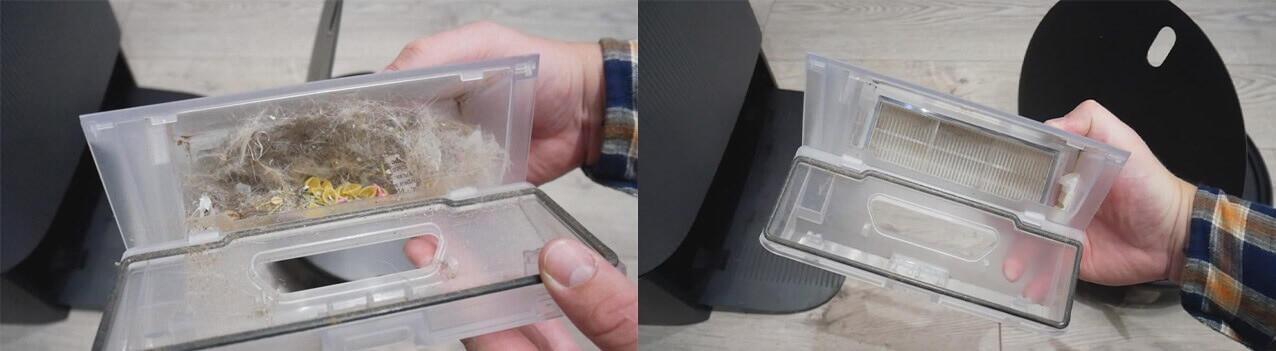
Self-cleaning quality
Obstacle clearance
The KaringBee S7 OMNI easily navigates 2 cm high thresholds. That's a plus!
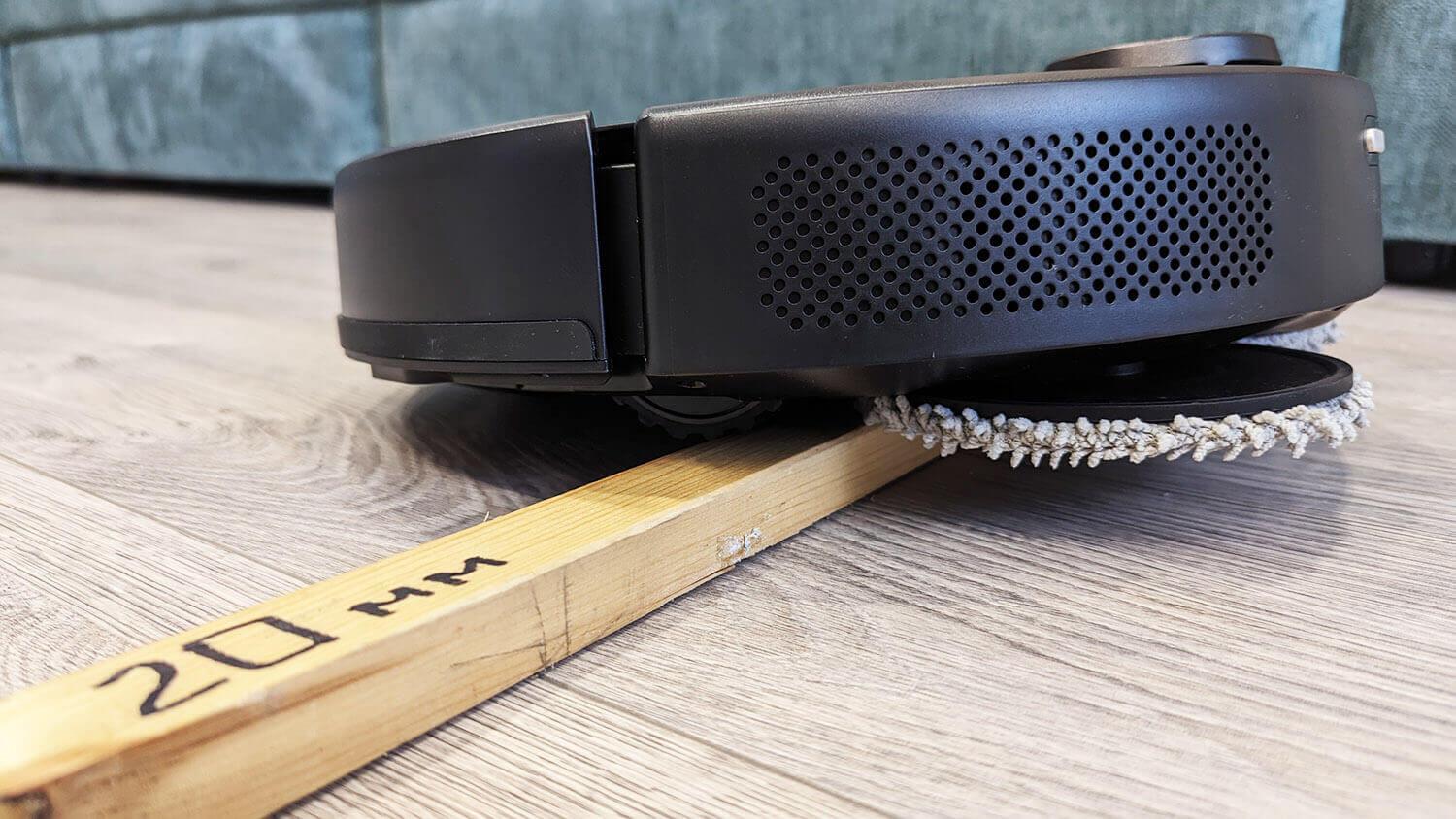
Obstacle clearance
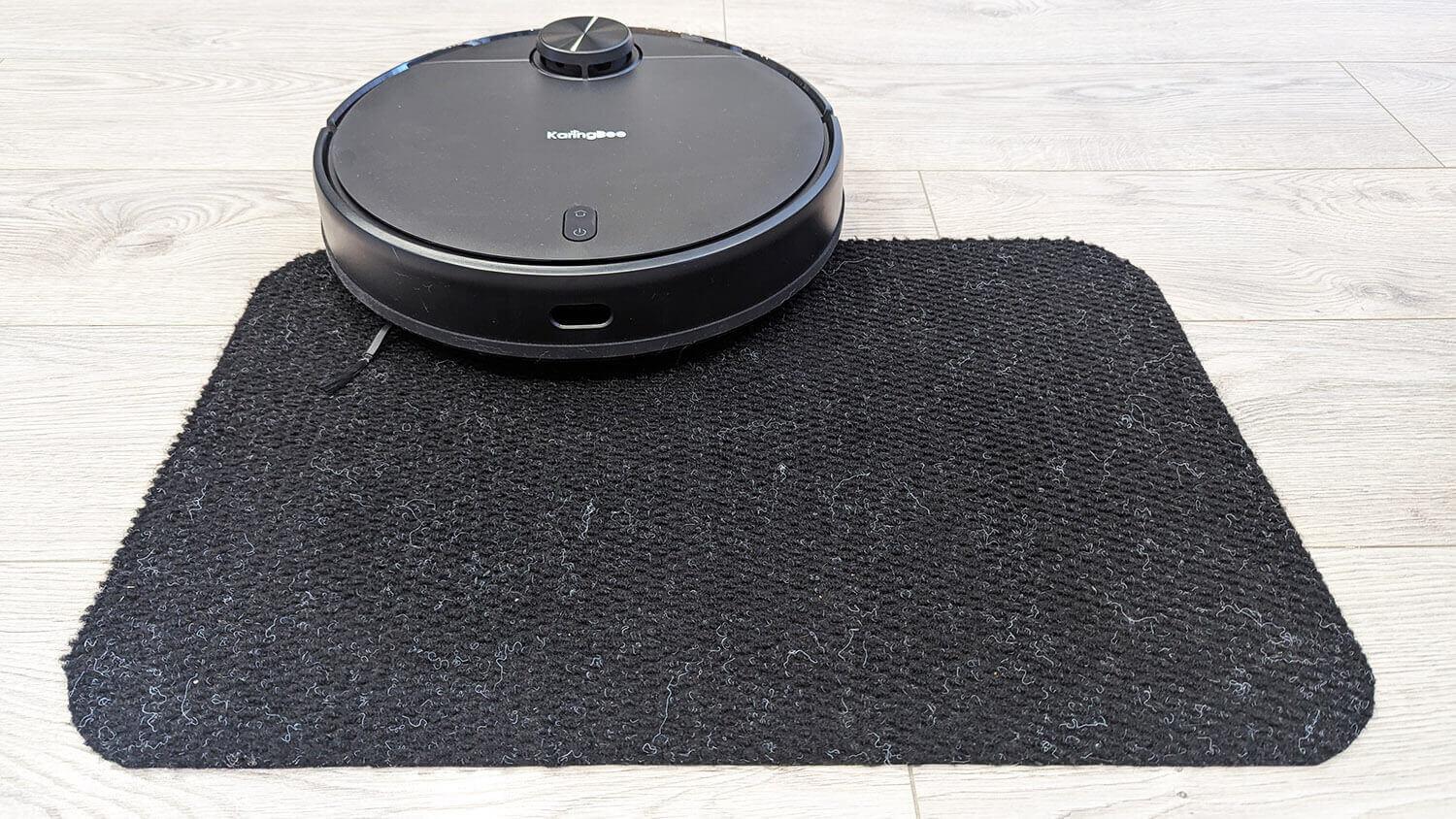
Driving on black surfaces
It's not afraid of black surfaces, and can easily navigate even completely black carpet. This is another advantage of the robot!
Driving on black surfaces
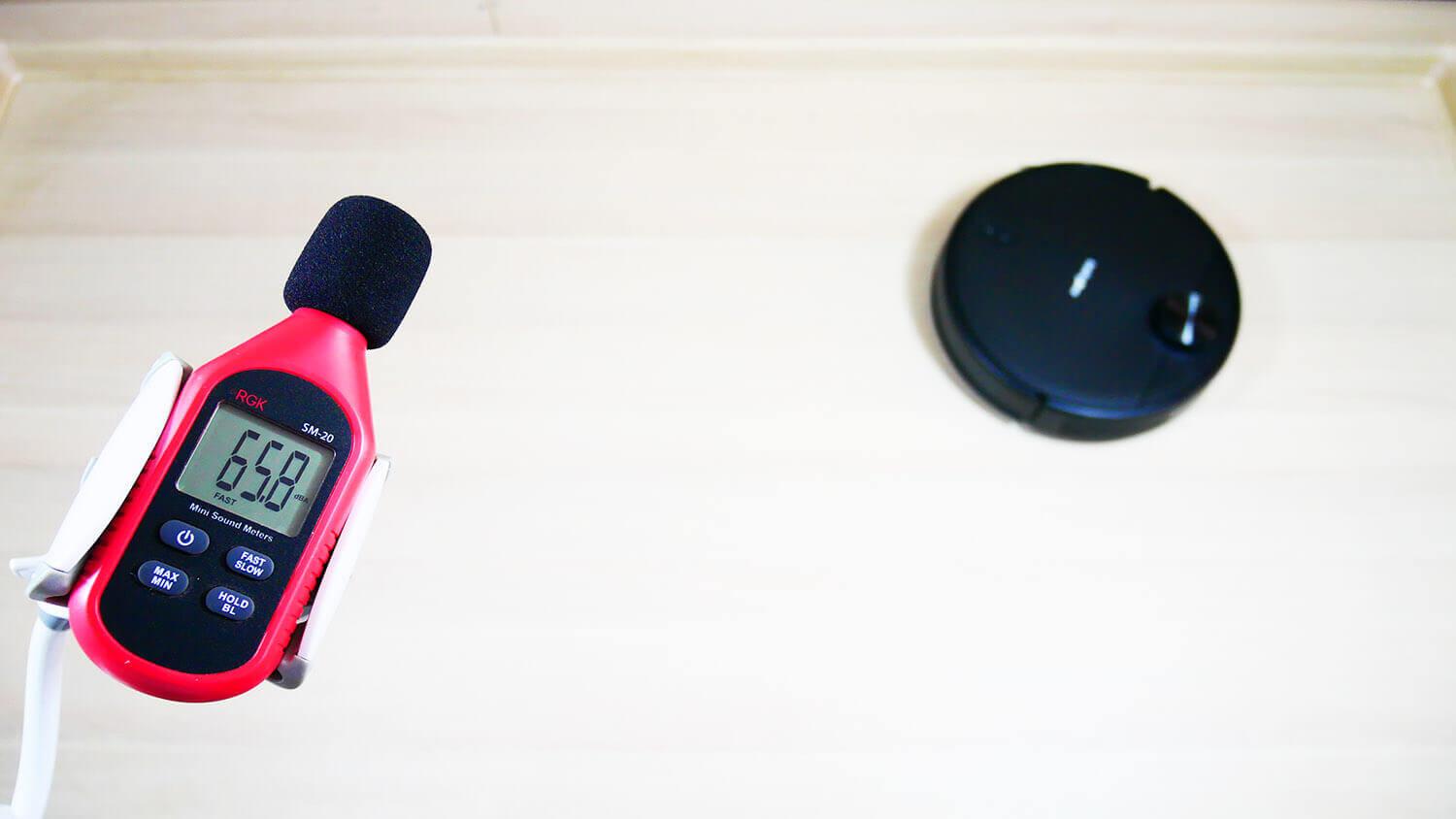
Noise level
As for the noise level, it ranges from 56 to 67 dB, depending on the selected mode. This is a standard noise level for a robot.
Noise level
Personal opinion
The KaringBee S7 OMNI robot vacuum cleaner has been thoroughly reviewed and tested. our evaluation system he managed to gain 134 pointsThe result is not very high, which is due to a number of comments that will be discussed below.
Overall rating of tested robot vacuum cleaners: https://robovac.washerhouse.com/en/rejtingi/robovac-obshhij-rejting-robotov-pylesosov-robo.html.
But don't be too quick to lose interest in this robot; there are certain conditions under which I would recommend taking a closer look. Let's take it one step at a time.
I liked the following:
- Availability of a combined station for self-cleaning, washing and drying napkins.
- High-quality self-cleaning of the dust collector and wipes.
- Effective drying of napkins with warm air.
- The Y-shaped movement pattern, which, in tandem with rotating cloths, improves the quality of wet cleaning.
- Good cleaning quality on hard surfaces.
- Good cross-country ability.
- Not afraid of black coatings.
- Yandex.Alice support.
- Good equipment.
- Complete Russification.
- Availability of warranty and service.
- Optimal price, considering the presence of the station.
Among the disadvantages I would like to highlight:
- There is no water tank in the robot.
- The central brush cannot be disassembled.
- The napkins do not rise when driving onto carpets.
- Non-removable tray in the station.
- There is no way to run the robot for dry cleaning only without removing the holders with wipes.
- Poor cleaning quality for medium pile carpets.
- The claimed suction power was not confirmed in tests.
- The station cannot be connected to the sewerage and water supply.
- Doesn't sweep into corners.
- There remains a narrow, non-washable area along the baseboard.
Considering the pros and cons, I can say that I would recommend this robot vacuum cleaner exclusively for cleaning hard floors, based on its design, capabilities, test results, and a few comments that are particularly relevant for carpeted floors. If you don't have carpeted floors, there are no criticisms at all. Some of these issues are typical for most robots, while others are forgivable given the price range. Therefore, if you're looking for an affordable robot vacuum cleaner with a full-fledged self-service station, and a warranty and comprehensive support are important, this model can compete with direct competitors from Xiaomi and its sub-brands. This is precisely because of the manufacturer's comprehensive support.
Overall, for a budget under $500, this is definitely one of the best robot vacuums, as there are virtually no robots in this price range with combined stations. This feature significantly increases the robot vacuum's battery life and cleaning performance.
On that note, I'd like to end this review. If you have any questions, please ask them in the comments. Happy shopping. Bye!