Dreame Roboticmower A1: A stylish robotic lawn mower with precise navigation and advanced features


Hello to all readers of the project! In this review, I'll be testing the Dreame Roboticmower A1, the brand's first robotic lawn mower. It's gained immense popularity in the year since its release, and I couldn't resist checking it out. What's so special about this model? Firstly, it features a lidar-based navigation system, allowing the robot to navigate with an accuracy of up to 1 cm. Furthermore, it doesn't require boundary wires or beacons, making it more convenient to use than similar products. Secondly, it's controlled via a proprietary app with a variety of settings and features, from scheduling mowing to adjusting the accuracy of its avoidance. Of course, cutting-edge technology isn't cheap. At the time of writing, the robot costs around $2,000. So, below, I'll show you how this lawn mowing robot works, test it in detail, and then highlight its pros and cons. So, let's get started!
Equipment
Let's start with a review of the package contents. The robot arrived in this large box:
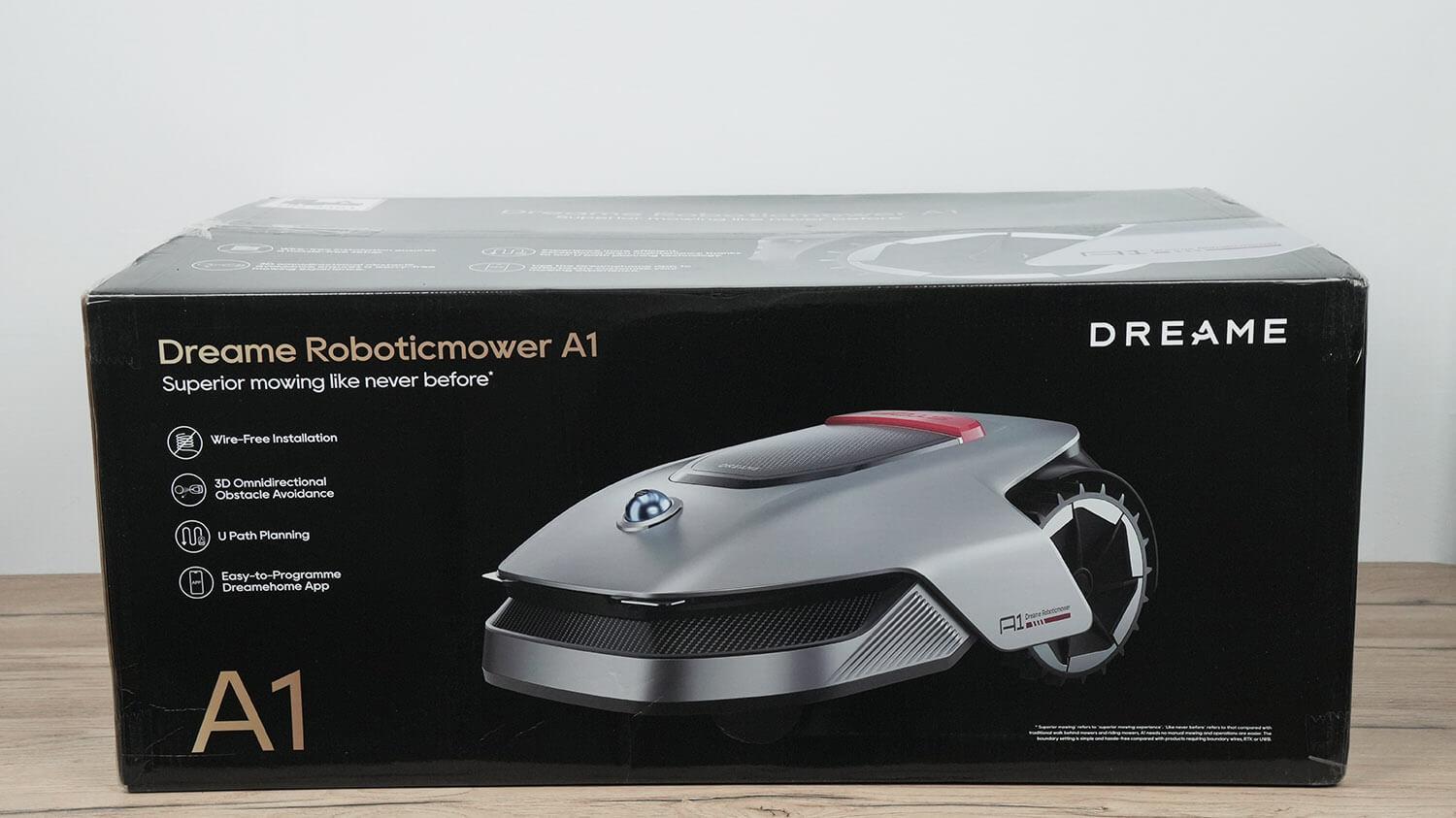
Box
It comes with a charging base, a power adapter, screws for securing the base to the ground with a hex key, a brush for cleaning the lidar when docking it with the base, a set of spare blades, an instruction manual, and a lint-free cloth for wiping the lidar.
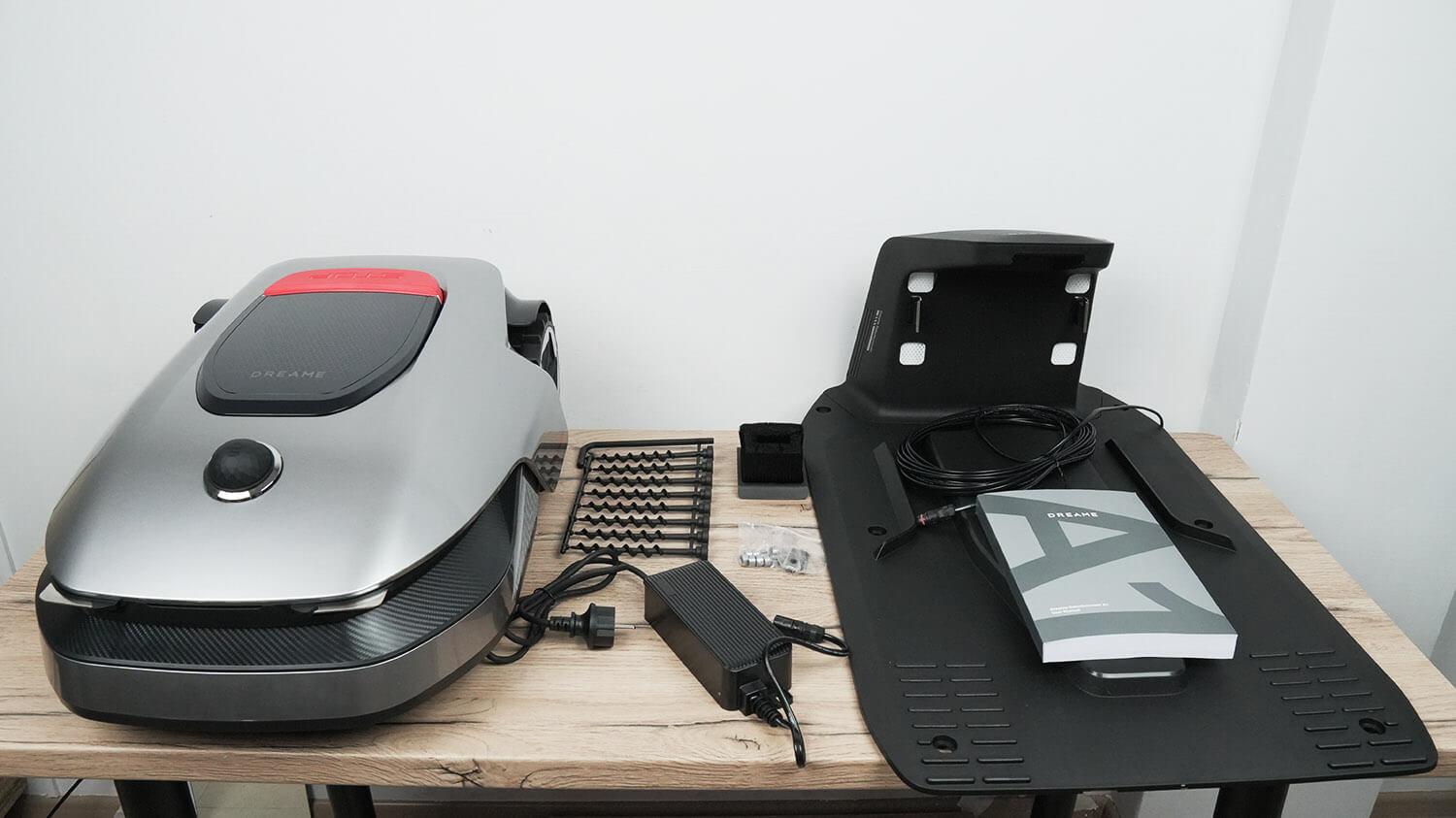
Equipment
I'll note here that, unfortunately, despite the manual being so thick, it's not in Russian, and I didn't like that. The device is complex, unusual, and requires careful study of the operating instructions, which will be difficult for Russian-speaking owners.
Appearance
Now let's take a look at the Dreame Roboticmower A1's design. It's finished in black and gray. It looks like a Porsche designer designed it, and it looks very stylish and premium.
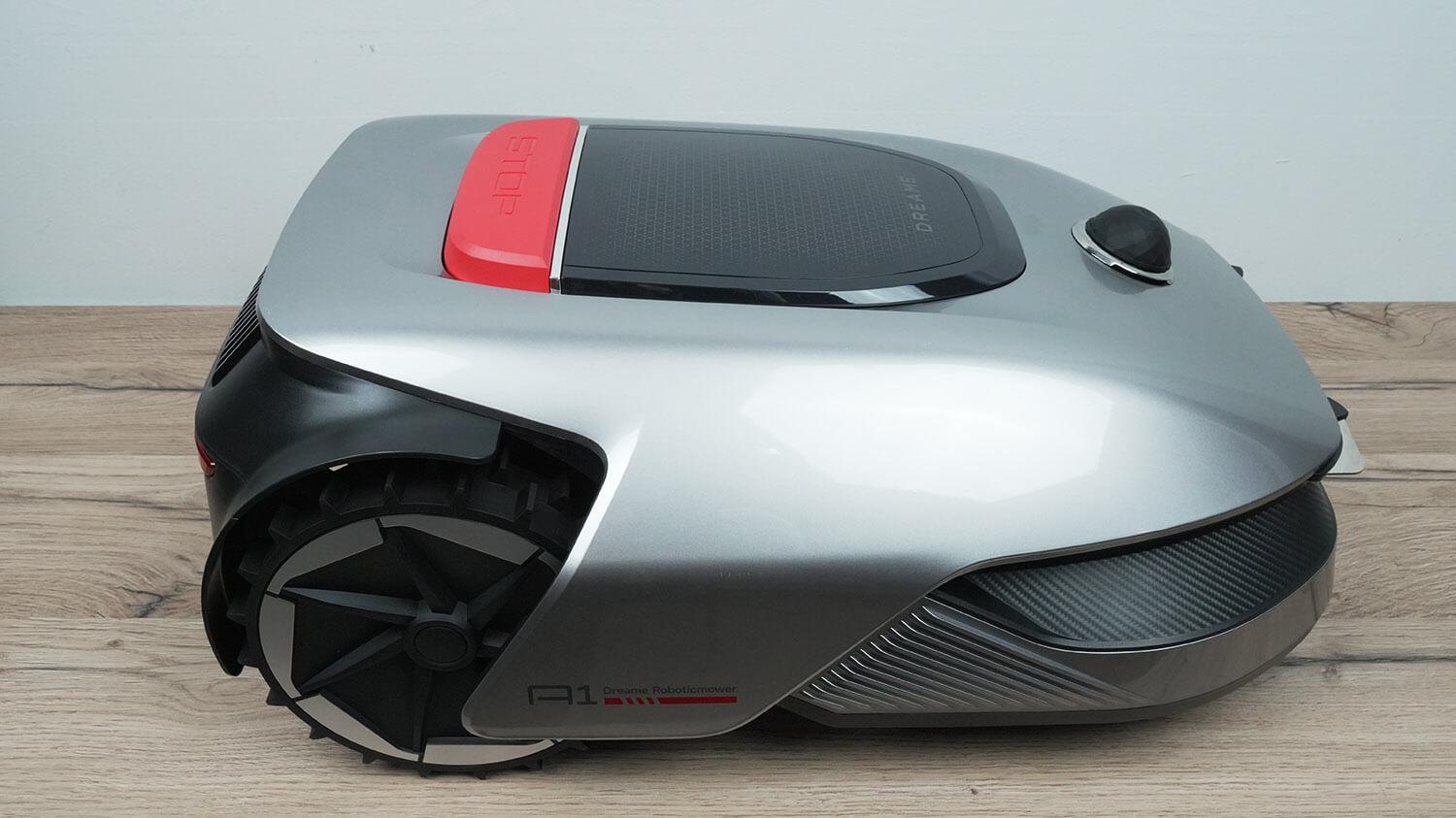
Side view
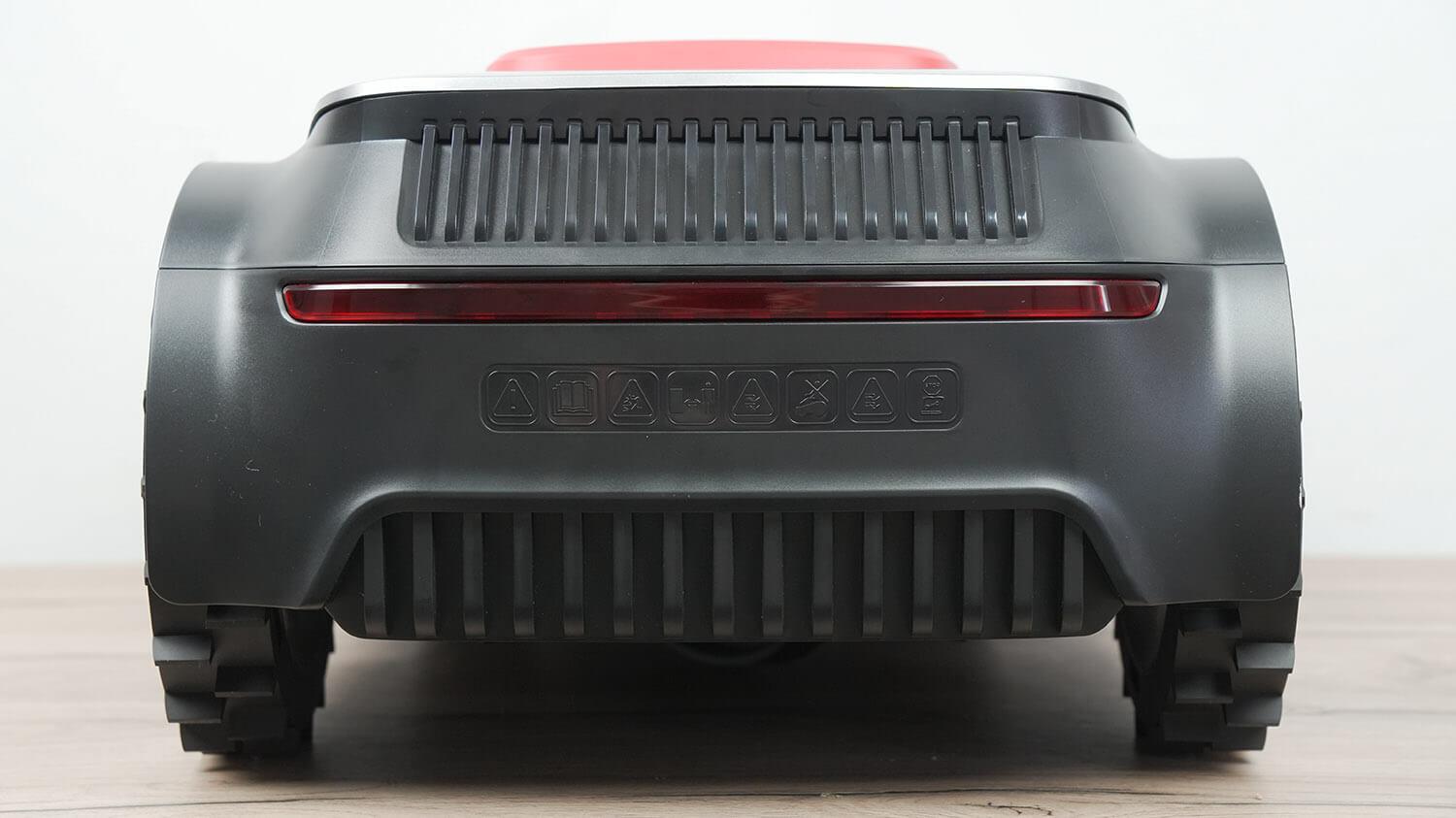
Rear view
The lidar, protected by a rubberized cover, is responsible for navigation. Don't throw it away; keep it somewhere handy, as it will be useful during operation.
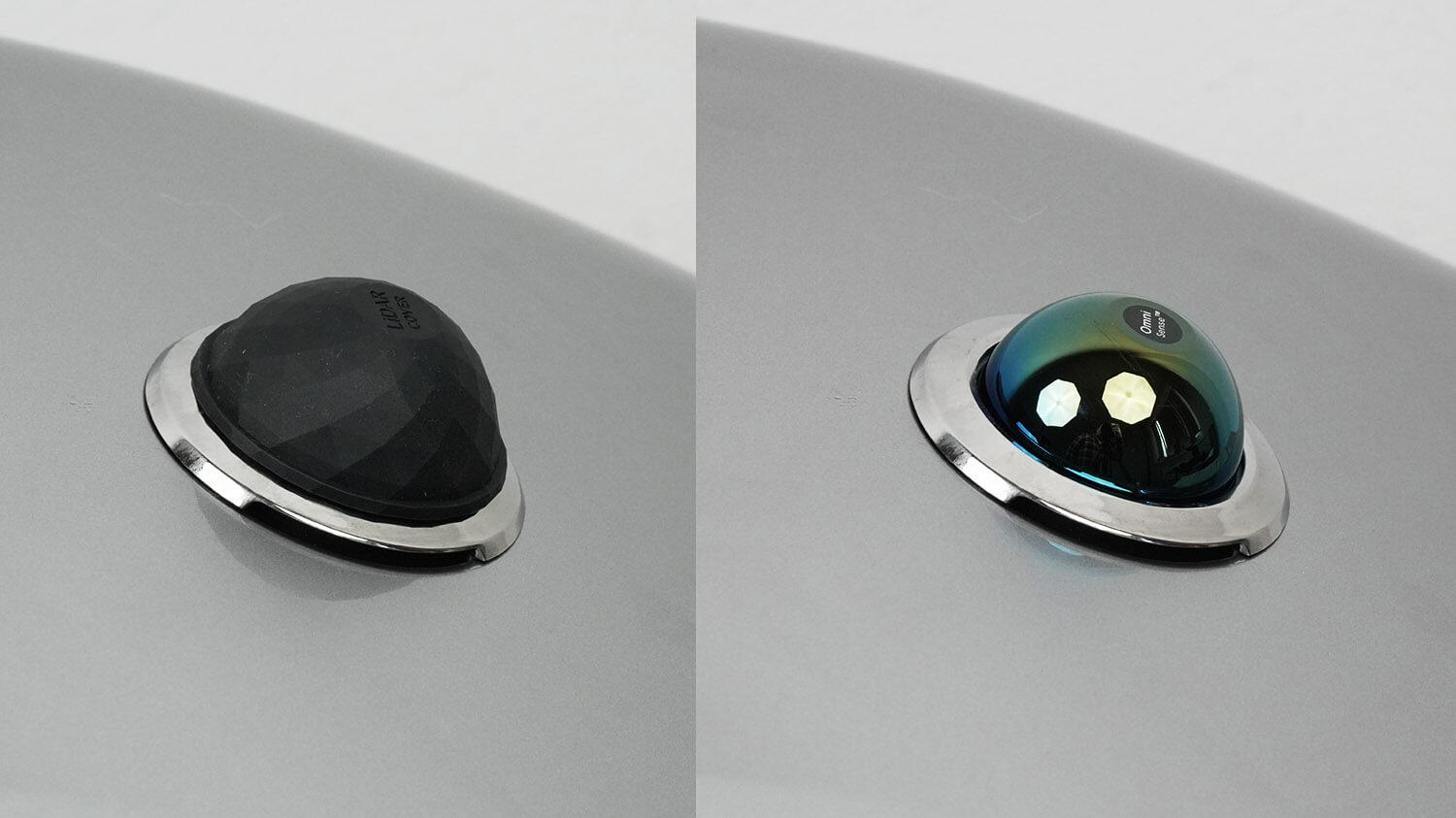
Lidar
The lidar's appearance differs from the typical turret found on robotic vacuum cleaners. Here, it's a glass hemisphere bearing the name of the implemented OmniSense™ 3D technology. Laser navigation enables the robot to precisely navigate without the need for boundary wires, RTK stations, or radio beacons. And the embedded algorithms allow it to move in a serpentine pattern without skipping sections.
The front of the robot is equipped with charging terminals and a soft-touch mechanical bumper.
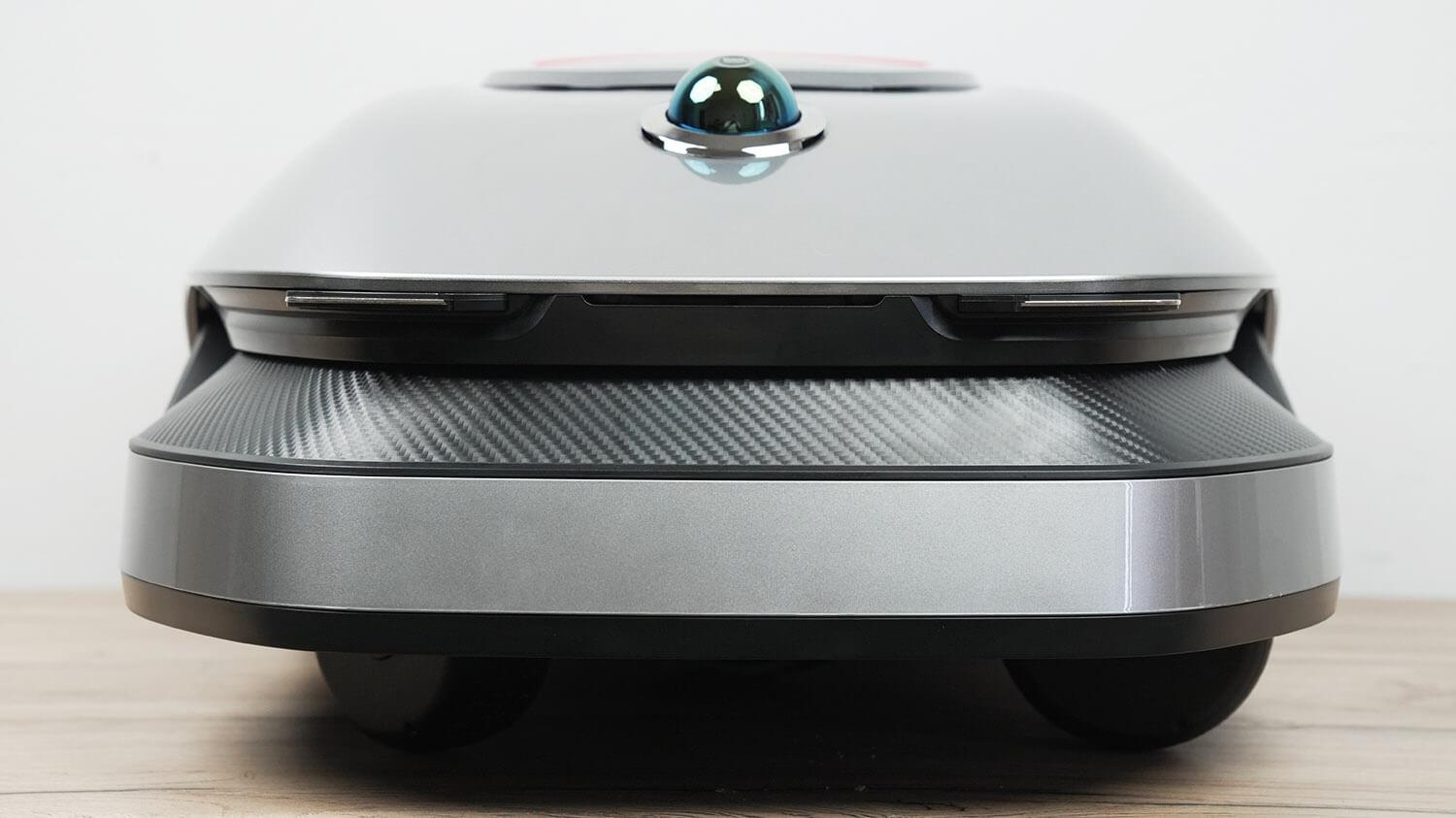
Front view
On top of the body is a large red emergency stop button, which also opens the top lid. Below it is a control panel with a display.
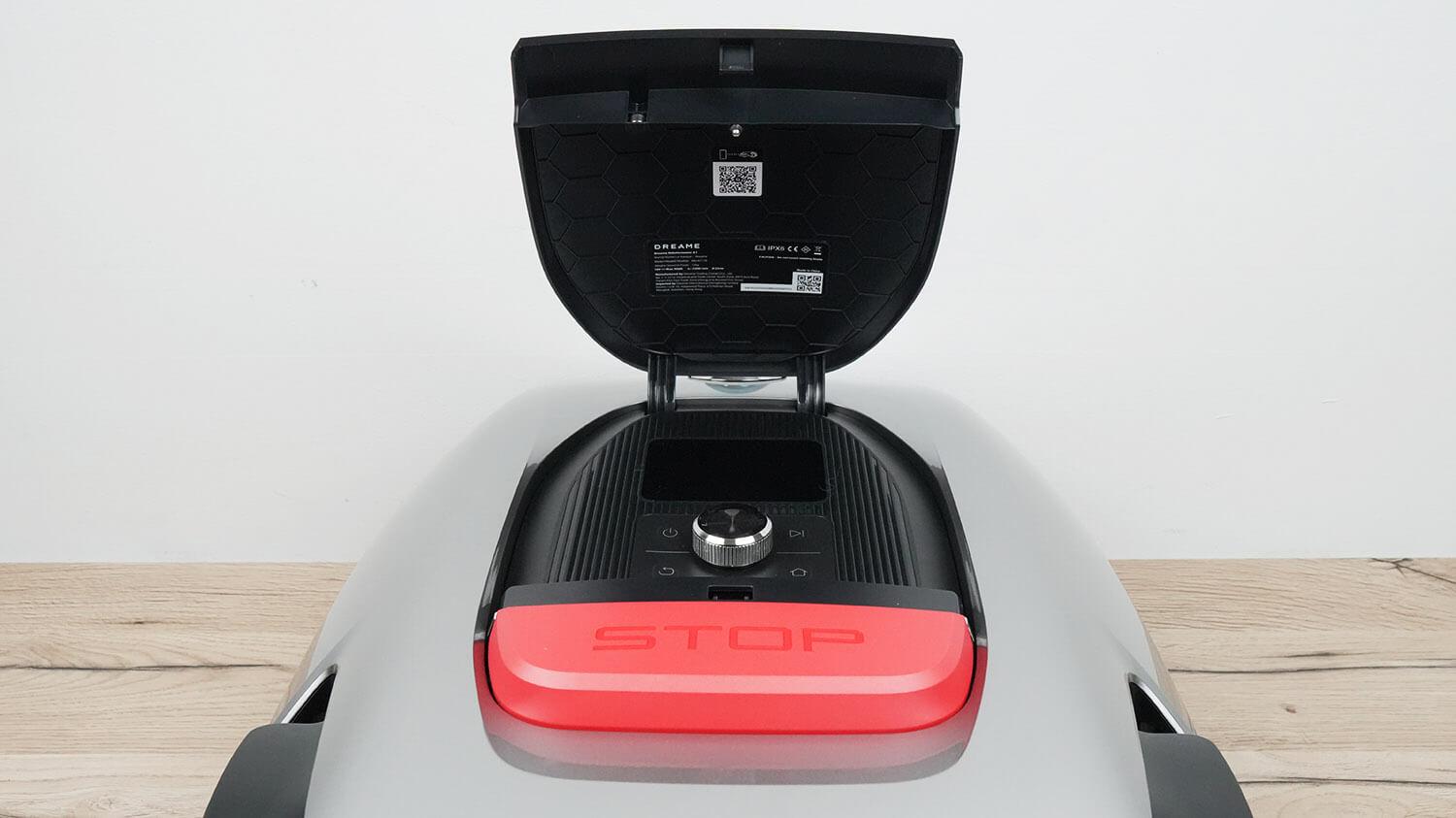
Control panel under the cover
The display is informative, but unfortunately, there's no Russian interface. There are four control buttons and a rotary switch. Conveniently, the robot can be controlled via this control panel.
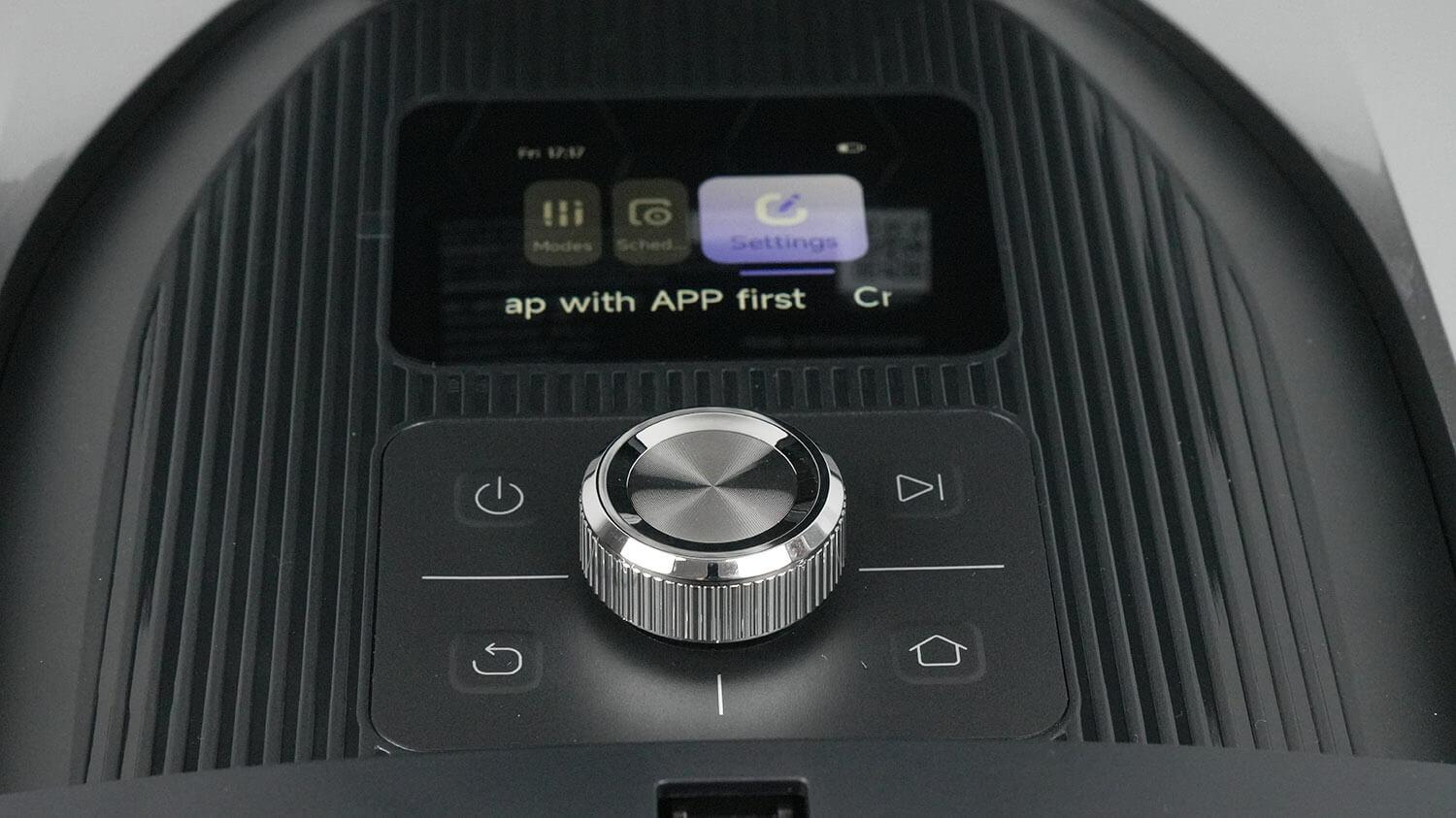
Control buttons
The robot moves using two large rear wheels with treads and auxiliary front wheels that rotate 360 degrees. The front wheels are removable, making it easy to maintain.
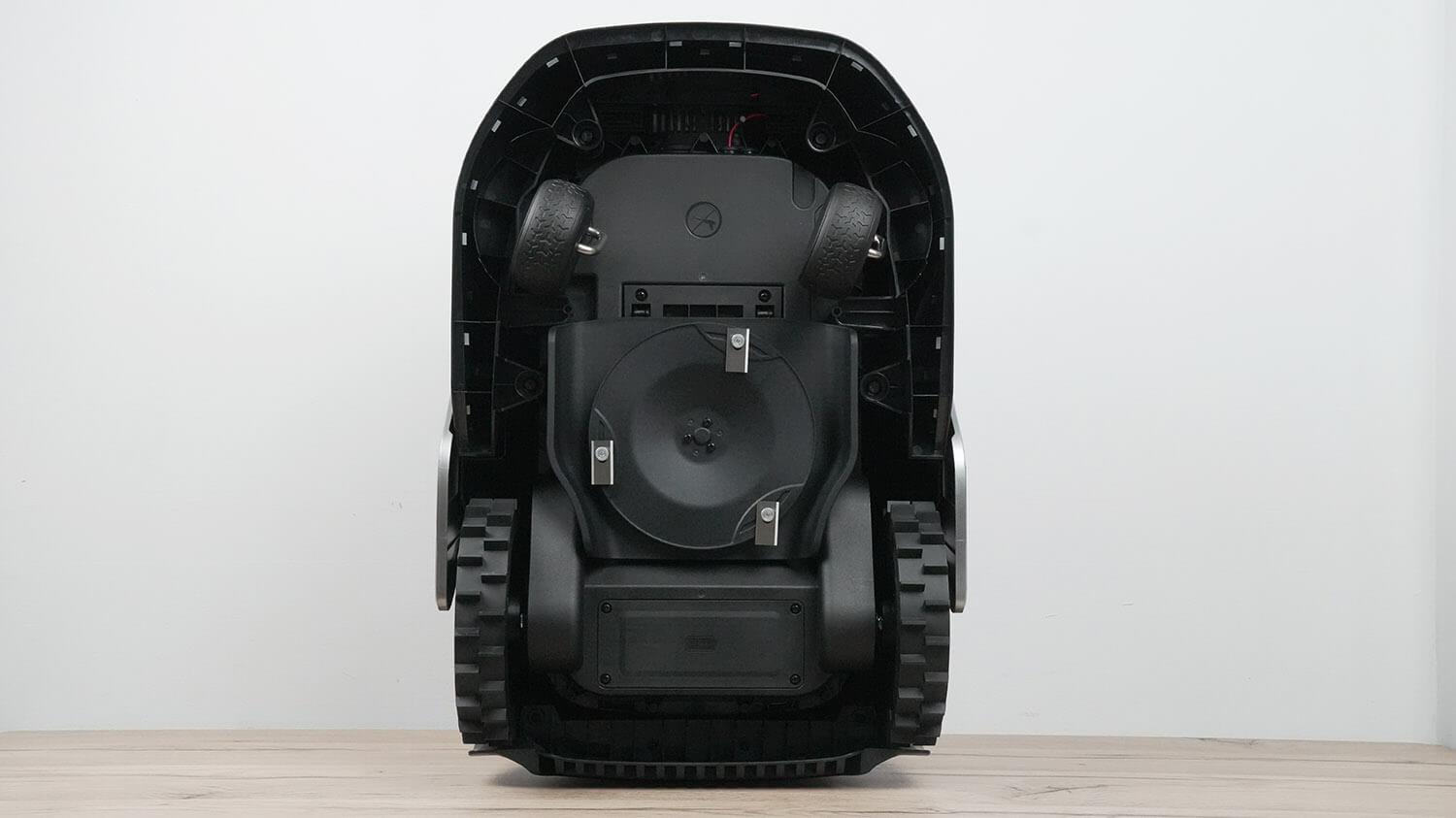
Bottom view
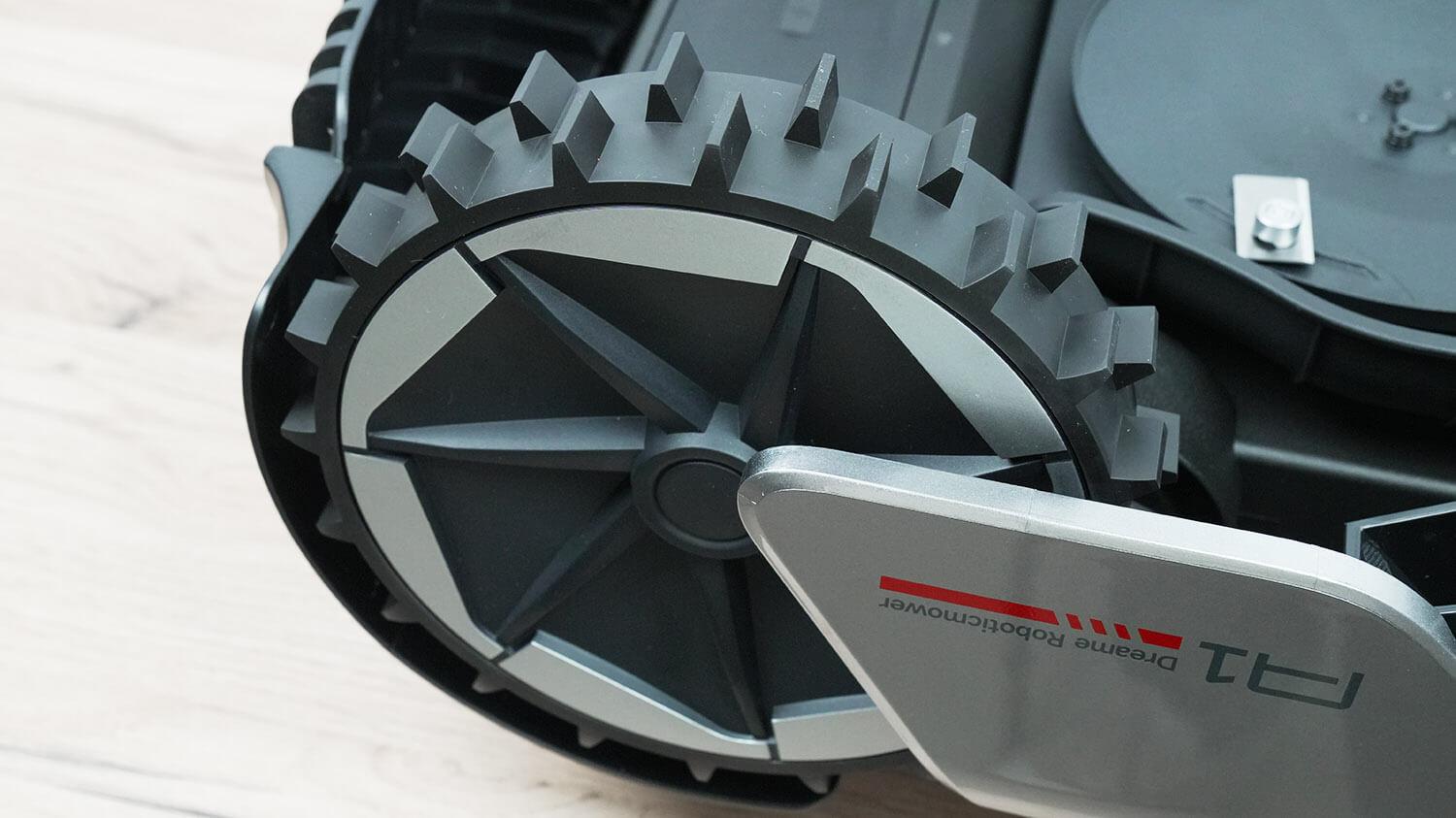
Rear wheels
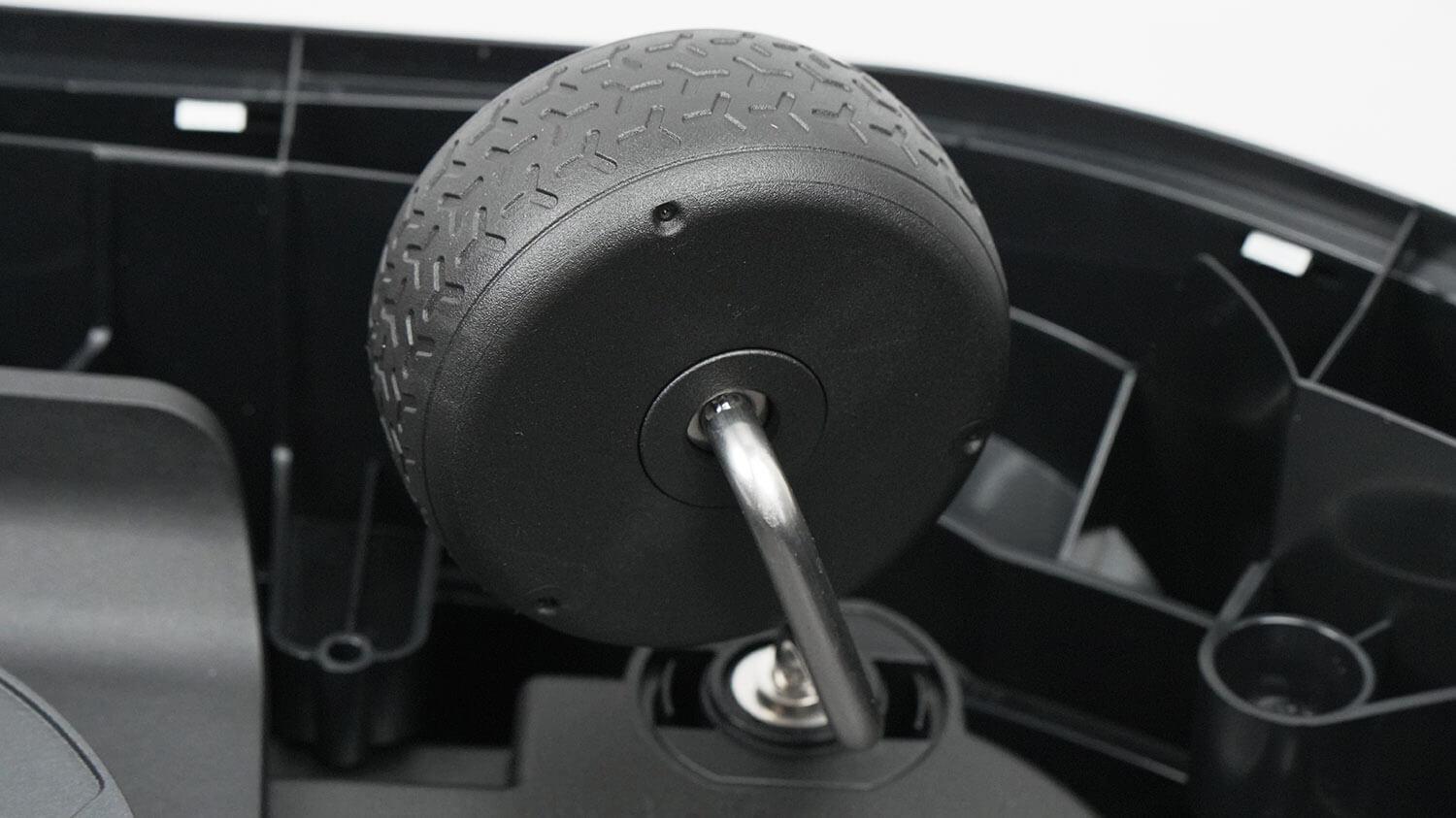
Front wheels
The lawn is mowed by three blades mounted on a blade mounting disc. The disc is centered on the body, so it's immediately clear that the robot will have a blind spot from the edge of the blades to the edge of the body, the width of which we'll verify in tests. Conveniently, the blades are quick-release, making them easy to remove for replacement or maintenance.
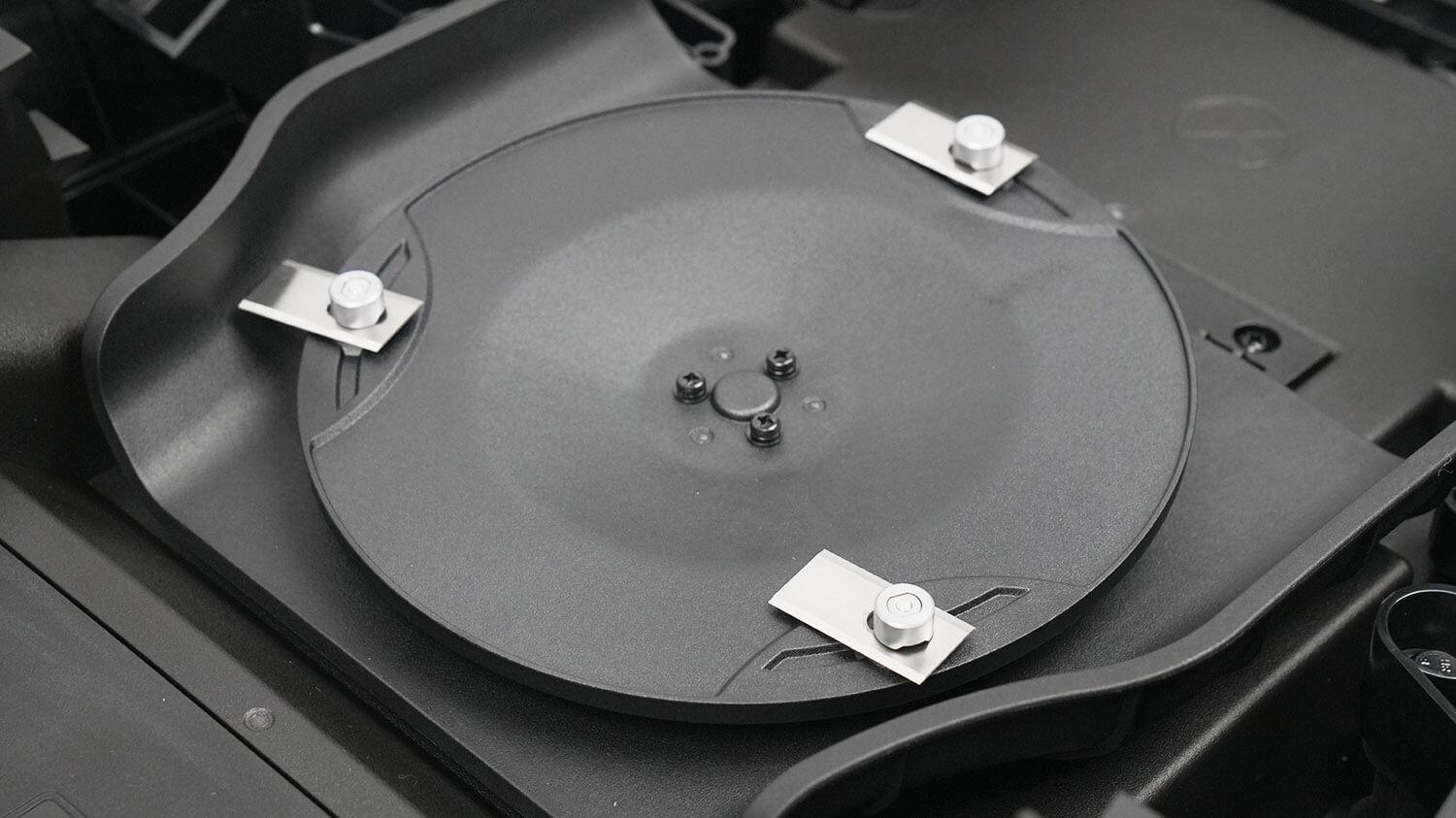
The knives are fixed to the disk.
The blade disc's floating mounting plate allows the blades to automatically adjust to the terrain and protect the disc from damage when hitting bumps or other objects. Furthermore, the lawn itself will be cut more evenly on uneven surfaces.
I would also like to point out that the lawn mowing height can be adjusted within a standard range of 3 to 7 cm.
During transportation and storage, you need to use a cover like this one, which is installed on the blade mounting disk right out of the box.
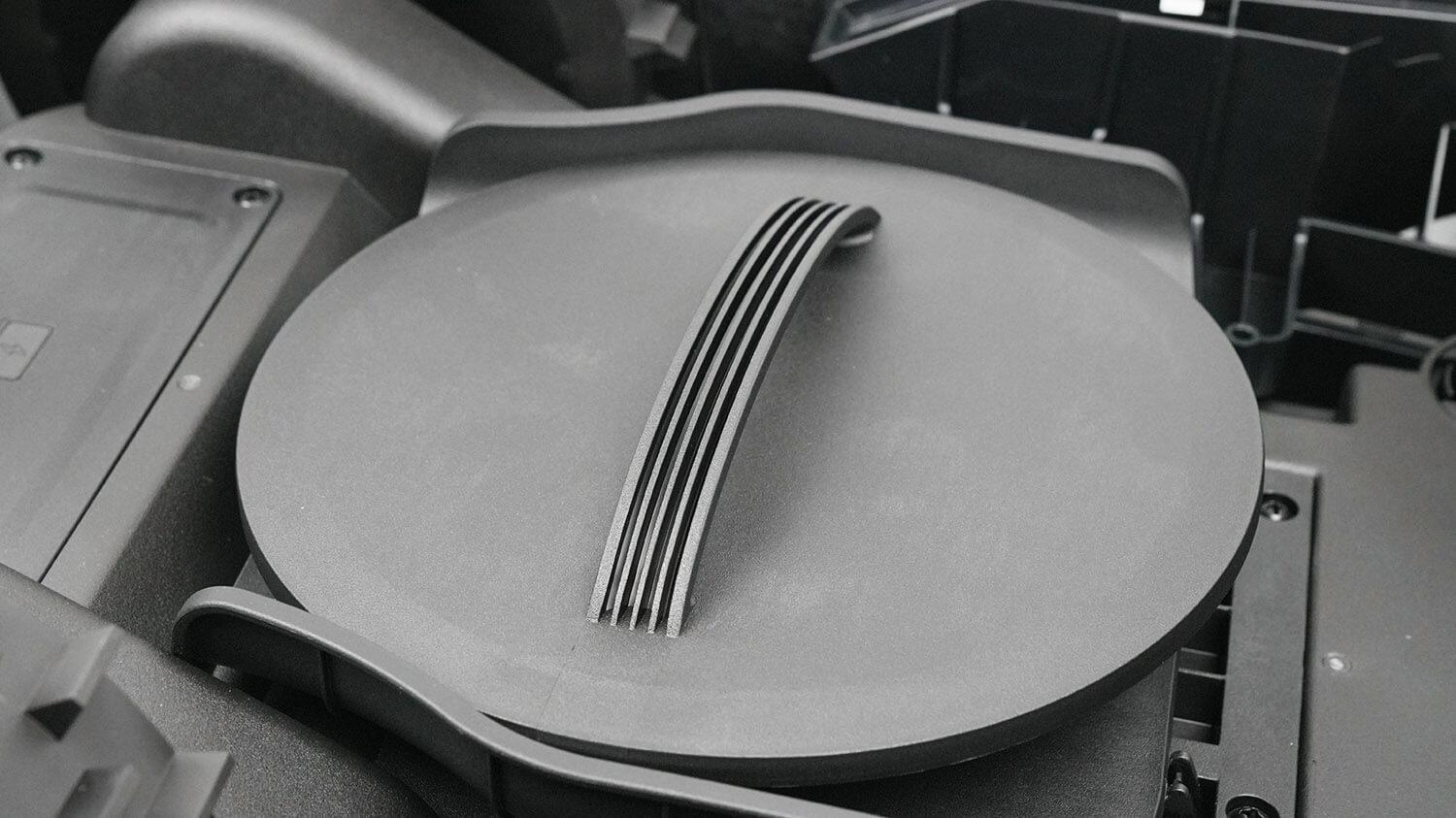
Protecting knives with a cover
It's also important to note that the robot's body is waterproof on all sides, making it easy to clean and safe to handle if exposed to rain. It has an IPX6 rating.
Speaking of the base, the Dreame Roboticmower A1 charges on it. A special brush needs to be installed in the docking station to clean the lidar sensor when the robot is docked to the base.
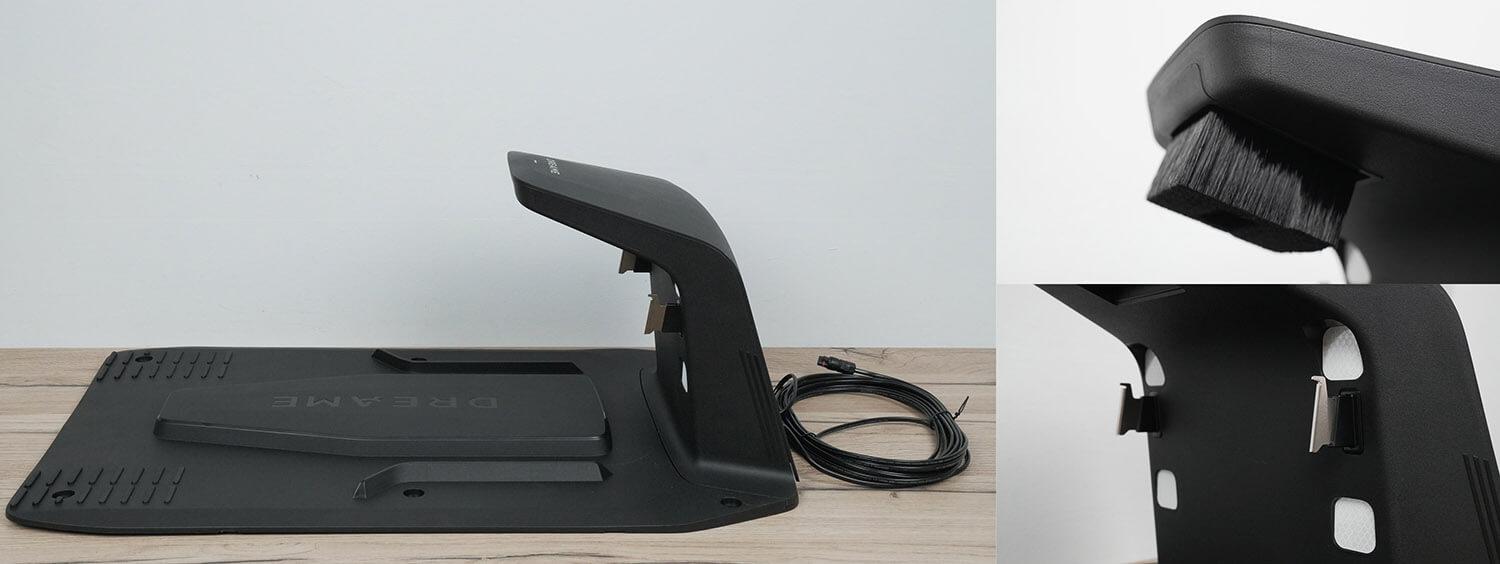
Base
The pros and cons of this design will be discussed during the final review. Let's move on!
Technical specifications
The main characteristics of the Dreame Roboticmower A1, as stated by the manufacturer:
- Battery: Li-Ion 5000 mAh.
- Charging time up to 65 min.
- Recommended lawn size: up to 2000 sq.m. (in 24 hours).
- Cutting height 30-70 mm.
- Mowing width 22 cm.
- Maximum cutting angle: 45% / 24°.
- Protection class: IPX6.
- Robot weight: 12 kg.
Here, in my experience, it seems that the battery is weak for this type of device, but at least fast charging is implemented in 65 minutes.
Functional capabilities
Let's move on to an overview of the Dreame Roboticmower A1's features. It's controlled via the proprietary Dreamehome mobile app. It's user-friendly, intuitive, and available in Russian. Connection was straightforward. You just need to create a four-digit PIN and enter it manually through the robot's control panel.
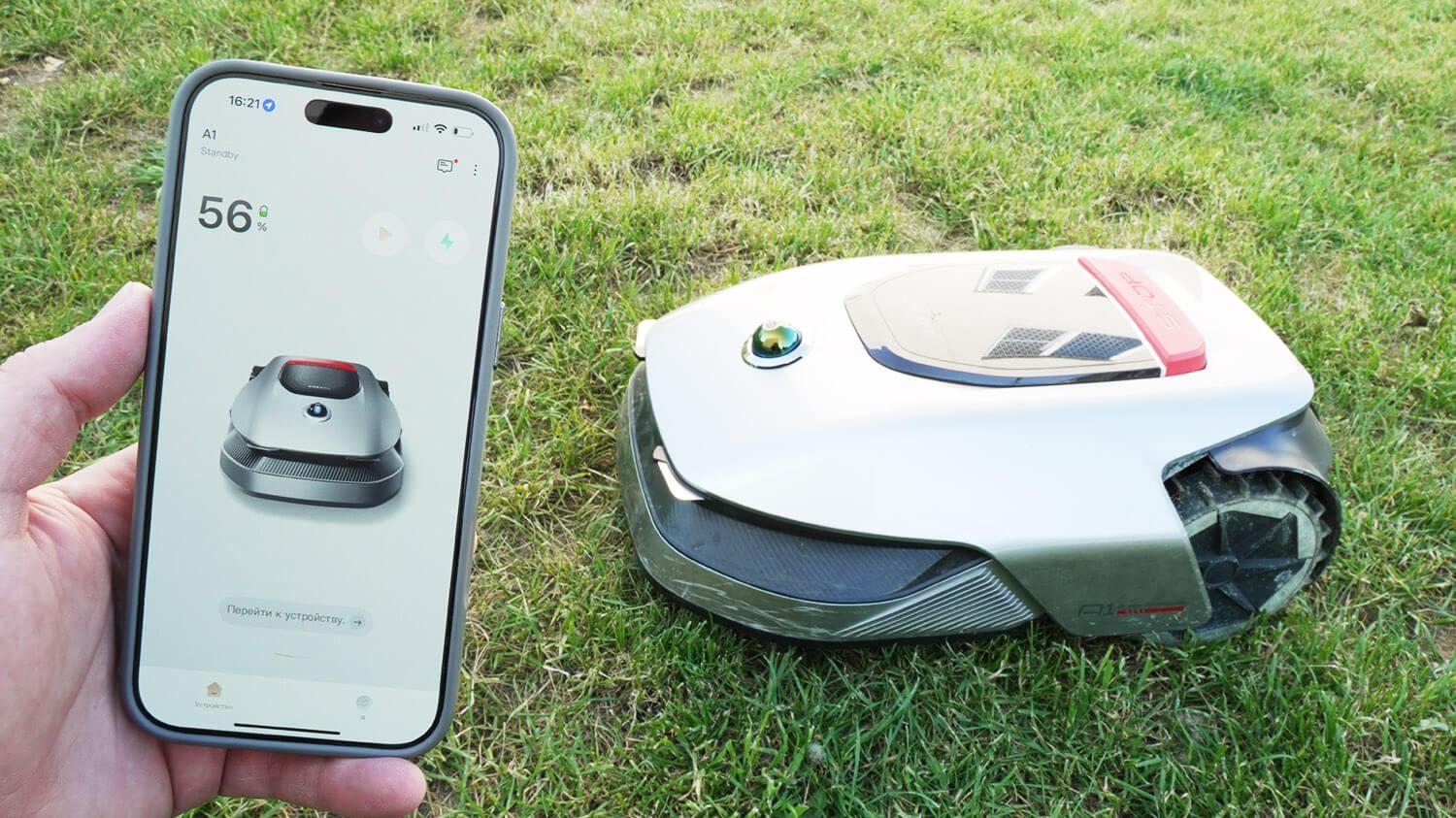
Control via app
Now about the capabilities. After creating a map and saving it, you can choose one of four operating modes: mowing the entire available area, mowing the edges, mowing a specified zone, or mowing a point up to 9 square meters. You can also set up a mowing schedule, which will increase the robot's autonomy. There's also a map editing section. Here you can set no-go zones, edit zone boundaries, add new zones, and set a route from one zone to another or for docking the robot with the base.


Functions
The mowing settings are equally interesting. You can choose between two driving modes: standard and efficient (aka fast). You can smoothly adjust the mowing height and, crucially, configure obstacle avoidance settings. Here you can turn obstacle detection on or off, select an obstacle avoidance height between 10 and 20 cm, manually set the mowing direction, which I find very convenient, and even enable automatic direction adjustment by 5° after each mowing cycle. You can also choose to automatically follow the edge after each selected zone and avoid detected obstacles along the edges, which I find equally useful.
Another interesting thing is that there is a user mode in which you can individually adjust the mowing parameters for each zone, which is very convenient!
Additional features include installing an alarm on the robot, viewing a mowing log with statistics for each cycle, checking the status of consumables, enabling rain and low temperature protection, setting up a "Do Not Disturb" mode, setting a laboratory mode for avoiding obstacles up to 5 cm high, setting up a charging mode and an anti-theft alarm, enabling a child lock mode, and selecting a voice package.
Some features are worth exploring in more detail. The anti-theft alarm system instantly sends a notification to your smartphone and immediately blocks the robot if it is picked up and moved outside the mapped area. In the latter case, you'll need to purchase a special communication module.
An interesting feature is rain protection. If the robot gets wet, it will automatically return to its base to wait out the storm. You can set the waiting time at the base in the settings, ranging from 1 to 8 hours. The same applies to low temperatures. If the outside temperature drops below 6 degrees Celsius, the robot will return to the base, as such temperatures are dangerous for it.
I'd also like to point out that the Dreame Roboticmower A1 supports voice notifications in Russian, which is a plus.
As you can see, there are a lot of features, and based on my limited experience testing robotic lawn mowers and other similar robots, the implemented capabilities are sufficient for flexible mowing settings tailored to individual needs. The only thing missing is an active camera for monitoring the yard, as is already popular in robotic vacuum cleaners.
Testing
Finally, let's move on to the tests, which will further reveal the robot's capabilities and help you form your opinion. I recommend watching the video review on robovac.washerhouse.com, where all the tests are clearly shown:
Getting ready for work
The first step is to set up the base in a suitable location, secure it, and launch the robot from the base to create a map. This is all cleverly designed. In remote control mode, using a smartphone as a remote control, we guide the robot as closely as possible along the boundaries of the area and close the route so that the robot returns to its starting point. Then, we plot a route from the starting point to the base, and the map is saved. We divide it into zones, set no-go zones if necessary, and test the launch.
Let me point out right away that I don't have a professional lawn, but a rural version, a mix of grass and weeds. I intentionally "ran" the area so the grass was tall to test the robot's capabilities in challenging conditions.
Launch on grass of different heights
And here we see that even with the obstacle detection system disabled, the robot is unable to crush the grass and mow it to its full potential. It bumps into the undergrowth and moves away. But this is normal, as the robot is not designed for such tasks. Note that the manufacturer's instructions state that before starting the mower, the area must be prepared by removing all unnecessary debris and cutting the grass to a depth of 10 cm.


Mowing tall grass
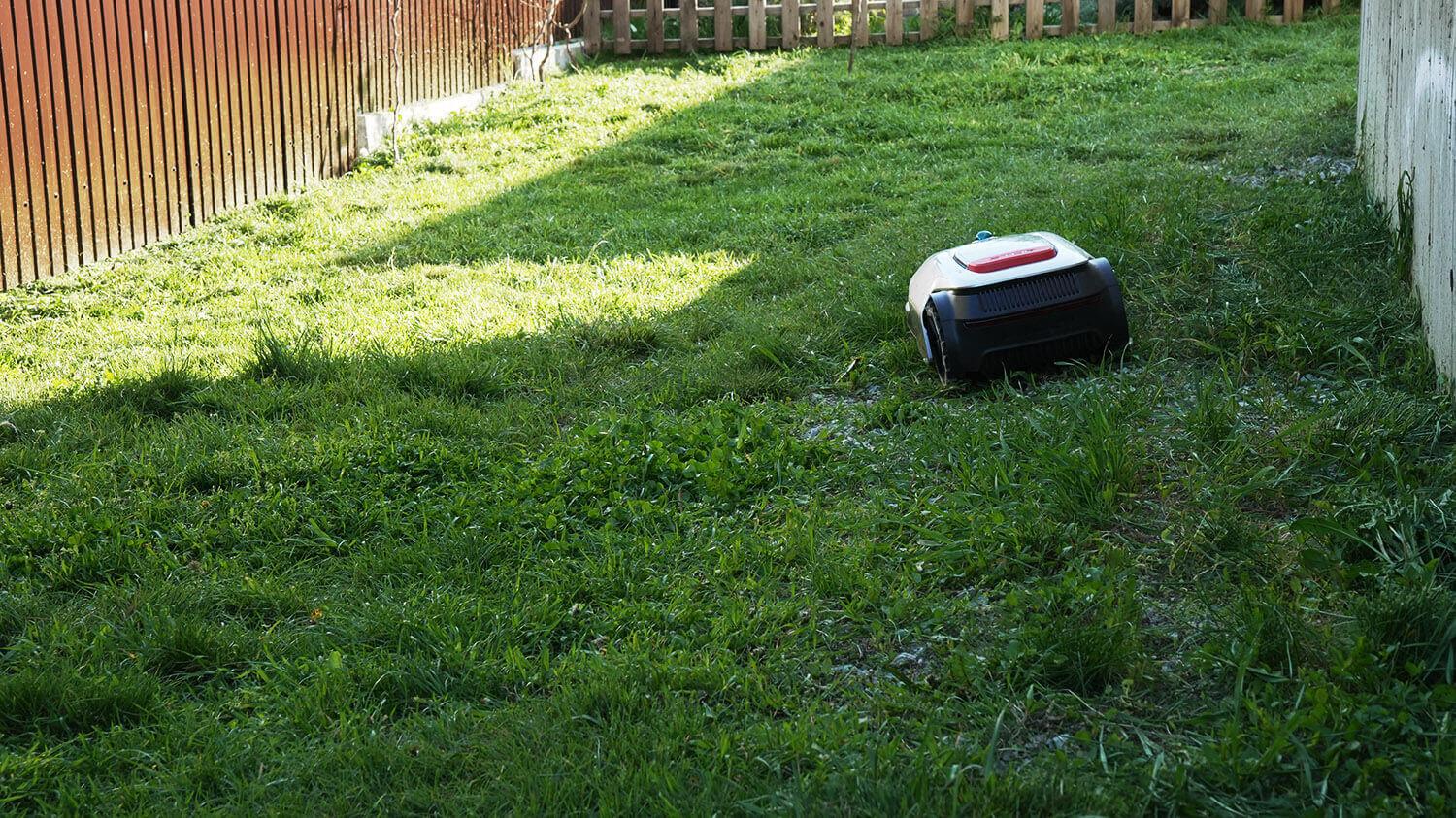
I tried manually cutting the grass down to about 10 cm. The robot's maneuverability improved significantly, but it still occasionally bumped its bumper into the shortened thickets and had to drive around them.
Mowing medium-height grass
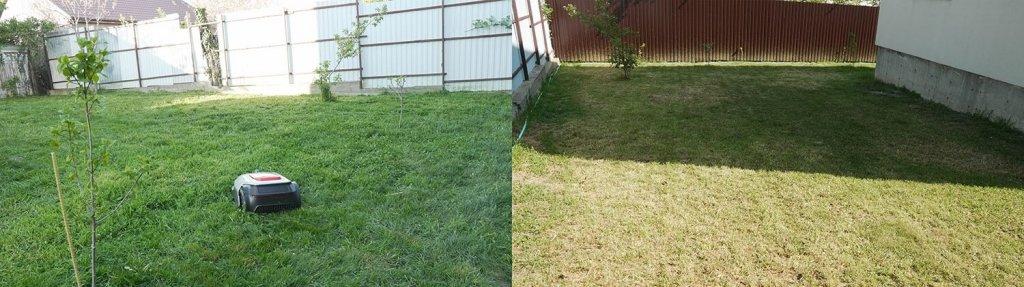
The last time I mowed the lawn, I cut it back to about 6-10 cm and ran the robot again. And then, finally, it started working properly. It covered the entire accessible area correctly, without missing a beat, leveling my uneven, hand-mowed lawn. Here's a look at how it did it and the condition of the lawn before and after several full runs:


Mowing the prepared area
Lawn before and after
A very good result in my opinion!
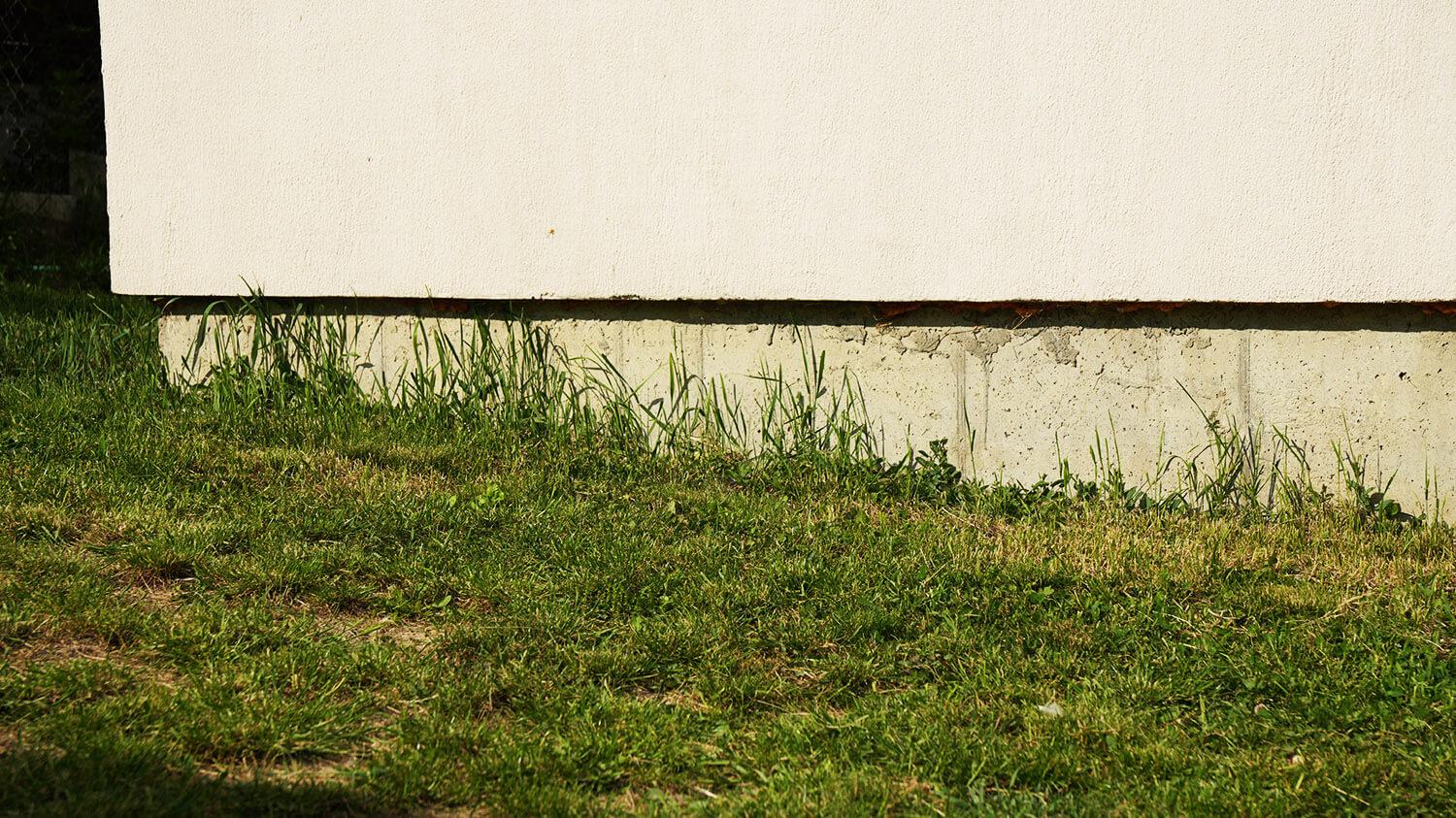
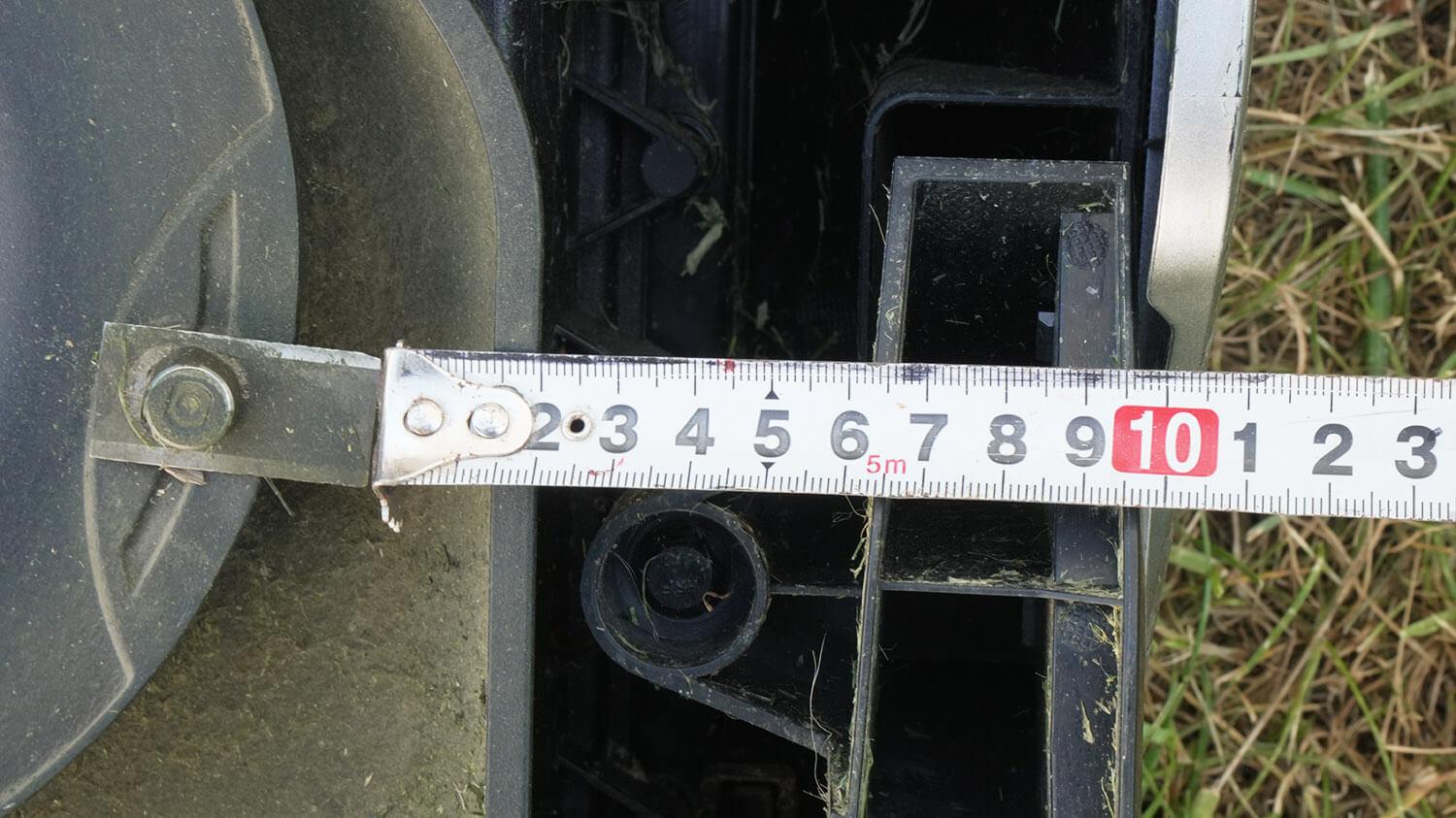
All that remains is a blind spot along the perimeter, out of reach of the knives. It's 10.5 centimeters wide.
Blind spot along the site boundaries
Blind spot width
This will be useful if the lawn isn't edged by low sidewalks or other structures that allow the robot to reach the edge of the lawn with its central part. In my case, the robot is able to mow the edge of the lawn along the path without any gaps or blind spots.
Autonomy
The next important thing to test was the robot's battery life. It managed to cover 160.9 square meters of territory in 96 minutes on a single battery charge in efficient mode, or 82.1% of my 200-square-meter plot. The battery was fully recharged in 65 minutes, as stated by the manufacturer. In total, one mowing and charging cycle is approximately 160 minutes.


Autonomy
As a result, I can say that although the battery is weak, it is greatly helped by the fast charging, which allows you to mow about 700-750 square meters of lawn in 12 hours, or about one daylight hour.
These figures will be kept for future comparisons with other robotic lawn mowers.
Object recognition system
I also tested the functionality of the advertised object recognition system. Once the area was evenly mown, I laid out common objects that might appear on the lawn or be accidentally left behind. I set the object recognition accuracy to maximum.
So, the Dreame Roboticmower A1 drove right over a garden hose without even noticing it. It carefully avoided a watering can. It ran over a lying shovel, as well as a hammer. It also ran over a toy hedgehog, which could have been any small animal. It also touched a ball, leaving only a large watering can untouched. The robot marked some objects as obstacles on the map, including trees out of frame, but didn't recognize anything as corresponding objects.


Object avoidance system
That is, I can't confirm the presence of an object recognition system, although it's unlikely that such technology would actually be implemented here. There's no camera with artificial intelligence, only lidar.
The robot's condition after testing and its maintenance
I'll show you what's happened to the Dreame Roboticmower A1 after exactly one month of use. Let's start with its visual condition. The situation here is certainly not encouraging. The entire body is heavily scratched. I think the plastic should be more durable and wear-resistant. This Porsche-designed robot looks like it's been through a real rally or a demolition derby.
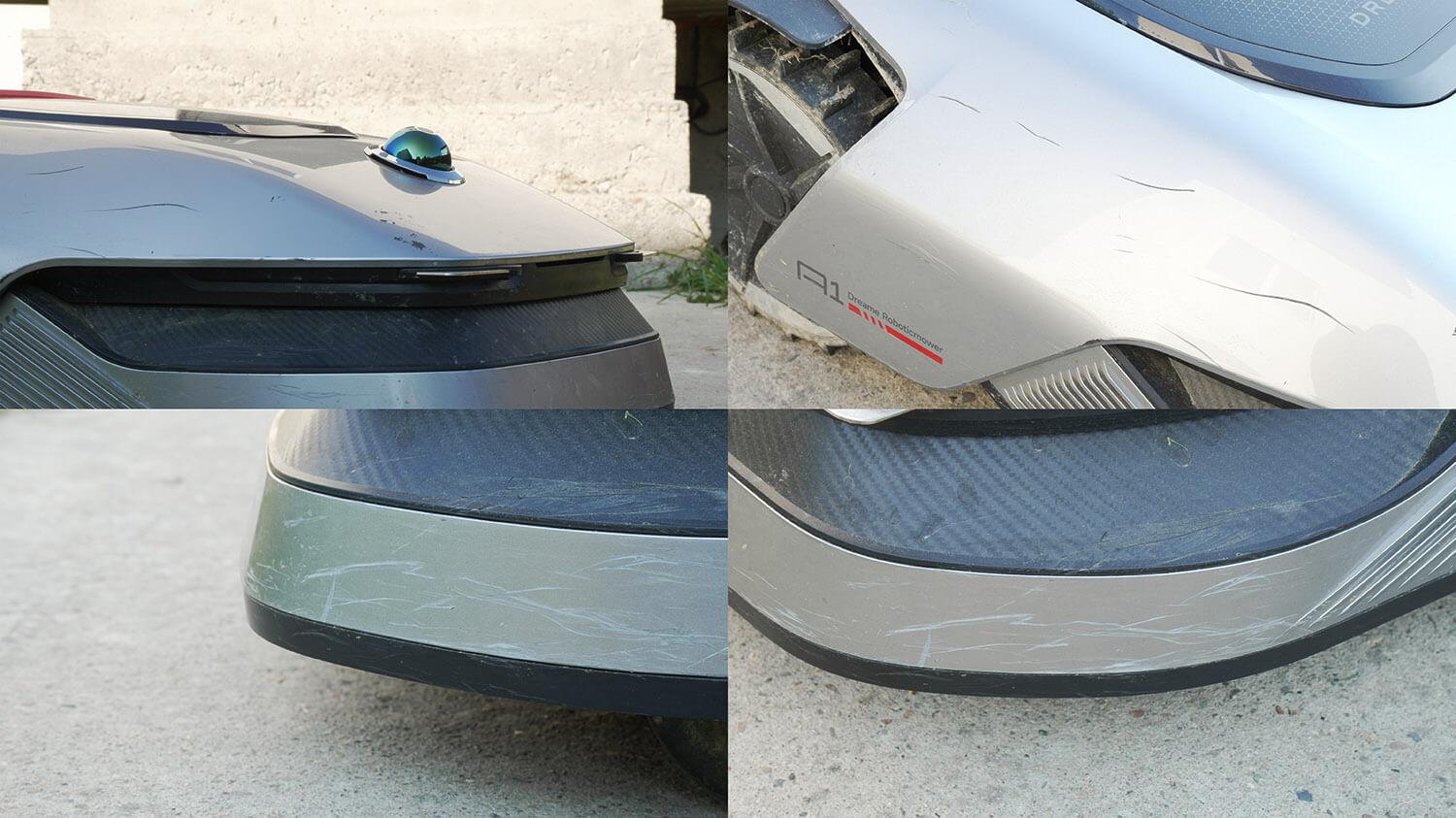
The robot's condition after a month of operation
Let's check the condition of the blades. Don't forget to replace the cover when turning the lidar over to avoid damage.
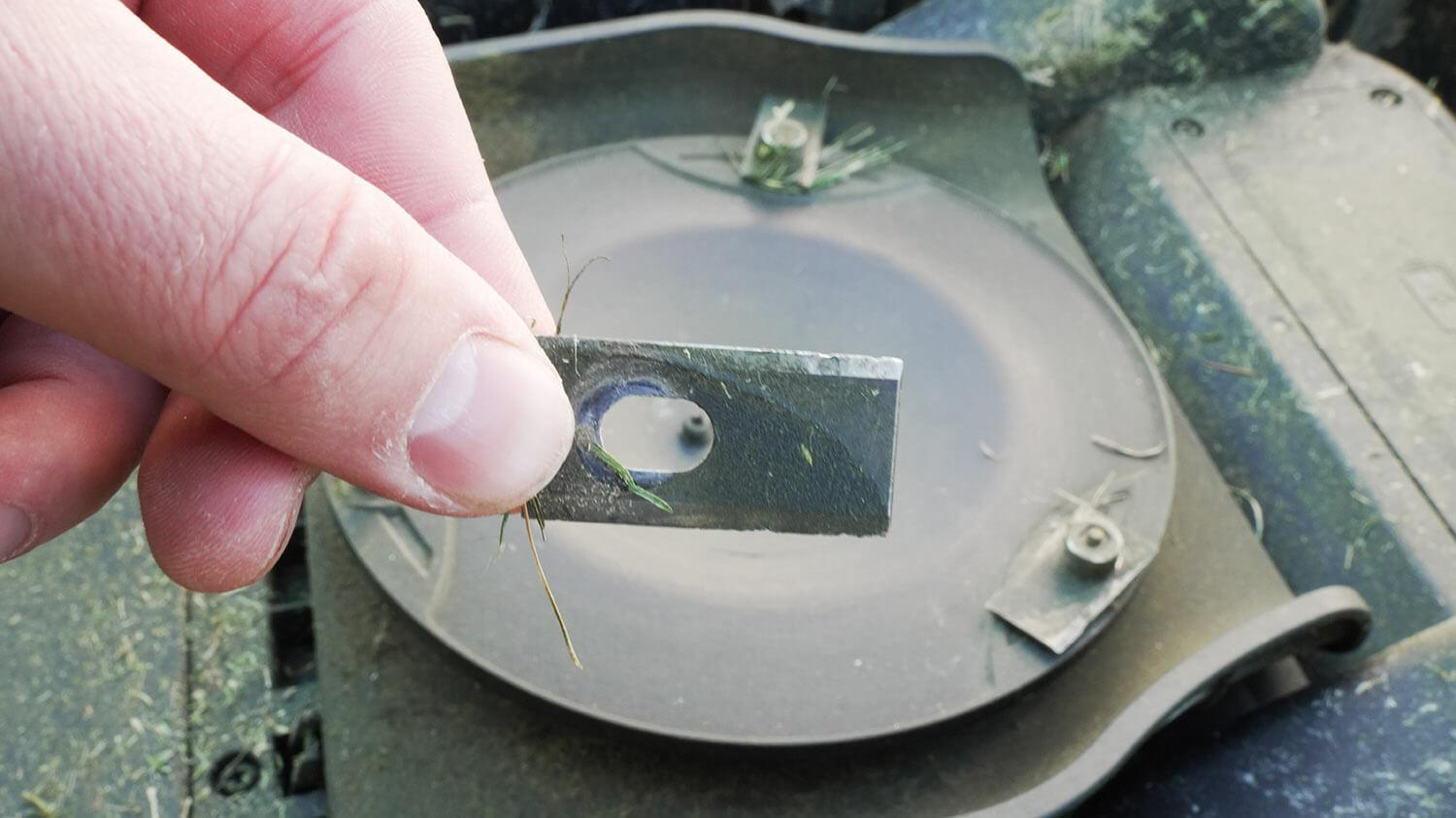
Condition of the knives
We can see they've been damaged after a month of use, but I can say there were a couple of unusual situations. First, I was running it through very tall grass. Second, it found a steel wire in the grass and wrapped it around the disc, causing the blades to come into contact with the wire. This is likely what caused this. Fortunately, the blades are included, and according to the regulations, they should be changed every 100 hours.
Speaking of the robot's cleaning function, it's convenient. We position it vertically and wash it with a hose. Using high-pressure washers is prohibited.
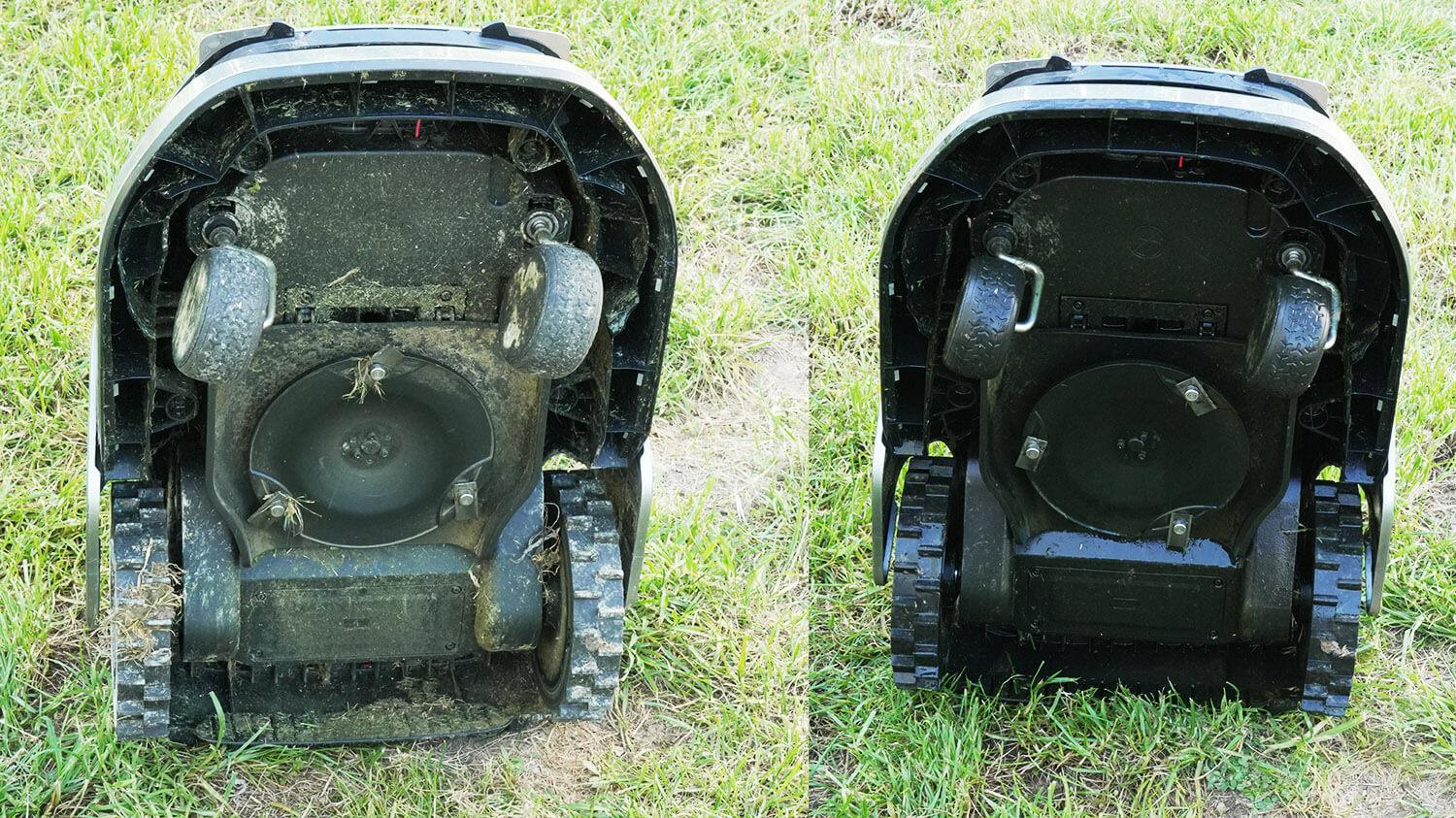
Washing the body
Some observations
In conclusion, I'll share a few observations. I wasn't very pleased with the robot's tendency to dig in and slip. It also slips on slopes. After speaking with an experienced user, he said the robot slips because it has a shorter wheelbase, wider axle, and wider wheels. Add to that the low suspension, making it more likely to get stuck if the terrain is sloped or unprepared.
I also didn't like the lack of manual remote control. Remote control is only available when the robot is close to a smartphone and connected via Bluetooth. Remote control would have made it possible to help the robot escape if it got stuck.
Ideally, it would be possible to automatically adjust to the lawn's boundaries. Manually adjusting the boundaries requires a fine line between the robot scraping against perimeter obstacles, such as fences, and mowing as close to the edge as possible, given its size. For example, robot vacuums are capable of maintaining an ideal distance from walls and other obstacles. So, it would be great if, using lidar, the robot could automatically adjust to the lawn's boundaries and move as close to the edges as possible, roughly following a manually set route. This is precisely the advantage of models with a boundary wire. By taking the time to install it once, you can precisely define the lawn's boundaries, which the robot will follow with high accuracy.
Personal opinion
The Dreame Roboticmower A1 robotic lawn mower was thoroughly reviewed and tested. I'll highlight the pros and cons I discovered, and then share my thoughts on it. I liked the following:
- Lidar-based navigation allows for rapid robot deployment without the need for wiring or beacons.
- Again, thanks to the lidar, the robot can mow the lawn in a serpentine pattern without missing any areas. It has a movement algorithm, whereas my previous robotic lawn mower moved in a random, diagonal direction across the lawn.
- The lawn mowing results were good after testing: the entire area was evenly trimmed, and the robot was able to automatically maintain it without human intervention. Simply schedule mowing and perform periodic maintenance.
- By moving in straight lines, the lawn looks attractive and is cut in stripes, which gives a beautiful effect.
- It is possible to adjust the direction of lawn mowing.
- Remote control via a convenient proprietary app, which offers a wide range of functions for flexible cleaning settings.
- The application interface and voice notifications are in Russian.
- An informative display on the robot's body allows you to control it without a smartphone if necessary.
- Quick-release blades for easy replacement and maintenance.
- The floating blade mounting disc automatically adapts to the terrain.
- The case is completely waterproof, protecting it from rain and allowing it to be washed with a hose.
- Software protection against rain and low temperatures.
- Well-thought-out security system.
- Setting the obstacle avoidance height in the application.
- You can set no-go zones and create several different mowing zones on the map.
- Custom mode allows you to flexibly adjust mowing parameters for different zones.
- Stylish design of the robot.
- Availability of warranty and service.
Now what I didn't like. There were quite a few comments, namely:
- The instructions and display on the robot are in English.
- The system for identifying objects requires improvement.
- There is a blind spot between the edge of the blades and the edge of the housing due to the disc not being shifted to the edge.
- The battery is a bit weak.
- Low suspension allows the robot to reach even grass just over 10 cm high.
- Slippage is observed on inclined surfaces and loose soil.
- Wear-resistant plastic housing.
- There is no way to remotely control the robot's movements manually via Wi-Fi.
- At the time of writing this review, I couldn't find replacement blades, a communication module, or other accessories for the robot for sale.
- High price.
Now I want to go through the comments and tell you what is important to me personally and what is not.
The lack of a Russian-language manual and display translation is certainly important to address so that Russian users, of whom there are and will be many, can read the manual and comfortably operate the robot.
A weak object detection system at this price is certainly odd, but on the other hand, this is the first model in the brand's lineup, and there's already information about the new Dreame Roboticmower A2, which features a camera. This means progress is ongoing, and they had to start somewhere to gain experience and refine the product. Plus, we're waiting for an update; there's a good chance the system will be refined using the existing technology.
The blind spot is a problem with most robotic lawn mowers. I think new models will address this by moving the disc or adding some kind of additional blade, similar to the side brush on robotic vacuums. However, it's probably more appropriate to use a line rather than a blade, for safety reasons.
Low suspension and slippage are individual shortcomings of this particular model, which will not be relevant if you have a flat, prepared area.
The plastic is not wear-resistant – probably also due to the first experience and the desire to make a product that is not only effective, but also beautiful.
It would be good to add remote control via a software update, or explain why this was not implemented right away.
The lack of consumables is really bad, and I hope this issue will be corrected, since the robot is expensive and is purchased for many years, and it requires frequent blade replacement.
And the price is certainly very prohibitive, but on the other hand, the robot's navigation technology is very advanced, and the software is well-designed and offers a wide range of settings. All of this costs money.
So what's the bottom line? I really liked the robot, and even despite all its shortcomings, I have a mostly positive opinion of it. Yes, you need to learn how to use it and properly prepare the area so it mows the lawn consistently and without errors. Once you've done this and set up a mowing schedule, you can make your lawn beautiful and neat, and that's what matters most.
I believe Dreame's entry into the robotic lawn mower market has been a very successful one. I'm confident that the product line will expand in the near future, and that new models will address most of the shortcomings mentioned.
Therefore, if these comments are not critical for you, I recommend purchasing this robot and will keep it for personal use.
If you have any questions, please ask them in the comments. If there are many, I'll release a separate video later with answers and new information about my experience.
Thank you all for your attention and happy shopping. Bye!