DJI ROMO P: Bold design, superior object avoidance, 25,000 Pa and an All-in-One Station!
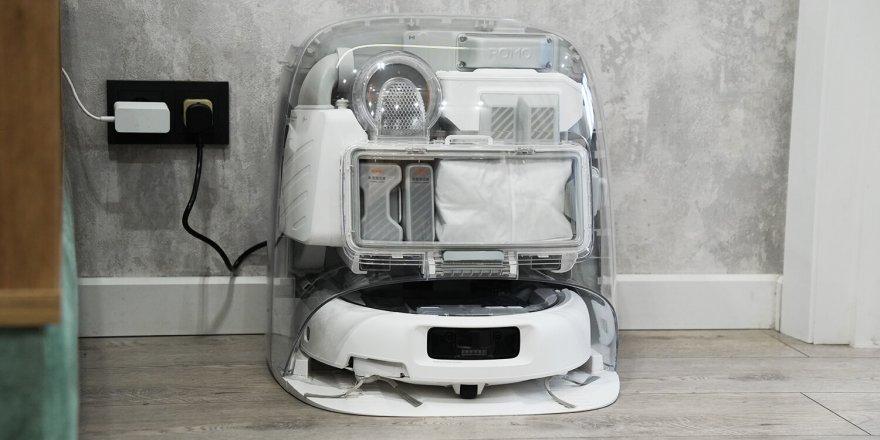
Hello to all readers of the project! This review will examine the much-hyped new product of 2025 – the DJI ROMO P robot vacuum cleaner. DJI is widely known for its drones, and now they've decided to enter the robot vacuum market with a bold solution: a cutting-edge robot vacuum cleaner with an all-in-one station, featuring a transparent body for both the robot and the station. This new product boasts a number of interesting features, including a backlit avoidance system, remote home monitoring, a corner brush, an edge cleaning cloth, an anti-tangle system, and even 25,000 Pa of suction power. The station meets all modern requirements. It features water heating, air heating, a self-cleaning dust bin, automatic detergent mixing, and even a connection to the sewer and water supply. In short, it offers a comprehensive feature set by 2025 standards. The price ranges from $1,000 to $1,800, depending on whether you order from China or from an official brand representative. So, below, I'll test the DJI ROMO P in detail, highlighting the pros and cons based on my test results, and then express my opinion on the robot. So, let's get started!
Regionalism
Let's start with the most annoying part. At the time of writing, the DJI ROMO P is the version intended for the Chinese market. Outside of China, when connecting to the app, a notification appears stating the model's region is incompatible. Connecting the robot to a network or accessing the menu is impossible. There are ways to bypass the regional lock, but disclosing them is prohibited by law, so it's recommended to consult the forums, as I did. Special thanks to Artem Belik for his help connecting the robot.
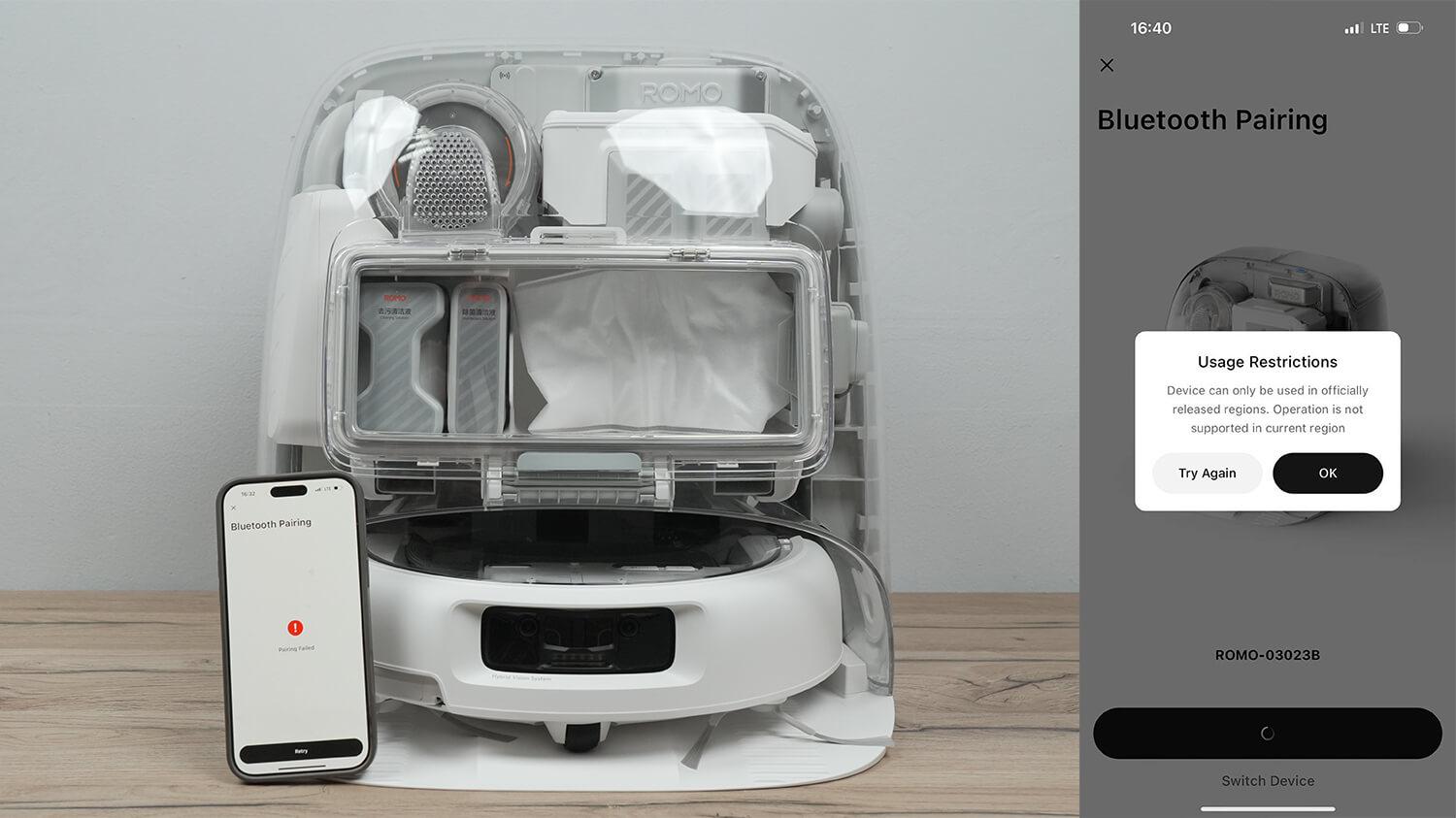
Regional blocking
Incidentally, as far as I know, even official brand representatives are currently selling the Chinese version with regional protection in local online stores. A global version of this robot is expected to be announced at the end of October. The brand has already published a promotional video on YouTube with the announcement date set for October 28, 2025. It would be great if they lifted the regional restrictions on the Chinese versions as well in that case.
After some fiddling around with the tambourine, everything worked perfectly for me. Let's get back to reviewing the robot itself.
Equipment
It came in this branded box:
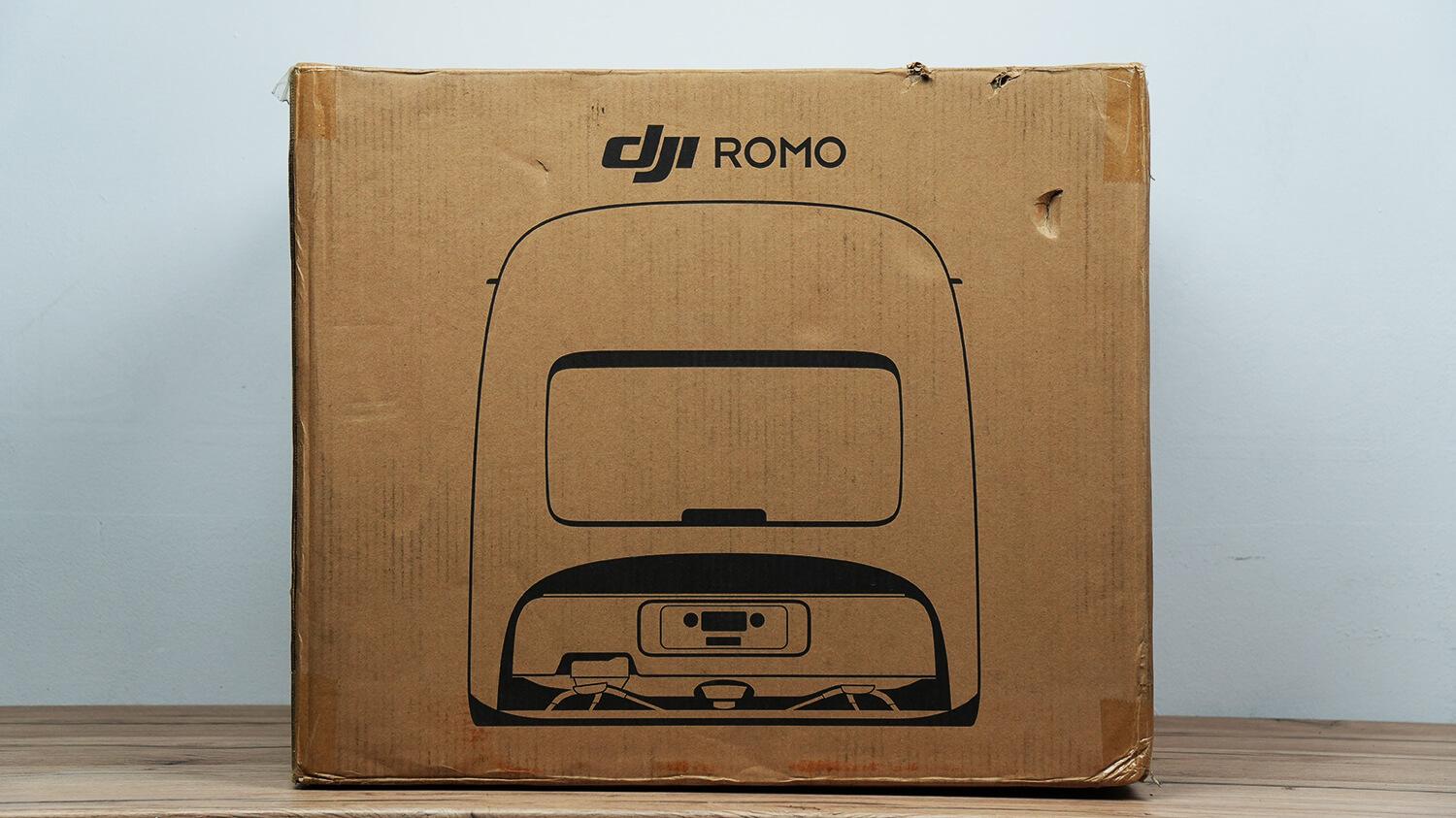
Box
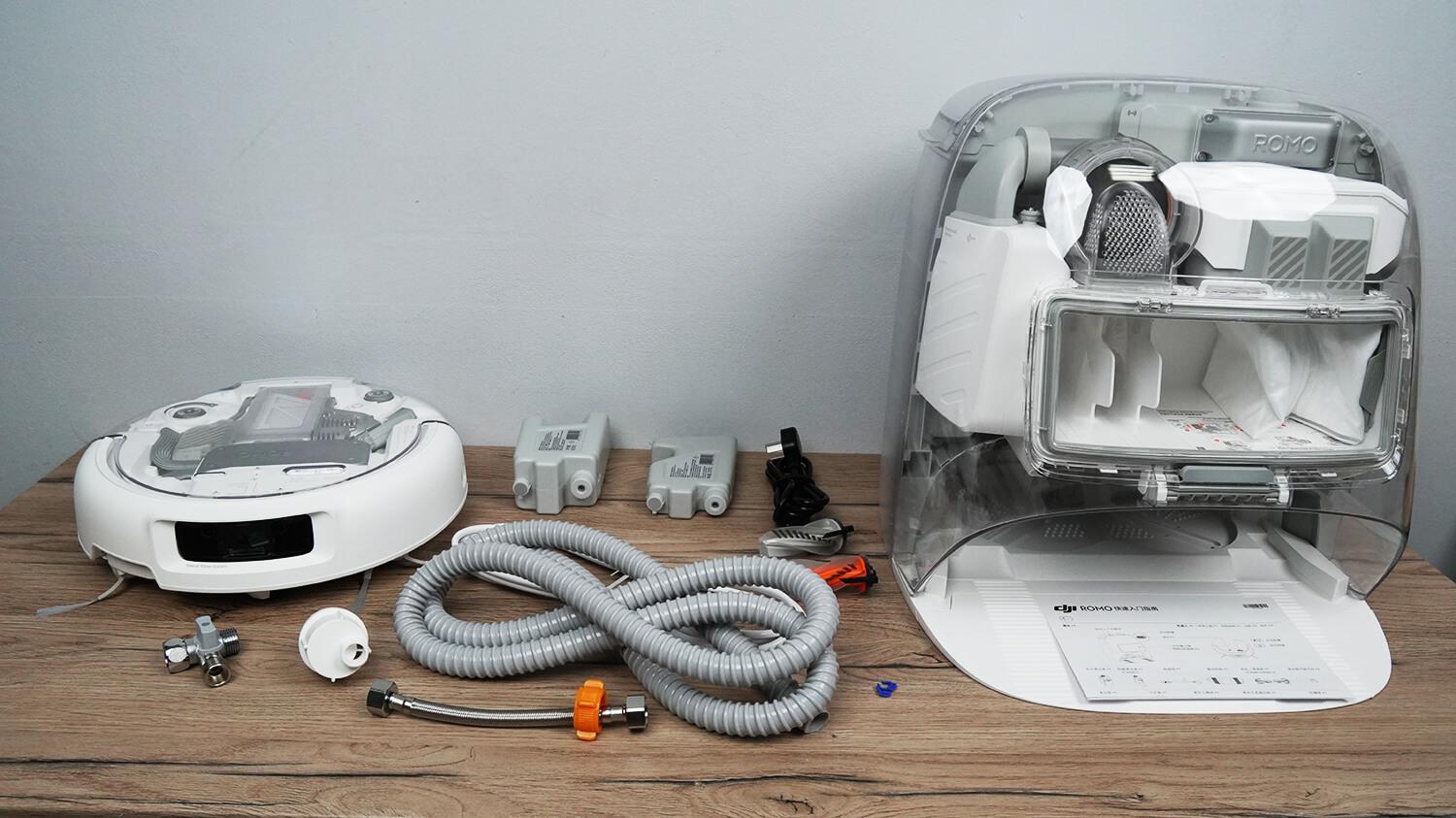
In addition to the robot and station itself, the delivery kit includes:
- Power adapter with Chinese plug.
- Two containers with detergents.
- Replacement turbo brush for carpets.
- Robot documentation in Chinese.
- Tube for connecting the station to the water supply.
- Hose for connecting the drain.
- Additional accessories for connecting the station to utility networks.
Equipment
Let's move on!
Appearance
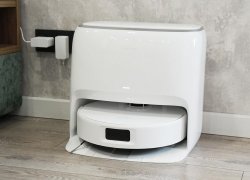
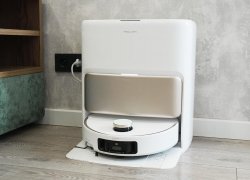
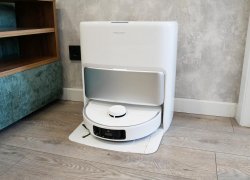
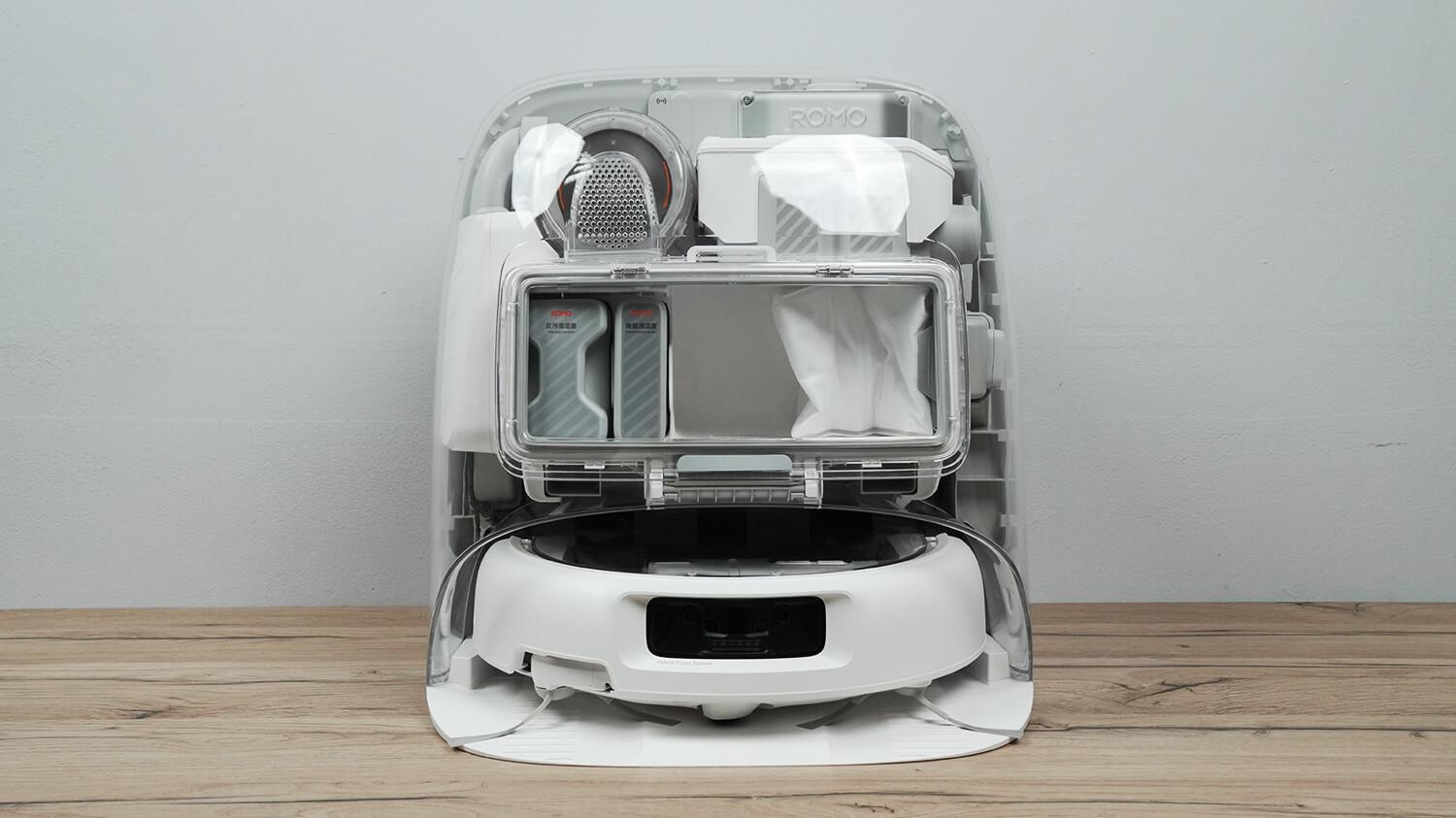
The DJI ROMO P is white. I received the version with a module for connecting to sewer and water pipes for review.
Robot at the sewer connection station
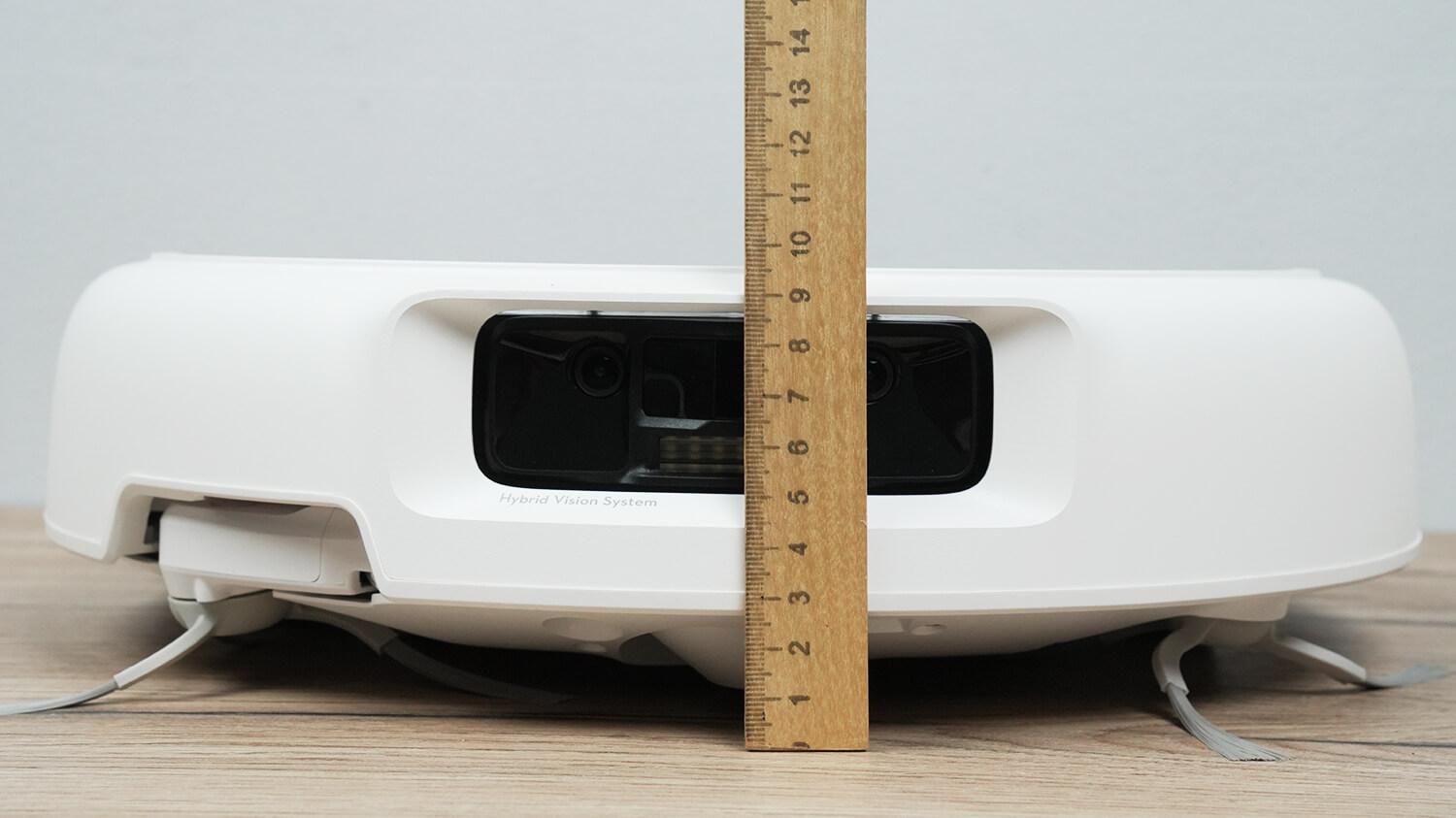
The robot vacuum cleaner itself is round in shape, the height of the body is stated as 98 mm, but in fact it is a little lower – about 96 mm.
Top view
Body height
The familiar lidar tower on top of the body is gone. Wall sensors are mounted on both sides of the bumper. The robot's navigation system, consisting of sensors and illuminated cameras, is located in the center.
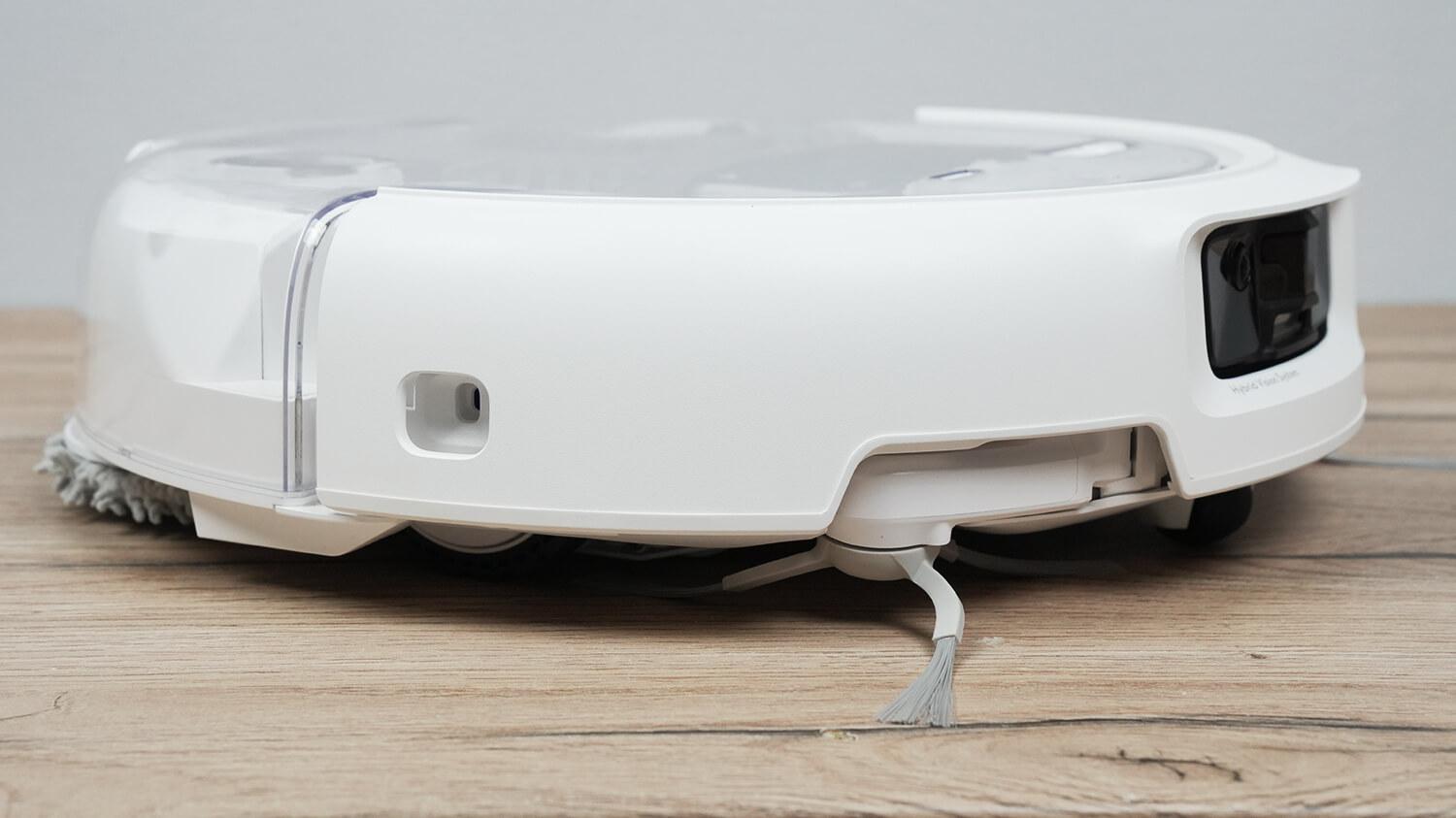
Side view
The technology is called the Hybrid Vision System. It claims to offer highly accurate object avoidance and binocular fisheye vision.
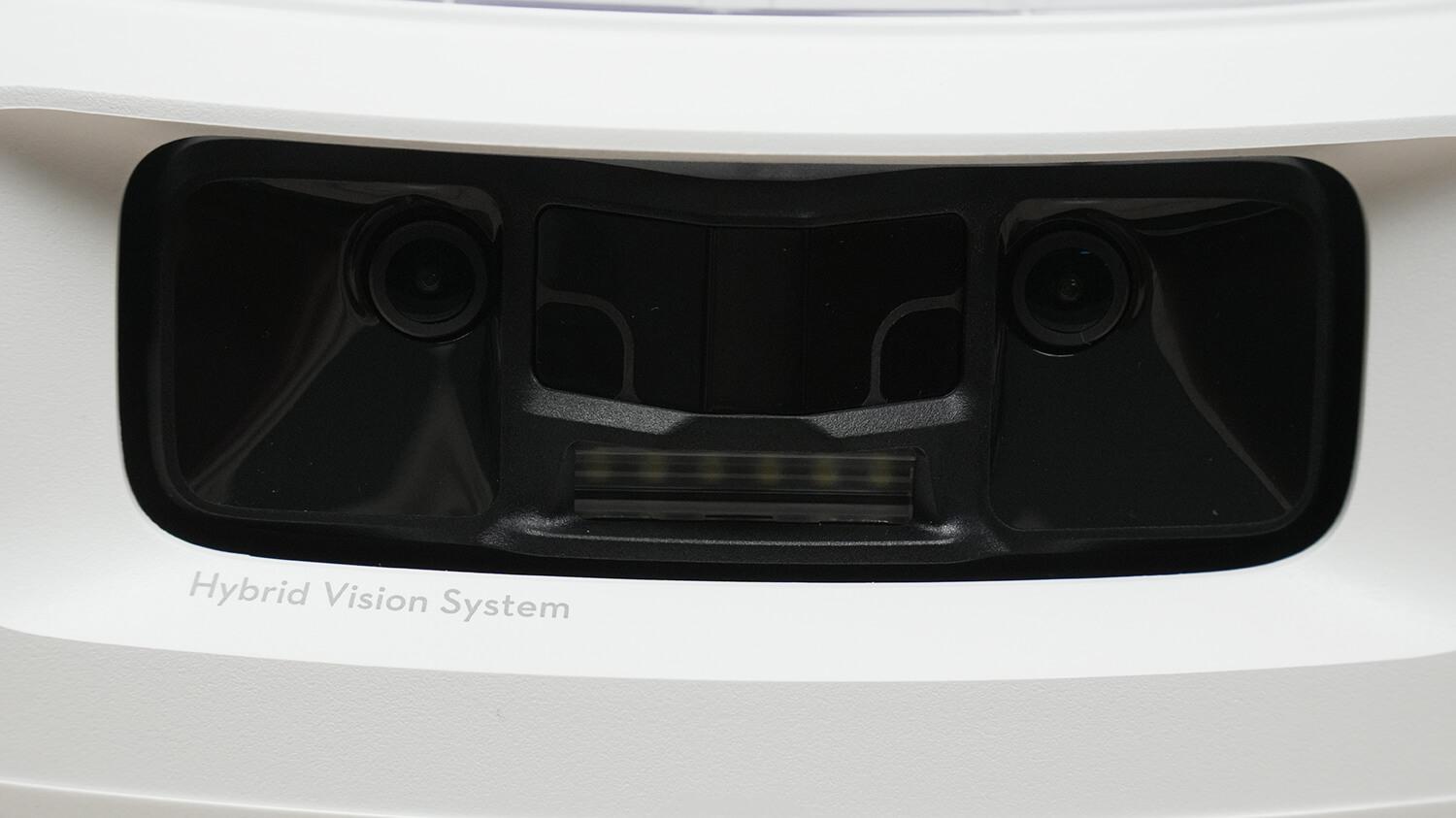
Object avoidance system
The camera can also be used for remote monitoring of your home via a smartphone.
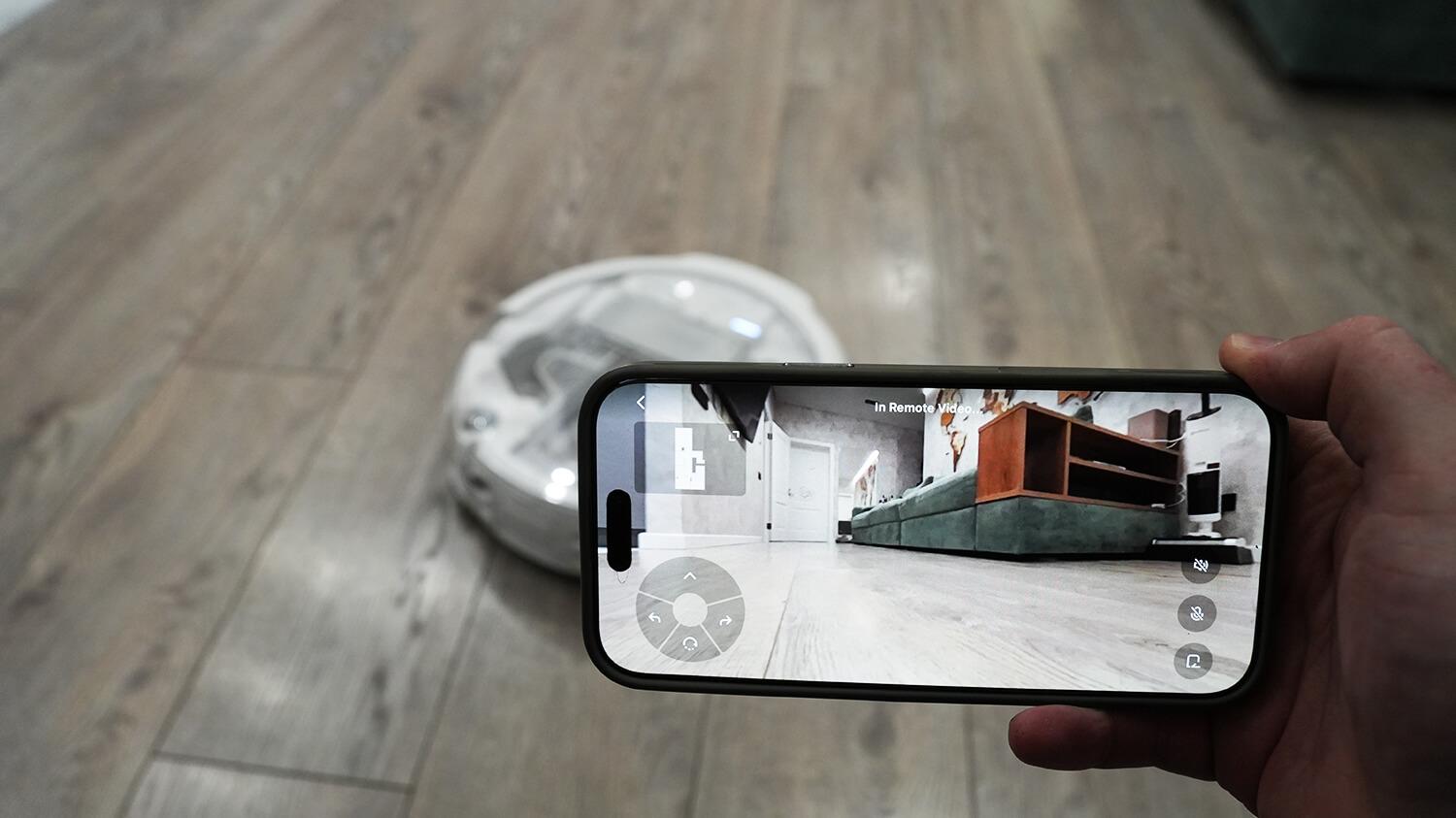
Remote home monitoring
On the top of the body there are two mechanical control buttons and a light indicator of the robot’s status.
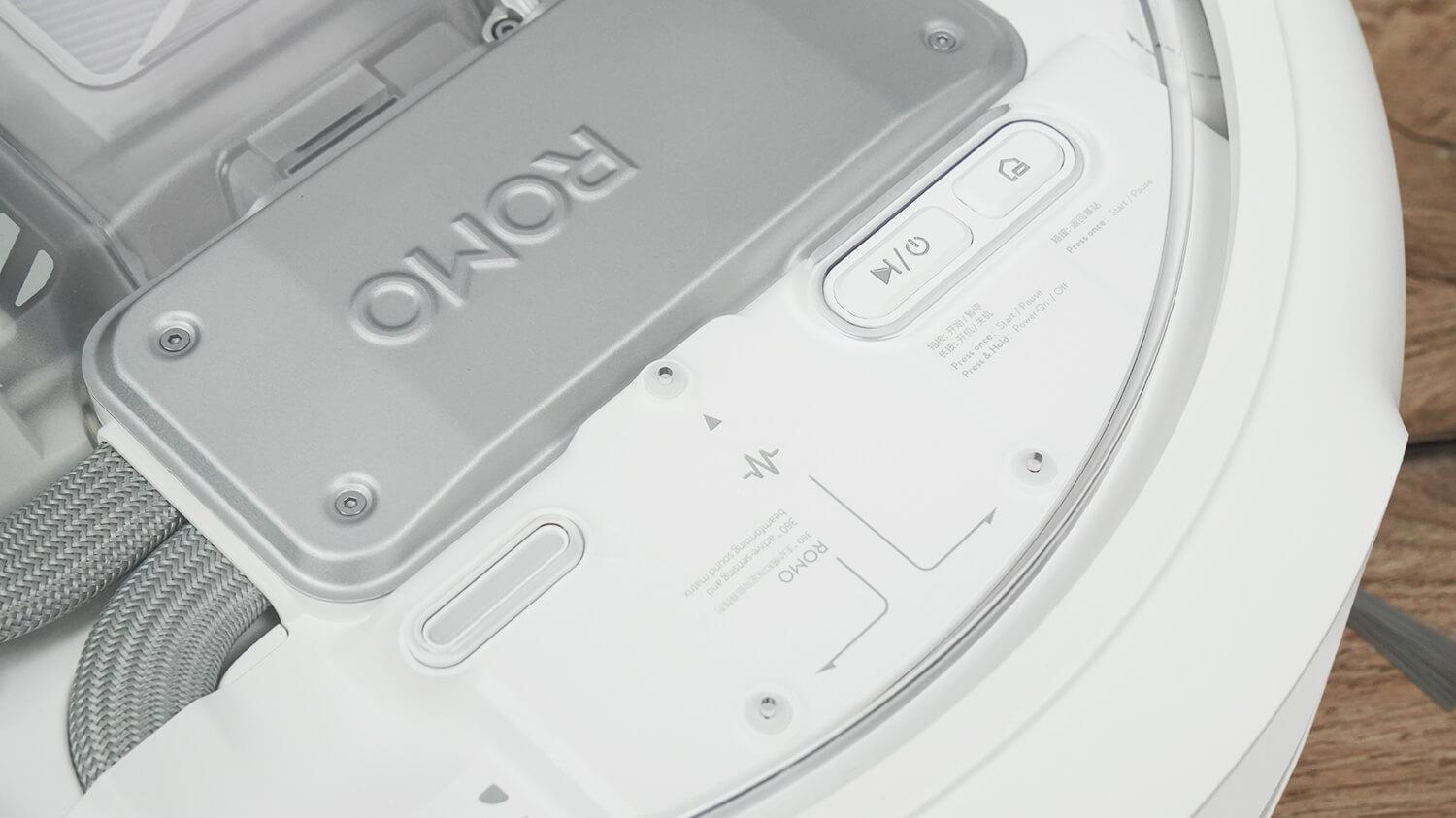
Buttons on the body
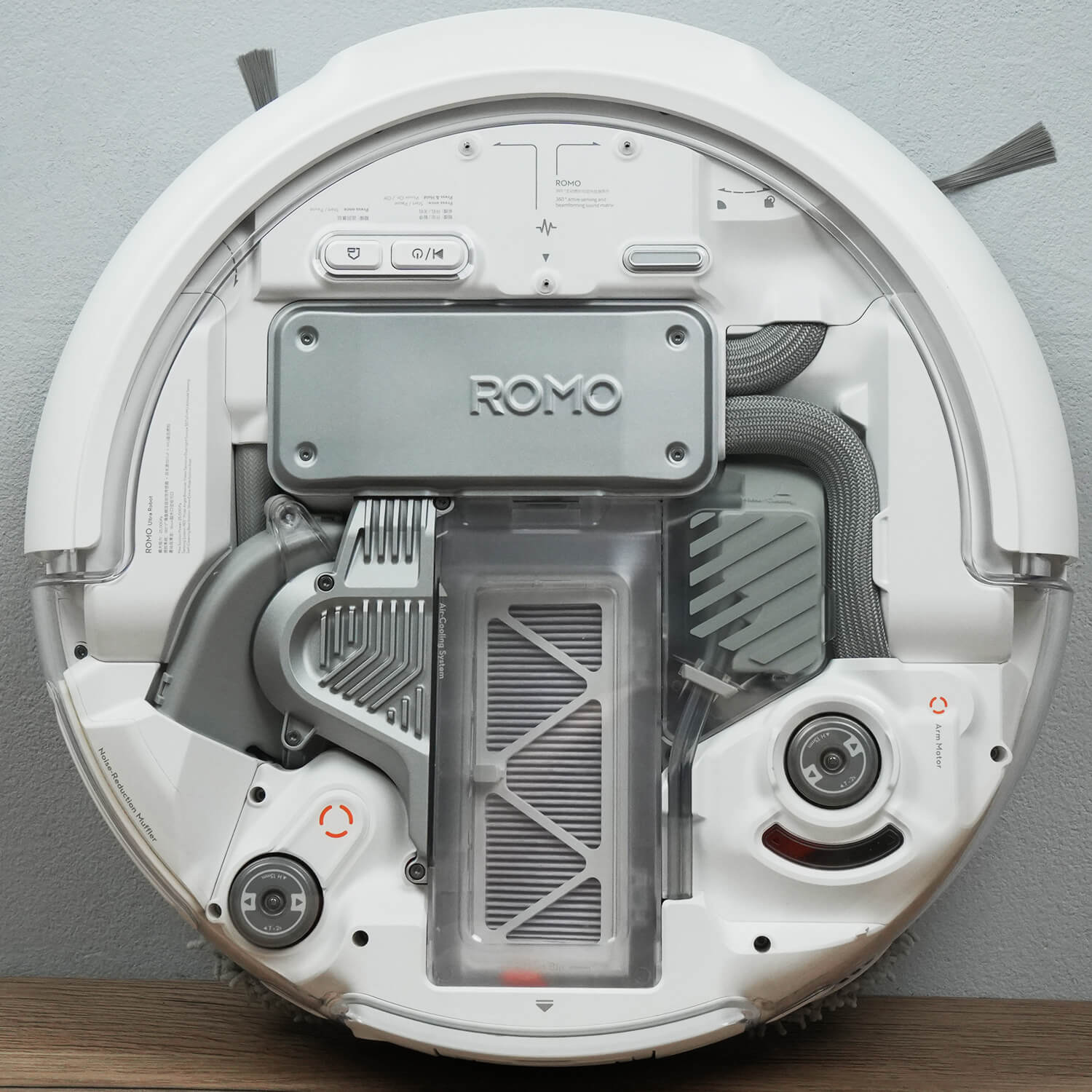
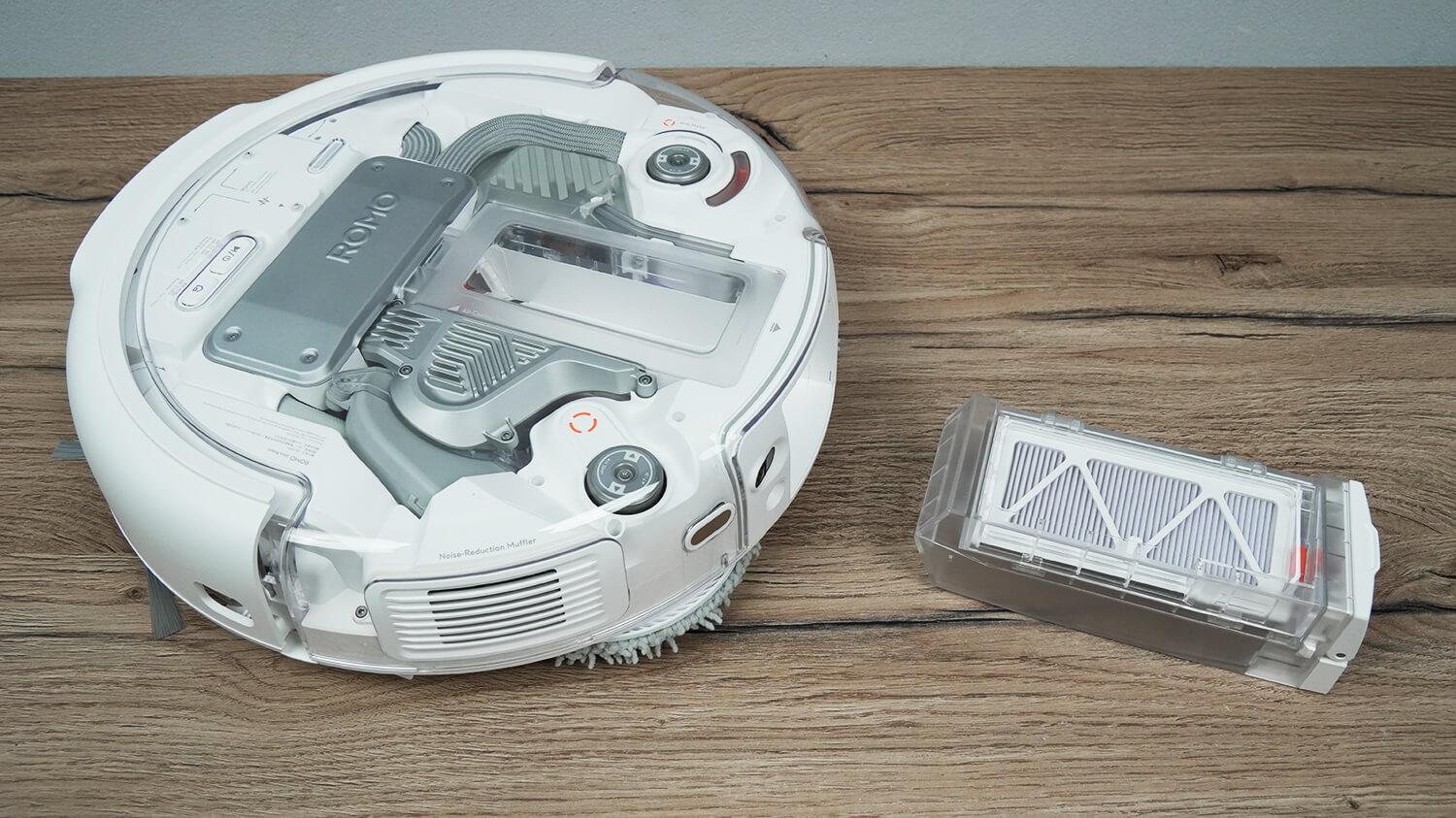
The dust collector is removable from the rear. Like the filtration system, it can be rinsed with water. The dust collector holds 260 ml. A flap is located at the end for emptying the waste into a bag located in the station.
Dust collector location
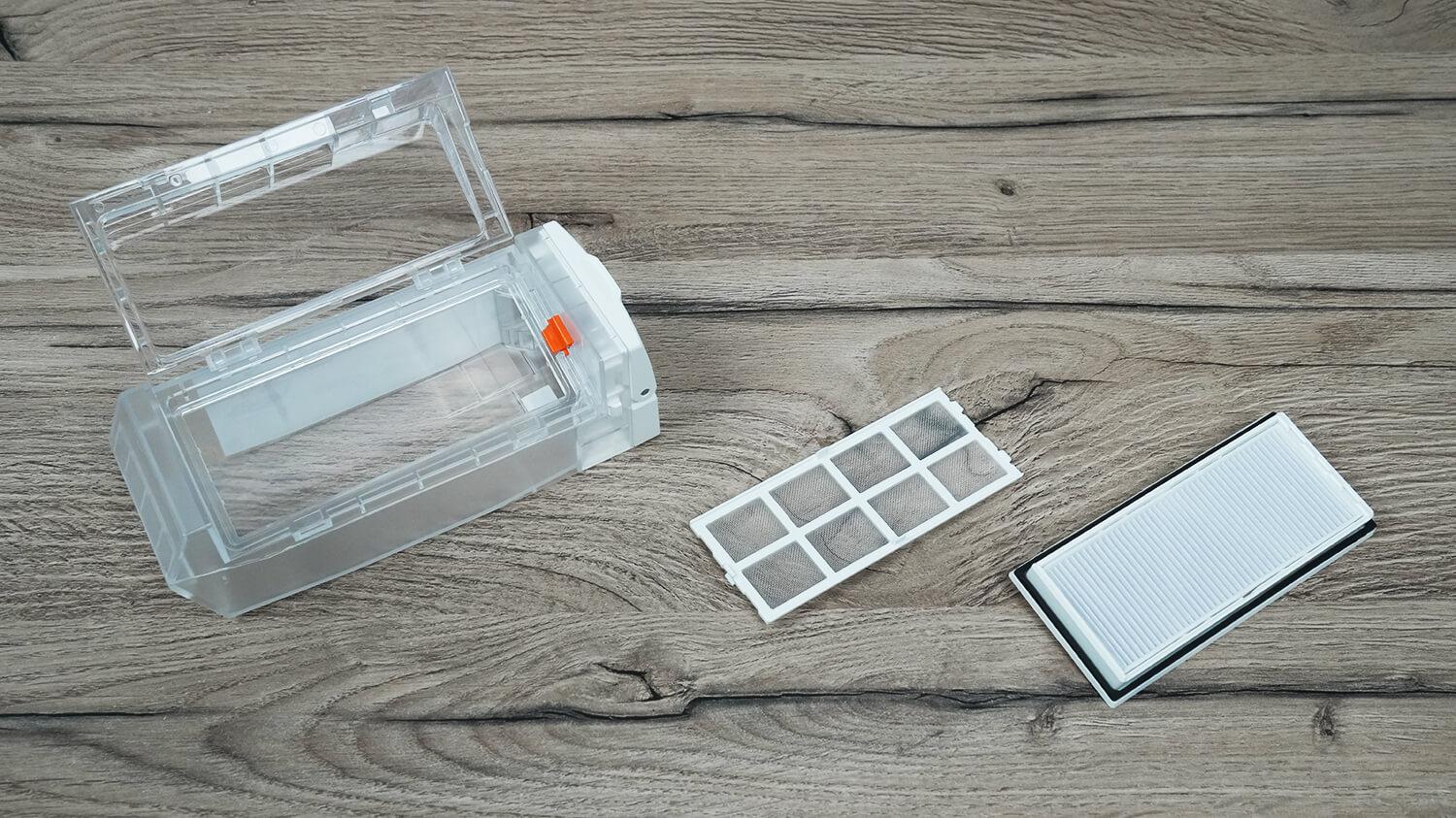
Filtration system based on HEPA filter and mesh.
Filtration system
The water tank is non-removable, but visible through the transparent housing. Its capacity is 164 ml, twice that of premium models. Water is pumped automatically through the station.
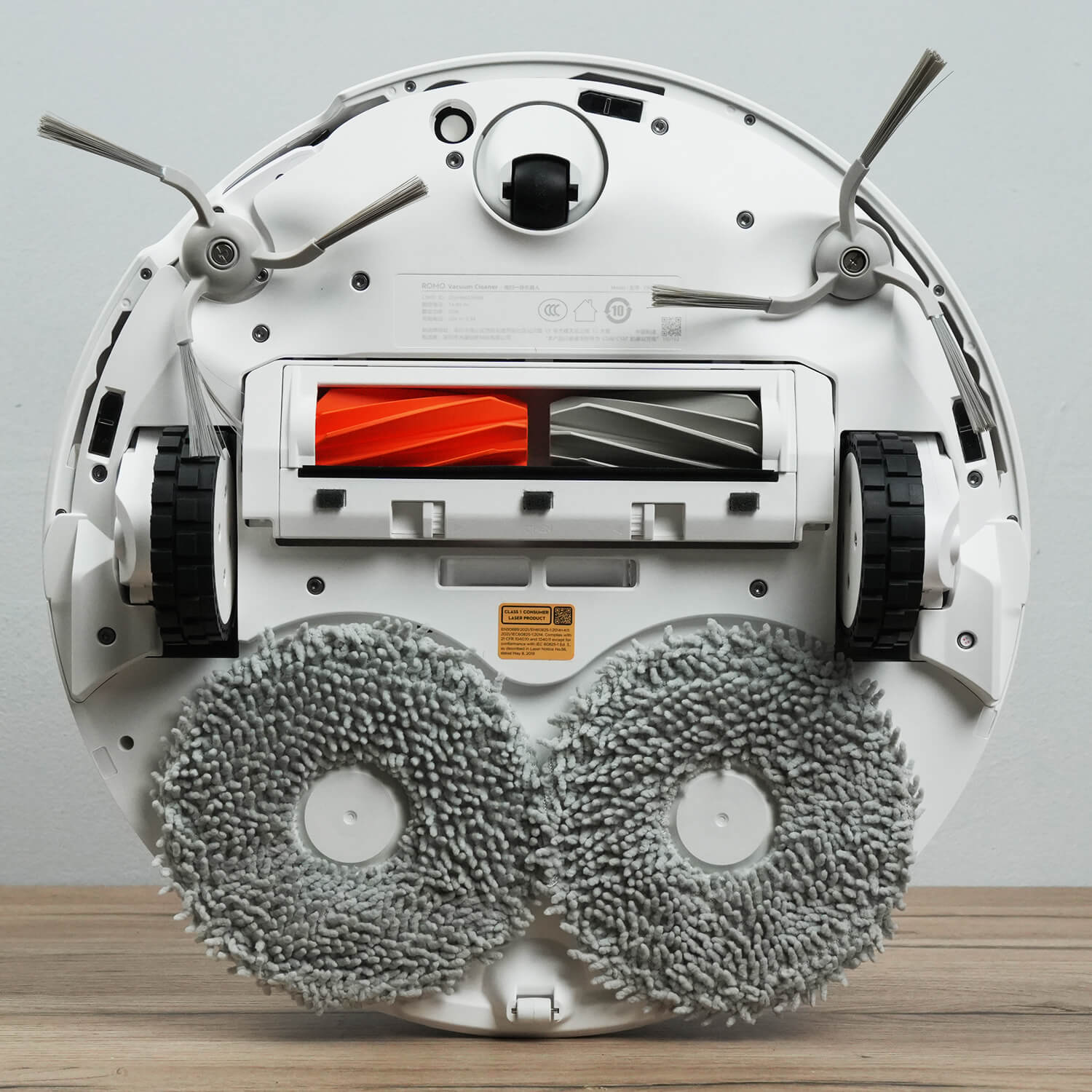
Surprisingly, the robot has only three fall protection sensors installed underneath. There's also a carpet sensor. There are two side brushes, both three-beam, secured with screws. One of the side brushes extends into corners to sweep up debris.
Bottom view
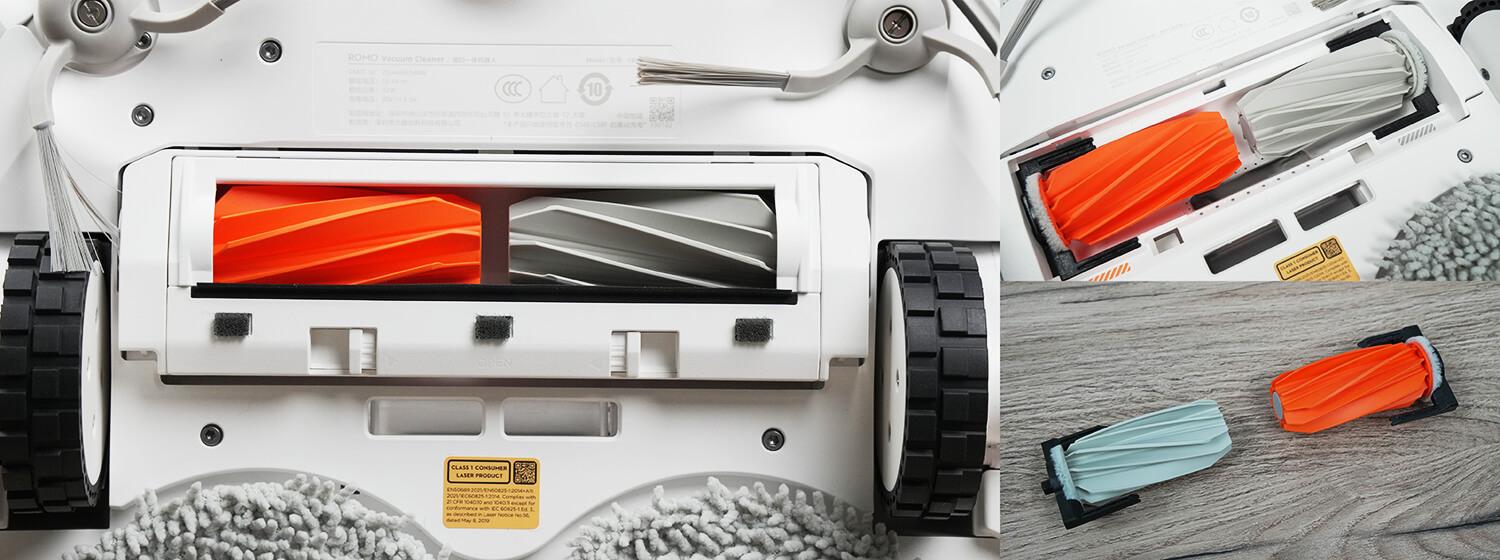
The central brush unit is floating. The central brush also automatically lifts up during floor cleaning. The turbo brush consists of two half-brushes with a central opening for debris removal. This design isn't unique, but it has already performed well in competitive tests.
Central brush
The unit comes with silicone brushes that can be disassembled for maintenance. They can be replaced with bristle-and-petal brushes, which are supposed to be better at picking up debris, including on carpets.
Floor cleaning is accomplished with two round, rotating cloths secured to holders with Velcro. The cloths are very thick and of good quality.
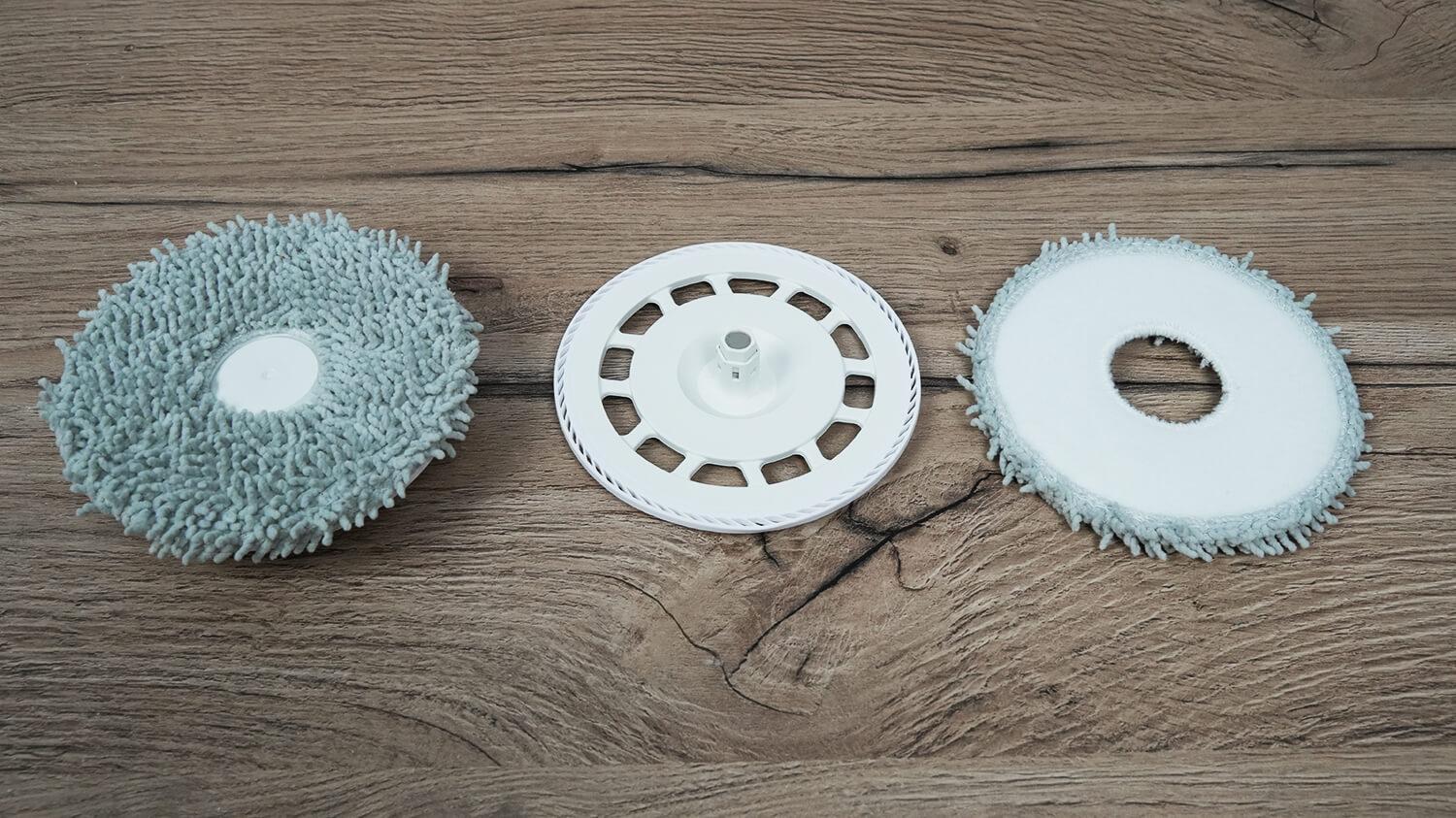
Wet cleaning wipes
Behind one of the holders, we see a mechanism that extends the cleaning cloth to the edge for a thorough cleaning of the floor along the baseboards and in corners. Both cleaning cloths automatically rise when entering carpets, in dry cleaning mode, and when the robot returns to the station.
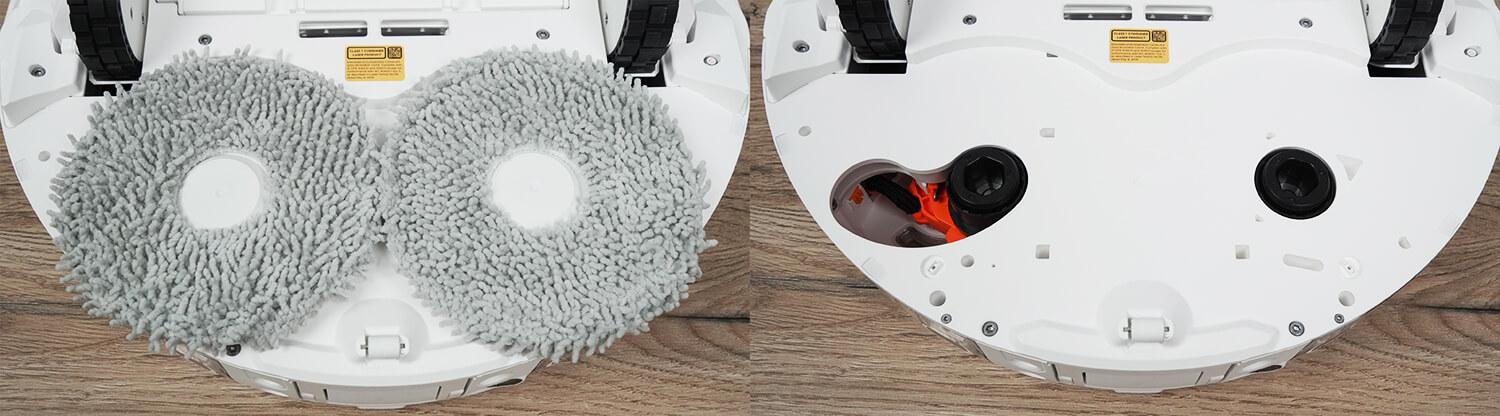
Napkin edge release mechanism
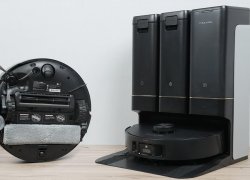
Now that we've dealt with the robot, it's time for the station. Here, the DJI ROMO P doesn't just recharge: it self-cleans the dust bin, washes the wipes with hot water, automatically mixing detergent from two different containers, dries the wipes with warm air, and dries the dust bin and dust bag. Plus, it features UV sterilization for the bag. And, as mentioned earlier, the version I received for review connects to both sewer and water lines.
The robot's ramp is removable, but the wipes tray is not, which is inconvenient. We'll test it to see how easy it is to maintain.
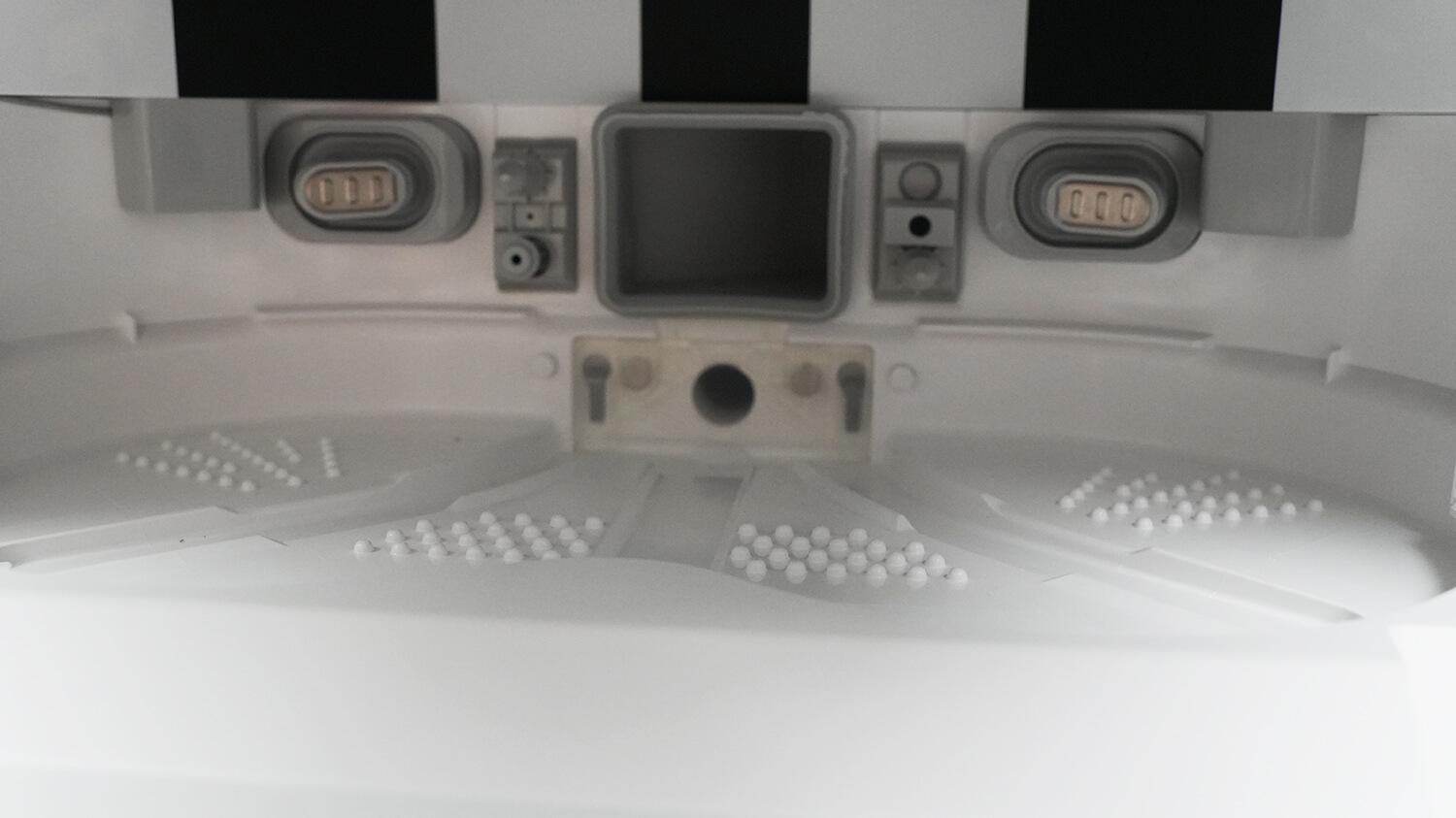
Napkin washing area
The water is heated during washing, and the drying process is done with warm air. I couldn't find the heating temperature on the website, but I'll check it myself during tests using instruments.
A waste bag and two detergent reservoirs are located under a cover above the robot's parking area. The standard 2.4-liter waste bag holds 400 ml of regular detergent, which is automatically mixed with clean water when washing the wipes. There's also a separate 200 ml disinfectant reservoir. You can select which detergent to use in the settings.
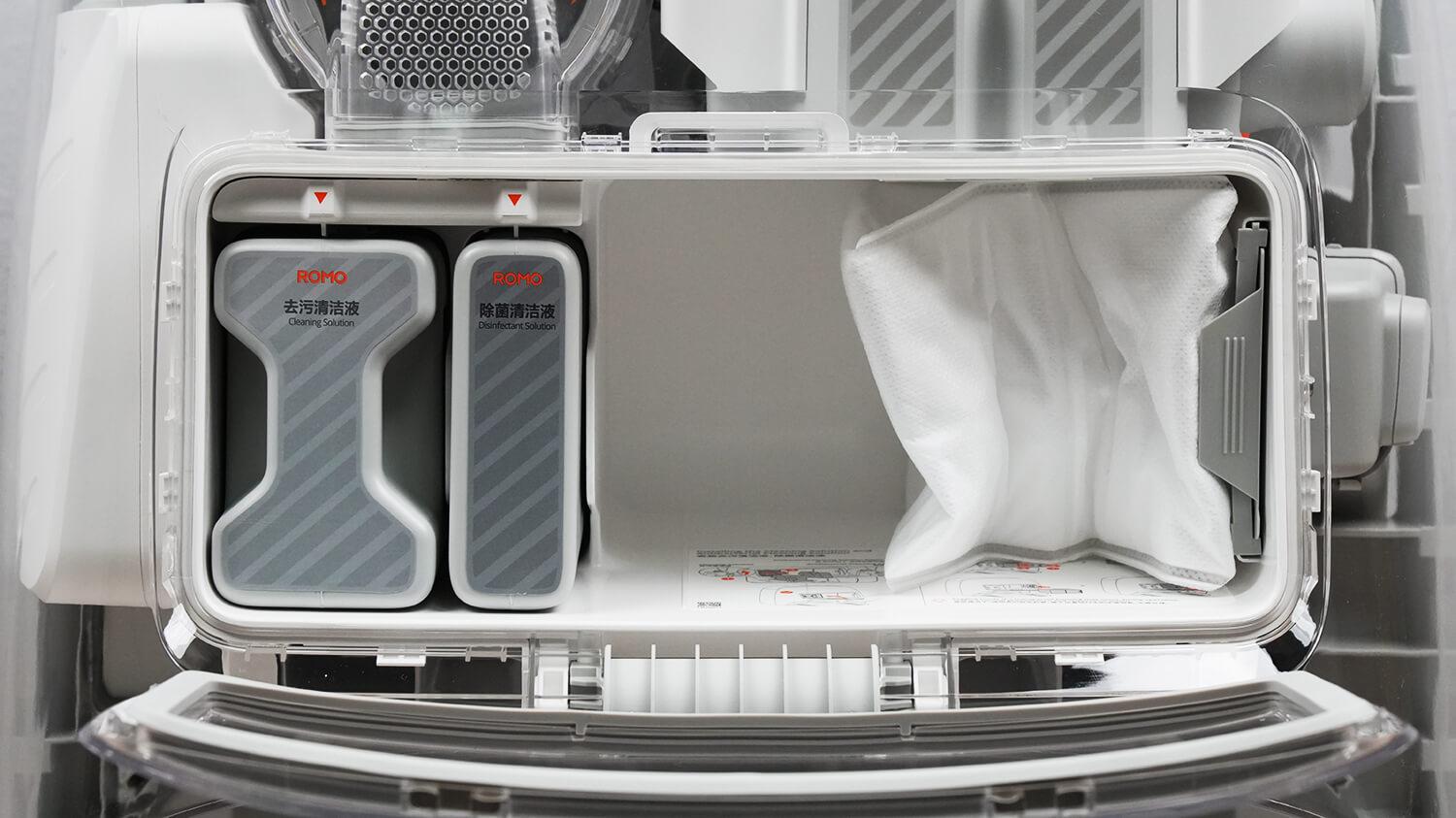
Detergent tanks and bags
As for the module, it's installed under the top cover. The dirty water tank houses a coarse filter. The clean water tank is of the standard design.
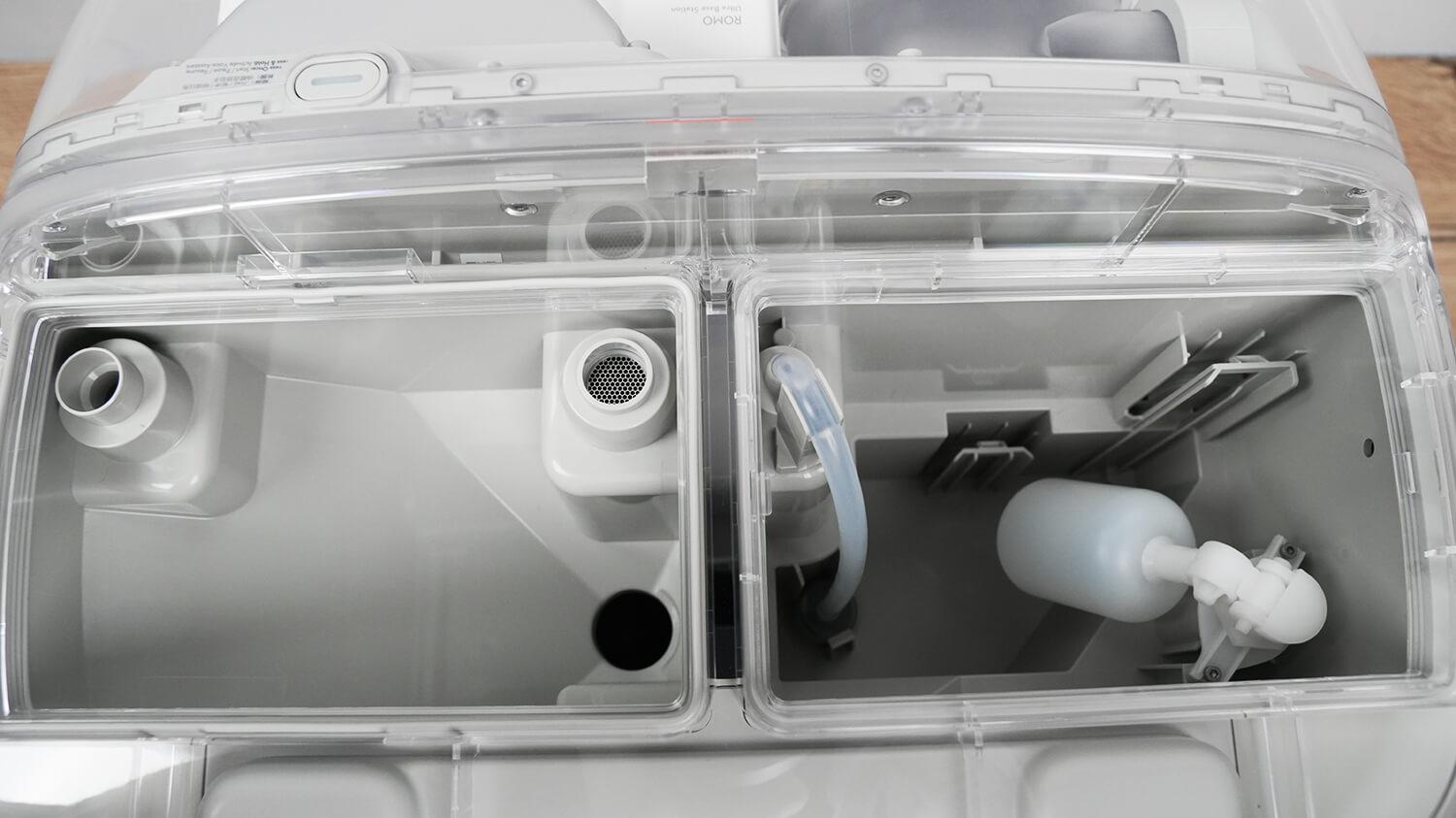
Water compartments in the station
The entire module can be removed from the station, which is convenient for maintenance.
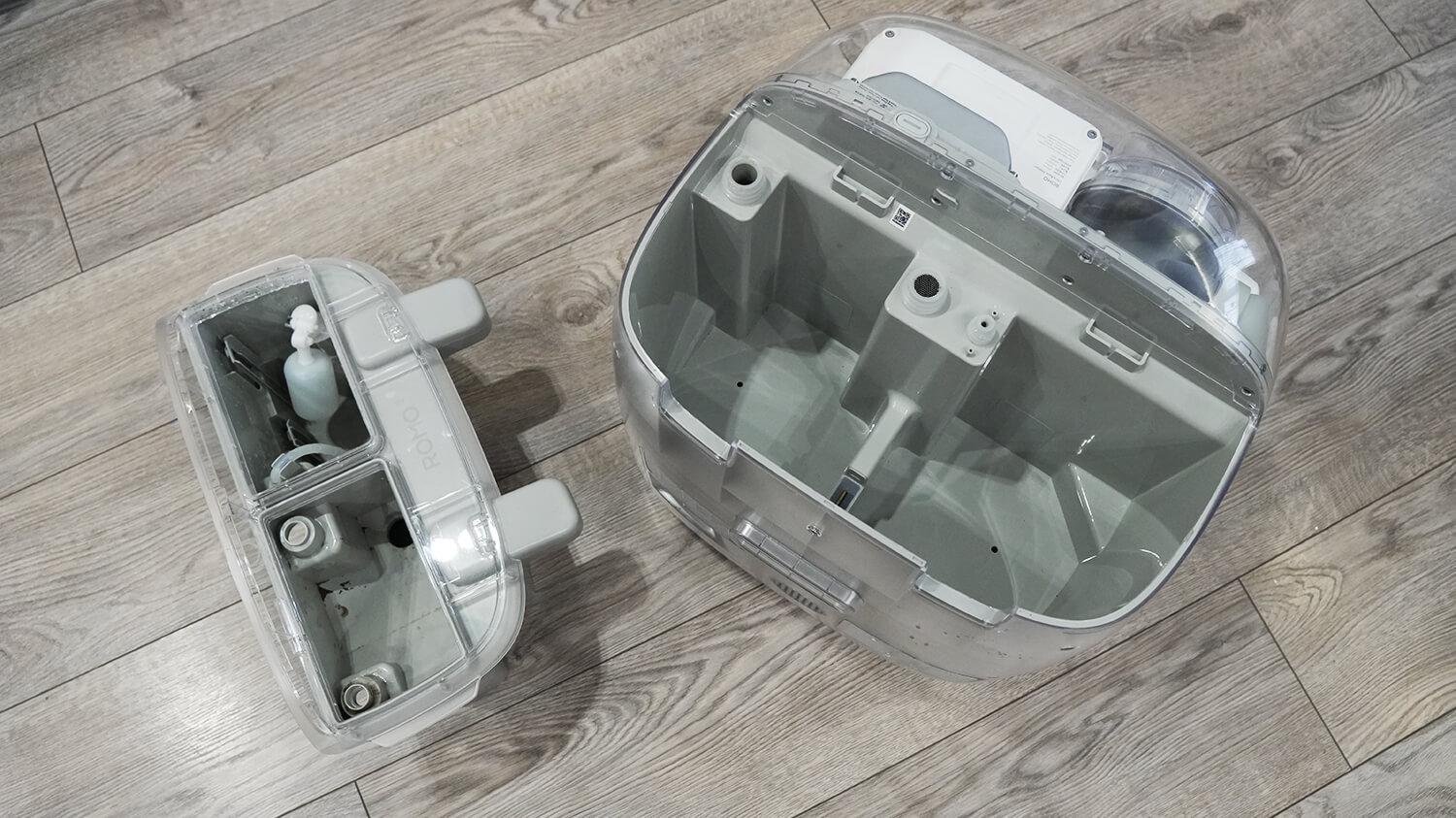
The module is removed from the station
But there's a caveat here—I hope they do support the ability to replace this module in the station with regular water tanks. However, local DJI representatives responded that this option is not supported. At a minimum, you can't purchase the module or tanks separately. The robot is sold with different station versions by default. If so, this is a very strange and illogical decision that negatively impacts the robot's versatility despite the physical ability to change the option. I hope the representatives are wrong. If anyone knows for sure whether it's possible to swap the module for tanks and vice versa, please share your reasons in the comments. I'd be very grateful.
So far, we see that the robot has both strengths and weaknesses. Let's see how it performs in tests.
Technical specifications
The main characteristics of the DJI ROMO P, as stated by the manufacturer, are displayed on the screen:
Robot vacuum cleaner:
- Li-Ion battery 5000 mAh.
- Suction power up to 25,000 Pa.
- Dust collector 260 ml.
- Water tank 164 ml.
- Operating time: up to 180 min.
- Dimensions: 352*98 mm.
Station:
- Detergent tank: 400 + 200 ml.
- Bag in the station: 2.4 l.
- Dimensions: 453*425 mm*440 mm
The highest claimed suction power stands out here, which will be verified in tests. The other characteristics are in line with similar devices.
Functional capabilities
Let's move on to an overview of the DJI ROMO P's features. It is controlled via the proprietary DJI Home mobile app. Besides the regional lock, there's another caveat: the app interface is in English, and some functions aren't even translated into English, remaining in Chinese, making it difficult to familiarize yourself with the robot's functionality. Incidentally, it speaks both English and Chinese.
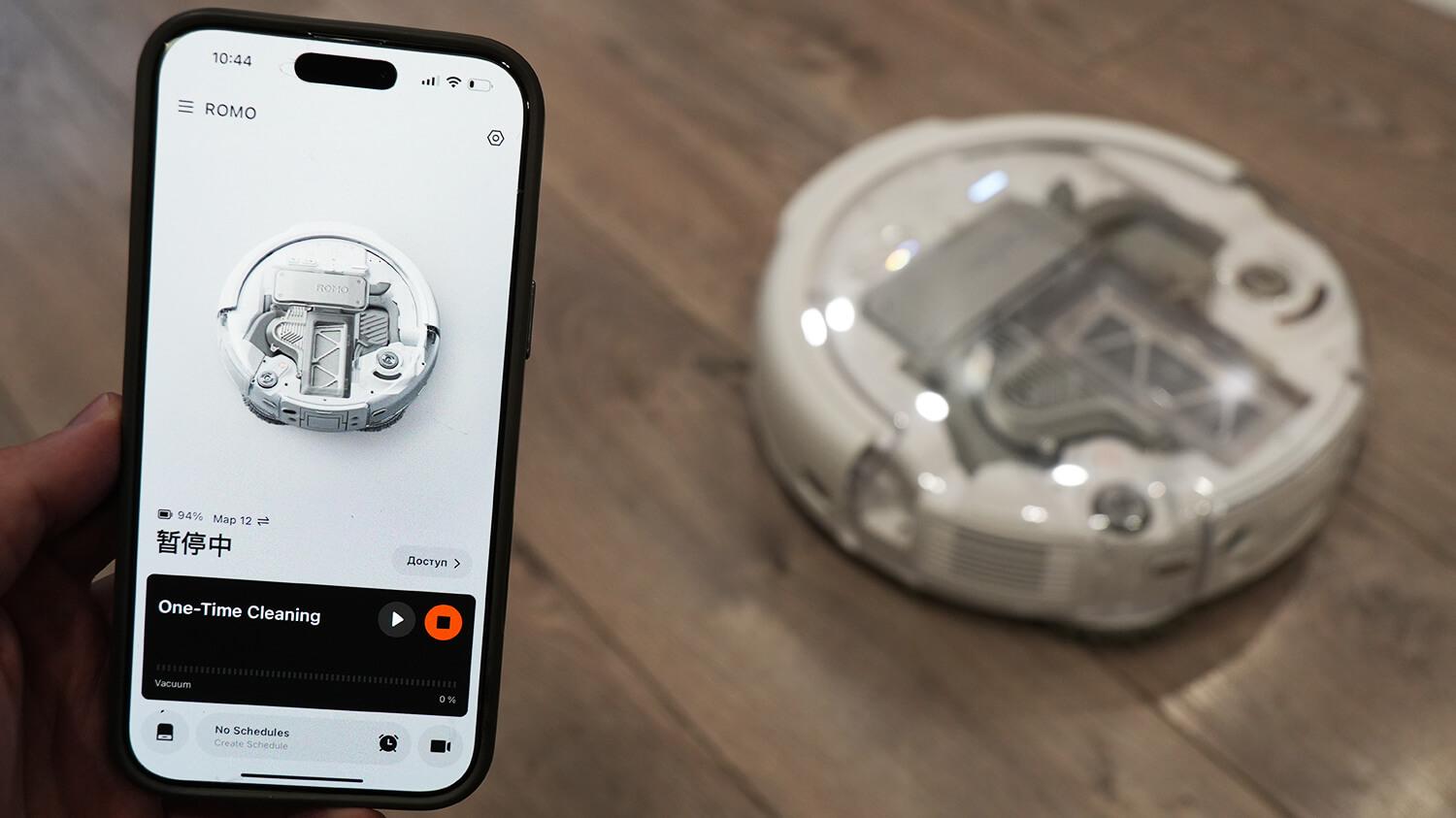
Control via app
All main functions are displayed on the screen:
- Self-cleaning dust collector.
- Washing napkins with hot water.
- Drying napkins with warm air.
- Drying the dust collector and garbage bag.
- Automatic addition of detergent.
- Raising the wipers and central brush.
- Side brush extension in corners.
- Moving the napkin to the baseboard.
- Identifying objects on the floor.
- Spot identification.
- Camera illumination in low light conditions.
- Remote home monitoring via smartphone.
- Saving multiple cleaning maps in memory.
- Automatic zoning of premises into rooms.
- Selecting areas and rooms for cleaning.
- Virtual walls and no-go zones (and for wet cleaning mode).
- Suction power adjustment.
- Setting the frequency of washing napkins.
- User mode.
- Cleaning log.
- Setting up cleaning according to a schedule.
- Automatic power increase on carpet.
- Carpet cleaning in wet cleaning mode.
- Support for the "Hey, ROMO" assistant.
Overall, there are a lot of options for flexible cleaning settings, but not all of them are implemented conveniently. For example, it's impossible, or at least I couldn't figure out how to set the frequency of wiping the station's wipes at a specified time interval, by area, or after cleaning a specific area. There are simply three frequency levels.
We've implemented the proprietary voice assistant "Hey, ROMO," but it's only supported in Chinese.
Well, I didn’t discover any unique interesting features.
Testing
A detailed video review with all tests has already been prepared and published on the channel:
Navigation
And now the most interesting part – the tests. Let's start with navigating within a room with obstacles. Interestingly, the robot first begins cleaning the selected area in a serpentine pattern. It carefully swept around the table legs and the box. After sweeping the available area, it moved on to traversing the perimeter. It neatly swept around the dryer legs, and the mirror didn't introduce any errors into the map. However, it's interesting that it didn't sweep one small area. We'll return to this later in this review.
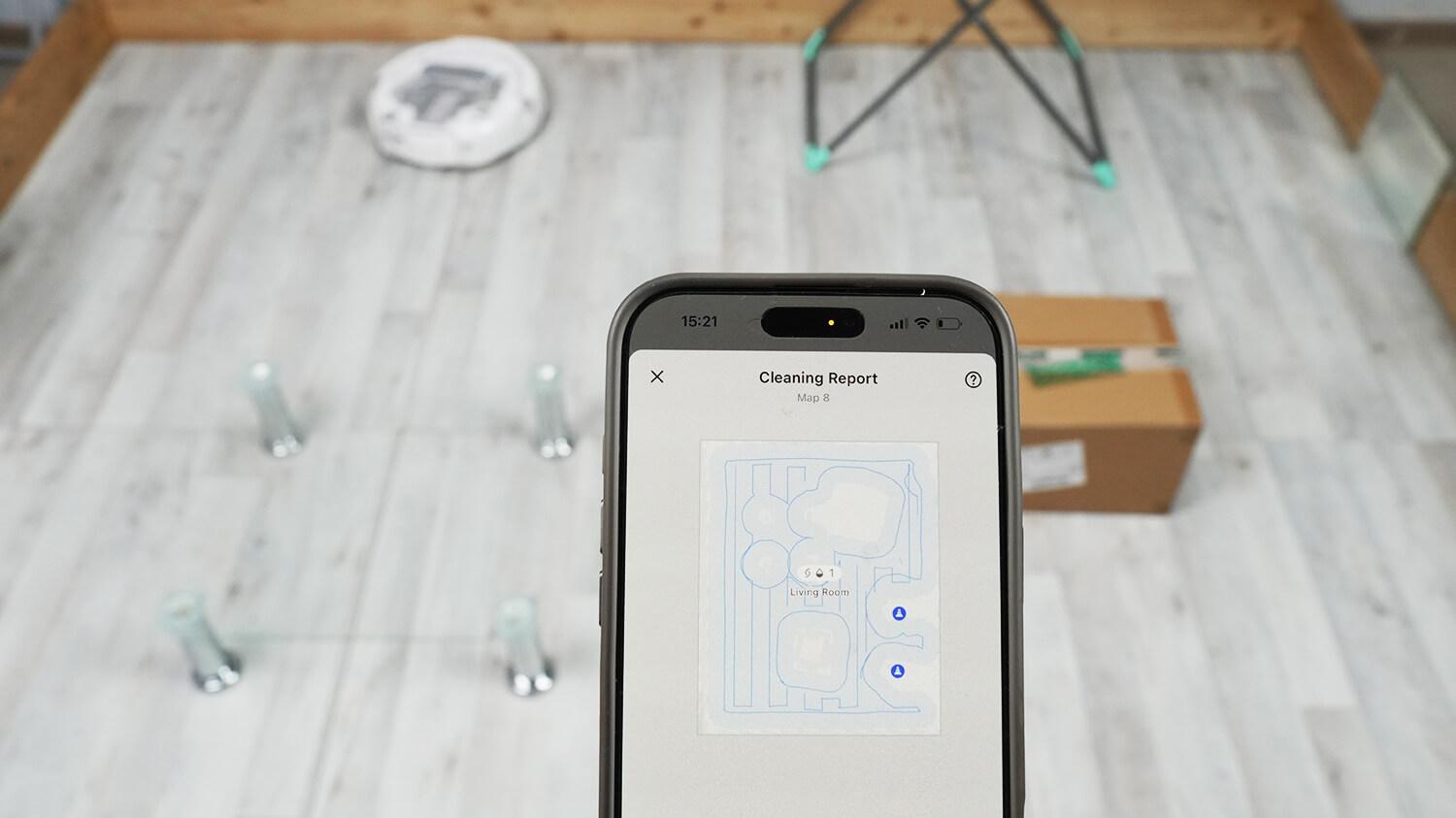
Navigating an Obstacle Room
Speaking of navigating within the house, the robot vacuum cleaned room by room in a serpentine pattern, then along the perimeter. From time to time, it stopped at the cleaning station to wash the wipes, then continued cleaning from where it left off. There were no uncleaned areas left; the test was passed!
Passing under low furniture
The minimum clearance height of the robot was also tested. The robot easily enters a standard 10 cm clearance and cleans within it with the backlight on.
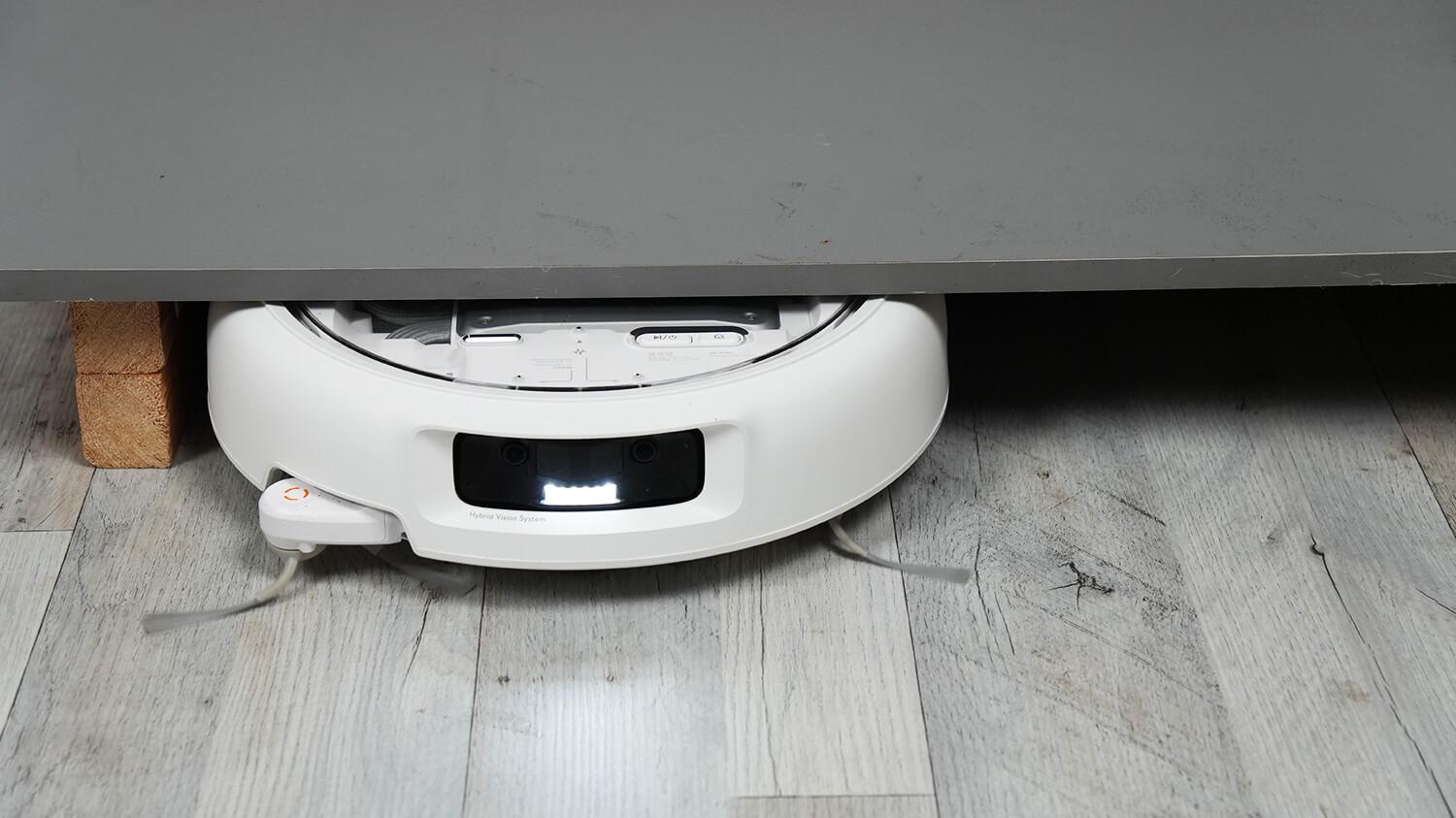
Passing under low furniture
Autonomy
I also tested the battery life when running the robot at maximum power with wet cleaning enabled. It lasted 224 minutes, cleaning 106 square meters of usable space. The robot's battery life is on par with premium robots, but there's a caveat. I ran it at maximum power for the last time, but in dry cleaning mode, to demonstrate an important point.
When using both dry and wet cleaning, the robot needs about an hour and a half to clean a 40 square meter room. During the cleaning cycle, the robot washed the cloths 4 or 5 times. In dry cleaning mode, it cleans for just over 40 minutes. This is because the cloth washing process is very lengthy, taking about 10 minutes per cycle, compared to 2-3 minutes for similar robots. I didn't run it for dry and wet cleaning a third time only because the battery only charges a few percent in 10 minutes, resulting in inaccuracies in battery life measurements due to the long self-cleaning and charging times.
Identifying objects on the floor
As for the object avoidance system, it's very well implemented. In good lighting, the DJI ROMO P was able to identify and accurately avoid all 6 of 6 household objects, 3 of 3 socks, 4 of 4 wires, and 6 of 6 simulated pet surprises. The only caveat is that the sensor and camera system detects objects on the floor, but doesn't recognize what exactly is lying there. This will likely be improved with a firmware update, but I can't confirm object recognition yet.
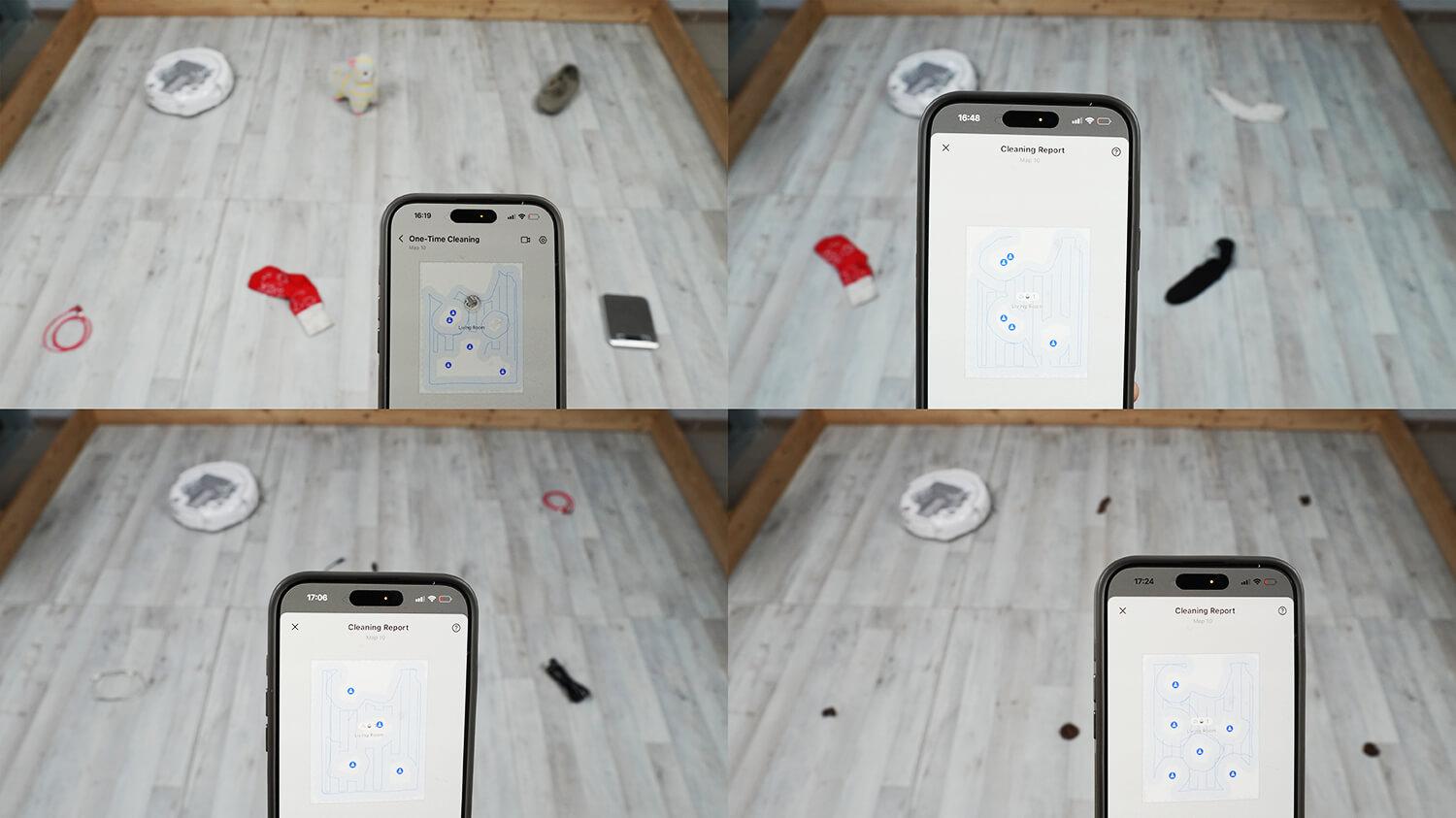
Identifying objects on the floor
In complete darkness, the DJI ROMO P was also able to identify and accurately navigate around six of six household objects, three socks, and four wires. Unfortunately, it snagged and chewed up one of the six, while safely avoiding the other five. A near-perfect result! Bravo, DJI engineers!
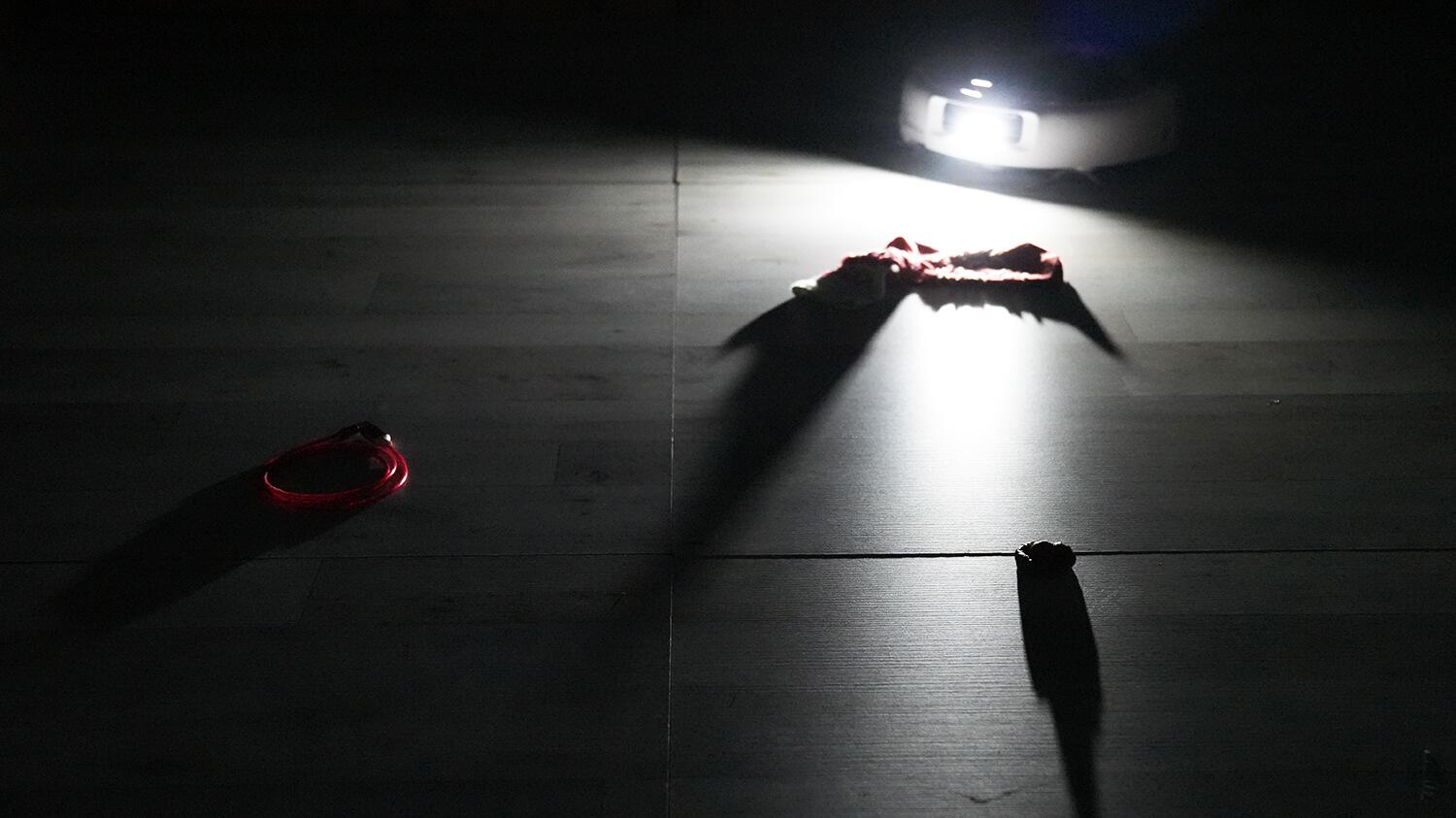
Identifying objects in the dark
The promotional materials claim the robot vacuum can detect and avoid even thin objects. I tested this with a playing card and a ski pass. Wow, the robot cleaned neatly around both objects and returned to the station.
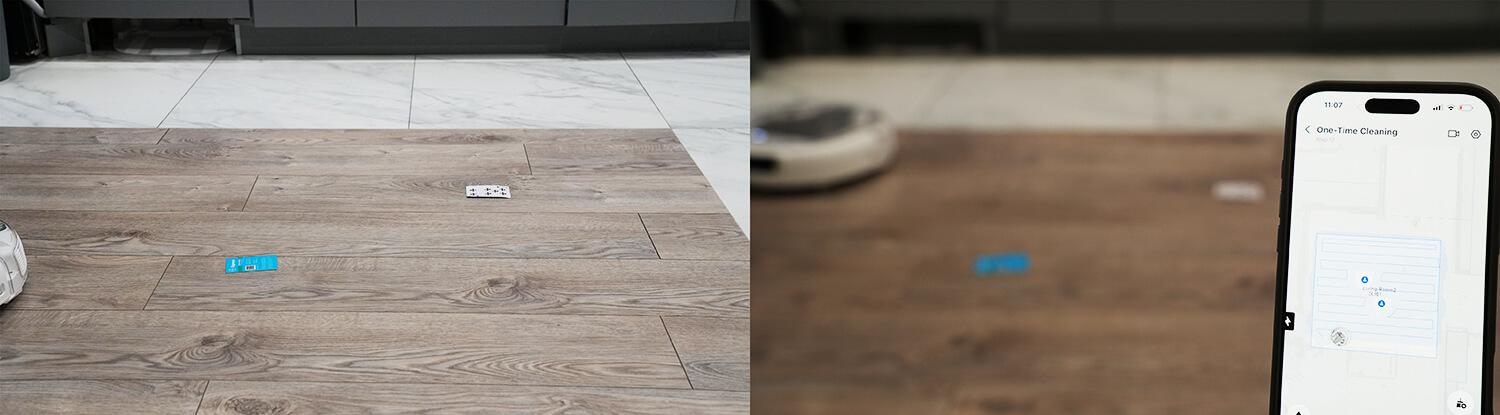
Identifying cards on the floor
The last thing to test was how the DJI ROMO P detects puddles and stains on the floor. I spilled ketchup, milk, and clear water on the floor. Here's the situation: it detected the ketchup stain on the second try, but failed to detect the milk and water, even after driving over them in standard mode. Upon detecting the ketchup stain, the robot turns off suction and raises the turbo brush, rotating its pads. No additional interactions, such as spot cleaning, are included. After cleaning the selected area, the robot simply returned to the station, even though the stain wasn't completely removed. In short, stain detection is present, but it's crude, just like similar robots.
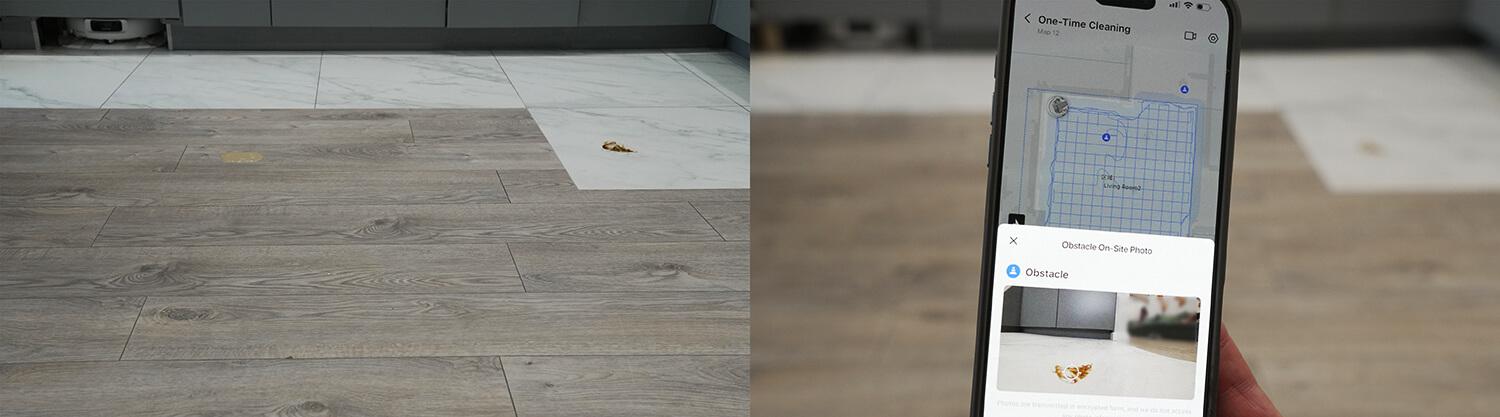
Spot identification
But in any case, I can say that the DJI ROMO P has a very well-implemented object avoidance system. One of the best among the robots I've reviewed.
Cleaning behind the curtains
I also checked whether the navigation system could clean behind curtains and drapes, something most lidar robots can't do. No, this robot, like most other robots, doesn't clean behind curtains.
Suction power
In terms of suction power, the robot vacuum was able to partially clean a 2 mm-deep crevice in "Quiet" mode, while in "Standard" mode, it cleaned 2 mm more effectively. In "Turbo" mode, a 2 mm-deep crevice was completely cleaned, and in "Deep" mode, the robot still managed to partially clean an 8 mm-deep crevice in two spots.
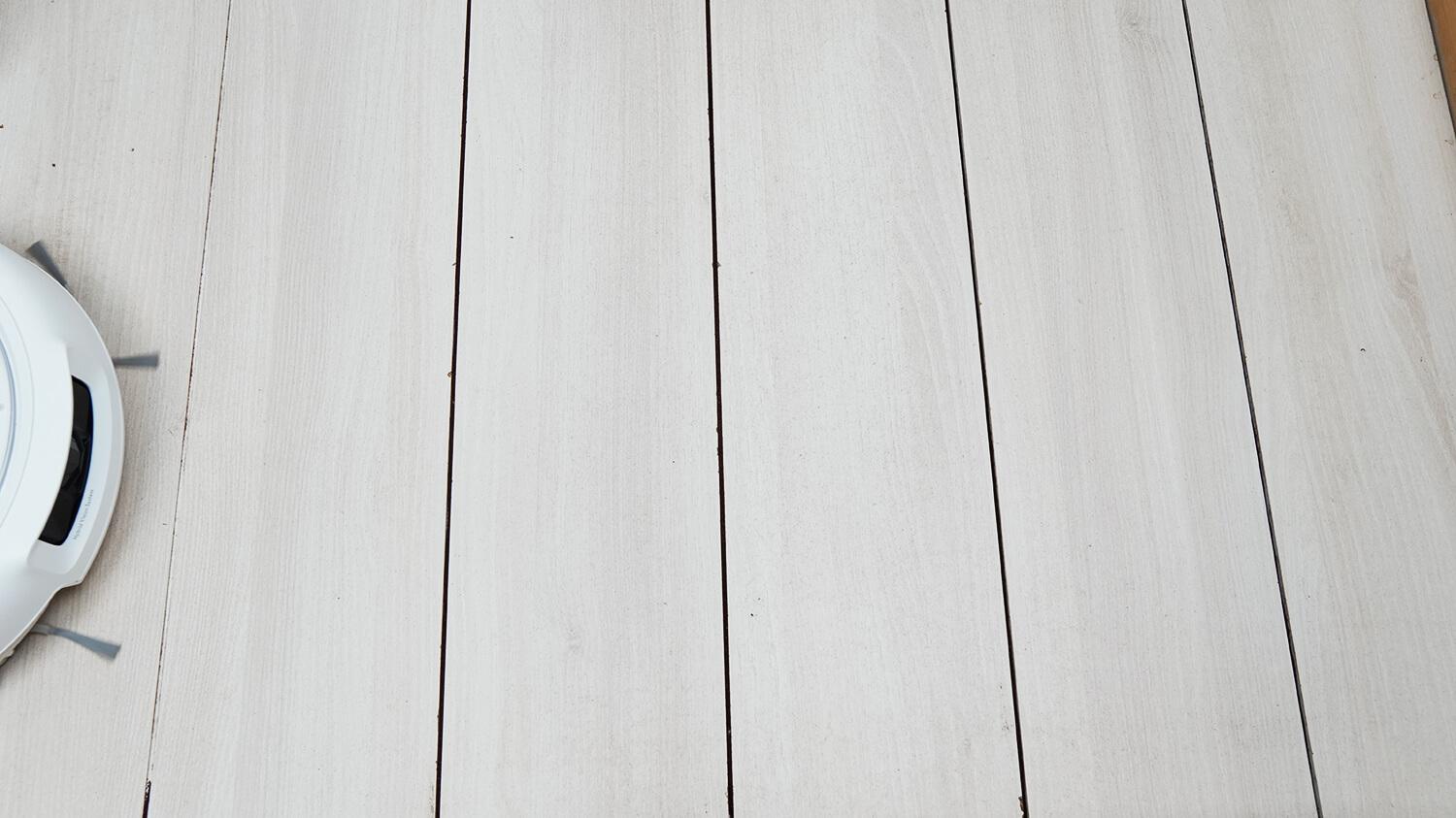
Suction power
As with similar products with the same central brush, the actual suction power is increased, but not as high as claimed, due to the design of these brushes. Due to the larger suction opening and the distance between the brushes and the housing, aerodynamic losses have occurred. While not as critical as with some premium competitors, they are nonetheless present.
Dry cleaning
Cleaning performance on laminate floors is excellent: the robot picked up all the debris from the flooring, including large, heavy cat litter pellets that often get stuck in the turbo brushes. Corner cleaning is particularly impressive—the retractable side brush picks up all the debris. Outside corners are also cleaned, although some small blind spots remain.
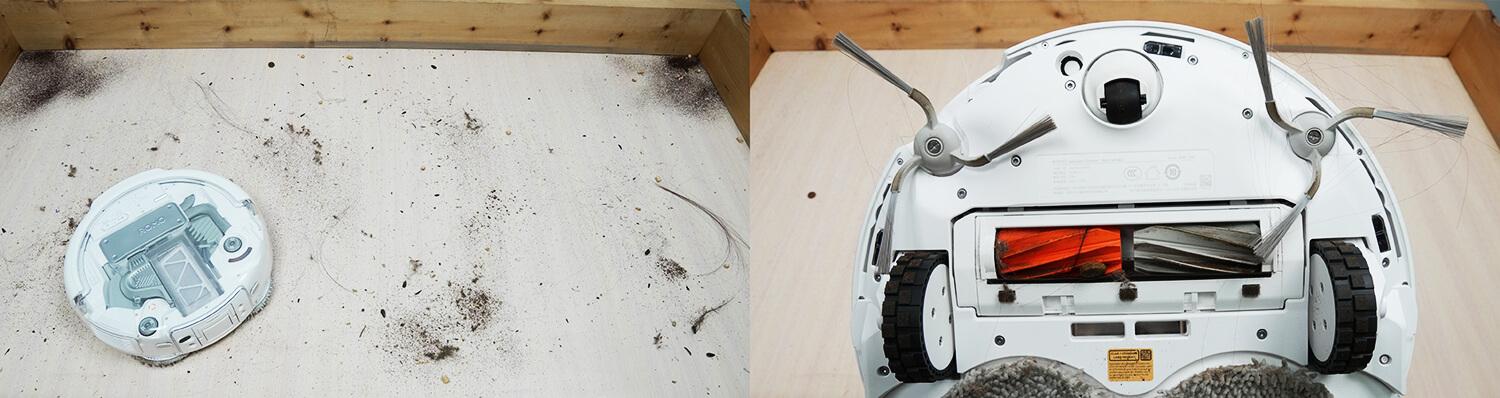
Dry cleaning
Look at the condition of the cleaning module. You can see that the central brush is slightly tangled, as are the side brushes. But it's not critical, given the amount of debris on the stand. Further testing is needed!
Anti-tangle Hair Protection
I tested the turbo brush's self-cleaning ability: I spread hair of varying lengths on the floor. The robot picked it up, but the hair still got tangled up in the brush. While these semi-brushes are easier to clean, similarly designed brushes are much better at removing hair and fur. This is likely due to the speed, shape, and material.
And here's the condition of the brushes after a week of use in an apartment with a shedding pet:
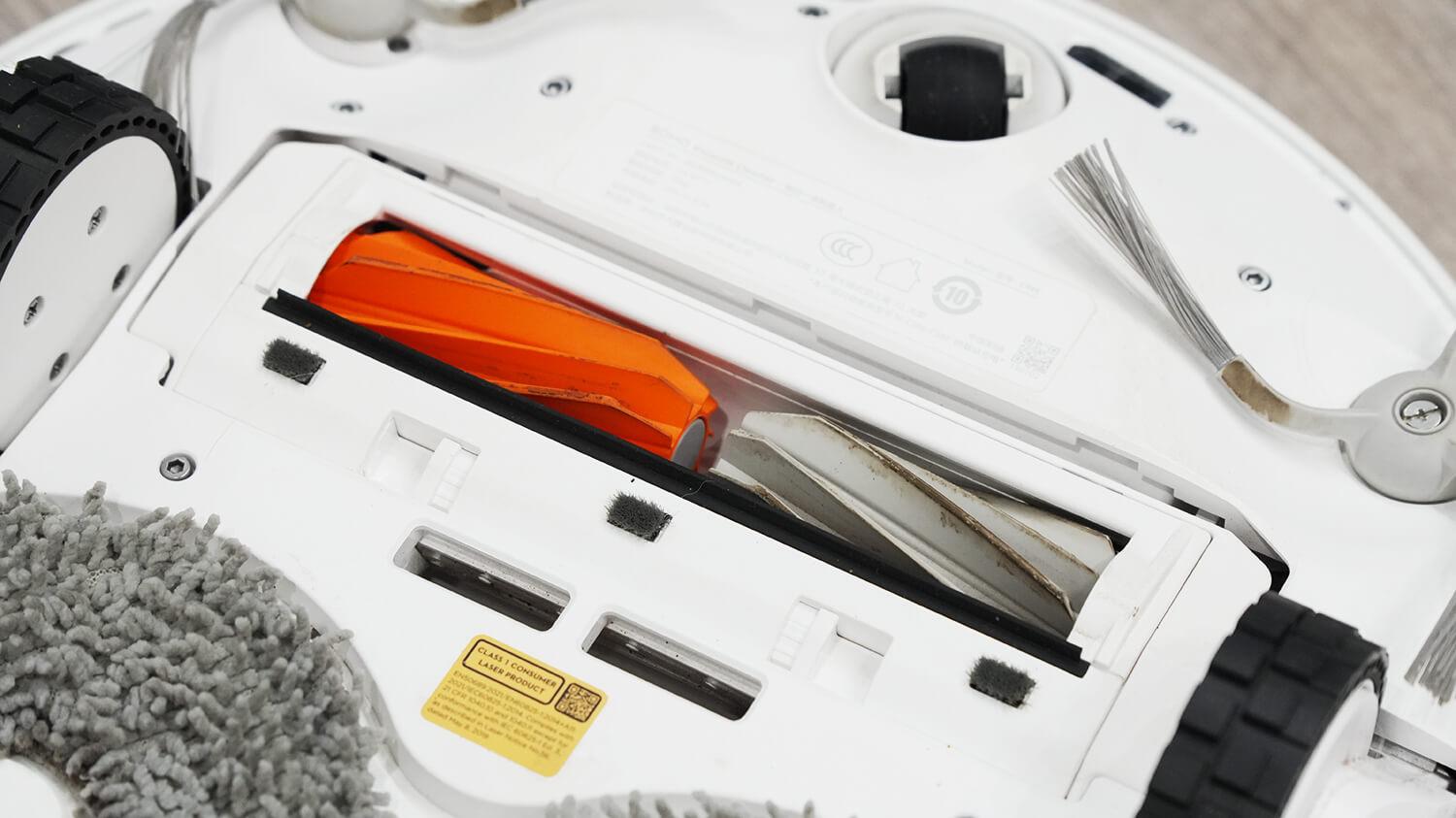
Condition of brushes in everyday life
Under these conditions, the brushes are clean, so I consider the cleaning module effective in terms of preventing hair and fur from getting tangled!
Carpet cleaning
I tested the carpet cleaning performance. I can say that the DJI ROMO P thoroughly cleaned low-pile carpet. It also cleaned medium-pile carpet thoroughly. However, the silicone brush still struggles to capture large debris. The bristle-petal brush performs better in this regard.
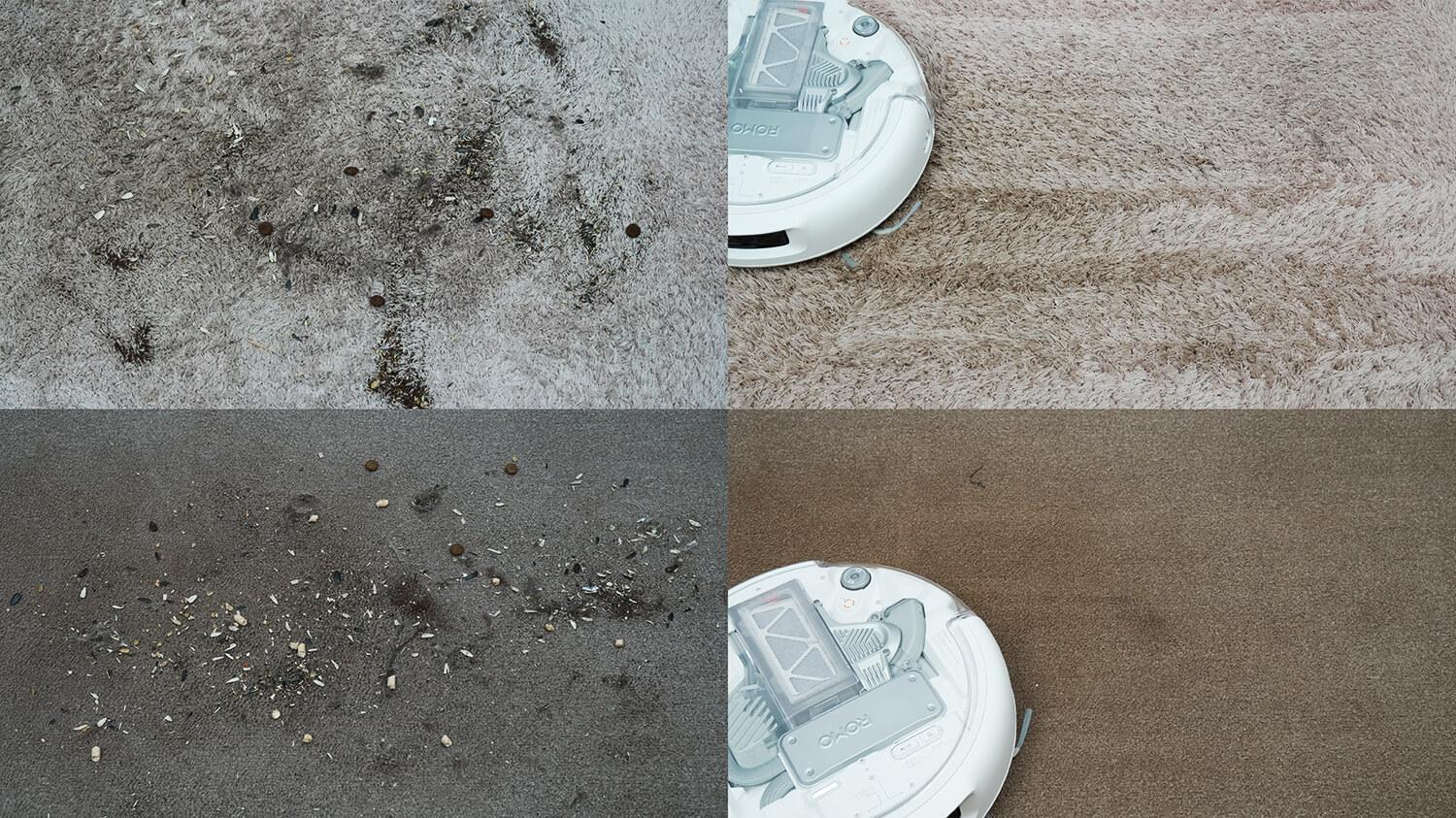
Carpet cleaning
Self-cleaning
Immediately after the "dirty tests," I checked how well the robot vacuum self-cleaned. I returned it to the station and started the self-cleaning process. The results weren't perfect, but I think they were good. Perhaps I caught a hair when I removed and reinstalled the dust container.
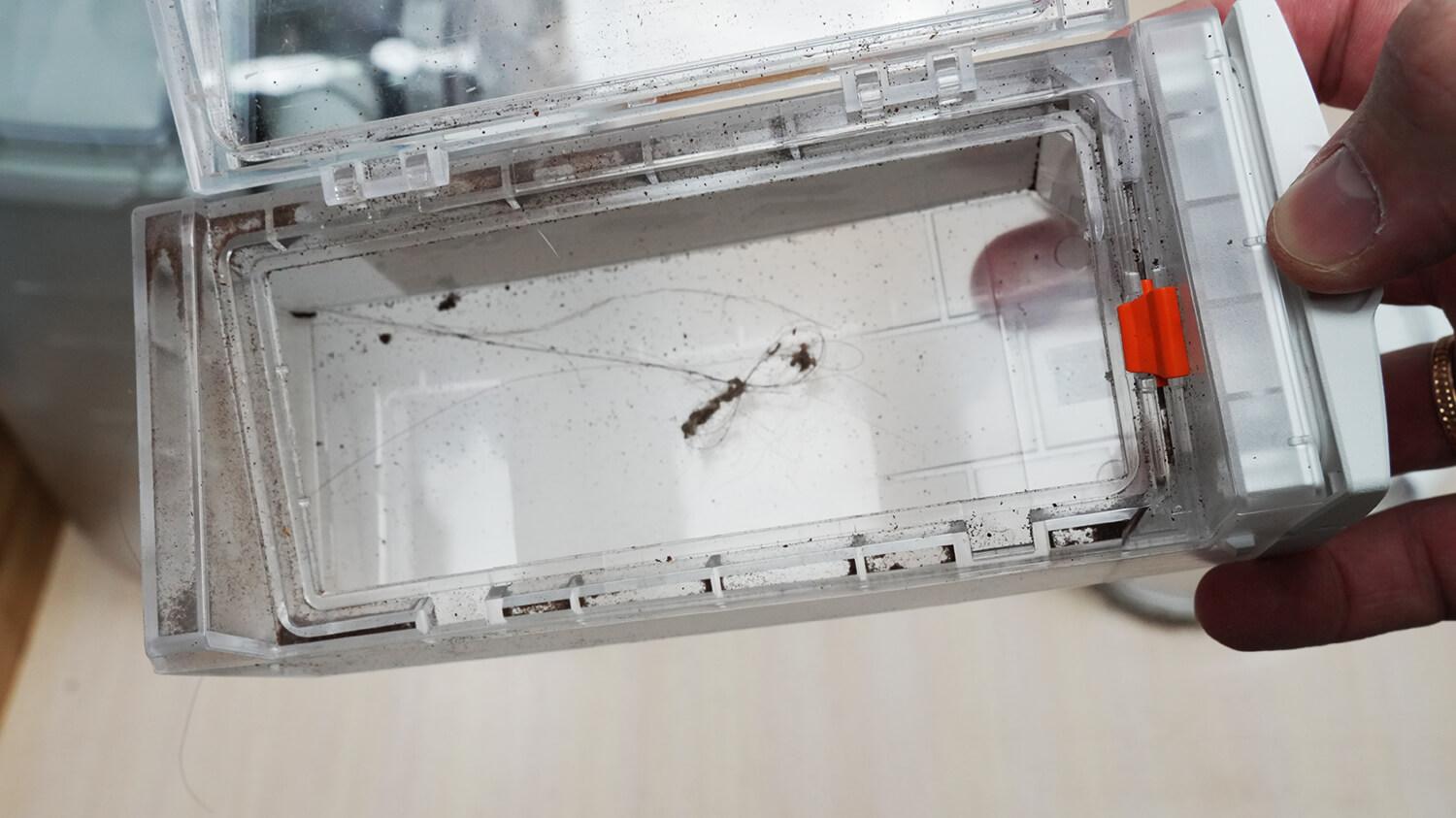
Self-cleaning
Wet cleaning and carpets
When it comes to wet cleaning on carpeted floors, there are several robot behavior options. The first is to automatically lift the cleaning cloths when entering carpets, allowing the robot to simultaneously vacuum and mop the floor, leaving the carpets dry and clean. The second option is to enable automatic carpet avoidance during wet cleaning. The third mode is carpet ignoring, in which the robot rotates the cleaning cloths on the pile, thereby performing wet cleaning. Some prefer this type of interaction. Another option is to pass over carpets without cleaning them.
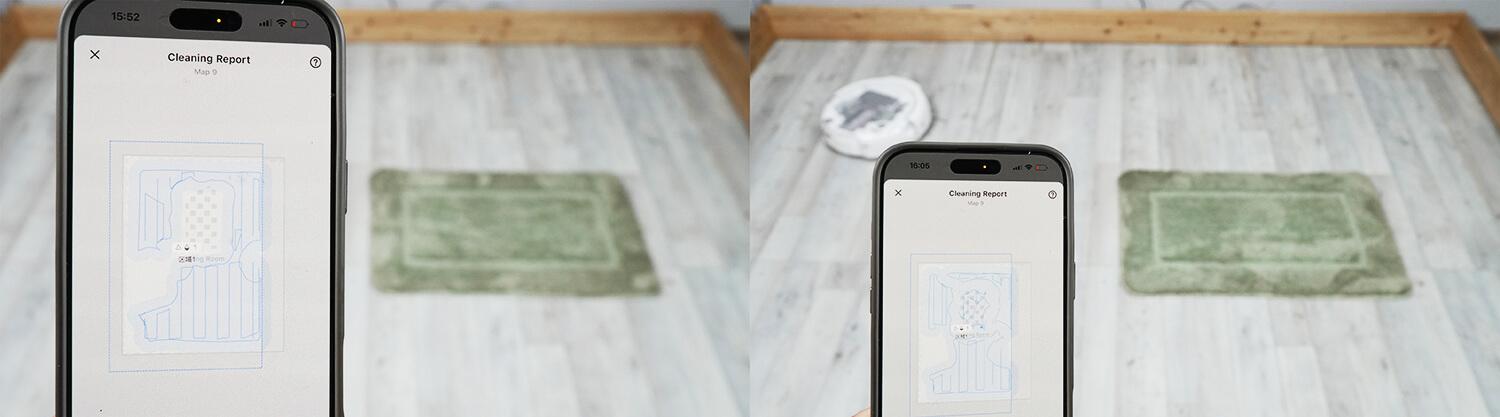
Wet cleaning and carpets
Wiping off dirt
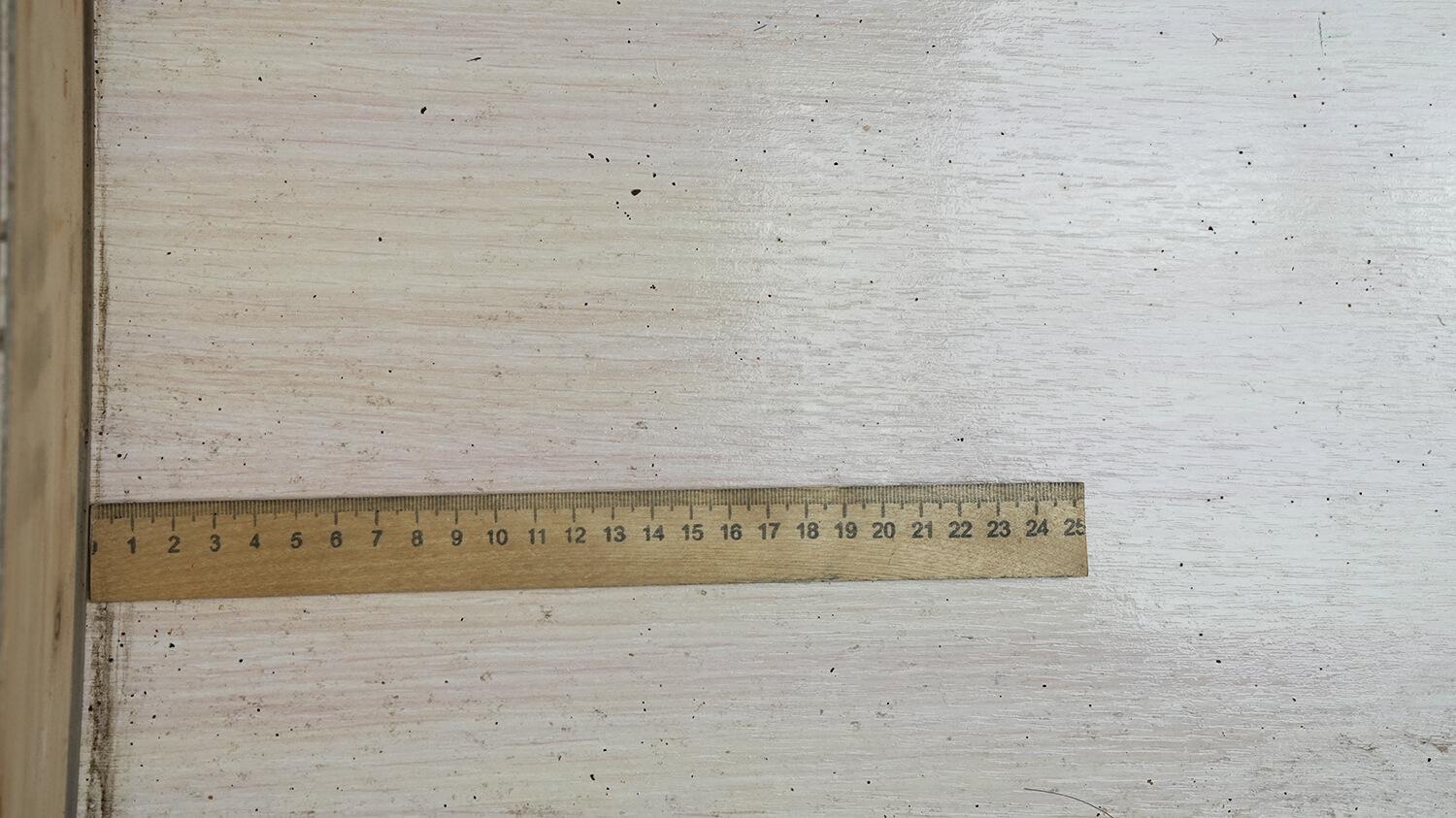
The cleaning performance is also excellent. The cloth presses firmly against the floor and absorbs dirt. The robot also cleans the edges of the cleaning area more thoroughly thanks to one of the cloths extending to the baseboard.
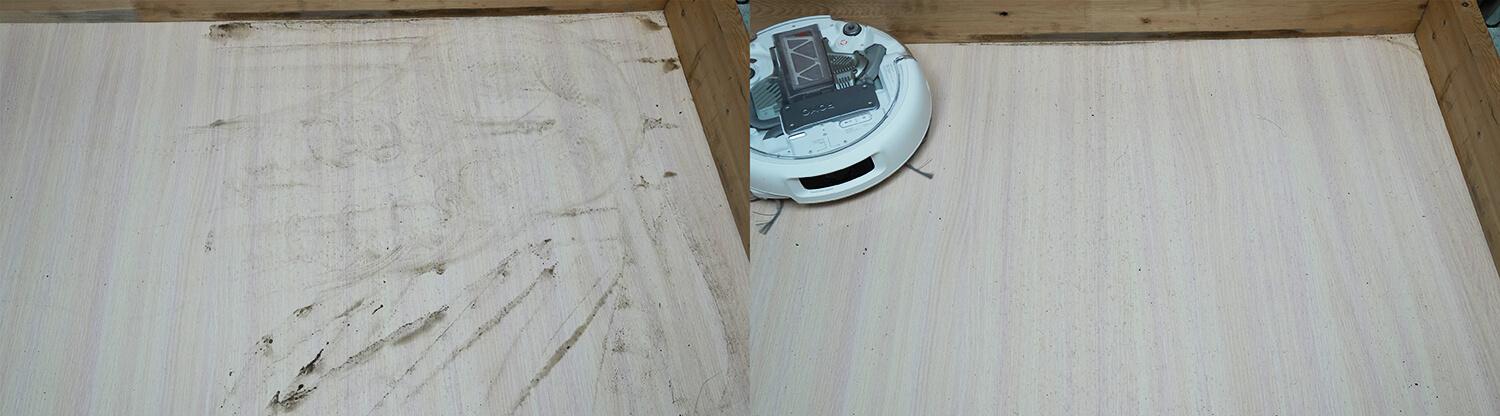
Wiping off dirt
However, a blind spot is still present, ranging from a few millimeters to a centimeter, as the robot maintains a short distance from walls.
Blind spot
Removing stains
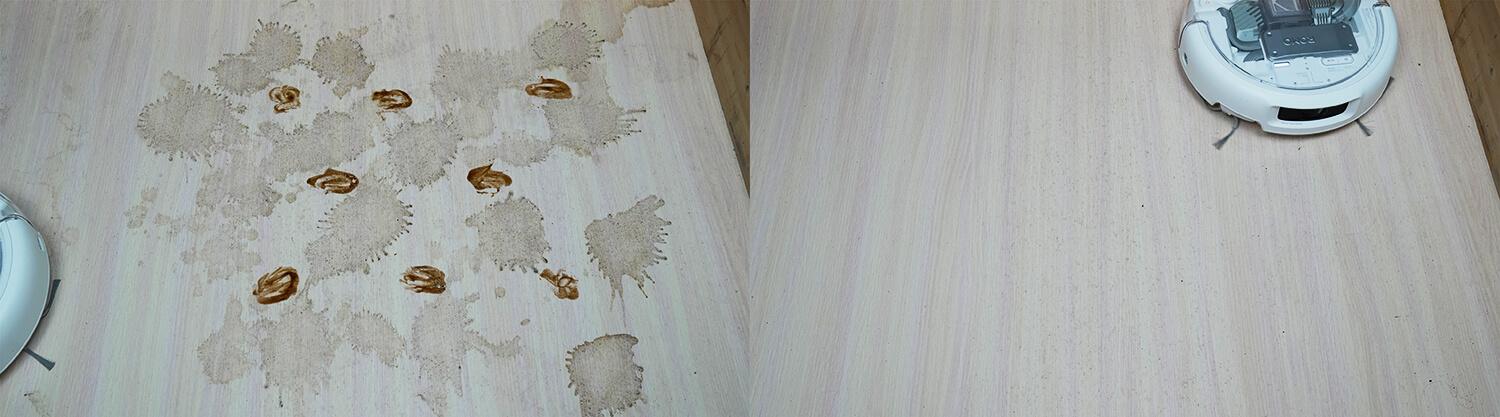
When it came to scrubbing tough stains, the robot was able to remove even dried-on coffee and sauce stains. And most interestingly, it only took four passes to remove the majority of the stains, and in just five passes, it completely removed the minimal sauce residue on the stand, while five to six passes is considered excellent.
Removing stains
This is now the best result on the project! It's probably due to the pressure of the mats on the floor and the thickness of the mats themselves, but the fact remains – the DJI ROMO P performed superbly.
Washing and drying test of napkins
I'd like to immediately talk about the efficiency of the station itself. Let's start with the cleaning quality of the wipes. Even after extensive testing, the wipes look significantly better after washing with the station. The water heating function and automatic detergent mixing undoubtedly improve the cleaning efficiency.
In a domestic setting, after washing the floor, the wipes are thoroughly rinsed at the station. No visible contamination was detected.
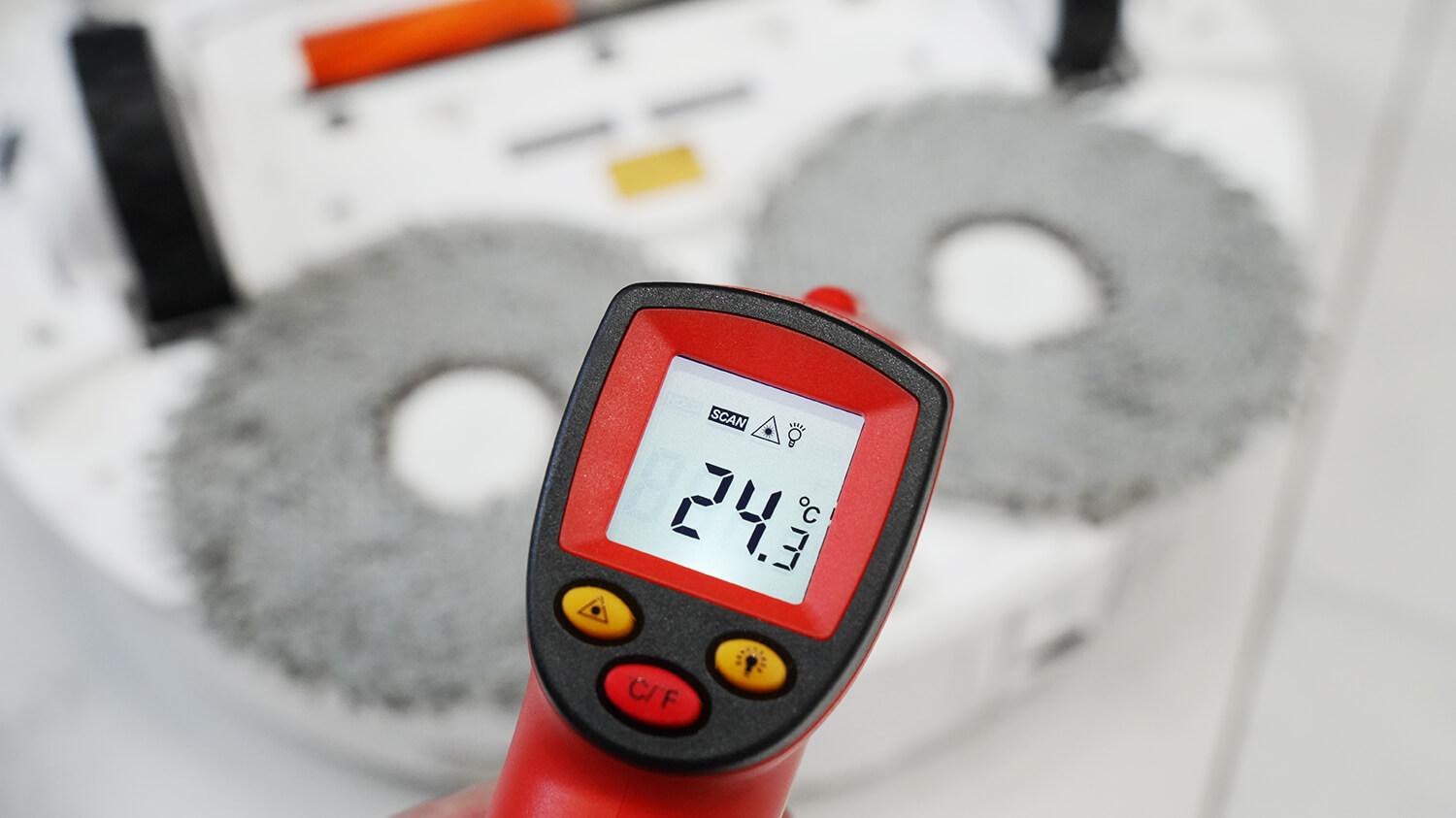
I decided to test the wash temperature myself—in my case, the peak temperature in the drain area was 46.4 degrees. After rinsing, however, the temperature of the cloths themselves was closer to room temperature, around 24-25 degrees, as the water heating temperature decreases during the wash cycle.
Temperature of napkins after washing
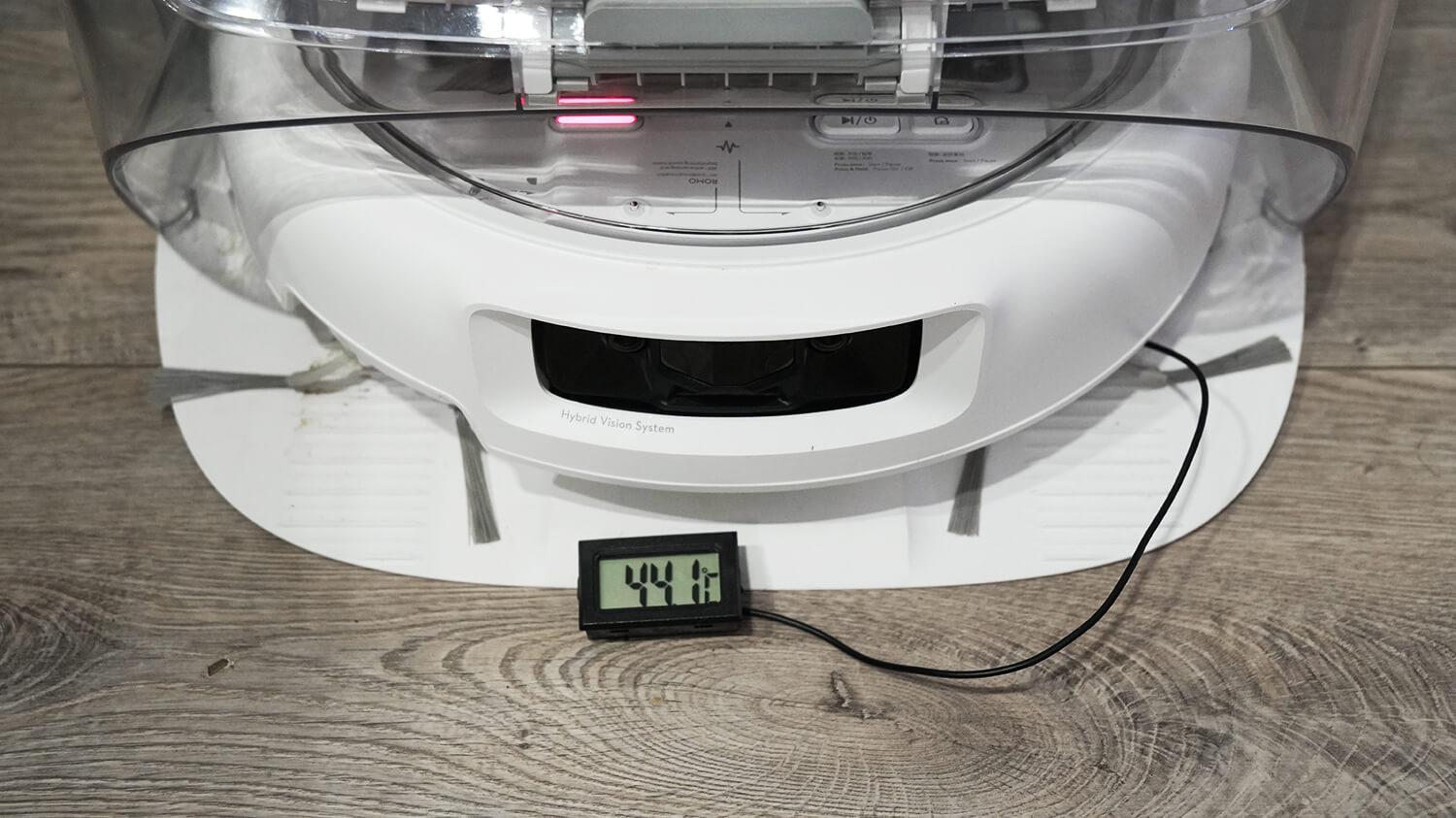
The drying temperature for the wipes is high – the sensor showed over 44 degrees, and that’s a good result!
Drying temperature for napkins
Station maintenance
A few words about station maintenance. After a week of using the robot in a domestic environment, we notice that the station's bottom is a bit dirty. We remove the ramp and wash it. However, the other components are not removable and will have to be cleaned in the station's installation area, which is not very convenient.
Obstacle clearance
The robot has good maneuverability. It can cross a 2 cm threshold.
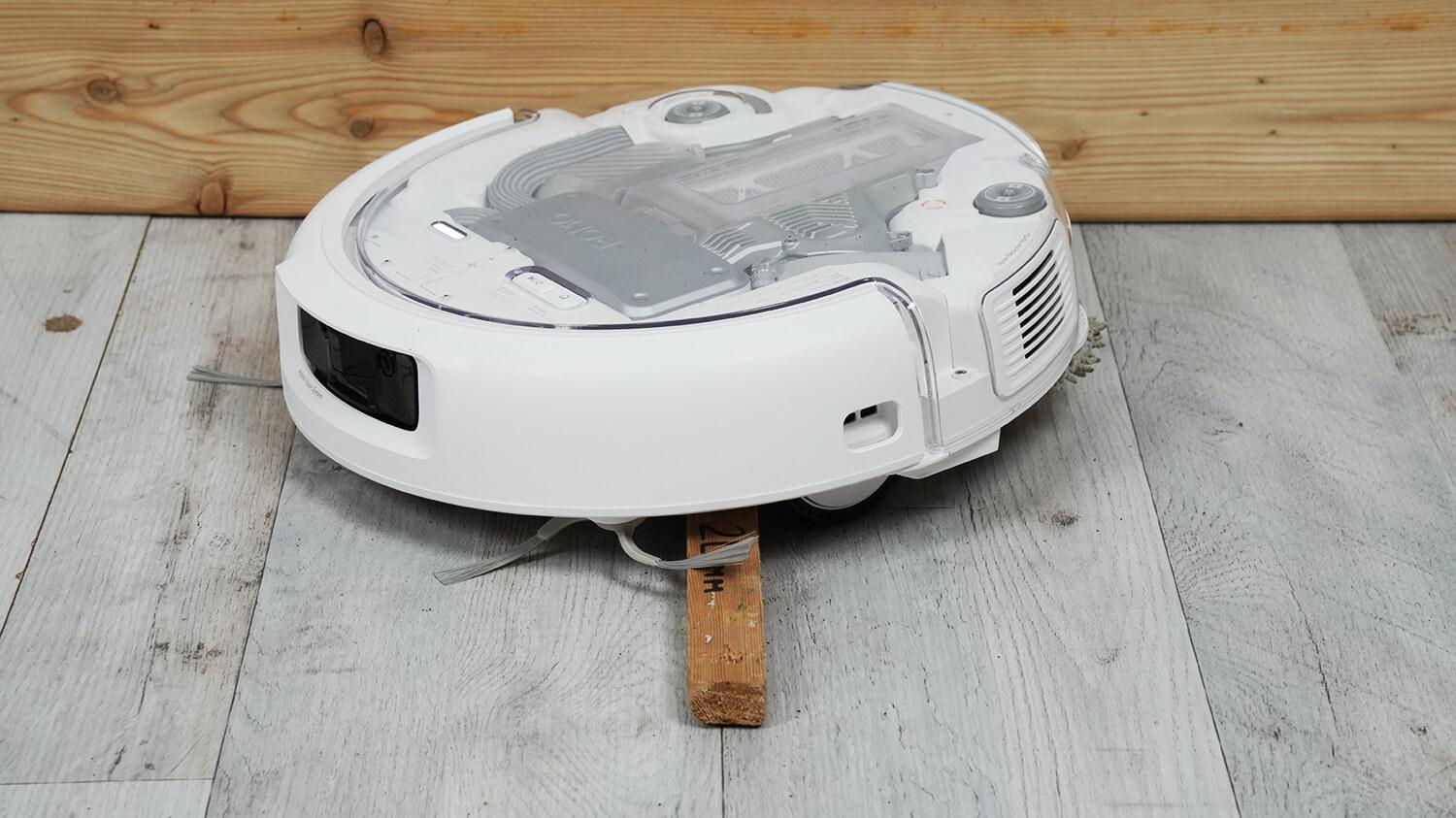
Obstacle clearance
Driving on black surfaces
Driving over black carpets is no problem. The robot glides over the black carpet as if nothing had happened.
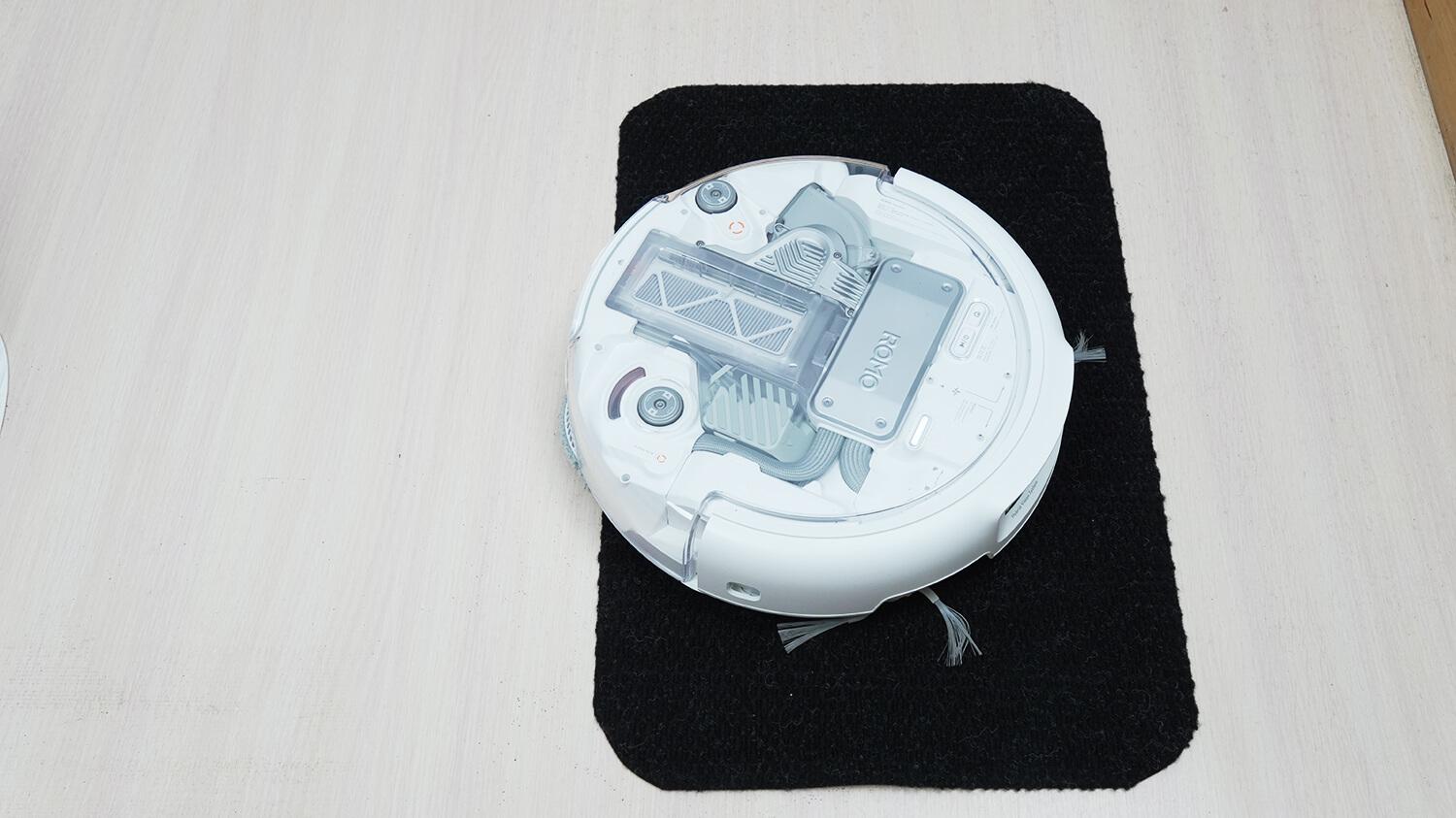
Driving on black surfaces
Noise level
As for the noise level, it ranges from 57 to 68.5 dB, depending on the selected operating mode. The robot's noise level is low, even considering its increased power.
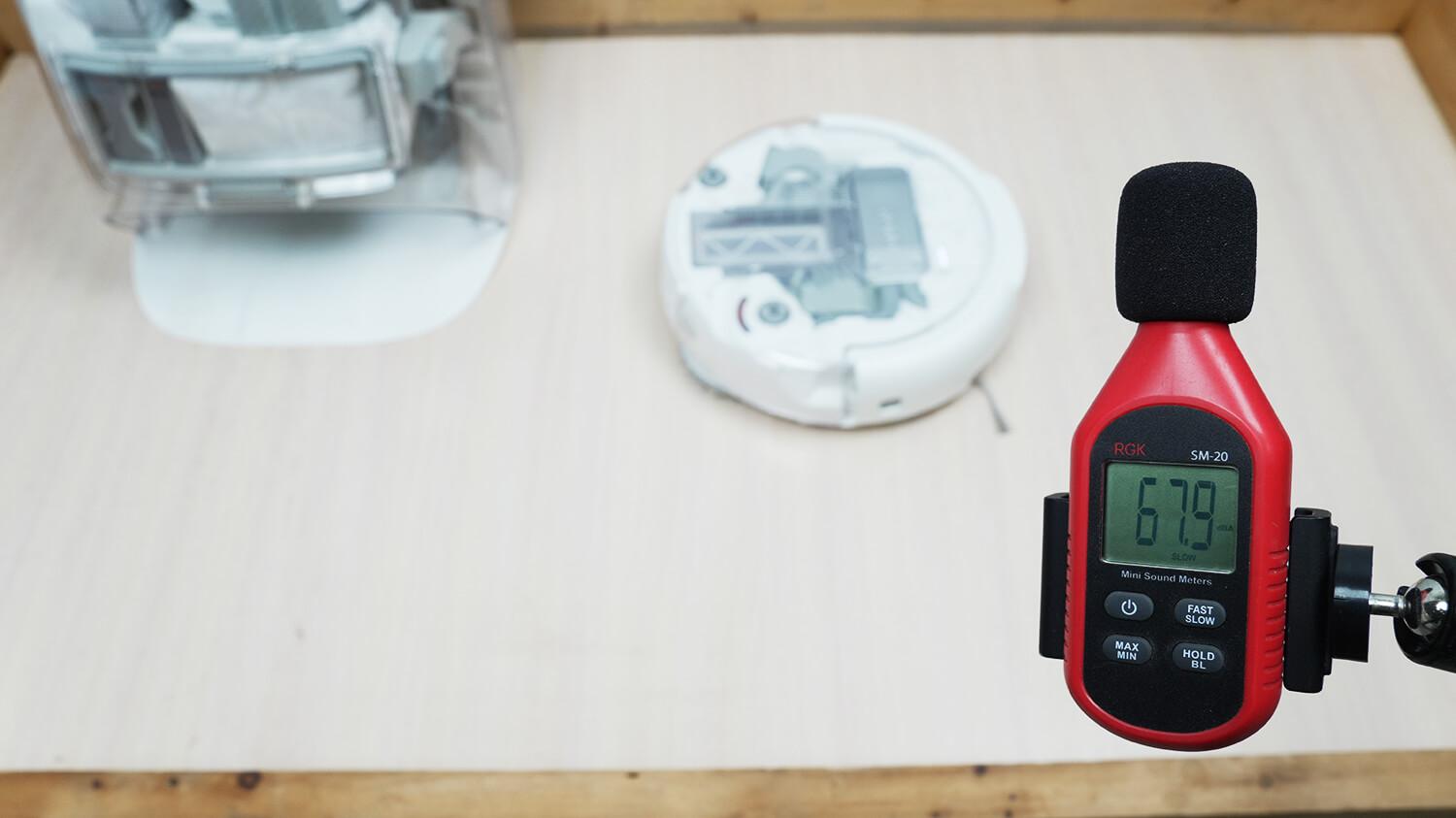
Noise level
The station's noise level during self-cleaning is between 67-70 dB. And that's a good result!
Personal opinion
The DJI ROMO P robotic vacuum cleaner has been thoroughly reviewed and tested. our evaluation system he managed to gain 218 pointsThe result is not as high due to a number of issues that will be discussed below. However, the robot is not included in the overall rating due to regional blocking. At least until support for our region becomes available.
Overall rating of tested robot vacuum cleaners: https://robovac.washerhouse.com/en/rejtingi/robovac-obshhij-rejting-robotov-pylesosov-robo.html.
I'll highlight the pros and cons I discovered, and then share my own opinion of the robot. I liked the following:
- A highly accurate object avoidance system in both good lighting and darkness. The robot can even avoid objects like bank cards, and that's amazing!
- A fully charged all-in-one station by 2025 standards. It features warm water napkin washing, warm air drying, a self-cleaning dust bin, automatic detergent mixing from two dispensers, and even a UV lamp for waste disinfection.
- The robot and station have a bold design. Opinions may differ, but I personally got a "wow" effect and consider the design very interesting, setting this model apart from similar models. It also shows that the brand isn't afraid to show off the robot's interior, and the build quality is very high, based on visual assessment.
- A station for connection to sewerage and water supply is provided.
- High-quality floor cleaning over large areas. The robot can remove tough stains faster than its competitors, clean floors right up to baseboards, and rinse the cleaning pads at the station. It also lifts the cleaning pads on carpets, allowing you to vacuum and mop simultaneously, leaving carpets dry and clean.
- Increased suction power.
- High-quality dry cleaning on various surfaces.
- The turbo brush is easier to clean from tangled hair and fur and, in household conditions, can shed fur and hair, remaining clean even after several weeks of use.
- Raising the central brush when washing the floor.
- The side brush extends into corners to sweep away debris.
- Two side brushes, for whom this is still an important factor when choosing a robot vacuum cleaner.
- The robot's water tank is capacious. Its capacity is larger than that of many similar devices.
- Remote home monitoring function via robot camera.
- The extensive range of features in the proprietary app allows for flexible cleaning settings.
- Good cross-country ability.
- The robot vacuum cleaner is not afraid of black carpets.
- Low noise level of the robot.
Now about the comments:
- First and foremost, at the time of writing, the DJI ROMO P is intended for the Chinese market and is regionally locked. Without some additional steps, you won't be able to use it outside of mainland China.
- Besides the regional lock, there are other inconveniences associated with the Chinese version. Specifically, the instructions are in Chinese, the app interface is partly in English and partly in Chinese, and the robot only speaks these two languages. Furthermore, the built-in assistant only works in Chinese.
- It's unclear whether the sewer connection module and water tanks are interchangeable. If not, it's very inconvenient that you can't purchase the module as an option, but must choose one of the stations.
- The claimed highest suction power was not confirmed in tests.
- At the time of writing, the robot doesn't recognize what's on the floor in front of it and doesn't display it with icons on the map. I can't confirm the presence of artificial intelligence.
- Doesn't clean behind curtains and drapes.
- The station's non-removable napkin washing platform is difficult to clean.
- The station takes a very long time to wash the cloths. The cycle takes up to 10 minutes. If you do five such washes in a single cleaning session, the cleaning time will be twice as long. I should also add that it's inconvenient that you can't choose the frequency of the cloth wash based on a set time or area covered.
- Another drawback is missing zones when running the robot on a map without a station. This could be, for example, the second floor. When testing in specific zones, for some reason it always avoided a single small empty area, as if the algorithms had programmed it to be a station. It's unclear why this is necessary, but in the test rigs, there was always one small zone that the robot always avoided.
So, what's the bottom line? In my opinion, DJI's entry into the robot vacuum market has been a very successful one. They've managed to combine one of the best object avoidance systems on the market, excellent dry and wet cleaning, increased suction power, and a fully loaded docking station in their flagship solution. And all this in a bold, transparent design, which many people talked about at the launch. This entire suite of features really works well. If they could add features found in premium competitors, as well as their own unique capabilities, they could confidently compete for the title of one of the best robot vacuums of 2025. But, first and foremost, the device's regional blocking is a real bummer. Few people will want to figure out how to bypass it, and it's not a given that the methods that work now will continue to work.
Therefore, I hope that adapted versions with full Russification will appear, and that new unique features will be added to the updated models, and that work will be carried out to eliminate the problems.
That's all from me. If you have any questions, please ask them in the comments. Happy shopping, everyone. Bye!