Trouver E30 Aqua: a budget-friendly robotic vacuum cleaner with anti-hair-tangling protection!
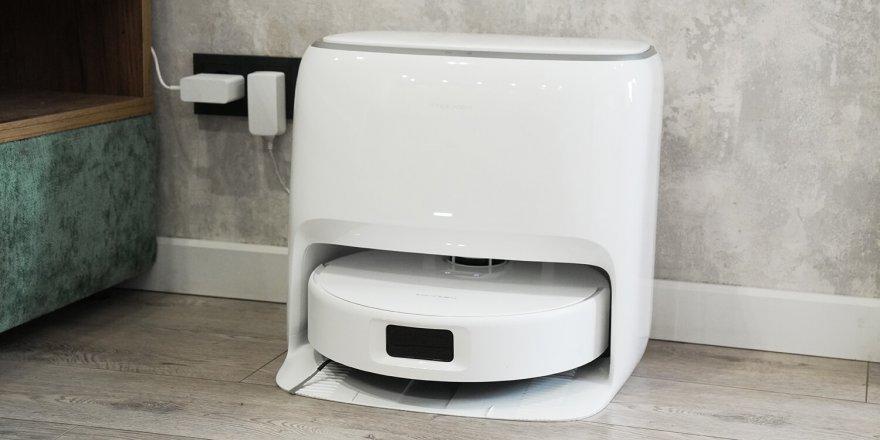
Hello to all readers of this project! In this review, I'll be taking a look at the new Trouver E30 Aqua robot vacuum. It features a powerful motor generating up to 10,000 Pa of suction, a lidar/object avoidance system, an updated turbo brush with anti-hair and pet hair protection, two round cleaning pads with a carpet lift function and a baseboard scroll function, and a cleaning station with an automatic detergent dispenser. This combination of features costs between $200 and $300, which is a great value for this type of equipment. Below, I'll thoroughly test the Trouver E30 Aqua, highlight its pros and cons based on my test results, and then share my personal opinion. Let's get started!
Equipment
The robot vacuum cleaner arrived in a branded box like this:
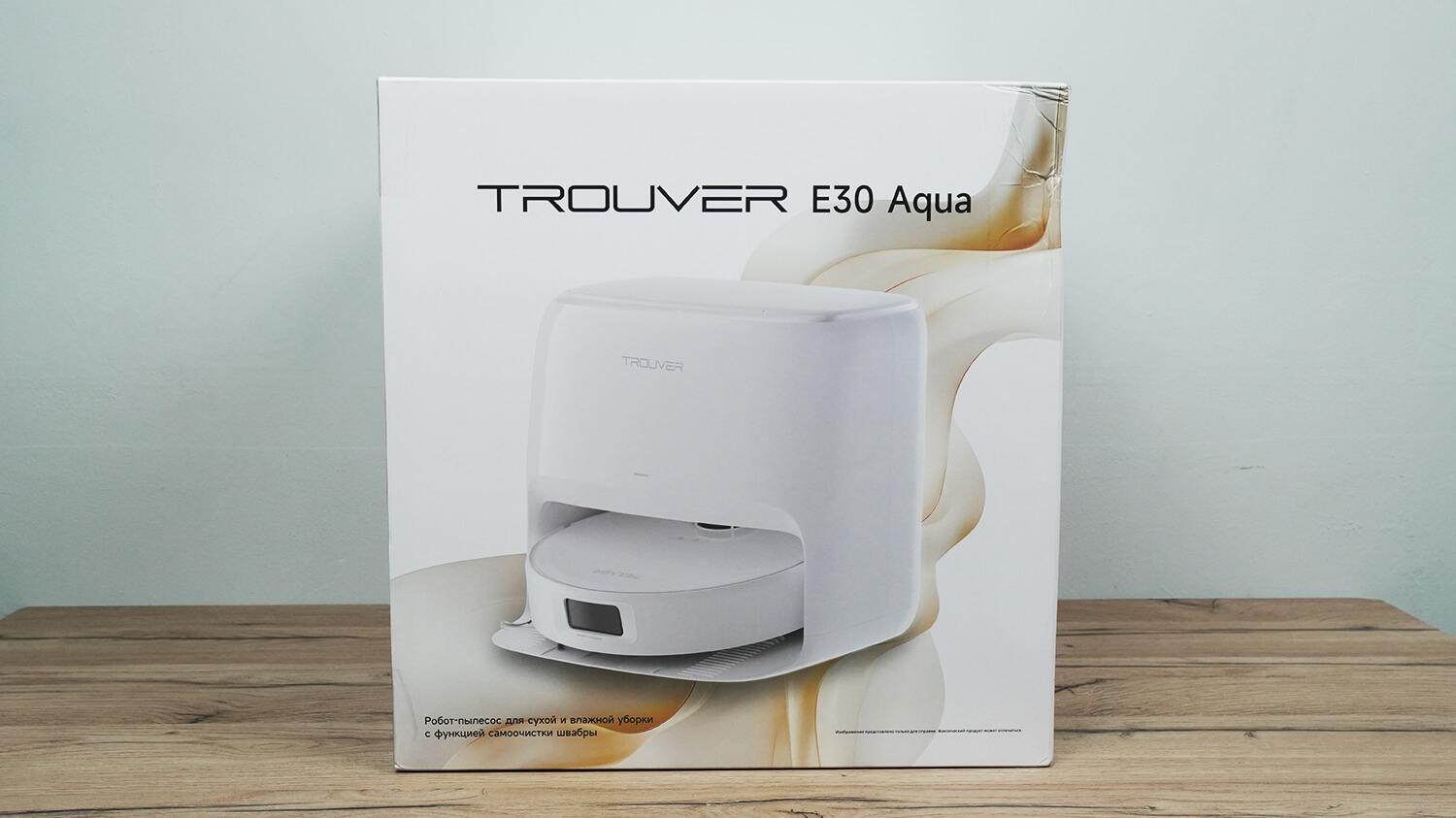
Box
In addition to the robot and station, the package includes a power adapter, a detergent tank, a disposable dust bag, and documentation for the robot in Russian.
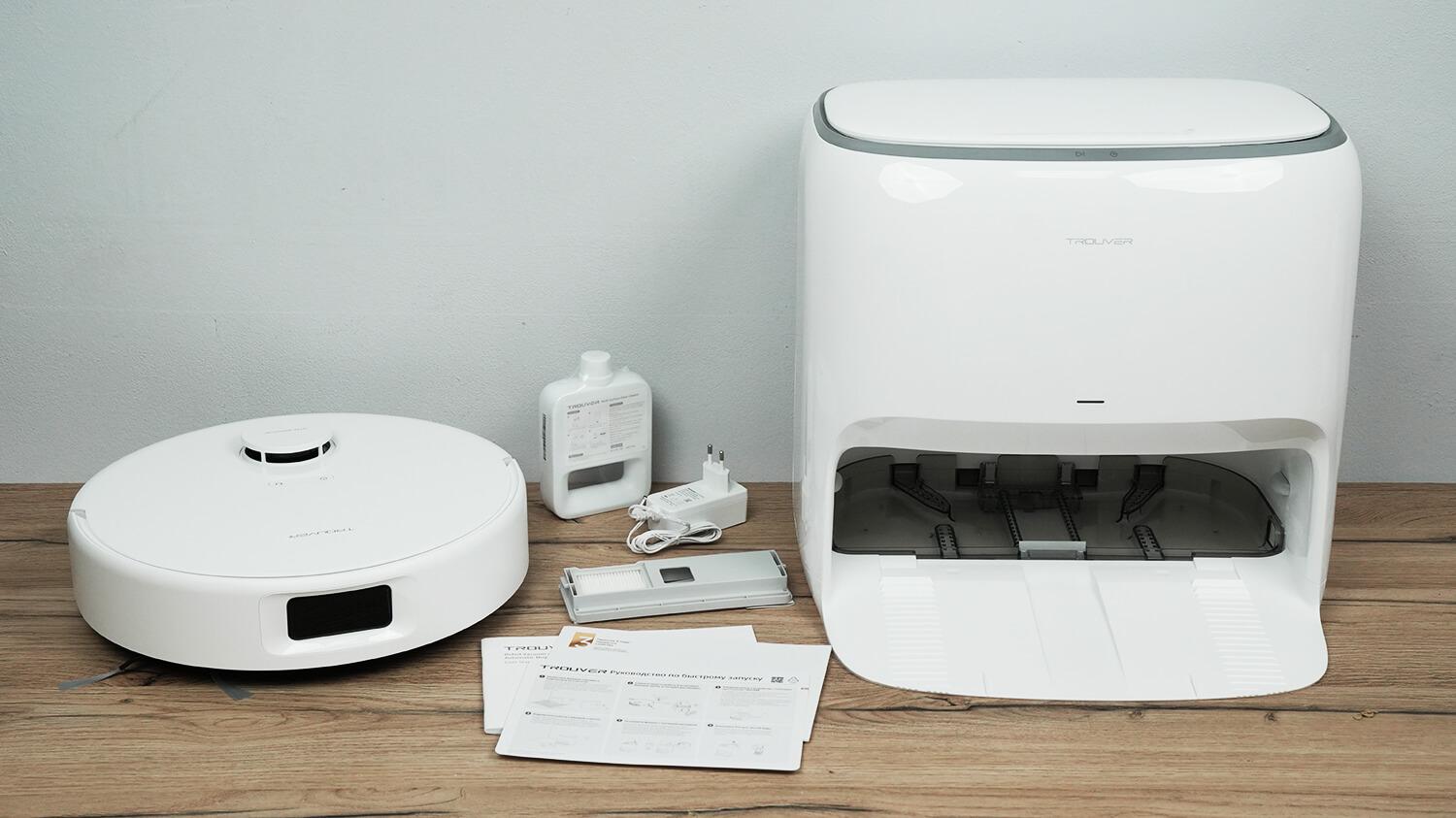
Equipment
Appearance
Now let's take a look at the Trouver E30 Aqua's design. Let's start with the robot vacuum itself. It's round and comes in white.
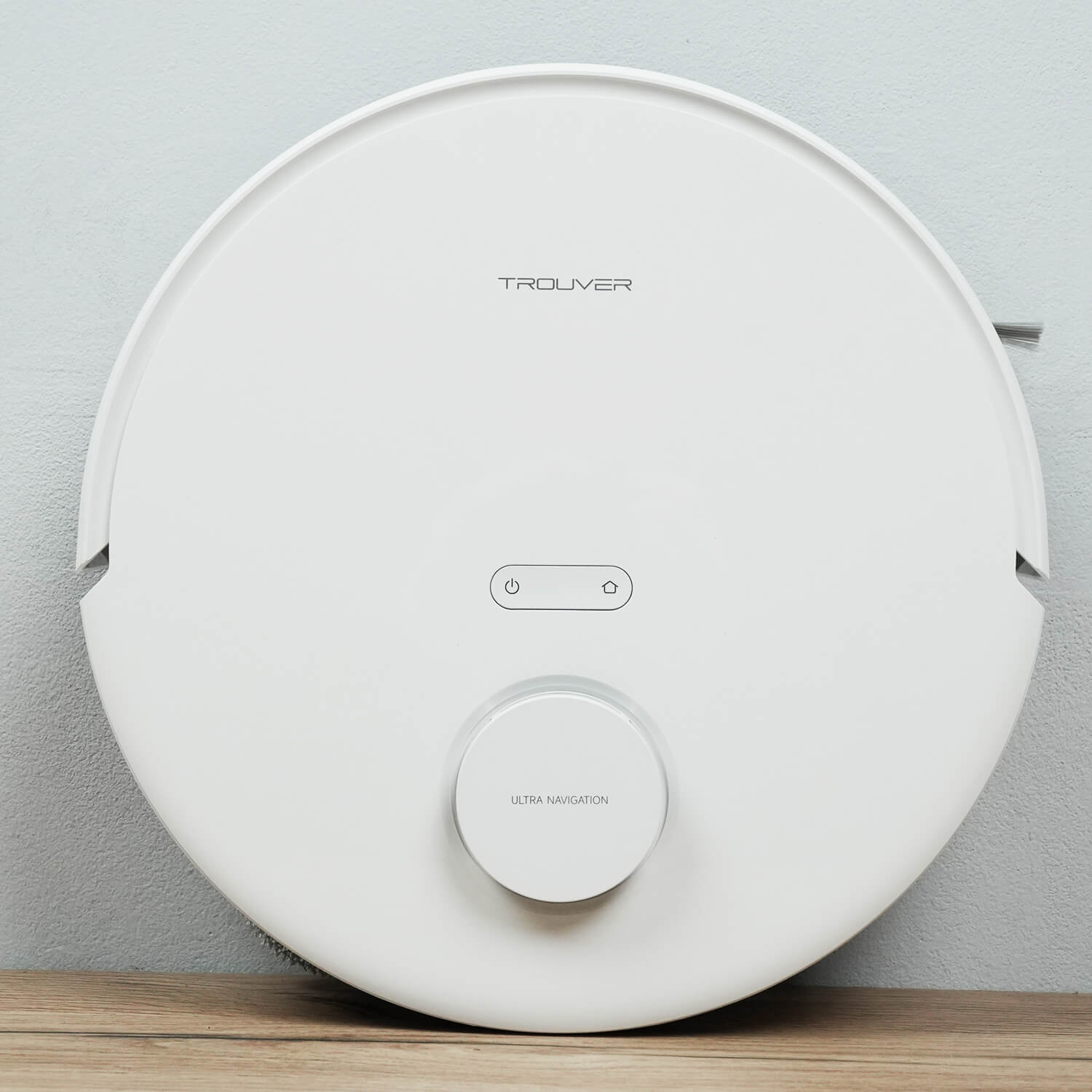
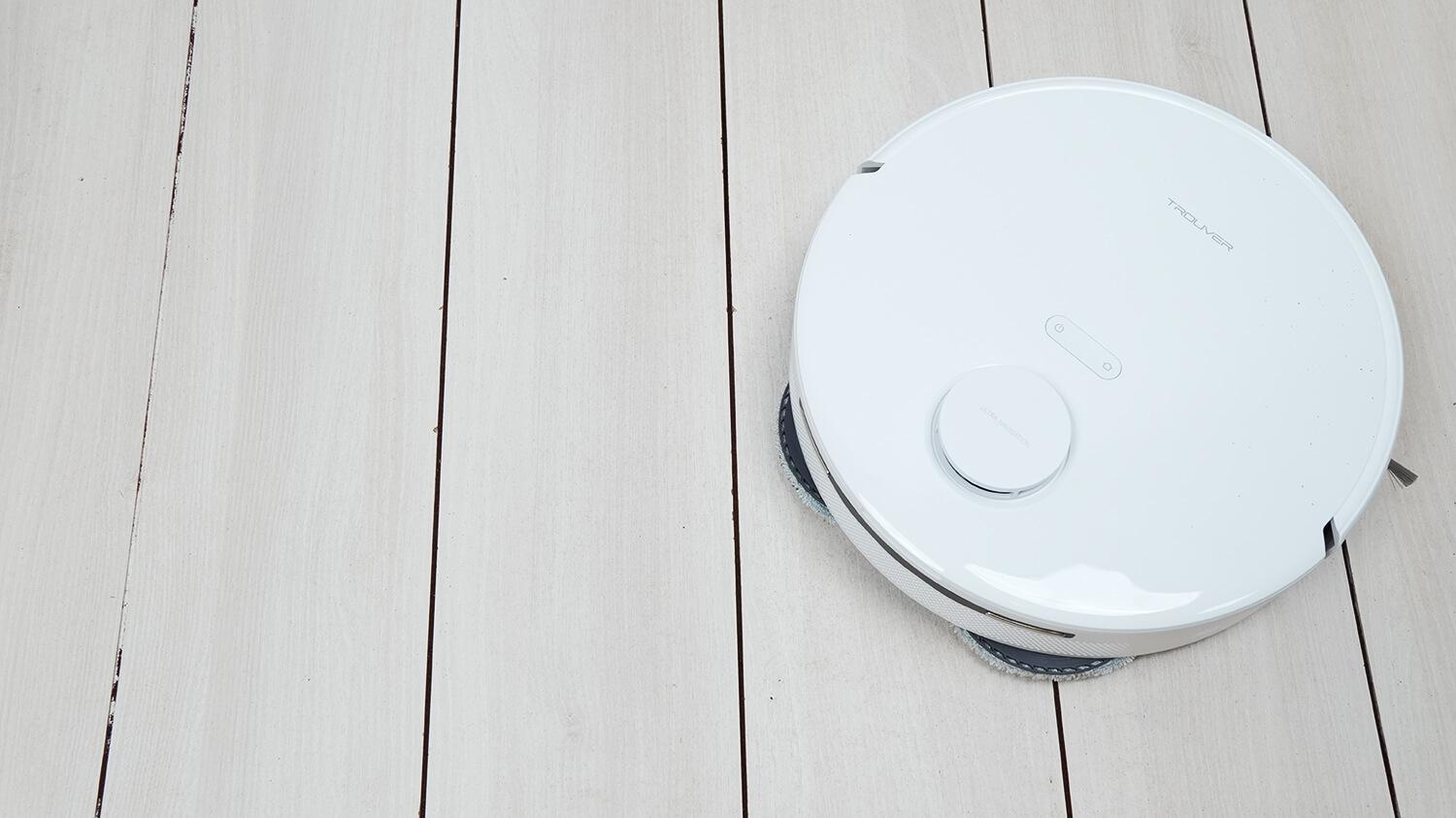
Top view
The height of the case is 10.8 cm, so it will not fit into a standard 10 cm clearance, and this is not good.
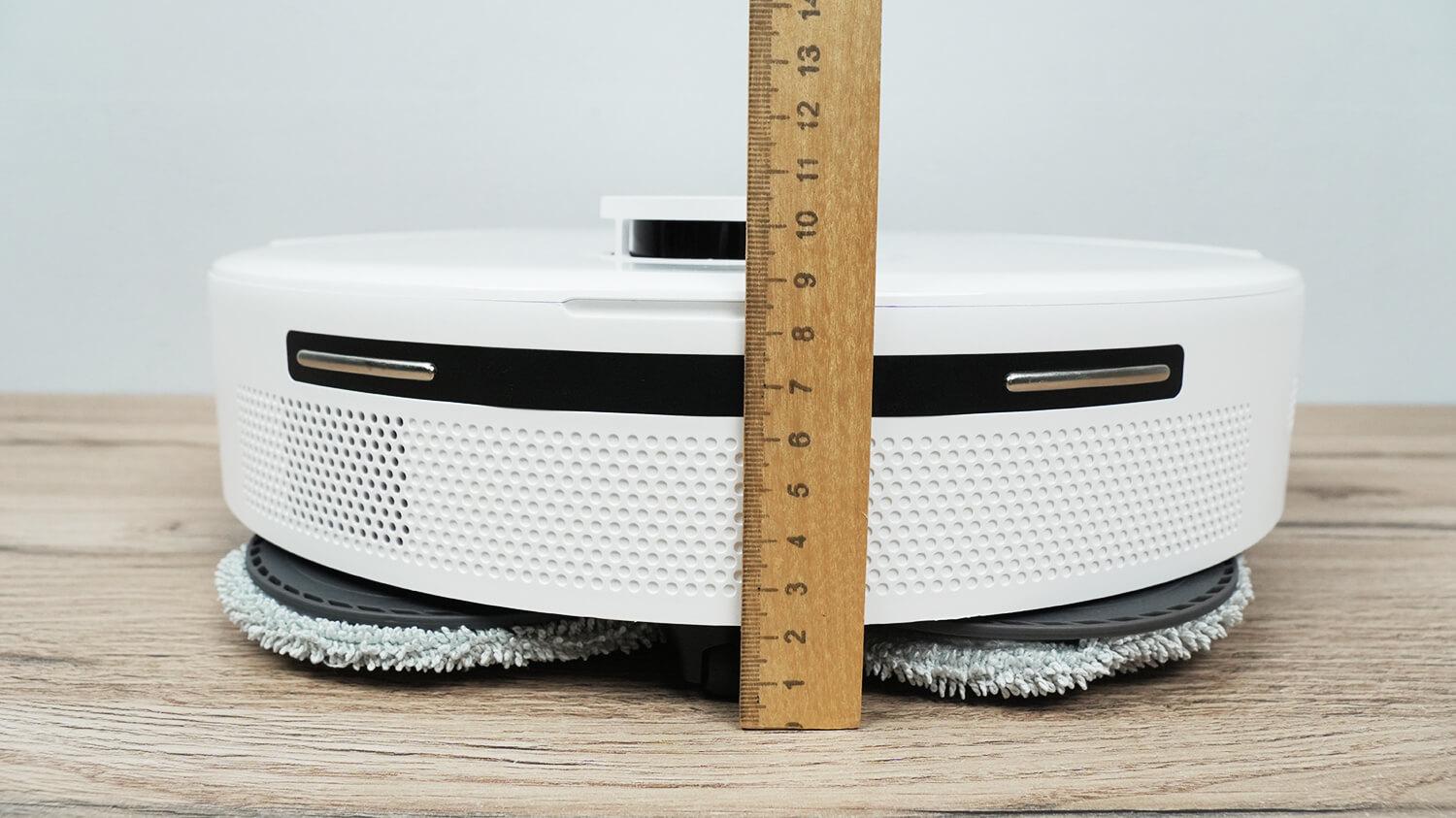
Body height
There's no wall sensor on the bumper, which is also disappointing, but in the center we see a sensor system for detecting and accurately avoiding objects on the floor, dubbed Adaptive Avoidance. There are no cameras, and therefore no remote home monitoring feature.
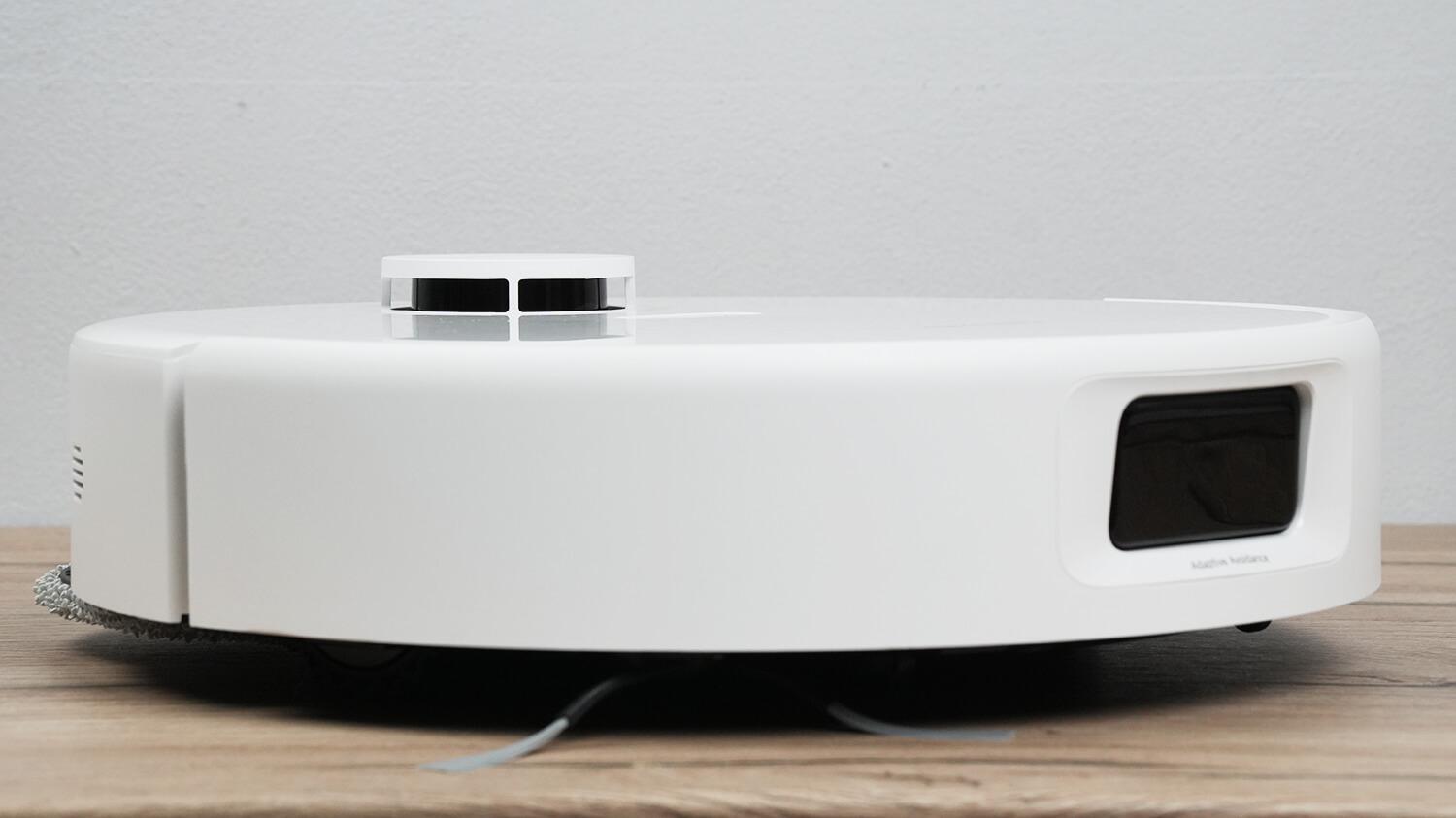
Side view
The main navigation device is the lidar, which is equipped with a spring-loaded cover to prevent it from getting stuck under furniture. Two mechanical control buttons are located next to it.
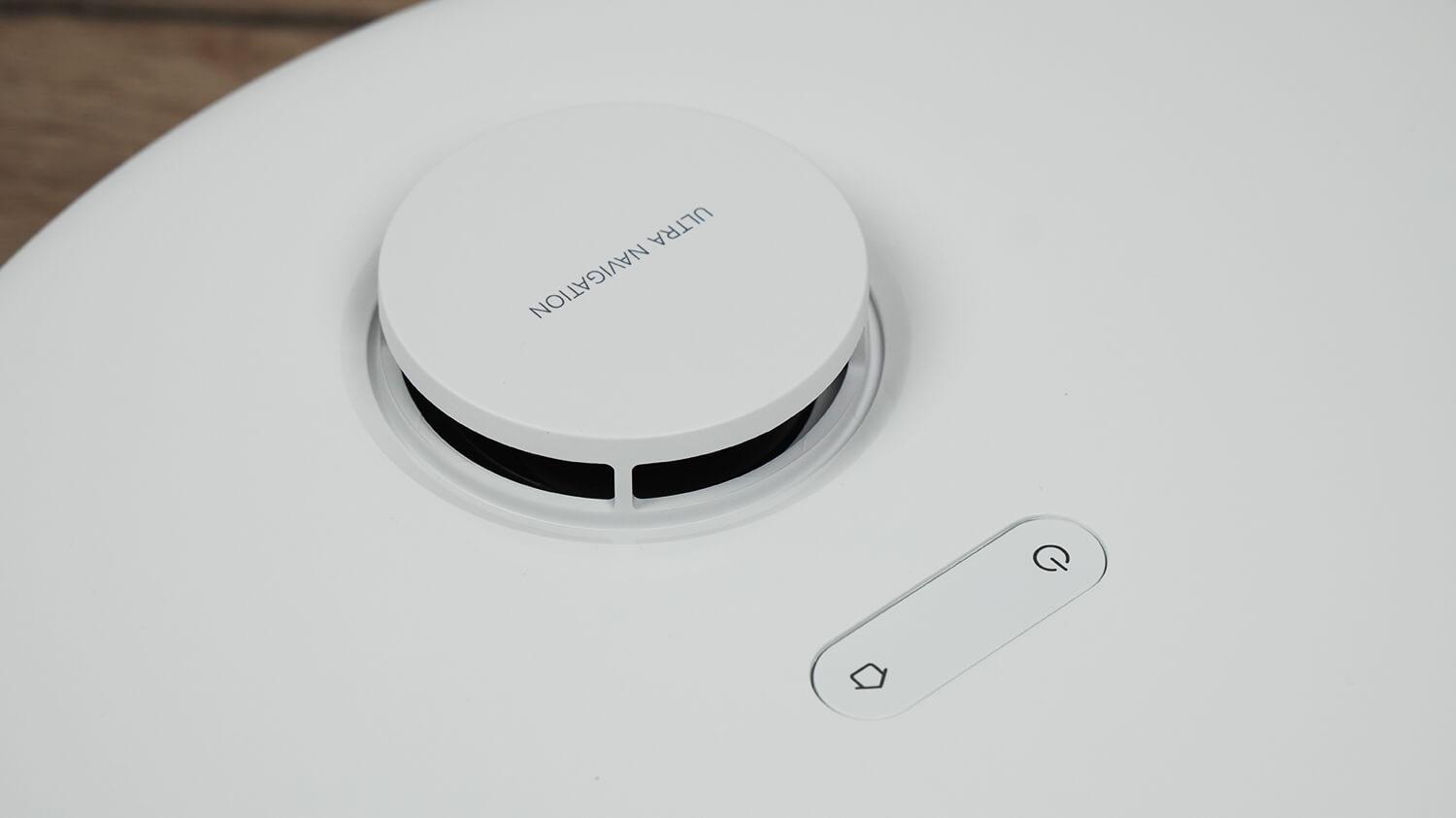
Lidar and control panel
The dust container is located under the top cover, which is conveniently held in place by magnets. The container itself is large, holding up to 800 ml of dry waste.
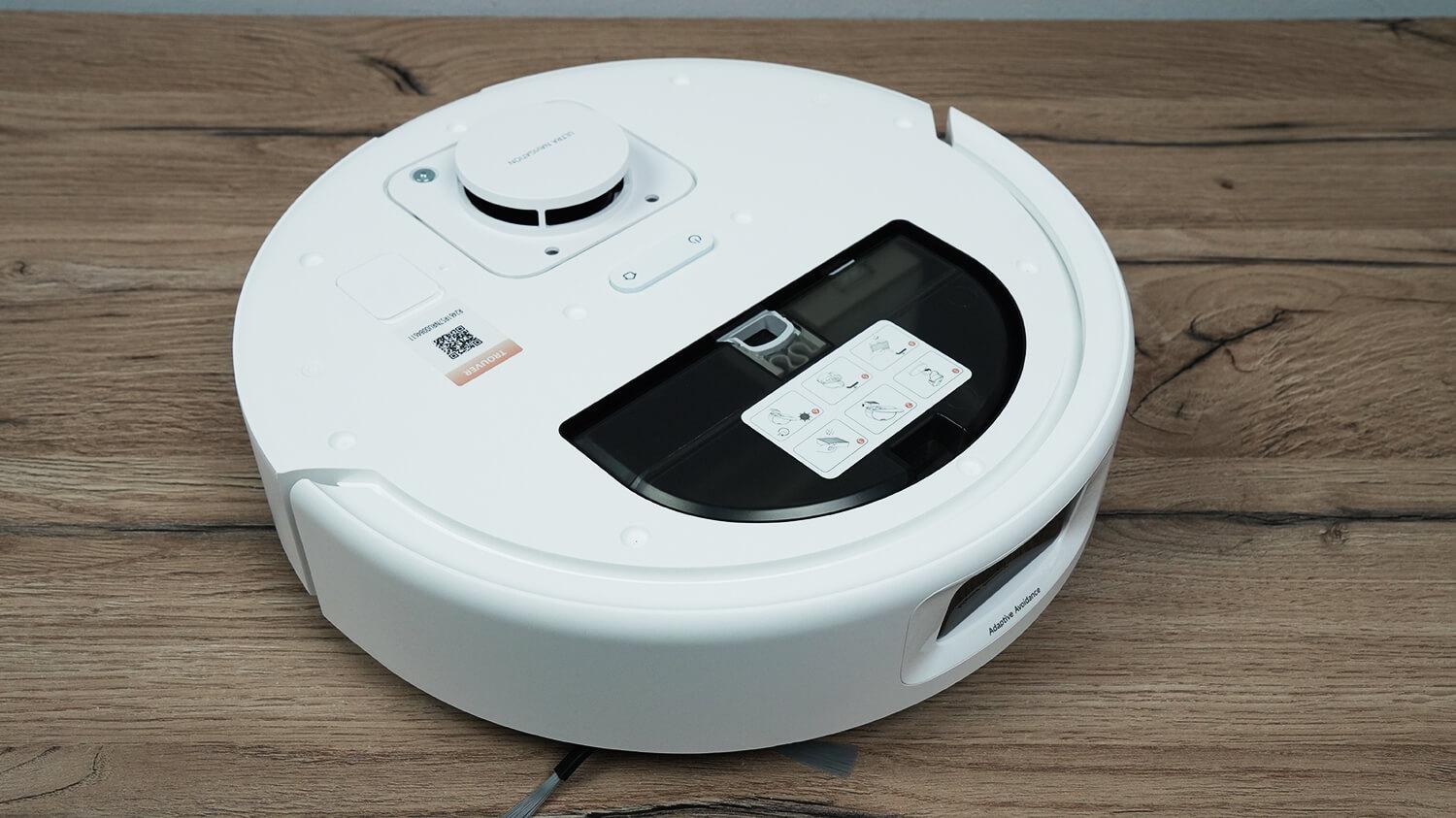
Dust collector location
Like the filtration system, it can be rinsed with water. It has two filtration stages: a HEPA filter and a mesh filter.
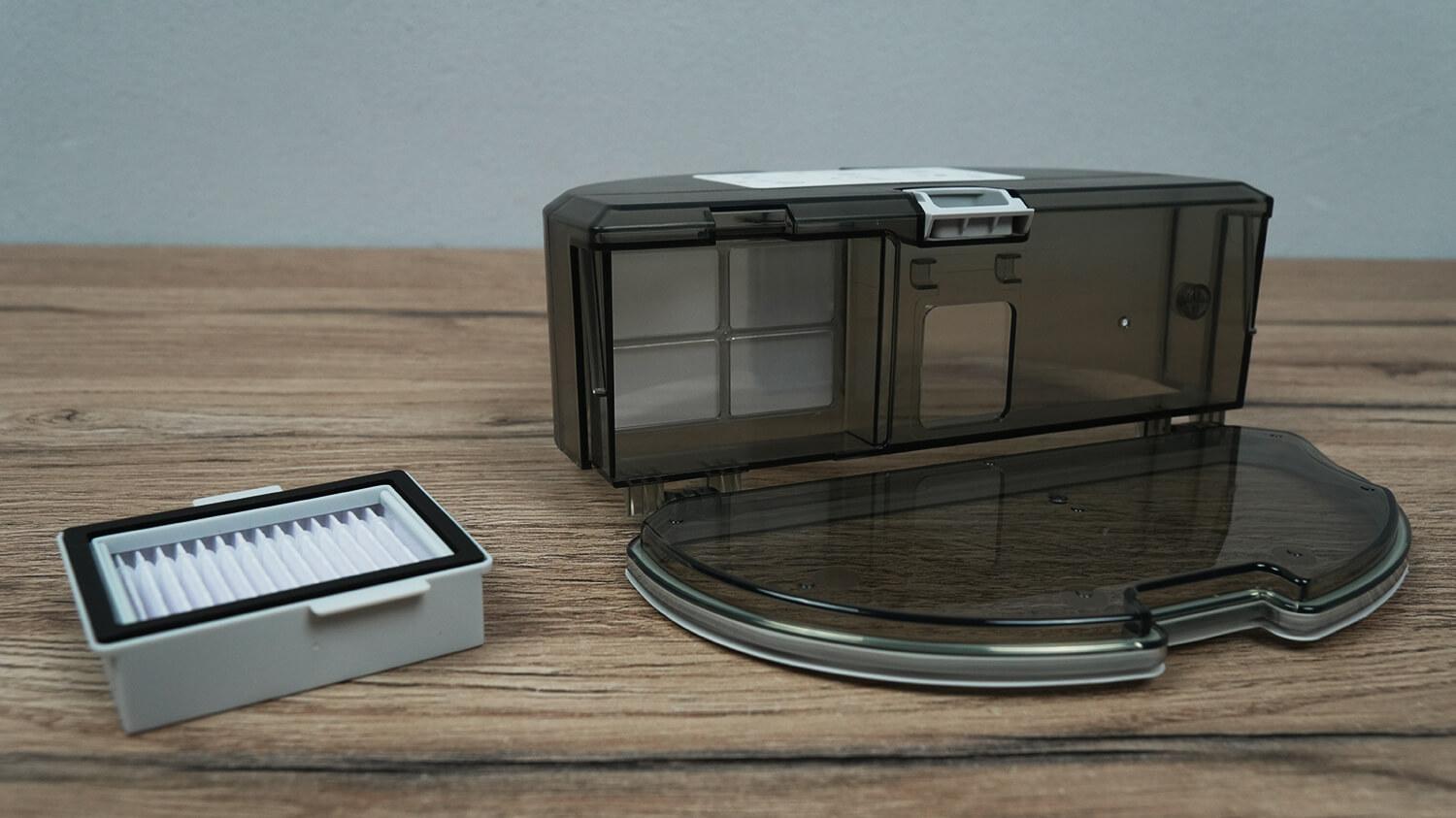
Filtration system
Instead of a dust bag, you can use a disposable bag with a HEPA filter, which may be convenient for some users. The robot does not have a water tank. The cloths are only moistened at the washing station.
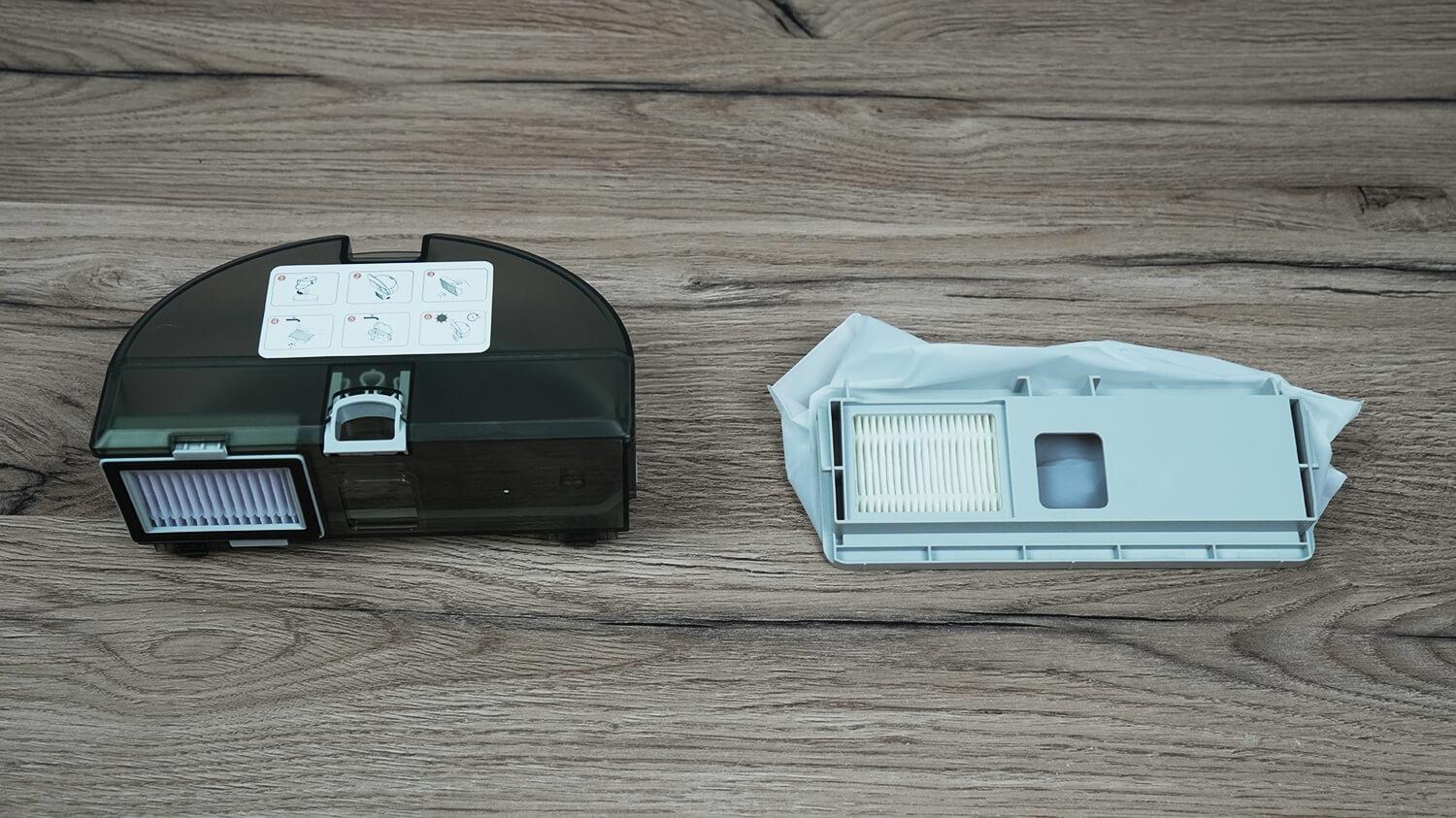
Dust collector and disposable bag
The robot has four anti-fall sensors installed underneath. It also has a carpet sensor, which was a nice touch. There's a single side brush: a three-beam, quick-release brush.
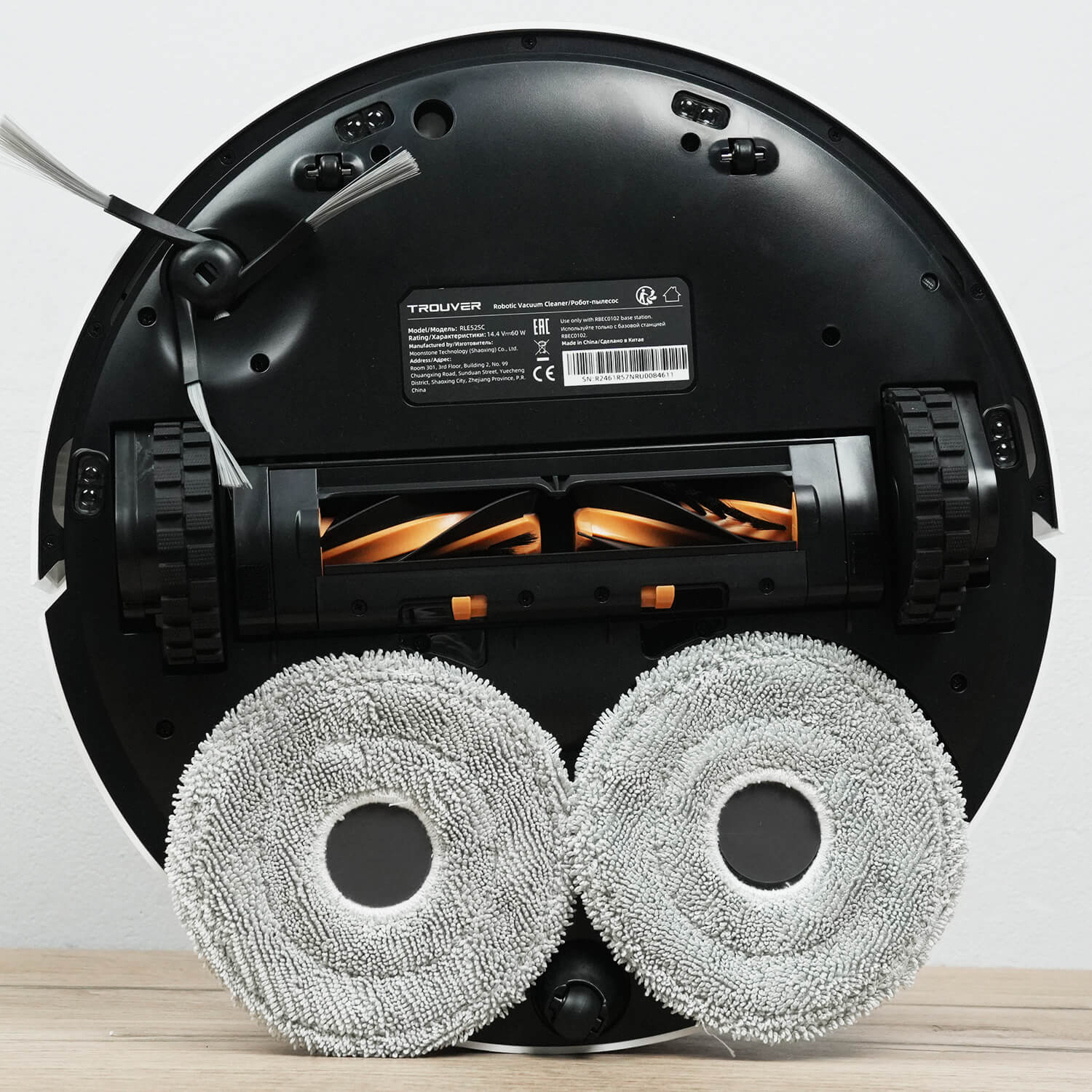
Bottom view
The central brush unit is floating. The updated AeroTwin turbo brush consists of two bristle-petal brushes with a gap between them to release tangled hair and pet hair. This solution isn't unique, but it has proven very effective in similar robots.
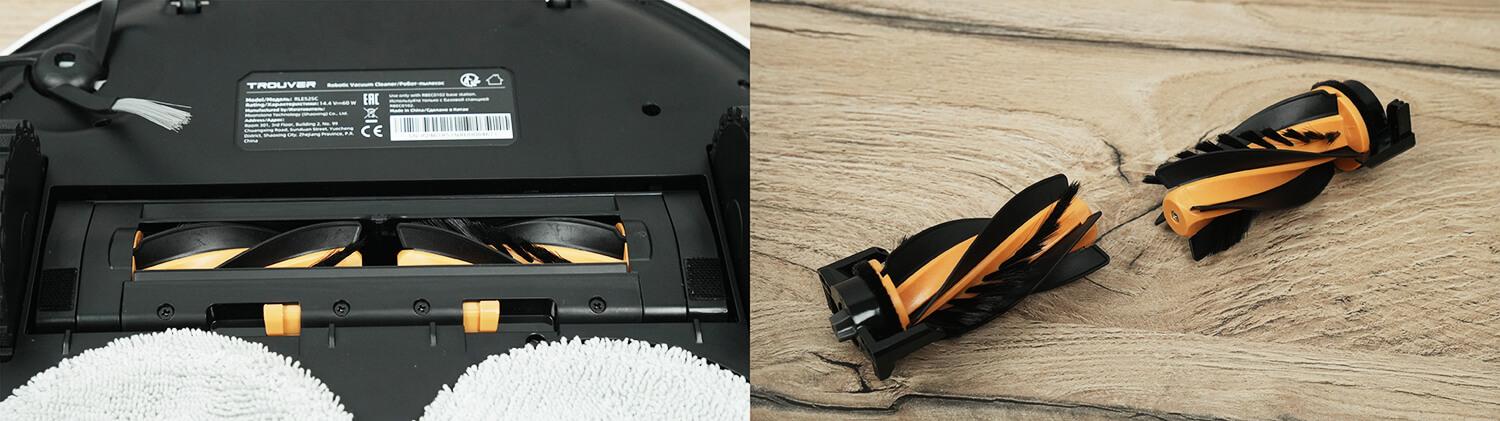
Central brush
The floor cleaning system is based on two round rotating pads. They are of a standard design and are attached to holders with Velcro. There is no mechanism for the pad to extend to the edge of the housing, but there is a mode for the rear part to rotate as the robot moves around the perimeter, which partially solves the problem of blind spots when cleaning the floor.
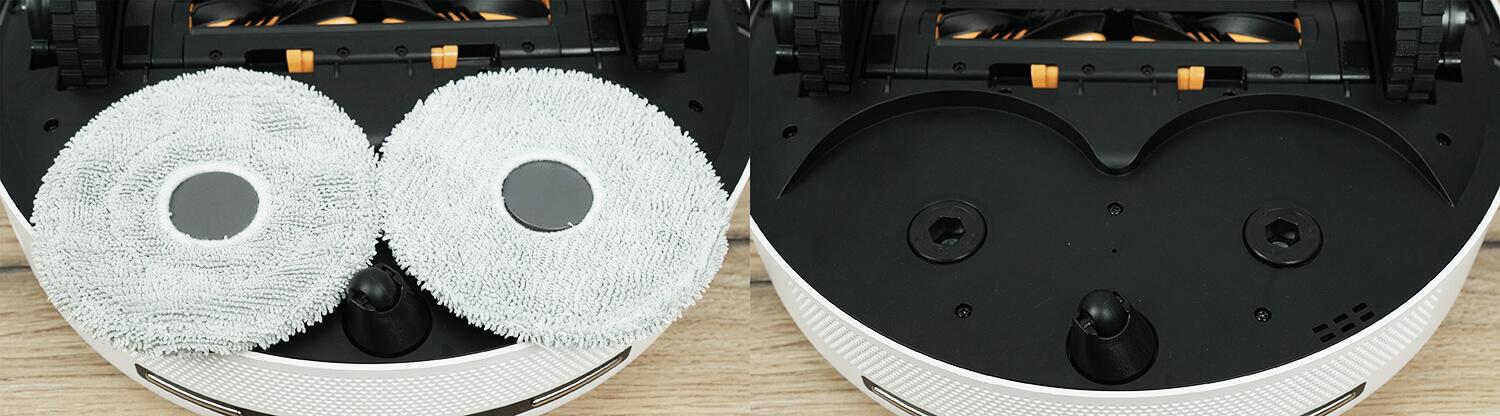
Napkins
There is also an automatic lifting of the cloths by 10 mm when driving onto carpets, as well as during dry cleaning.
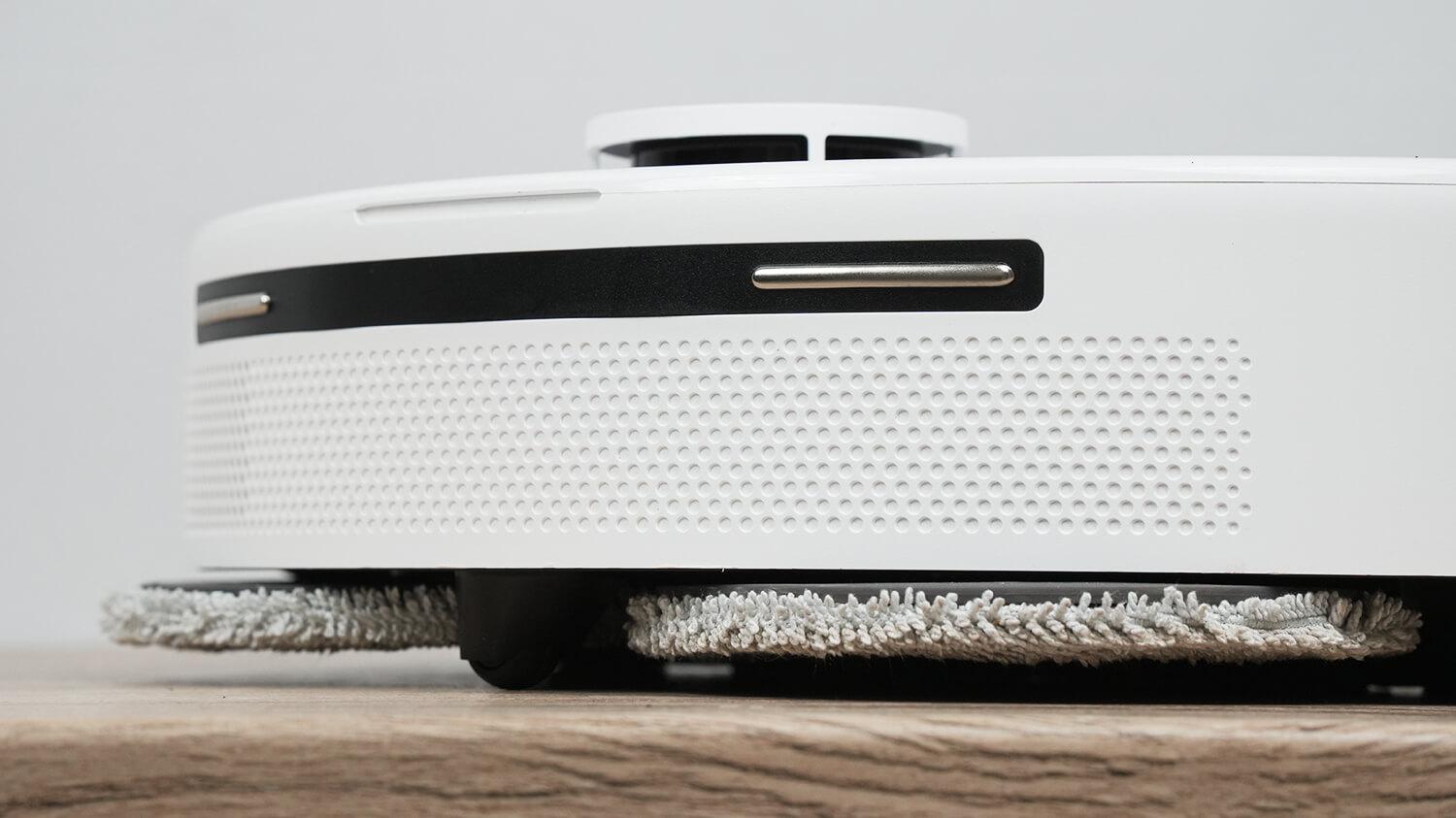
Lifting napkins
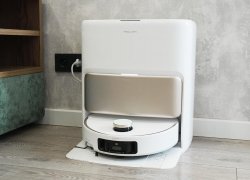
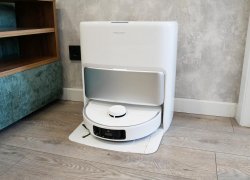
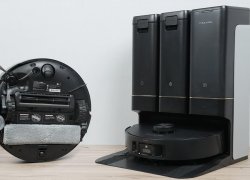
Now that we've covered the robot, let's talk about the station. The Trouver E30 Aqua charges, washes and dries cloths, and automatically mixes detergent into clean water from a separate container during washing. Unfortunately, there's no water or air heating, due to the robot's budget price.
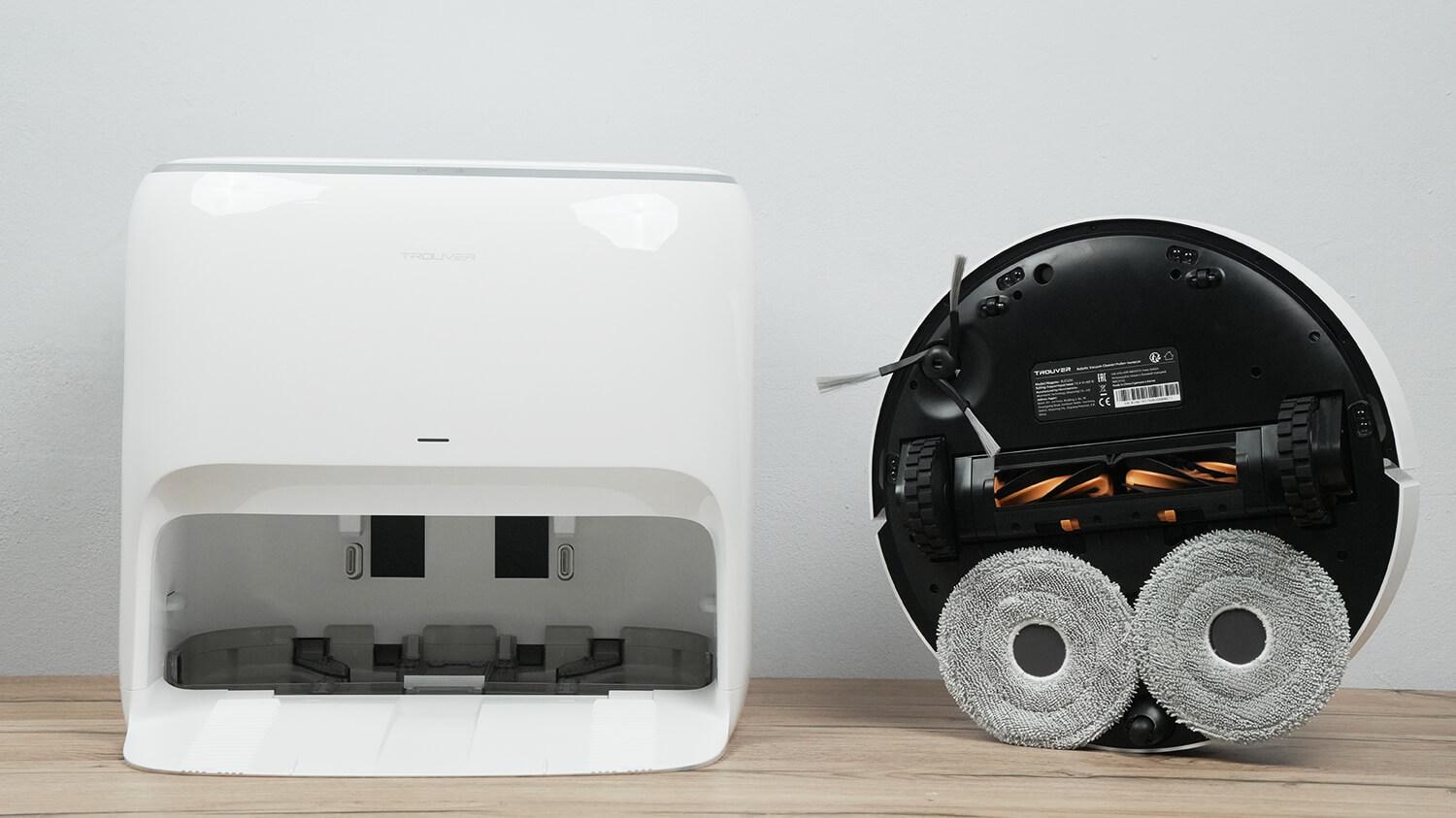
Robot and station
The ramp for the robot to enter is not removable, but the tray for washing napkins can be removed from the station for maintenance.
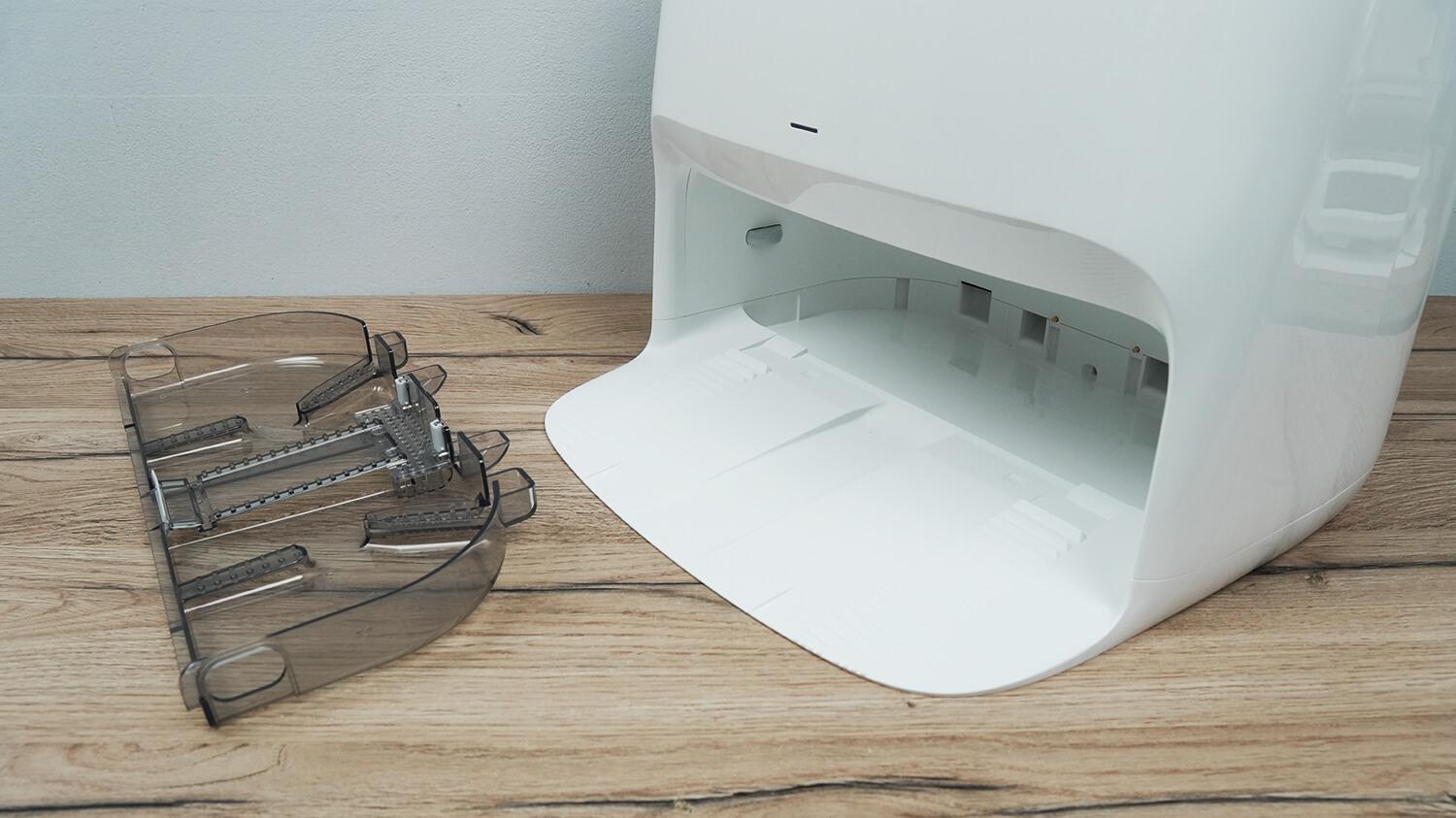
Removable tray
The station has two touch-sensitive control buttons on top. Under the lid are tanks for dirty and clean water, with capacities of 3.5 and 4 liters, respectively.
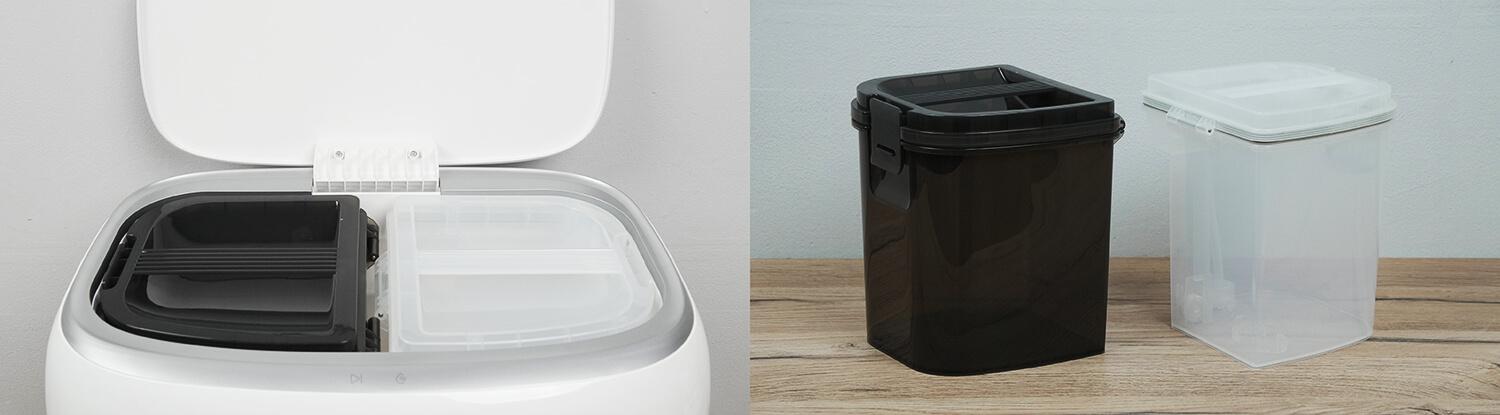
Water tanks
A container for automatically mixing detergent is installed behind the clean water tank. This station is not connected to the sewer system.
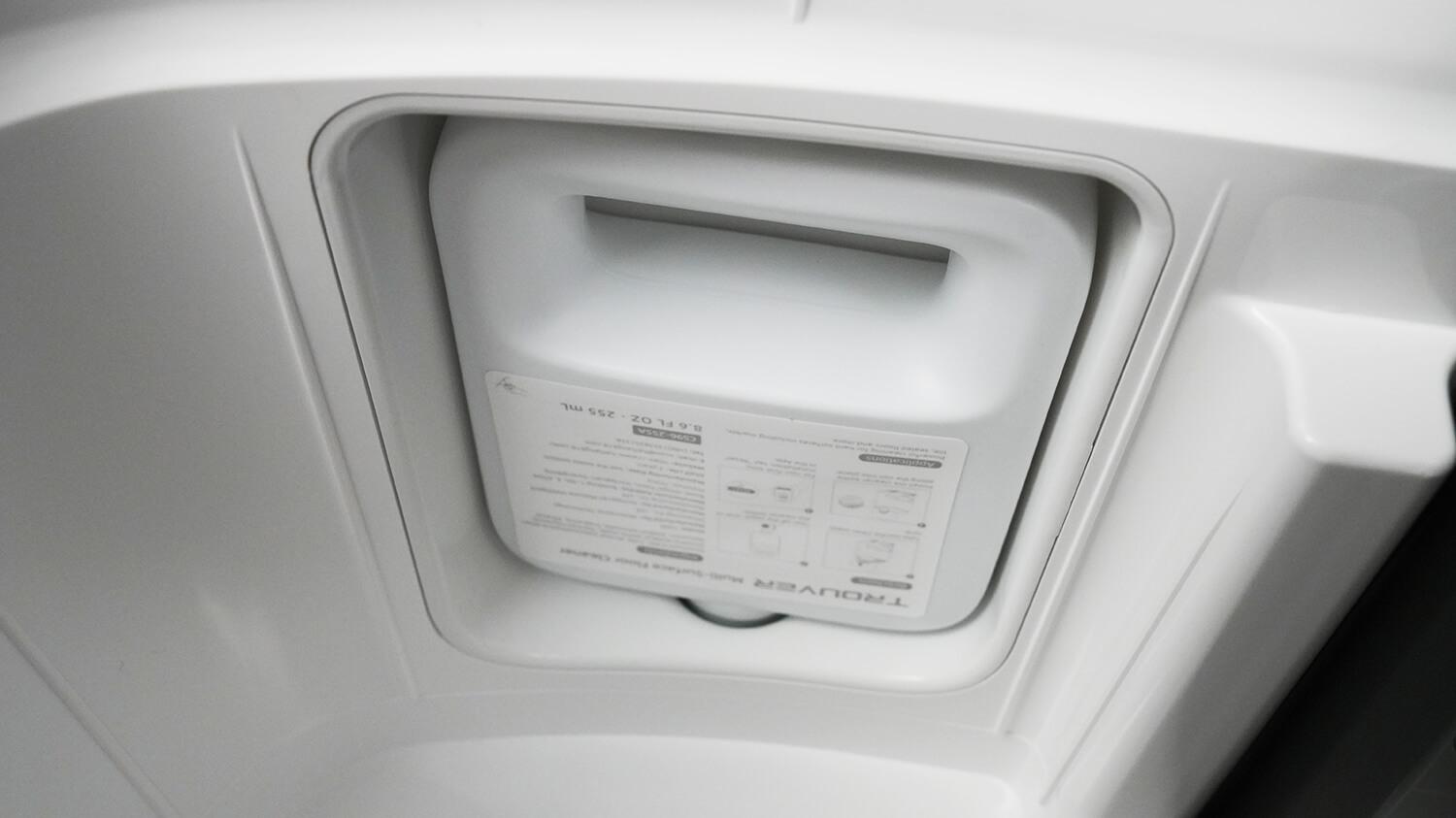
Container with detergent
All the pros and cons will be discussed at the conclusion. Let's move on!
Technical specifications
The main characteristics of the Trouver E30 Aqua, as stated by the manufacturer:
Robot vacuum cleaner:
- Li-Ion battery 5200 mAh.
- Suction power up to 10,000 Pa.
- Dust collector: 800 ml.
- Water tank: none.
- Obstacle clearance up to 20 mm.
- Robot dimensions: 350*108 mm.
Station:
- Clean water tank: 4 l.
- Dirty water tank: 3.5 l.
- Station dimensions: 421*398*387 mm.
What stands out here is the high suction power, which will be verified in tests, as well as the increased dust collector capacity.
Functional capabilities
Let's move on to an overview of the Trouver E30 Aqua's features. The robot vacuum is controlled via the proprietary Trouver mobile app. Connecting to the network is straightforward, following the manufacturer's instructions. The interface is in Russian, and everything is clear and user-friendly.
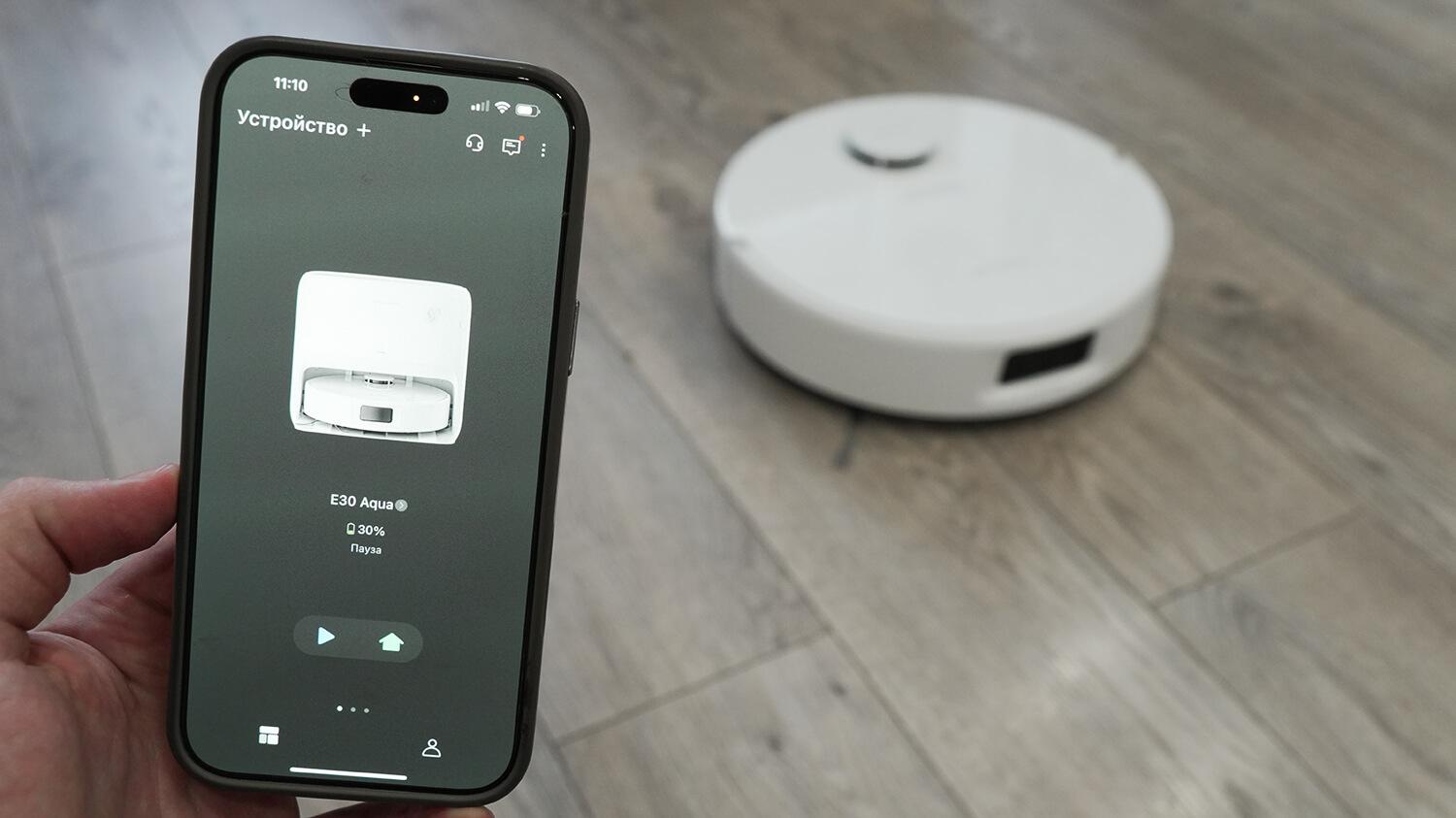
Functional capabilities
The main functions are displayed on the screen:
- Washing napkins (without heating water)
- Drying napkins (without heating the air).
- Automatic addition of detergent.
- Raising napkins.
- Scrolling the body along the perimeter.
- Identifying objects on the floor.
- Saving multiple cleaning maps in memory.
- Automatic zoning of premises into rooms.
- Selecting areas and rooms for cleaning.
- Virtual walls and no-go zones (and for wet cleaning mode).
- Suction power adjustment.
- Setting the frequency of washing napkins.
- User mode.
- Cleaning log.
- Setting up cleaning according to a schedule.
- Automatic power increase on carpet.
- Carpet cleaning in wet cleaning mode.
- Yandex.Alice support.
We see that the functionality is limited compared to older models in the Trouver line; however, the basic capabilities for flexible cleaning settings are still implemented.
Testing
A detailed video review of the Trouver E30 Aqua, including all tests, has already been prepared and published on the channel:
Navigation
And the most important thing is testing. First, we'll check the robot's navigation in the obstacle course room. After leaving the station, the robot began cleaning the perimeter. It didn't get in the way of the clothes dryer legs, but it also swept around the box and the table legs, then returned to the station. The mirror introduced an error in the map, but the robot didn't hit it, and this is generally a standard behavior for lidar robots. So, there are no complaints about the navigation.
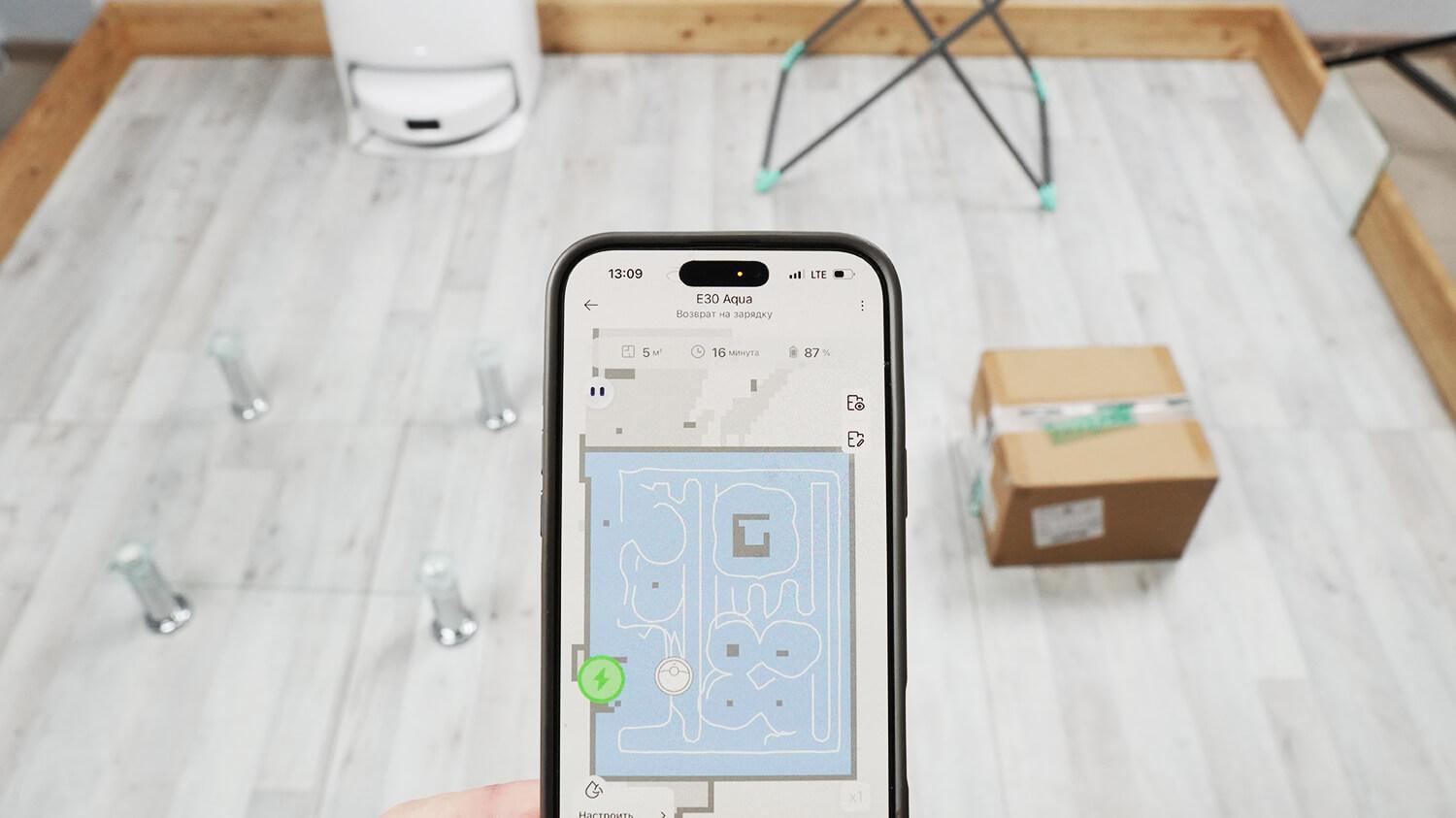
Navigating an Obstacle Room
Speaking of navigation within the house, the robot vacuum cleans room by room, following the perimeter, then in a serpentine pattern. After each room, as I've determined, it returns to the station and washes the wipes, then resumes cleaning from where it left off. There are no uncleaned areas left; this model has excellent navigation!
Passing under low furniture
The minimum height at which the robot can pass was also tested. Given that the robot is taller than 10 cm, it physically won't fit through that gap. However, it can pass through 11 cm without any problems.
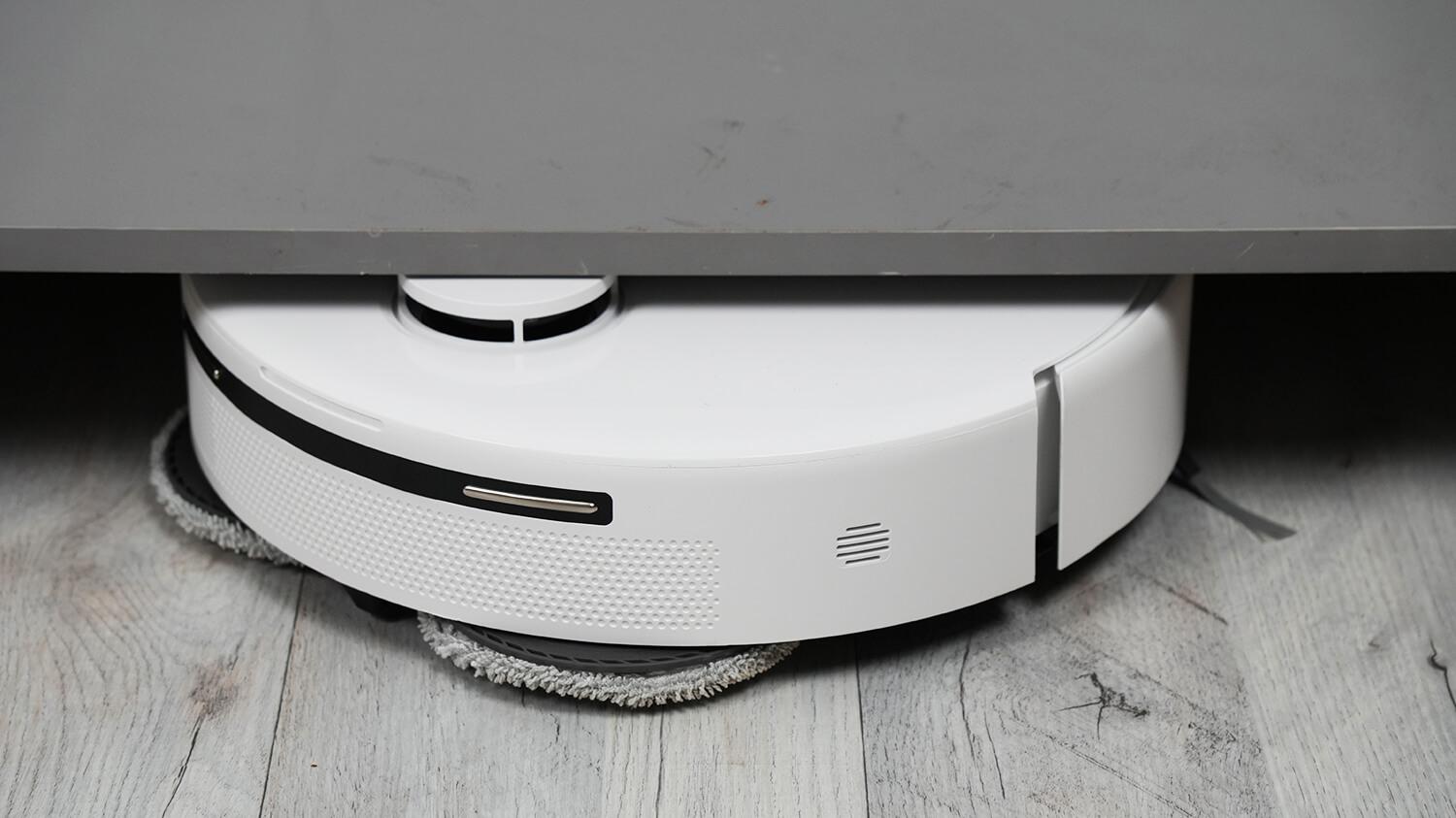
Passing under low furniture
Autonomy
I also tested the battery life when running the robot at maximum power with wet cleaning enabled. It lasted 97 minutes, cleaning 45 square meters of usable space. In reality, that's a little more than one full cleaning of a two-bedroom apartment. However, I should note that there's a resume cleaning mode after charging at the base, so this model can clean twice that amount. It's worth noting that the cleaning time itself is quite standard, but the cleaning speed is slower than most similar models, as the robot spends a significant amount of time scrolling around the perimeter. When using the baseboard cleaning mode, robots typically clean my apartment in 45-50 minutes, while this model took 74 minutes. I think it makes sense to use the baseboard cleaning mode every few cleanings, rather than every time, if you want the robot to clean more square meters on a single charge or do it faster.
Definition of objects
As for the object avoidance system, it's as primitive as expected. Of the six standard household objects tested, the robot avoided only two: a toy and a shoe. The rest were either run over or chewed. Of the three socks, it avoided the black one, chewed the white one and failed, and also avoided the colored sock. The final result was 2 out of 3. Of the four wires, it avoided only the thick black one; it avoided the other three, chewing one in the process. It avoided all six simulated pet surprises, chewing some of them and failing.
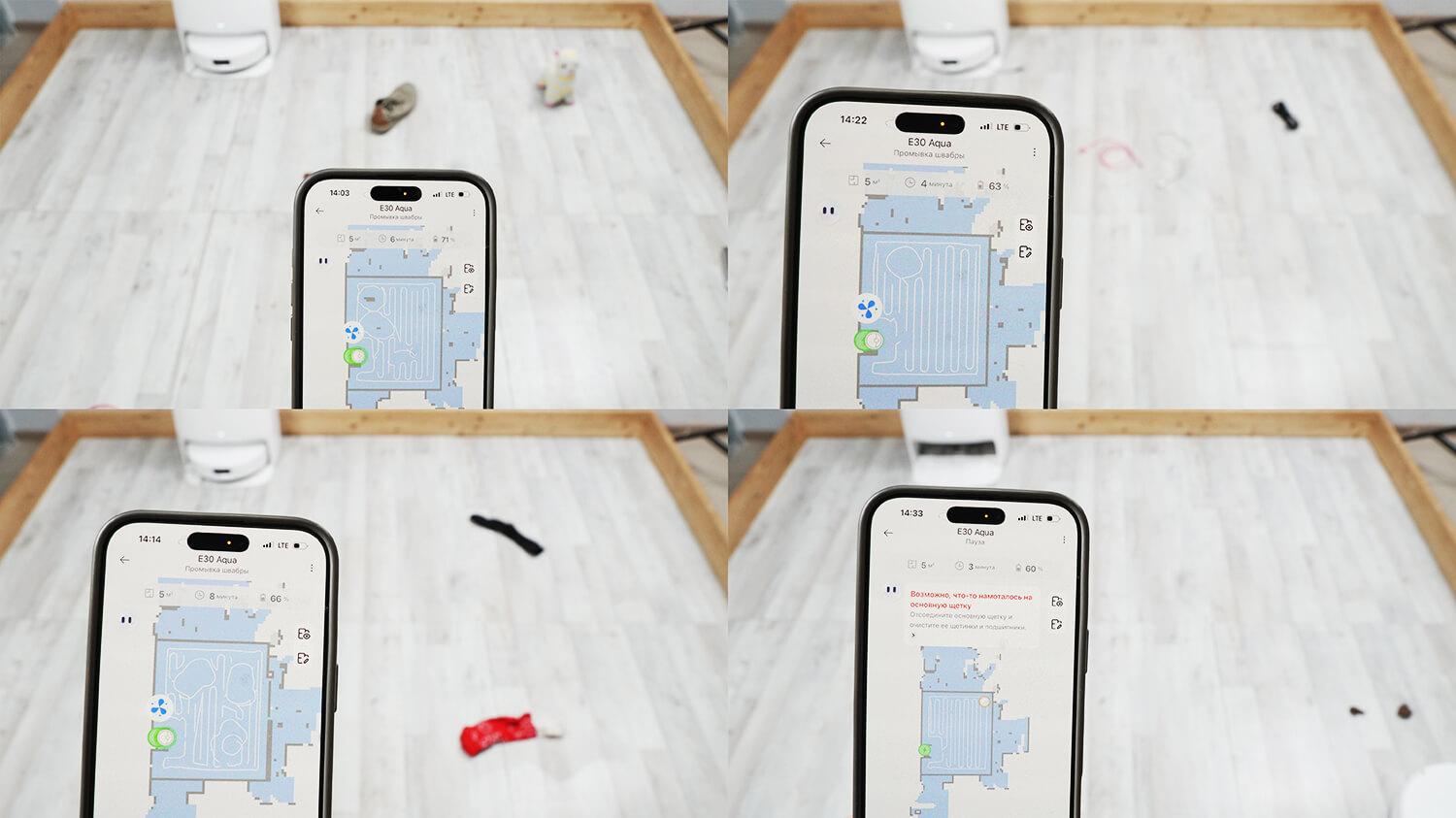
Definition of objects
As a result, the object detection system is weak, but the robot is still a little more accurate than its counterparts that do not have any sensors for avoiding objects.
Suction power
One of the most important tests was to check the robot's actual suction power on a test bench with crevices of varying depths. In "Quiet" mode, the robot managed to partially clean a 2 mm-deep crevice; in Standard mode, the result remained unchanged. In "Turbo" mode, the 2 mm-deep crevice was cleaned better, and the robot even partially cleaned the 4 and 6 mm marks. In Maximum mode, the result remained unchanged, and the robot somehow managed to cover up the 4 and 6 mm areas it had previously cleaned.
Suction power
In conclusion, I can say that the suction power is actually slightly increased, but there are aerodynamic losses due to the gap between the brushes, so the suction at the outlet is lost. power drops in modern robots and how important this point is, I discussed in a separate video, which I recommend watching.
Dry cleaning
The robot cleaned the entire stand easily, picking up debris of varying textures well across the laminate flooring. Only the corners remained unswept, a problem with most round robots without a retractable side brush. A small blind spot also remains near the outer corners, a problem also observed with most competitors.
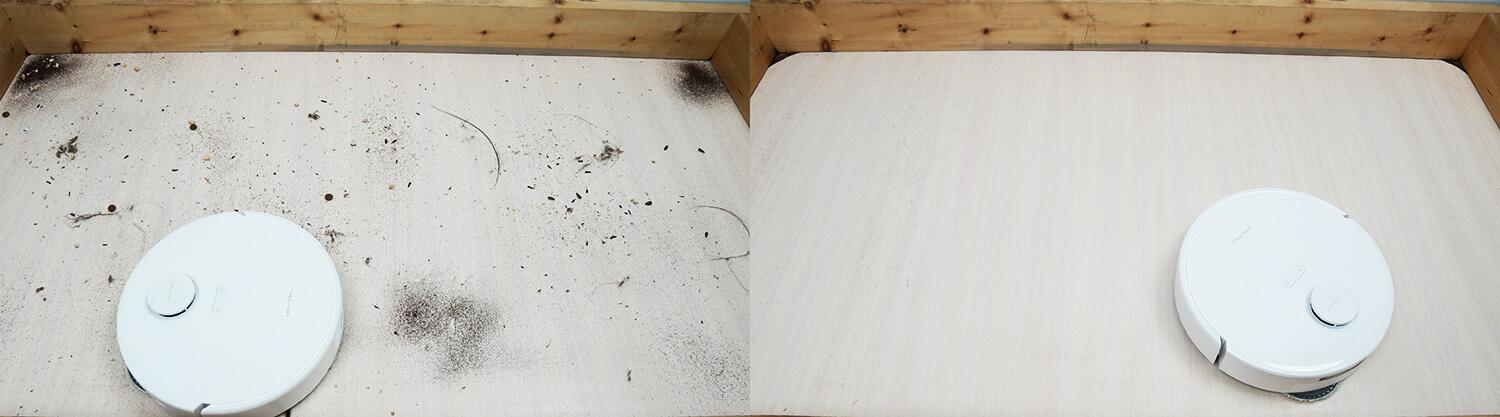
Dry cleaning
Let's check the condition of the cleaning module. The brushes have picked up some hair, but we see that most of it is directed toward the central gap. Further testing is needed.
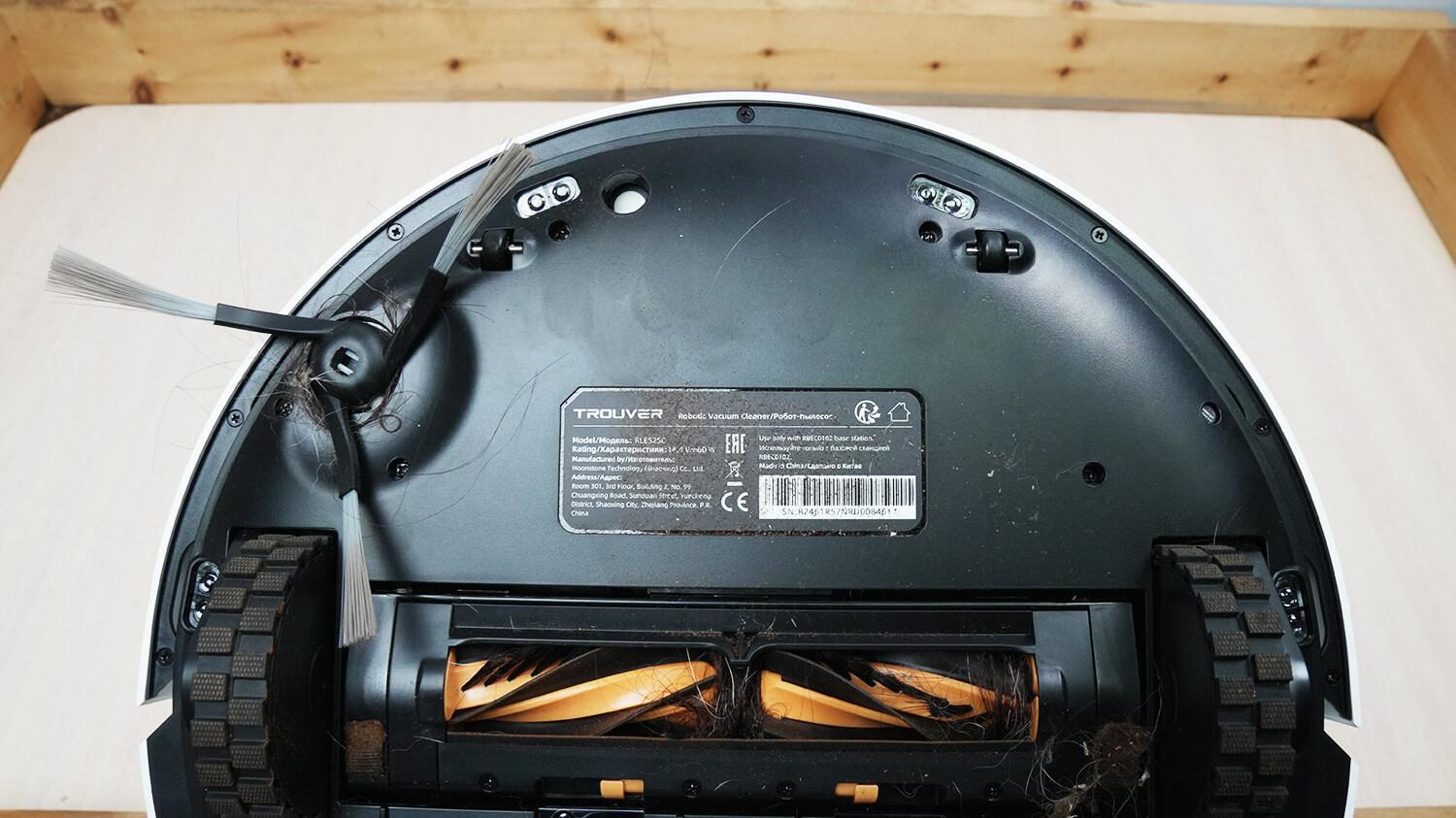
Cleaning module status
Anti-tangle Hair Protection
I tested the turbo brushes' self-cleaning feature: I laid hair of varying lengths on the floor. The robot picked it up, revealing hair tangled around the brushes. What I liked was how easy it was to remove hair thanks to their special design.
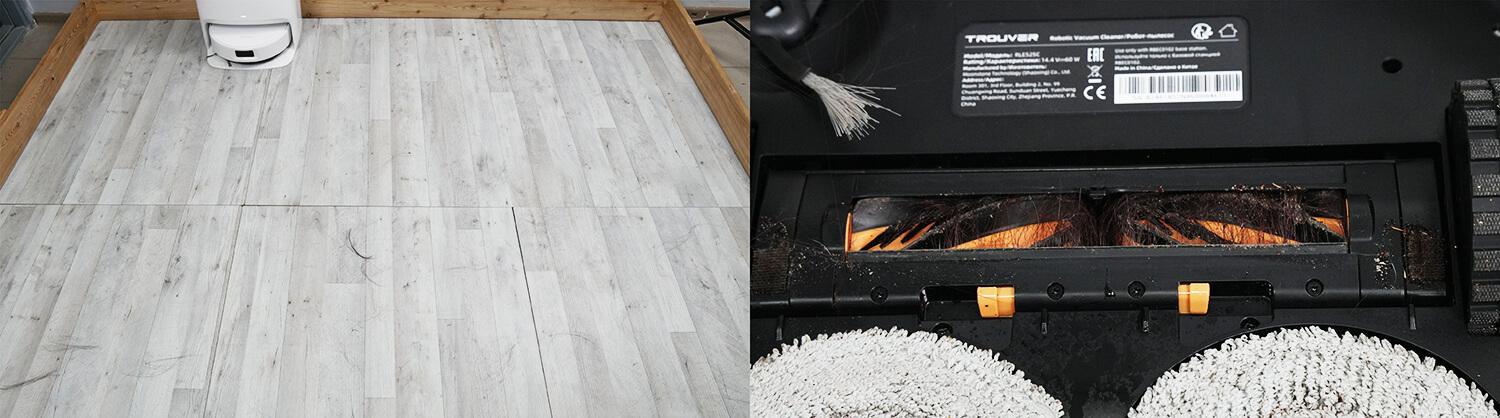
Anti-tangle Hair Protection
And here's the condition of the brushes after a week of use in an apartment with a shedding pet:
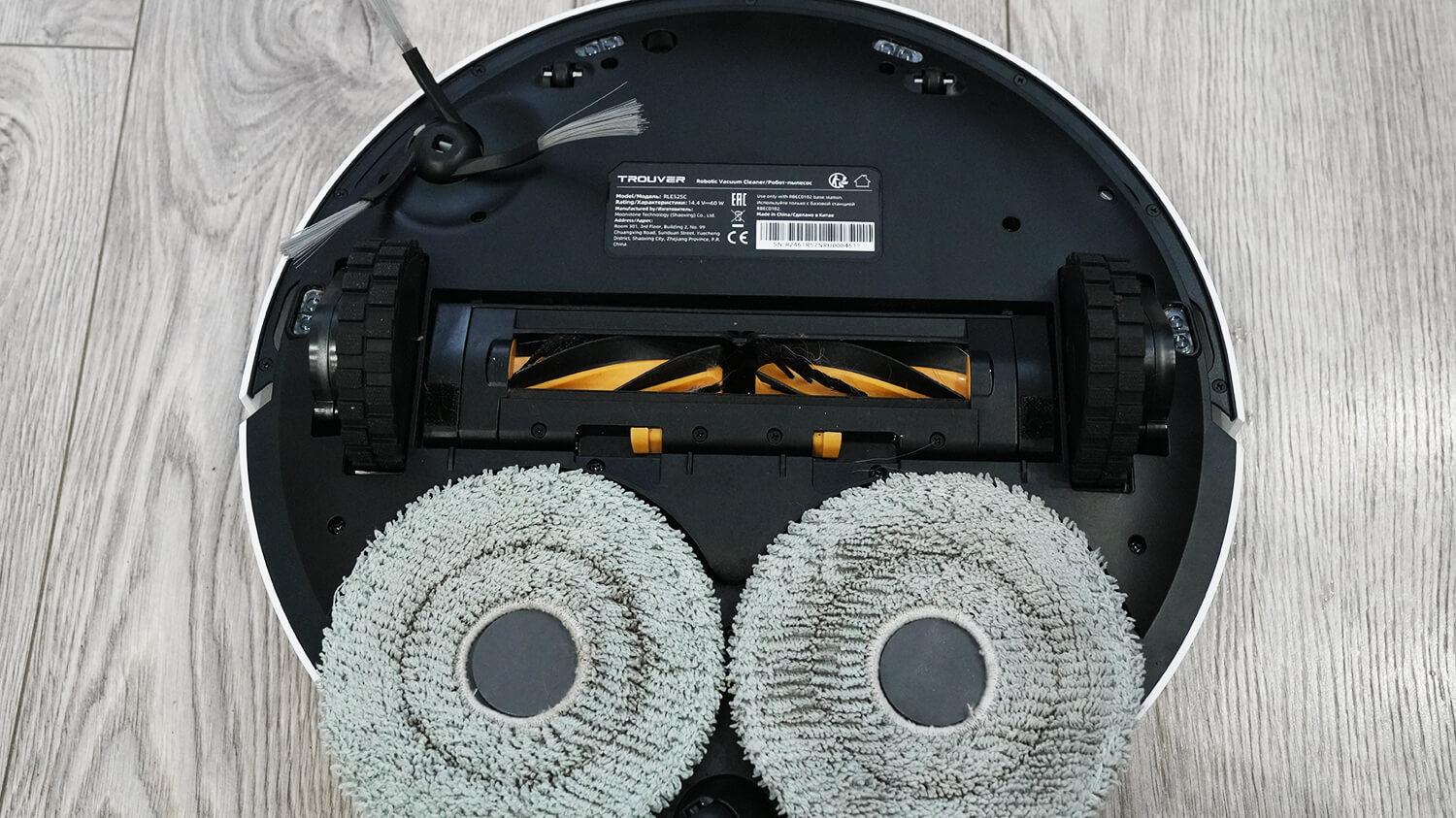
The condition of the cleaning module in everyday life
Under these conditions, the brushes are clean, so I think the updated cleaning module is effective in preventing hair and fur from getting tangled!
Carpet cleaning
Additionally, debris was scattered on a low-pile carpet. And I can say the Trouver E30 Aqua Complete did a good job. It's also capable of cleaning medium-pile carpet. Test passed!
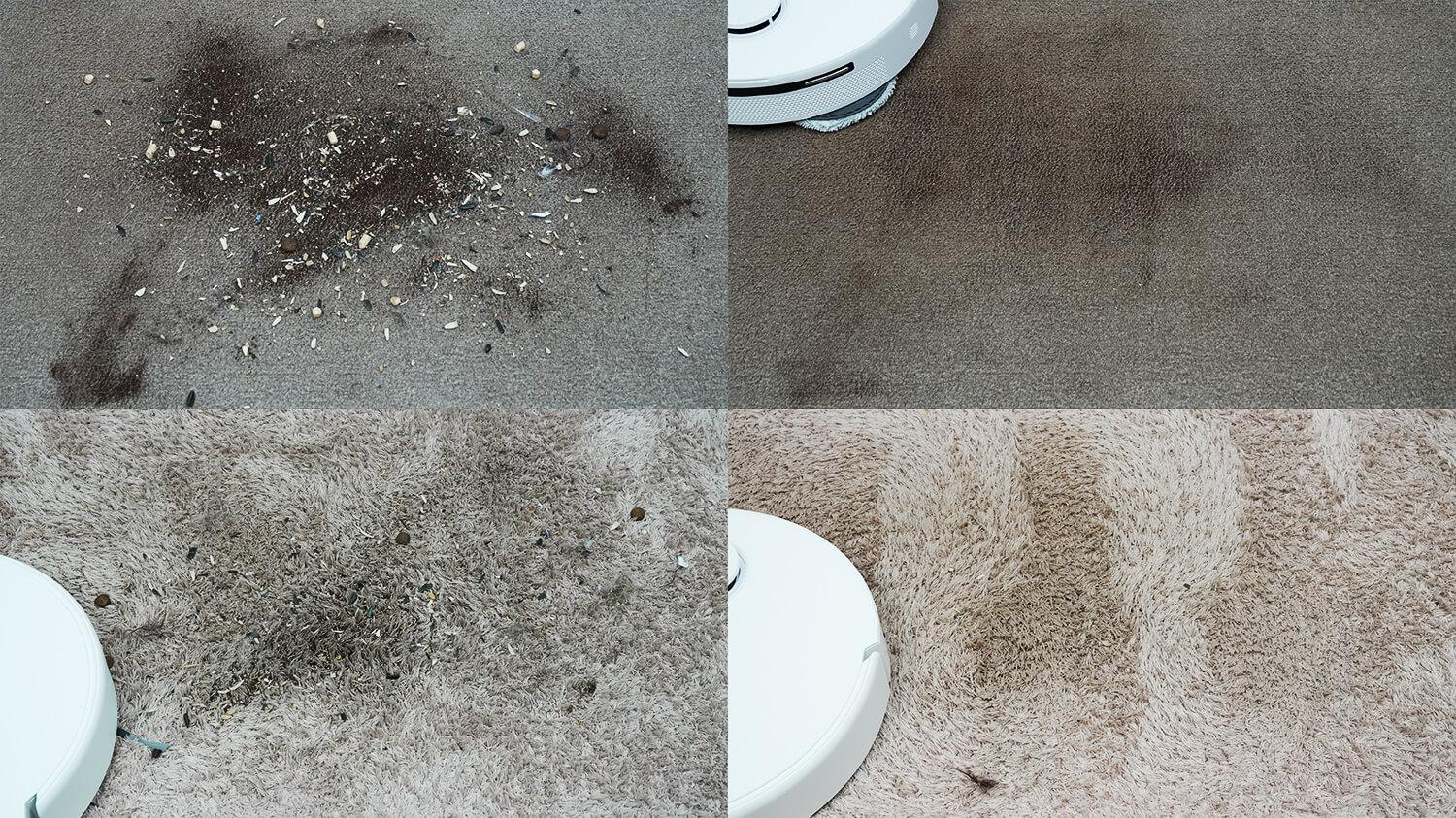
Carpet cleaning
Wet cleaning and carpets
When it comes to wet cleaning on carpeted floors, there are several robot behavior options. The first is to automatically lift the cleaning pads when entering carpets, allowing the robot to simultaneously vacuum and mop the floor, leaving the carpets dry and clean. The second option is to enable automatic carpet avoidance during wet cleaning. Finally, the third mode is to ignore carpets, where the robot rotates the cleaning pads on the pile, thereby performing wet cleaning. Some users prefer this type of interaction.
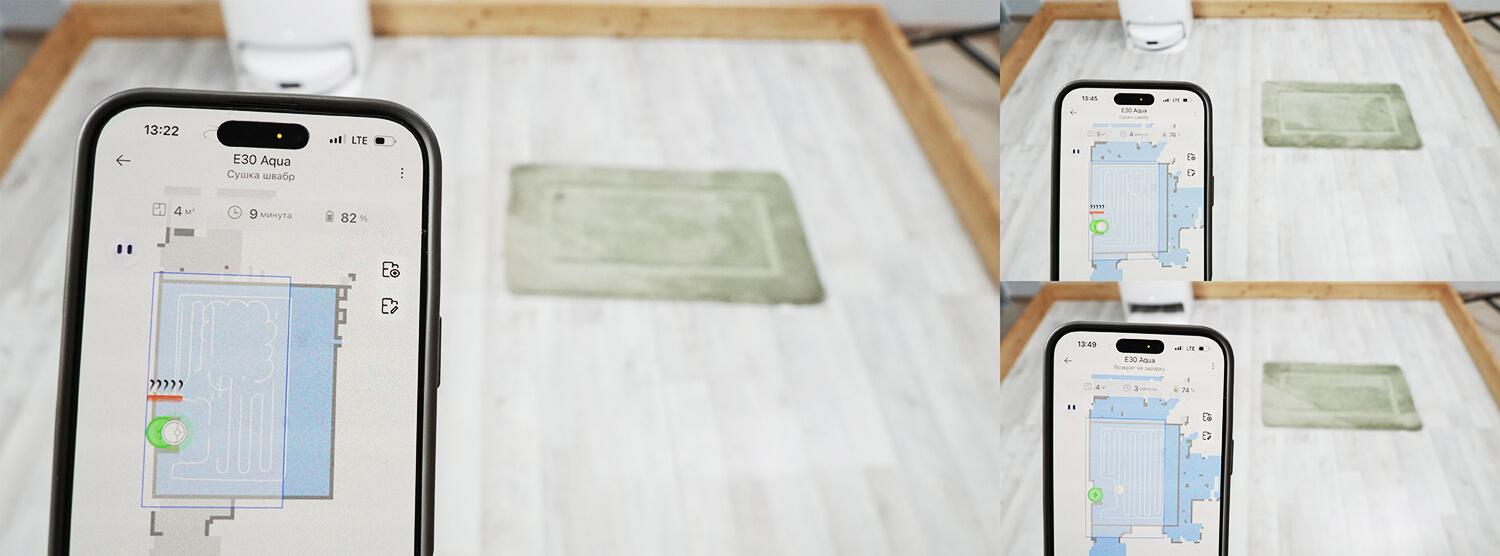
Wet cleaning and carpets
There's just one thing I'd like to correct: if the carpet is close to walls and furniture, the robot still scrolls when it goes around the perimeter with the mats raised. This is completely unnecessary.
Wiping off dirt
The dirt removal performance is also excellent. The wipes press firmly against the floor and absorb dirt. At the same time, there's a minimal dirty zone between wipes along the baseboard—about 1 cm. While not critical, there's still a difference compared to the effectiveness of a sliding wiper. In everyday use, I can say there's no visible blind spot, which is a plus.
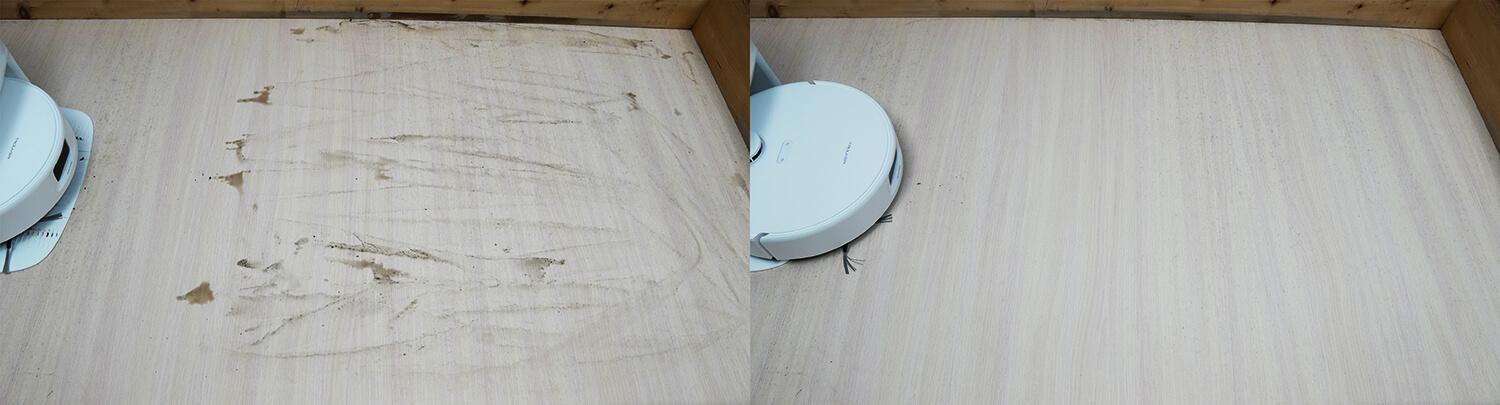
Wiping off dirt
Removing stains
When it comes to removing tough stains, the robot was able to remove even dried-on coffee and sauce stains. Granted, it didn't do it on the first try. To be precise, most of the stains were removed after the seventh attempt. But by the eighth attempt, the stand was completely clean. This is a good result; on average, similar robots complete this task in just eight to ten attempts. A result of four to six passes is considered excellent.
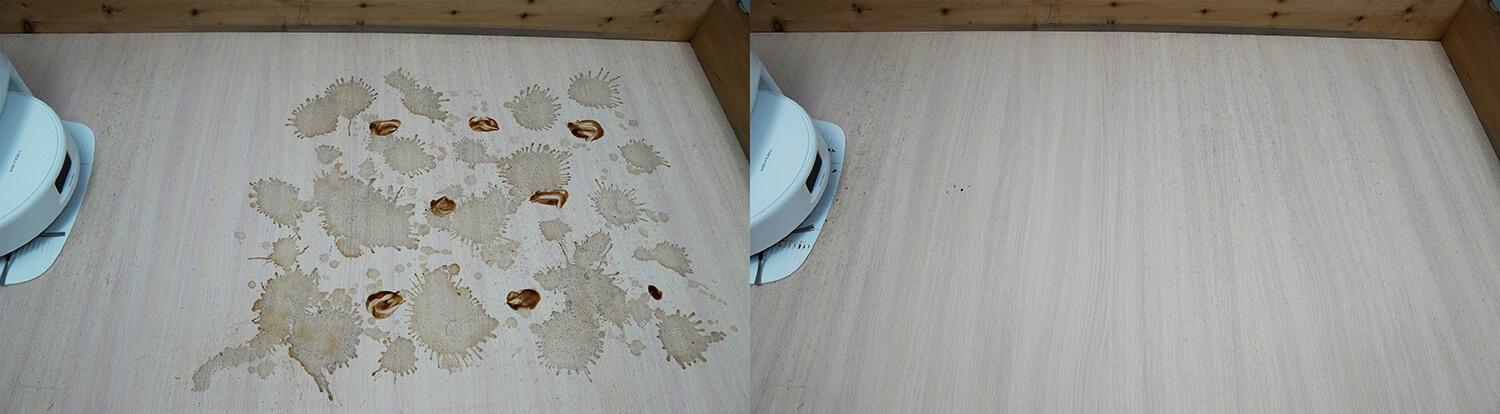
Removing stains
Washing and drying test of napkins
I'd like to immediately talk about the efficiency of the station itself. Let's start with the cleaning quality of the wipes. Even after extensive testing, the wipes look significantly better after washing with the station. The automatic detergent mixing feature undoubtedly improves the cleaning efficiency here.
In a domestic setting, after washing the floor, the wipes are thoroughly rinsed at the station. No visible contamination was detected.
As for drying the wipes, even without heating, in my case 5 hours was enough for the station to completely dry the wipes, so it is already effective.
Station maintenance
A few words about station maintenance. After using the robot for a week in a domestic environment, we see that the station's bottom isn't really that dirty. It's convenient that the tray is removable and can be washed in the sink. However, the drain is non-removable, and it also gets dirty. It's less convenient to clean, and it's strange they didn't make it removable like its siblings in the line.
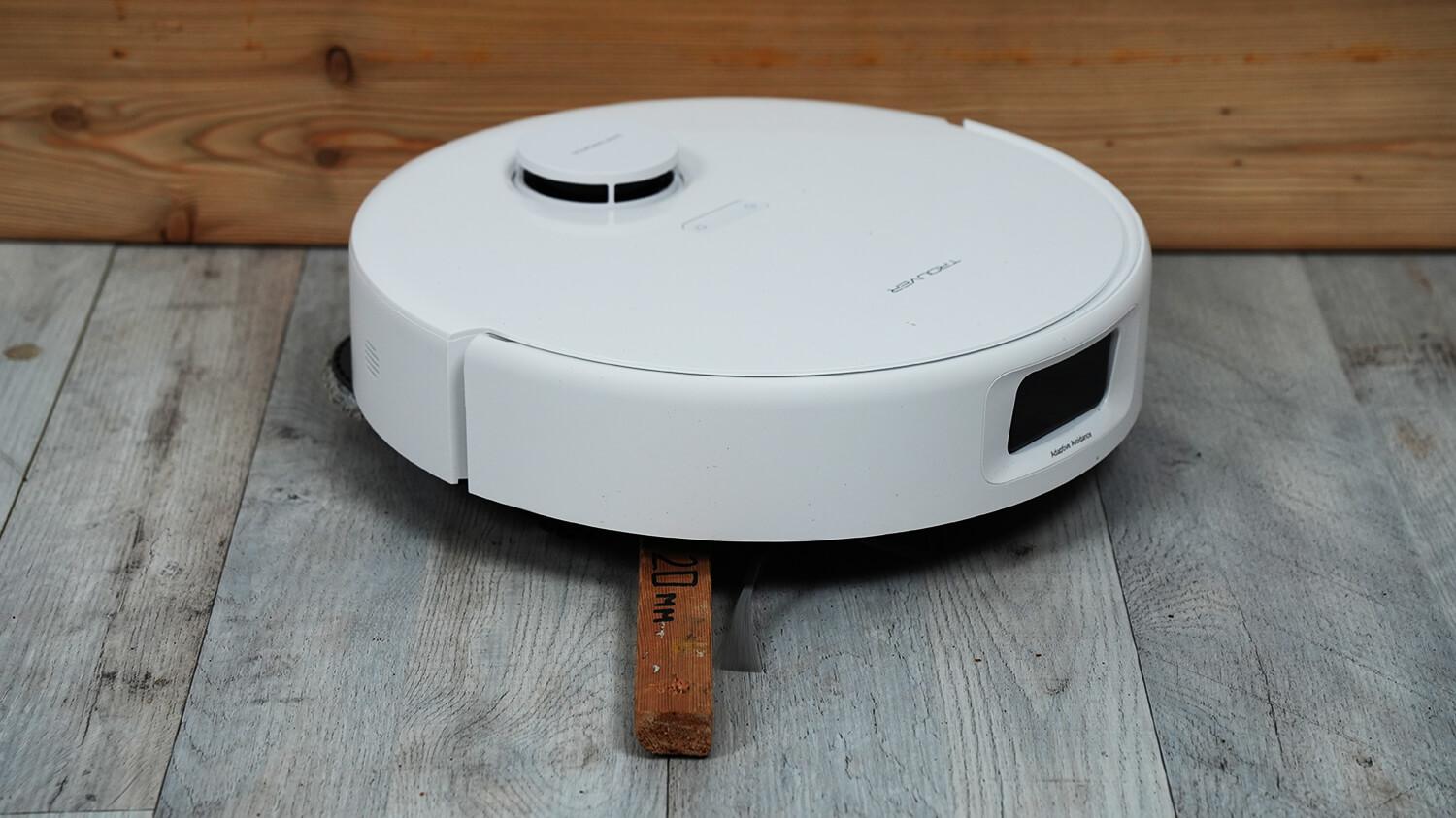
Obstacle clearance
The robot can easily navigate 2cm-high thresholds. That's a plus!
Obstacle clearance
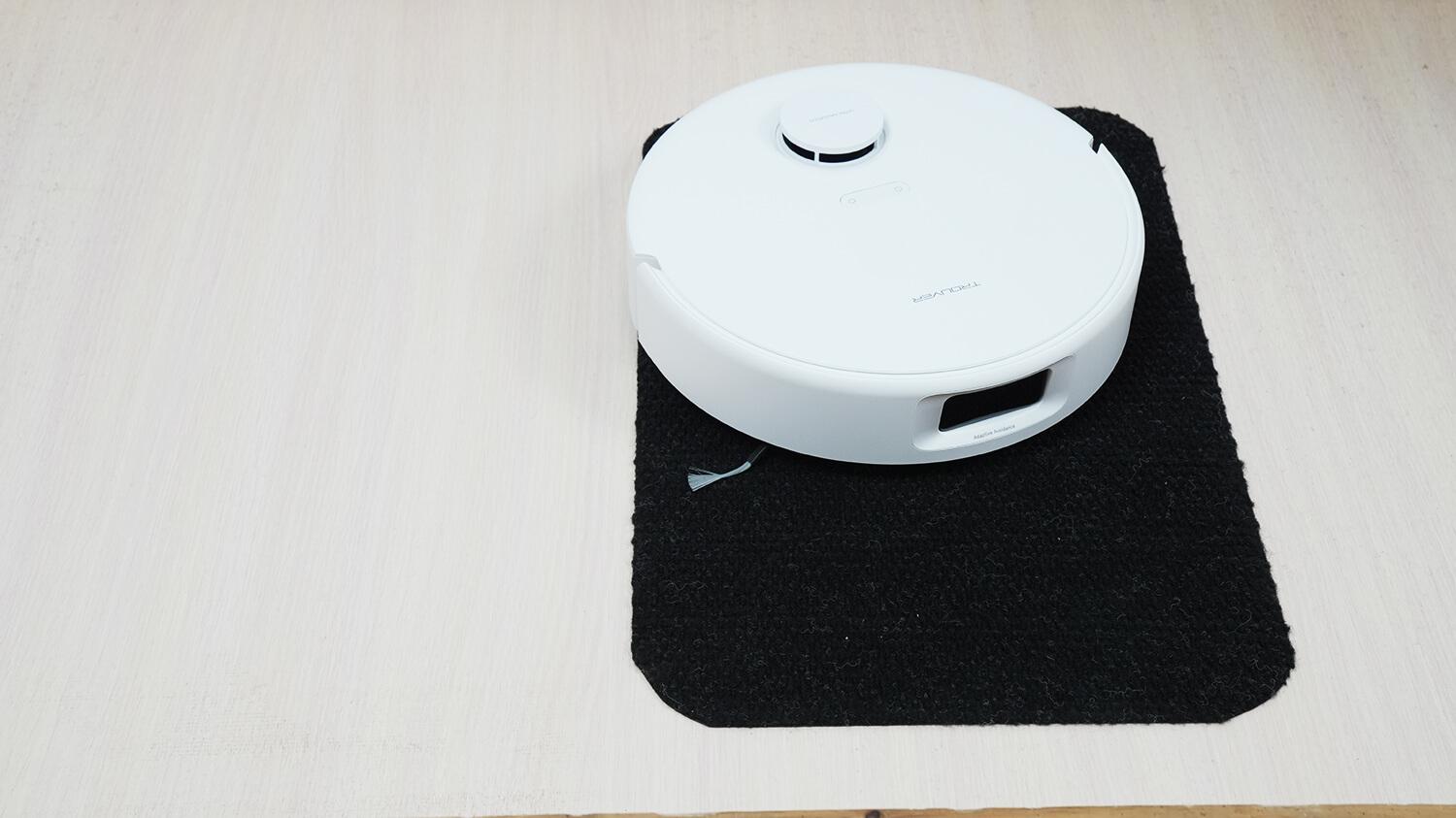
Driving on black surfaces
It's also not afraid of black surfaces, easily driving on completely black carpet. This is another advantage of the robot!
Driving on black surfaces
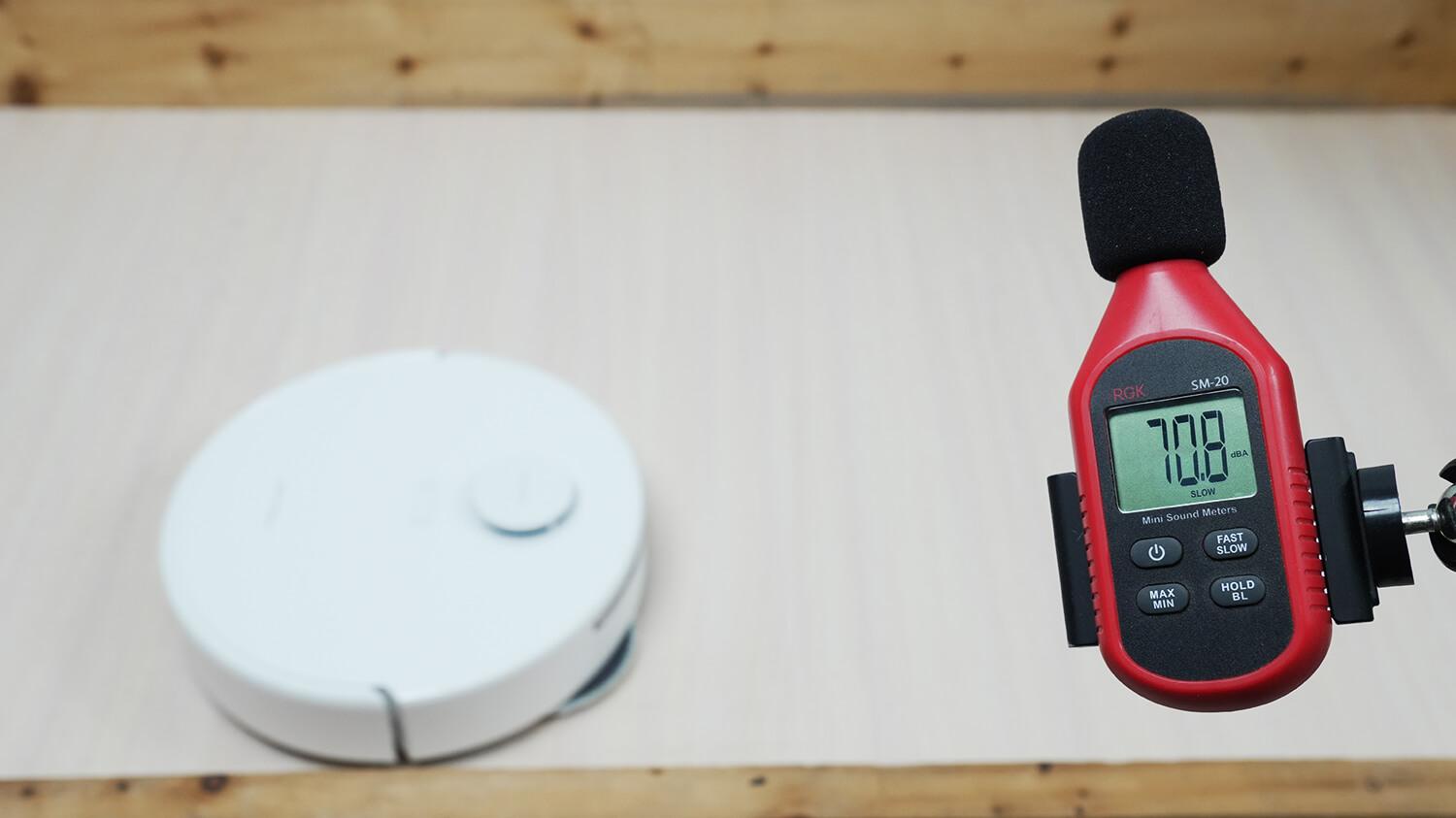
Noise level
I measured the noise level myself. It ranges from 63 to 71.5 dB, depending on the selected operating mode. The reading is slightly elevated, but not critical.
Noise level
Personal opinion
The Trouver E30 Aqua robot vacuum cleaner has been thoroughly reviewed and tested. our evaluation system he managed to gain 168 pointsAnd this is an excellent result for the robot's price segment.
Overall rating of tested robot vacuum cleaners: https://robovac.washerhouse.com/en/rejtingi/robovac-obshhij-rejting-robotov-pylesosov-robo.htmlI'll highlight the pros and cons I've discovered, and then express my own opinion about the robot.
I liked the following:
- First and foremost, the optimal price, taking into account the presence of the station and the overall design features of the robot.
- High-quality wet cleaning of large areas thanks to a wipe washing station.
- Automatic mixing function for detergent from a separate tank.
- Rotating the body while washing the floor minimizes blind spots along walls and furniture.
- The robot is capable of removing even difficult stains.
- The Trouver E30 Aqua automatically lifts its cloths when it reaches carpets, allowing it to vacuum and mop at the same time, leaving carpets dry and clean.
- Effective dirt collection on both hard surfaces and carpets.
- The updated turbo brush makes it easier to clean hair and fur.
- Capacious dust collector.
- The robot is compatible with disposable bags, which may be convenient for some users.
- A convenient proprietary app that brings together all the essential features for flexible cleaning settings.
- Yandex.Alice support.
- Full Russification of the application interface, voice commands, and instructions.
- The robot vacuum cleaner is not afraid of black surfaces.
- The robot cleans more accurately thanks to a system of sensors on the front bumper.
- Good cross-country ability.
- Availability of warranty and service.
As for the shortcomings, there are quite a few of them as well. My main criticisms include:
- The system for identifying objects requires improvement.
- The height of the body exceeds the standard 10 cm.
- There is no wall sensor.
- There is no water tank in the robot.
- Scrolling the body while walking around the perimeter takes a long time, and as a result, in this mode the robot cleans longer than its counterparts with a retractable cloth.
- A non-removable ramp for the robot to enter the station.
- There is no self-cleaning function for the dust collector on the station.
- There is no heating of water and air in the station.
- Doesn't sweep out debris in the corners.
- Aerodynamic losses are observed, which is why the claimed suction power is not so high in reality.
So, what's the bottom line? Yes, there are quite a few complaints about the robot. But, firstly, the advantages outweigh them, and they are far more important. And secondly, most of these complaints are related to the robot's price range. This model often costs as little as $200. For that price, competing brands offer robots with a standard charging station or, at best, a self-cleaning station, which significantly improves ease of use. However, a cleaning station for cleaning cloths in a budget of under $300 is a rare and very useful option, significantly improving the quality of floor cleaning. Moreover, this price includes not only the station but also all the additional features of the robot, and this is considering that it is fully adapted to the market and comes with an official warranty.
So, it's definitely one of the best robot vacuums under $300, and certainly the best for $200, despite all its shortcomings. These are more likely differences from more expensive models, so you don't get the impression that it's just as good as, say, its older sibling. Trouver P50 Pro UltaThere are differences, but whether they're significant to you, given the price difference, is up to you to decide.
I'd like to end this review on that note. If you have any questions, please ask in the comments. Happy shopping, everyone. Bye!