Roborock S5 Max vs. S6 MaxV: Is it worth the extra cost and what are the differences?
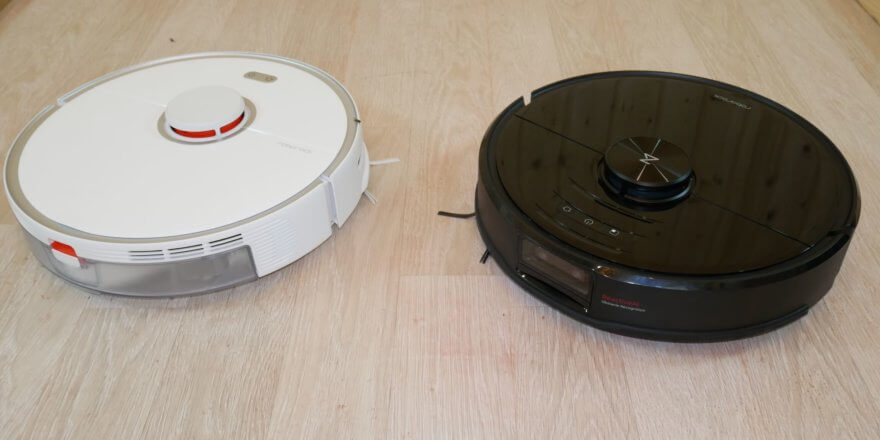
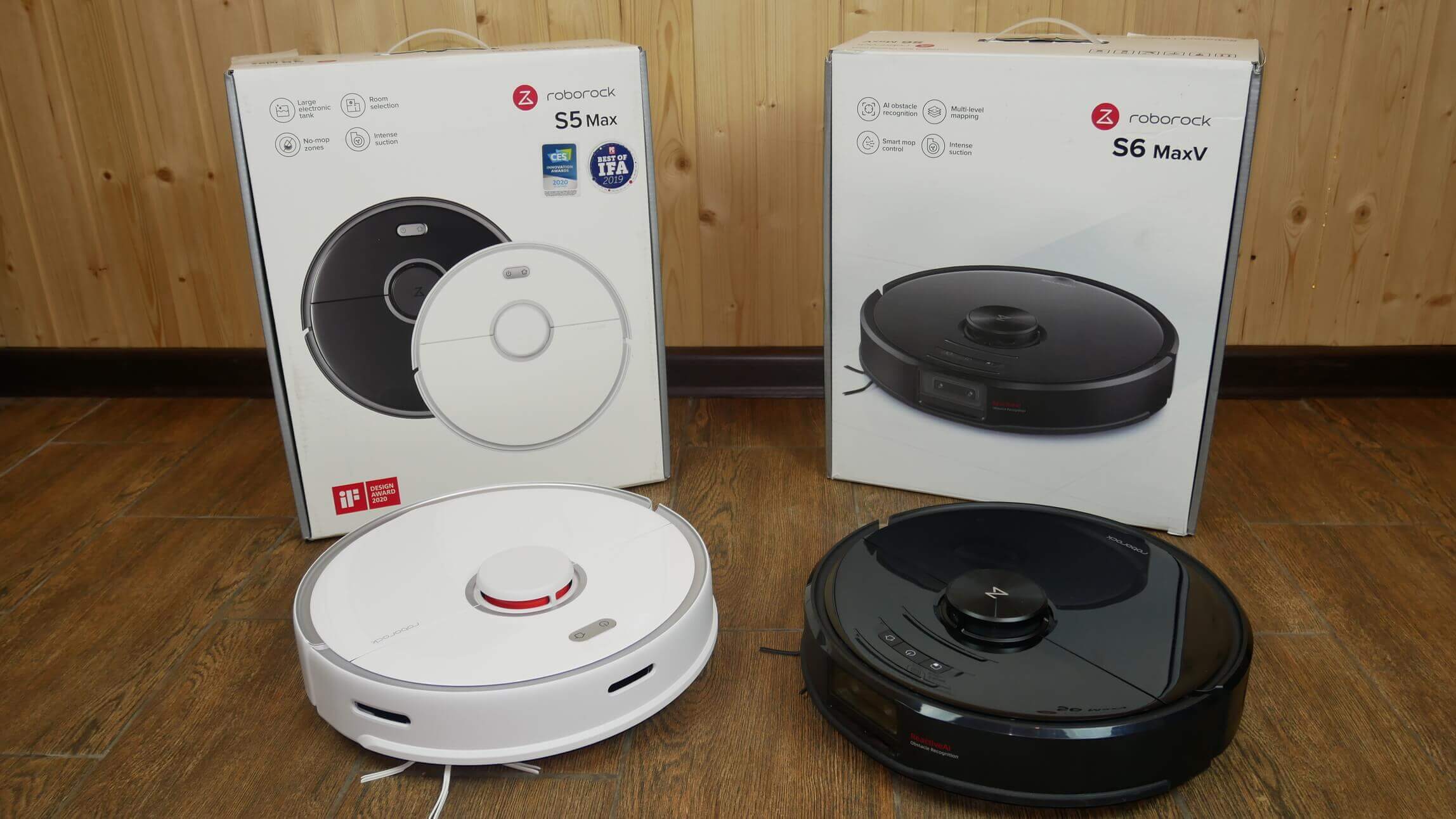
Greetings to everyone from the site's editorial team robovac.washerhouse.com! We finally got around to comparing Roboorock's two flagship robot vacuums. This is the new 2020 product – Roborock S6 MaxV and its predecessor, which was released in 2019 – Roborock S5 MaxThese robot vacuum cleaners are very similar in appearance and design. At first glance, the only distinguishing feature is the addition of a front-facing camera to the updated model. This has improved navigation and added some useful features. The S5 Max costs approximately $360, while the S6 MaxV costs $550. We based our prices on quotes from Lamobile, which provided the robots for our comparative test. The price difference is significant for many, so it's important to determine whether it's worth the extra cost and what other differences exist between the Roborock S5 Max and S6 MaxV robots, besides the new innovative sensor. That's what we'll explore now. Let's get started!
Appearance
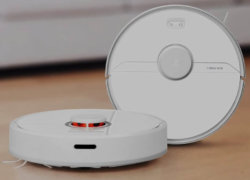
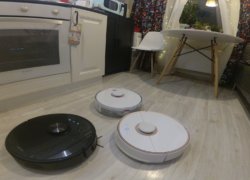
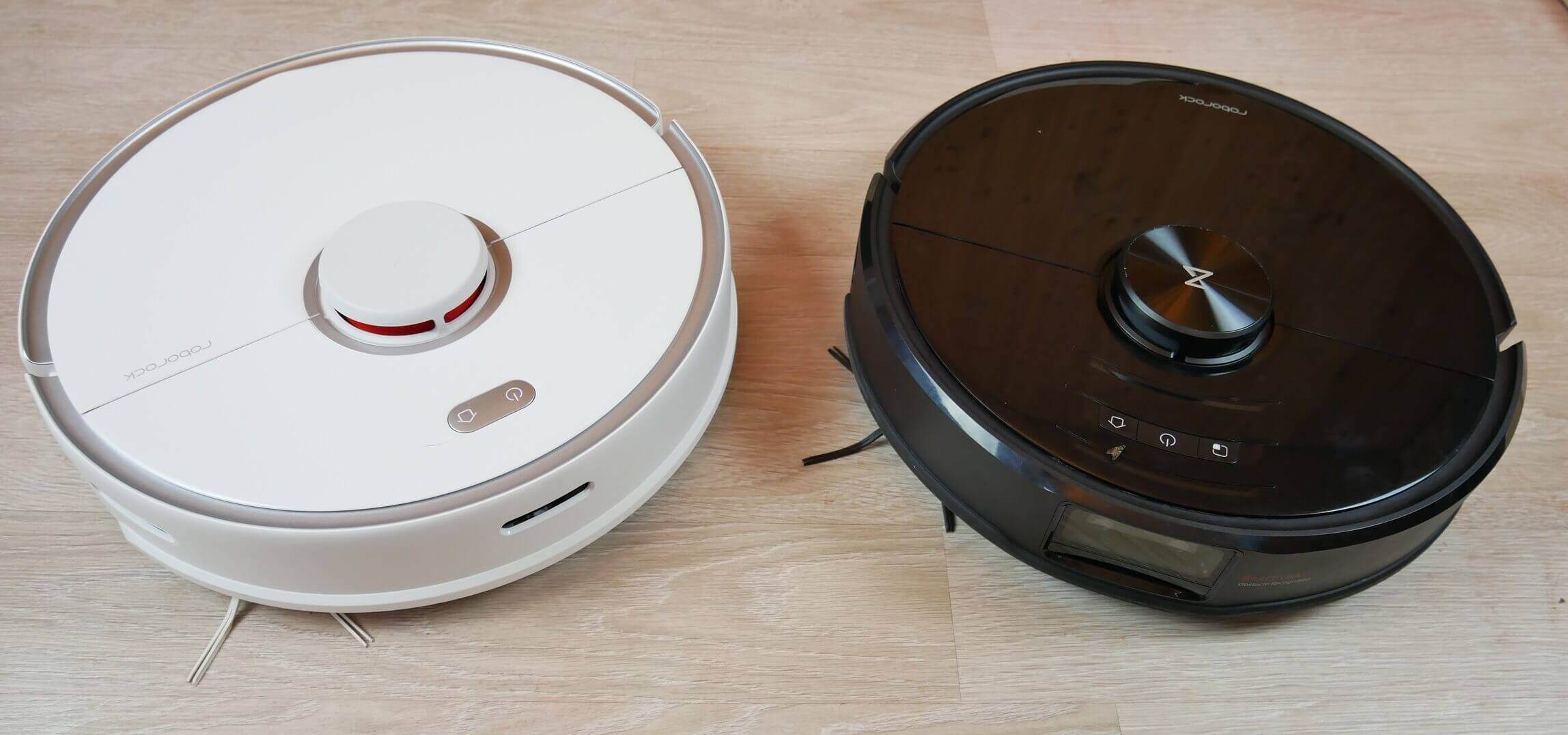
Let's compare the robot vacuums visually. In our case, the S5 Max is white, and the S6 MaxV is black. Both robots have a lidar sensor on top for navigation. It's equipped with a mechanical button to prevent it from getting stuck under furniture. The S6 MaxV's top panel has three control buttons: Start/Pause, Forced Home, and Spot Cleaning. The S5 Max has two buttons: Start/Pause and Home. To activate Spot Cleaning, hold down the Home button. So, there's basically no difference.
Top view
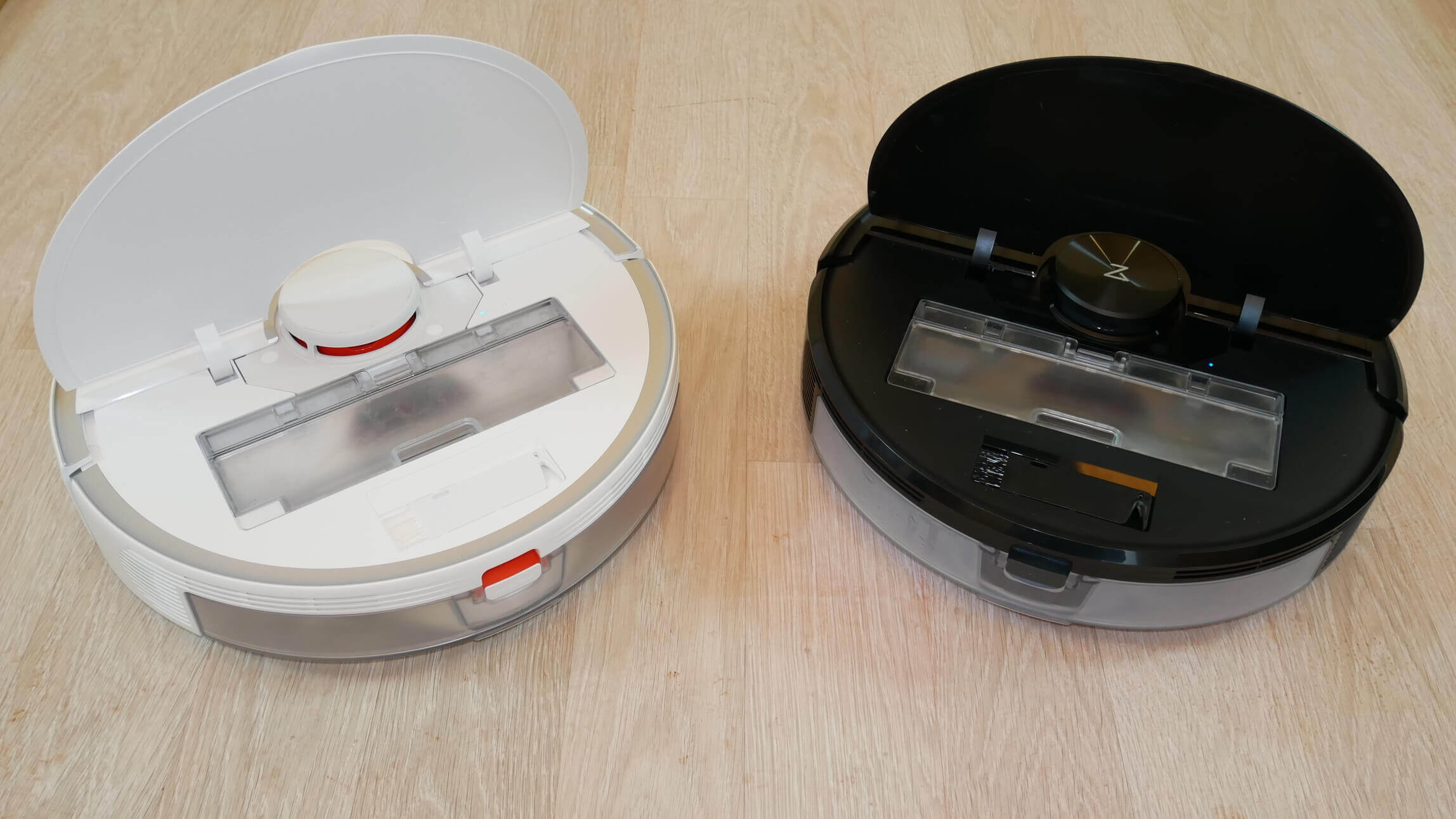
The dust container is located on top, under the lid. It is identical on both robots. It holds 460 ml and contains a washable HEPA filter.
Placement of dust collectors
The S5 Max has a charging sensor mounted on the front bumper, while the S6 MaxV has a dual front-facing camera that detects objects on the floor. We'll talk more about that later. On the right side of the S5 Max, there's a horizontal wall sensor; on the S6 MaxV, this sensor is located vertically in the same location.
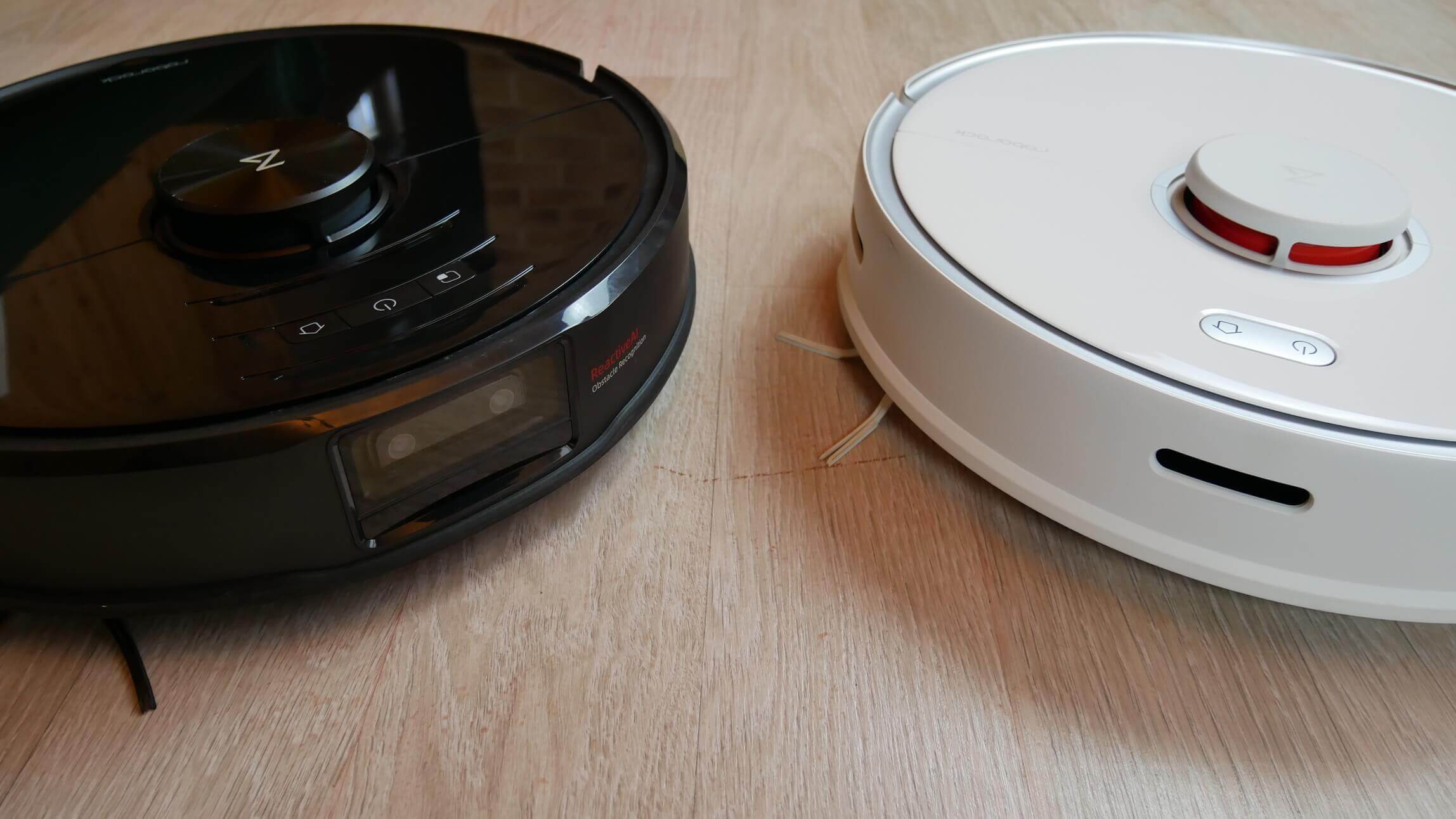
Front view
Both the 5th and 6th models have a rear-mounted water tank with electronic water flow control. The tank capacity is 297 ml.
The robot vacuums are also very similar underneath. They have the same wheelbase, detachable central brush, silicone five-point side brush, charging terminals, and swivel wheel. The only difference is the number of cliff sensors. The S6 MaxV has six, while the S5 Max has four, like most other robot vacuums in the Roborock line.
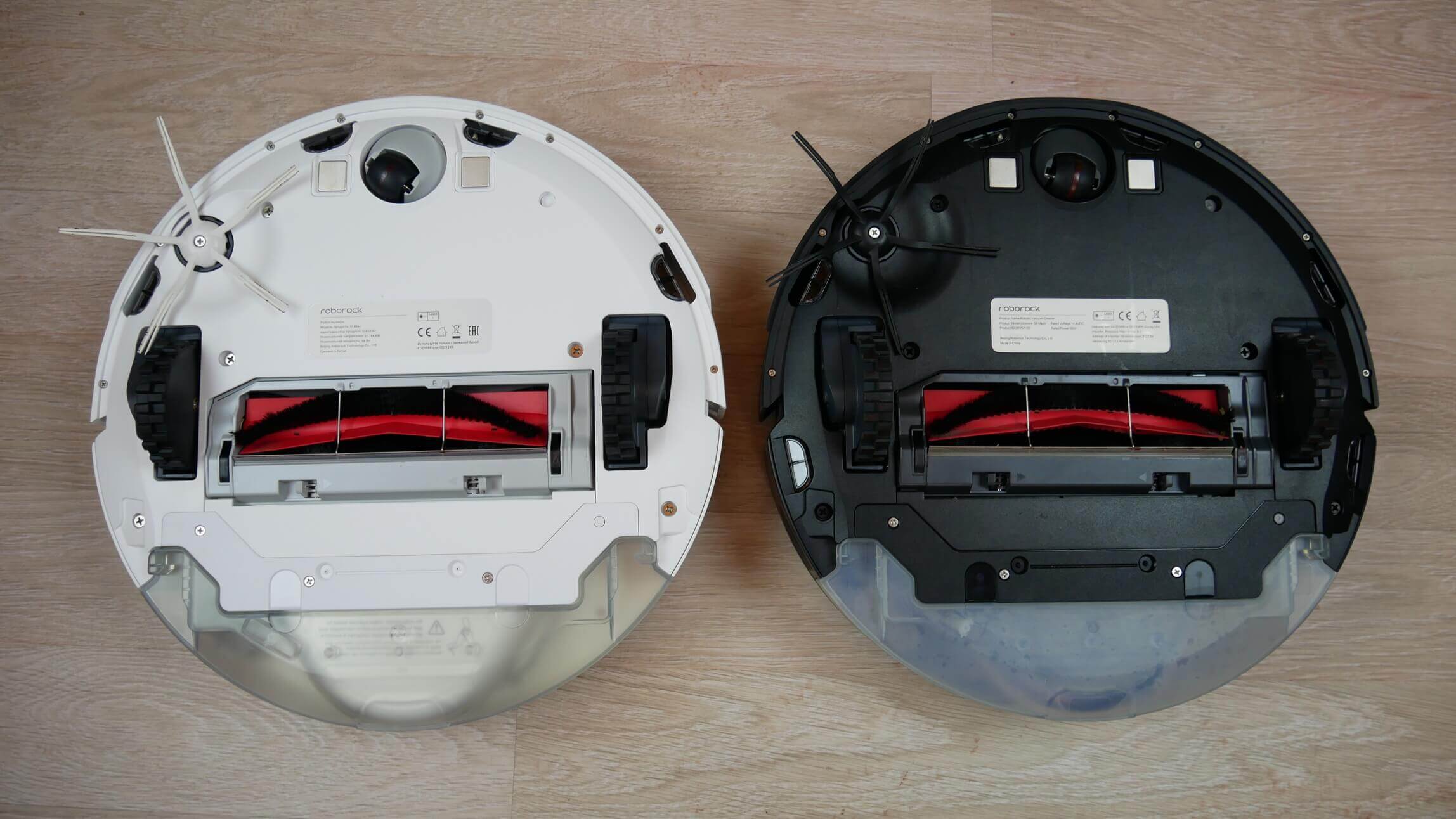
Bottom view
These are all the design differences between the robots. Let's move on to comparing the characteristics.
Technical specifications
So, in this table, we'll summarize the main characteristics of the Roborock S5 Max and S6 MaxV and compare them:
| Roborock S5 Max | Roborock S6 MaxV | |
| Battery | Li-Ion 5200 mAh | Li-Ion 5200 mAh |
| Suction power | Up to 2000 Pa | Up to 2500 Pa |
| Battery life | Up to 3 hours | Up to 3 hours |
| Charging time | Up to 6 hours | Up to 6 hours |
| Cleaning area | Up to 250 sq.m. | Up to 250 sq.m. |
| Overcoming obstacles | Up to 20 mm | Up to 20 mm |
| Noise level | Up to 69 dB | Up to 67 dB |
As you can see, the main difference is the suction power: the flagship Roborock S6 MaxV has increased it to 2500 Pa. Furthermore, the engineers have slightly dampened the motor, so the robot should be quieter than its predecessor.
Functional capabilities
In terms of functionality, robot vacuum cleaners are also virtually identical: they can create a room map and save it in memory, with up to four unique maps. They can also adjust suction power and water flow, zone the room into rooms, create no-go zones, and create virtual walls in the app. They can also create separate no-go zones in wet cleaning mode to protect carpets. Furthermore, the robots can be set to clean on a timer, continue cleaning after recharging, and clean in selected zones. It's much more interesting to talk about the differences in functionality.
Firstly, the Roborock S6 MaxV can be controlled not only through Mi Home but also through the proprietary Roborock app. Roborock's app reportedly fixes issues faster than Mi Home. The S5 Max, however, only supports Xiaomi's proprietary ecosystem app, Mi Home. The interfaces are identical, and I found only one difference in functionality. Mi Home allows you to set a gentle cleaning mode, which allows the robot to clean as quietly as possible. This mode is not available in the Roborock app.


Mi Home and Roborock
The second functional difference is crucial when comparing these robots. It's the active camera's capabilities. Firstly, it allows the robot to detect objects on the floor and avoid them, preventing the robot from becoming entangled in wires, for example, and objects from being damaged.


Definition of objects
Secondly, an active camera can be used to monitor your home via a smartphone. This can be useful if, for example, you don't remember whether you turned off the iron before leaving the house. Or if you have reason to believe there are intruders in the house. Or, for example, to check on your pet. Overall, this camera has a wide range of uses. But the main thing is that it helps improve your cleaning process.
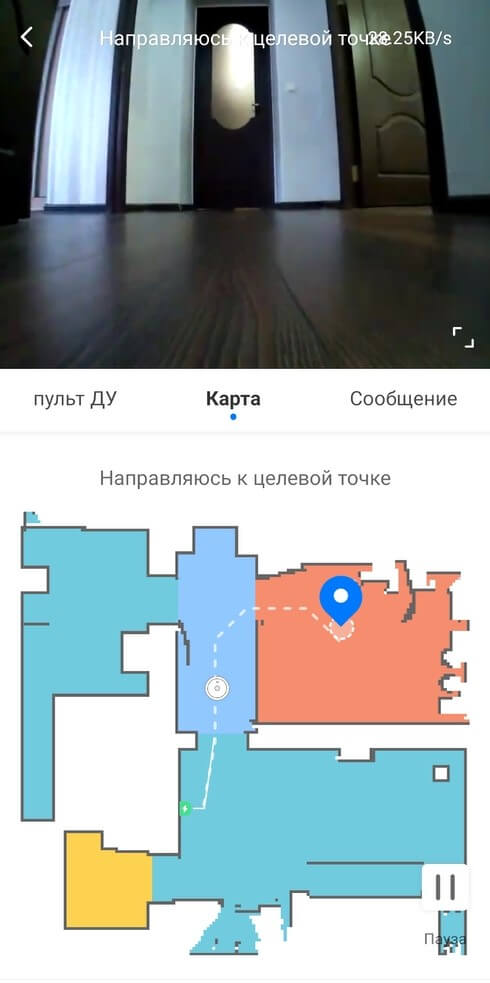
Active camera of a robot vacuum cleaner
Incidentally, you can also transmit voice messages to the robot, up to 15 seconds long. The sound isn't perfect, but it's still suitable for certain tasks.
Comparative tests
We conducted nine different tests to compare the Roborock S5 Max and S6 MaxV in cleaning performance (carpet, laminate, tile), navigation, obstacle avoidance, noise level, and more. You can see the results and how each performed in our detailed video review:
If you can't watch the video (which we highly recommend), you can check out the summary of the comparison:
Navigation in difficult conditions. We placed several objects on the floor in a single room that could interfere with cleaning in real-world conditions. These included a children's toy, a charger, a shoe with laces, and a chair. The Roborock S5 Max avoided all obstacles except the charger cord, which it got tangled in, requiring us to remove the cord wrapped around the brush. Under similar conditions, the Roborock S6 MaxV recognized the charger, carefully navigated around it, and continued cleaning. So, in terms of navigation in challenging conditions, the new flagship with its active camera is clearly superior. During our tests, we also noticed that the Roborock S6 MaxV cleaned better around chair legs and also collected debris closer to the base.
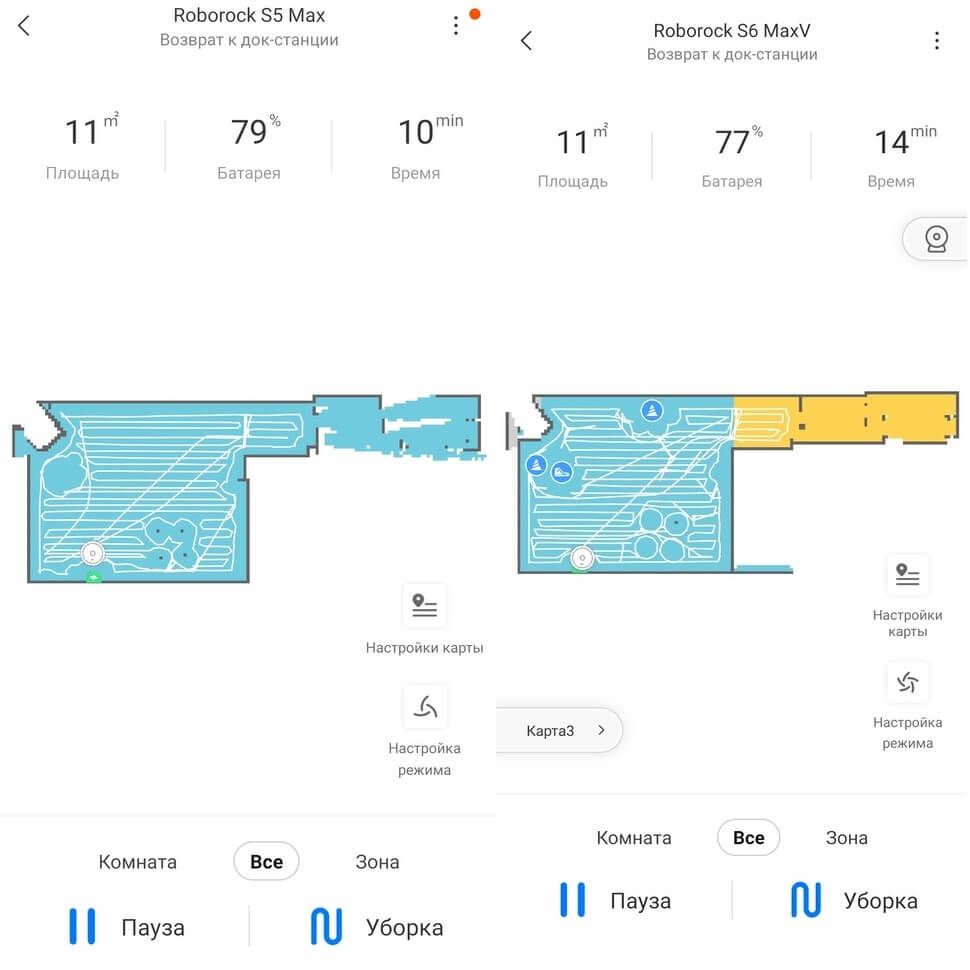
Comparison of navigation in complex conditions
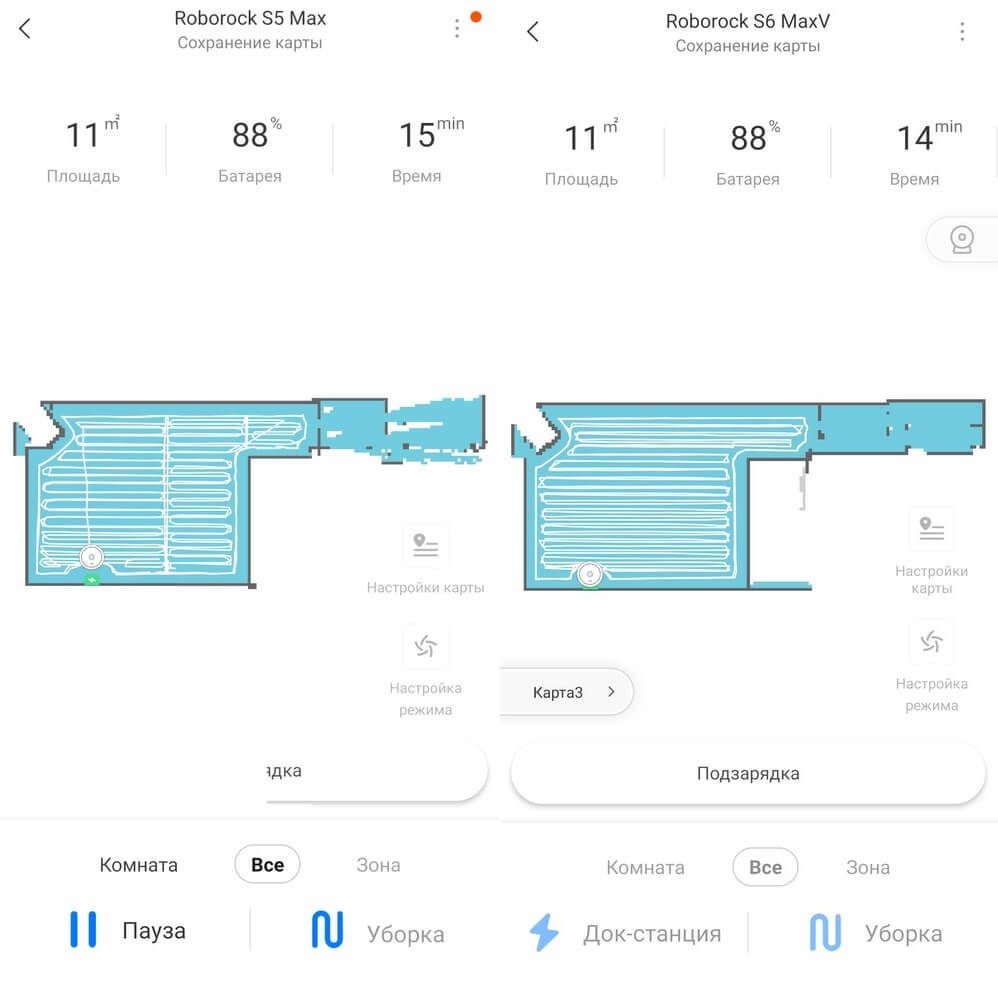
Navigation under standard conditions. We also compared how the robot vacuums navigated standard conditions without major obstacles. Within a single room, the Roborock S5 Max divided the available space into several zones, while the S6 MaxV cleaned the entire area in a single, serpentine motion. Ultimately, it cleaned 11 square meters in 14 minutes, while its predecessor took 15. The difference isn't significant.
Room cleaning speed
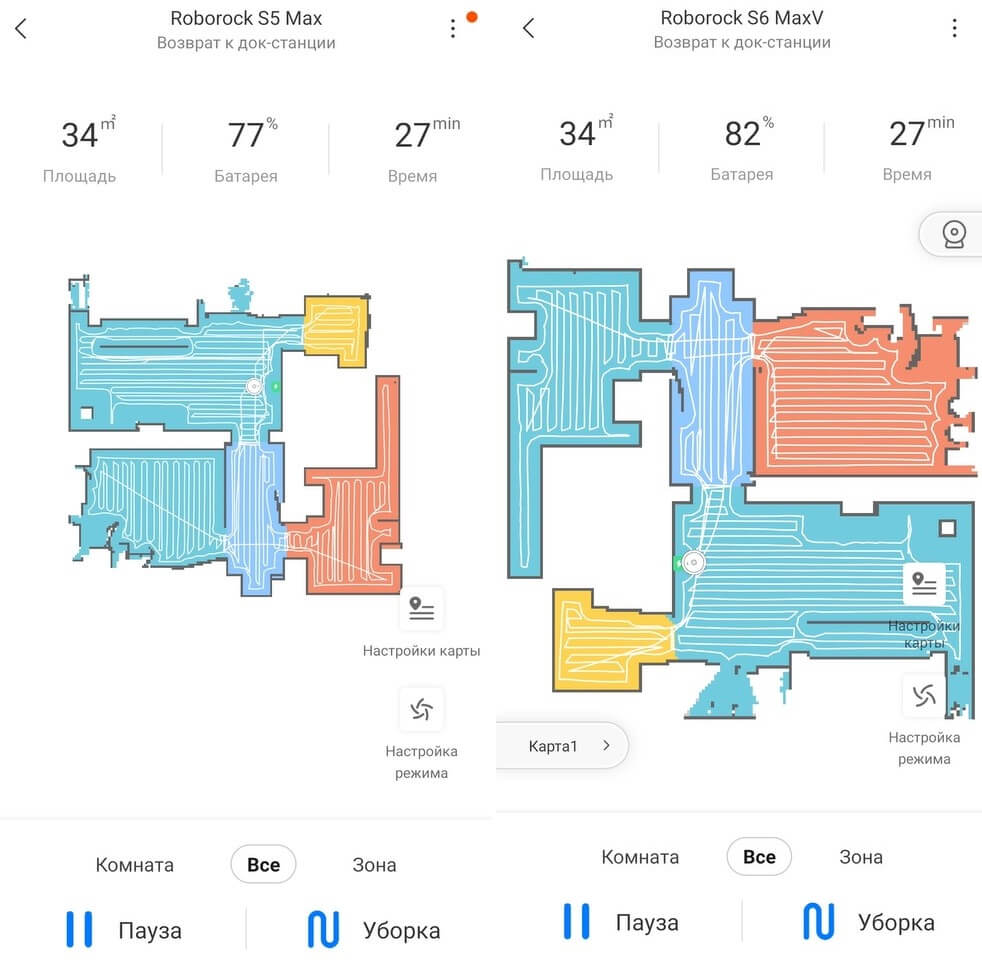
We also demonstrated how robot vacuums perform within a home—in our case, five rooms with a total usable area of 34 square meters. The Roborock S5 Max built a precise map of the room, covered the entire area, and cleaned it in 27 minutes. The Roborock S6 MaxV has the same navigation algorithm and cleaning time. This means the robots are completely identical in terms of navigation and are perfectly aligned.
House cleaning speed comparison
Dry cleaning test on tiles. We defined a cleaning zone and scattered 100 grams of various debris, including sand, grains, flakes, pet hair, and hair. Our task was to determine which robot vacuum cleaner would pick up the most debris in the same amount of time. In our case, this meant passing the selected zone three times. The Roborock S5 Max collected 94 grams out of 100 grams. This result is good in my opinion. The Roborock S6 MaxV collected 1 gram more: 95 grams out of 100 grams. This is a minor difference, so we can say that both robots perform equally well on hard floors.
Carpet cleaning test. We increased the challenge and scattered debris on a fluffy carpet. We used 50 grams of similar debris in this test. The Roborock S5 Max picked up 17 grams of debris from the carpet. It picked up grains and pet hair, but sand proved difficult to extract from the pile. Hair got tangled in the center brush. Visually, the Roborock S6 MaxV cleaned the carpet just as well, but it picked up 21 grams of debris. This is a slightly larger difference, perhaps due to its increased power, although this difference was not noticeable on the tile floor. However, judging by the contents of the dust bin, the robot picked up more sand than the S5 Max.
Room-wide cleaning test. We scattered 100 grams of sand around the room to determine how much each robot could collect. The Roborock S6 MaxV collected 94 grams of sand, while the S5 Max collected 97 grams.
What's the bottom line? One robot vacuum cleaner or the other performs slightly better in dry cleaning. But in reality, the results are very close, and both robots, in my opinion, performed well. They are essentially identical in design; the increased suction power should have played a role, but it didn't quite work.
| Roborock S5 Max | Roborock S6 MaxV | |
| Cleaning up trash in a limited area on tiles | 94/100 | 95/100 |
| Cleaning up trash in a limited area on the carpet | 17/50 | 21/50 |
| Cleaning up trash within the room | 97/100 | 94/100 |
Wet cleaning test. We also compared the wet cleaning performance of laminate floors at the booth. We used slightly dried shoe stains as the dirt sample. The water flow rate was set to the maximum level, 3. The Roborock S5 Max performed admirably, leaving no streaks or dirt marks. The Roborock S6 MaxV, under the same conditions, cleaned the floor just as well. This isn't surprising, as the robots have identical tanks, identical cleaning pads, and the same contact force.
Obstacle clearance. The robots' cross-country ability was also compared. We used thresholds of 10, 15, and 20 mm height. Both robots easily crossed obstacles of 10 and 15 mm height, but they had difficulty crossing 20 mm, as this is the maximum height they can overcome. However, the manufacturer was right; the stated characteristics correspond to reality.
Dark areas on the floor. At the request of one of our subscribers, we showed how these two robots perform on dark flooring. Some robots' anti-fall sensors are triggered in this situation, detecting black patterns on carpet and black tiles as height differences. In our case, both robots navigated the dark areas of the floor without issue.
Noise level. The final test is the noise level of the compared robots. Here are the measurement results (dB):
| Roborock S5 Max | Roborock S6 MaxV | |
| Careful | 45 | — |
| Silent | 52 | 50 |
| Equilibrium | 53.2 | 52.4 |
| Turbo | 54 | 54 |
| Maximum | 55 | 56.2 |
We see that the Roborock S5 Max is even slightly quieter in maximum mode, while the S6 MaxV is quieter in other modes. However, it's important to note that the S6 MaxV is 20% more powerful, so credit to the engineers for increasing power while maintaining a low noise level.
Let's sum it up
We've done a detailed comparison of the Roborock S5 Max and Roborock S6 MaxV, and what can we conclude? These robots offer roughly the same cleaning performance, and their specifications and key features are equal. Both robot vacuums are clearly worth considering, and it's no wonder the Roborock S5 Max has been our top pick for the first half of 2020. ranking of the best robot vacuum cleaners in first place.
Roborock flagships
If cost is a concern for you, I recommend the Roborock S5 Max, as it offers the best value for money and cleaning performance. It has everything you need and can expect from a modern premium robot vacuum.
But if you're less concerned about saving money and truly want the manufacturer's flagship model, then the Roborock S6 MaxV is definitely worth considering. Artificial intelligence, object recognition, and the ability to connect to an active camera via a smartphone are features unique to this robot. Overall, only a couple of competitors on the market offer similar functionality, but they're not widely used in the CIS, so they're outperformed. Therefore, this robot vacuum cleaner is completely worth the money, and for me, after comparing all the features, it's clear that the new navigation system makes the Roborock S6 MaxV a more compelling option.
If you want to save even more, it might make sense to take a look at Roborock S6 Pure, with less functional wet cleaning, but not inferior to dry. Or choose between Roborock E4 and Mijia 1C, if the area is small.
That concludes our comparison of the Roborock S5 Max and S6 MaxV. Please share your thoughts on these two robots in the comments. Happy shopping, everyone.