Comparison of Xiaomi S10+, S20, and S20+ robot vacuum cleaners: what are the differences and which one is better?
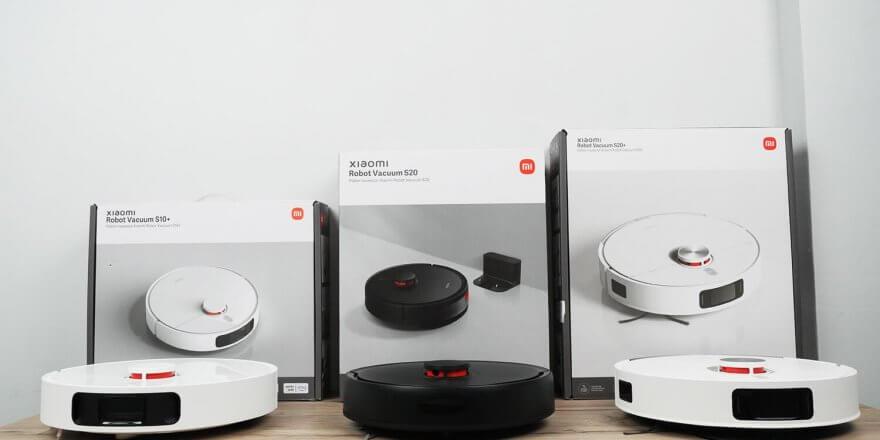
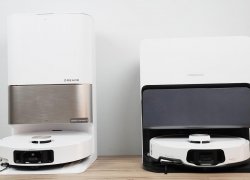
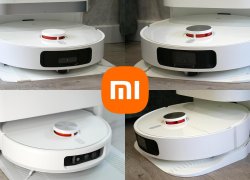
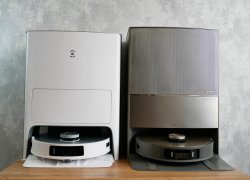
In this review, I'll compare three Xiaomi robot vacuum cleaners I recently tested: the Xiaomi Robot Vacuum S10+, S20, and S20+. Despite the relatively small price difference and visual similarities, these robots actually have significant differences that are important to understand. Below, I'll compare their designs, specifications, and test results, after which I'll express my opinion on which robot vacuum cleaner is best for different conditions. Let's get started!
Price
First of all, let's compare the cost of the robots. The most affordable one Xiaomi S20Its price is in the range of $160-200. The next one in ascending price is Xiaomi S10+Its price starts from 24 and goes up to $300. The most expensive Xiaomi S20+, the cost of which ranges from $25 to $300.
Design and characteristics
Now let's look at the differences between the Xiaomi S10+, S20, and S20+ robot vacuum cleaners in terms of design and key features.
I entered all the data into a table for easy reference:
| S10+ | S20 | S20+ | |
| Color | White | White and black | White and black |
| Battery | 5200 mAh | 3200 mAh | 5200 mAh |
| Suction power | 4000 Pa | 5000 Pa | 6000 Pa |
| Navigation | Lidar with spring-loaded cover | Lidar, stationary | Lidar with spring-loaded cover |
| Object Identification System | Eat | Absent | Eat |
| Wall sensor | Absent | Absent | Eat |
| Fall protection sensors | 4 | 3 | 4 |
| Carpet sensor | Absent | Absent | Eat |
| Dust collector | 450 ml (washable) | 400 ml (not washable) | 450 ml (washable) |
| Filtration system | HEPA (washable) and mesh | HEPA (not washable) and mesh | HEPA (washable) and mesh |
| Water tank | 200 ml | 270 ml | 290 ml |
| Floating turbo brush block | Yes | No | Yes |
| Central brush | Bristly-petal, collapsible | Bristly-petal, non-separable | Bristly-petal, collapsible |
| The principle of floor mopping | Two rotating napkins | Straight napkin with a Y-shaped movement path | Two rotating napkins |
| Lifting napkins | Absent | Absent | Eat |
| Blind spot near the baseboard | 4.5 cm | 6 cm | 4.5 cm |
| Case dimensions | 350*97 mm | 325*98 mm | 350*97 mm |
As you can see, in terms of design and specifications, the S20 model is significantly inferior to both the older S20+ and the younger, if we're judging by the series, the S10+. Several points are worth highlighting here.
The S20's battery is significantly weaker, while its claimed suction power is higher than the S10+ but lower than the S20+. These tests will test the robot vacuum cleaners' real-world performance and battery life.
The S20's lidar doesn't have a spring-loaded cover, so the robot can get stuck under furniture if the clearance is too narrow for the robot to pass through.
The object detection system allows robots to carefully navigate around objects on the floor, such as socks, wires, or even pet surprises. The S20 doesn't have this system, and the S10+ does, but it's very crude, as I'll show in a comparison of test results. The S20+'s object detection system works perfectly, making it the neatest robot.
The same goes for the wall sensor. Only the S20+ has one, which helps the robot navigate more accurately around objects and, more importantly, navigate along walls and furniture without touching them. The other two robots are more likely to scratch baseboards, furniture, and other objects.
Only the S20+ has a carpet sensor, and only this robot can automatically increase suction power on carpets and avoid them when wet cleaning. The S20 doesn't respond to carpets, and the S10+ can't automatically increase suction power when dry cleaning, but it can at least avoid carpets when pads are attached.
The washable dust container is very convenient for cleaning the robot. Simply rinse it with water, dry it, and return the clean container to the robot. The same goes for the filter. The filter itself is much better in the S10+ and S20+. The S20 has a HEPA filter similar to most budget robot vacuums.
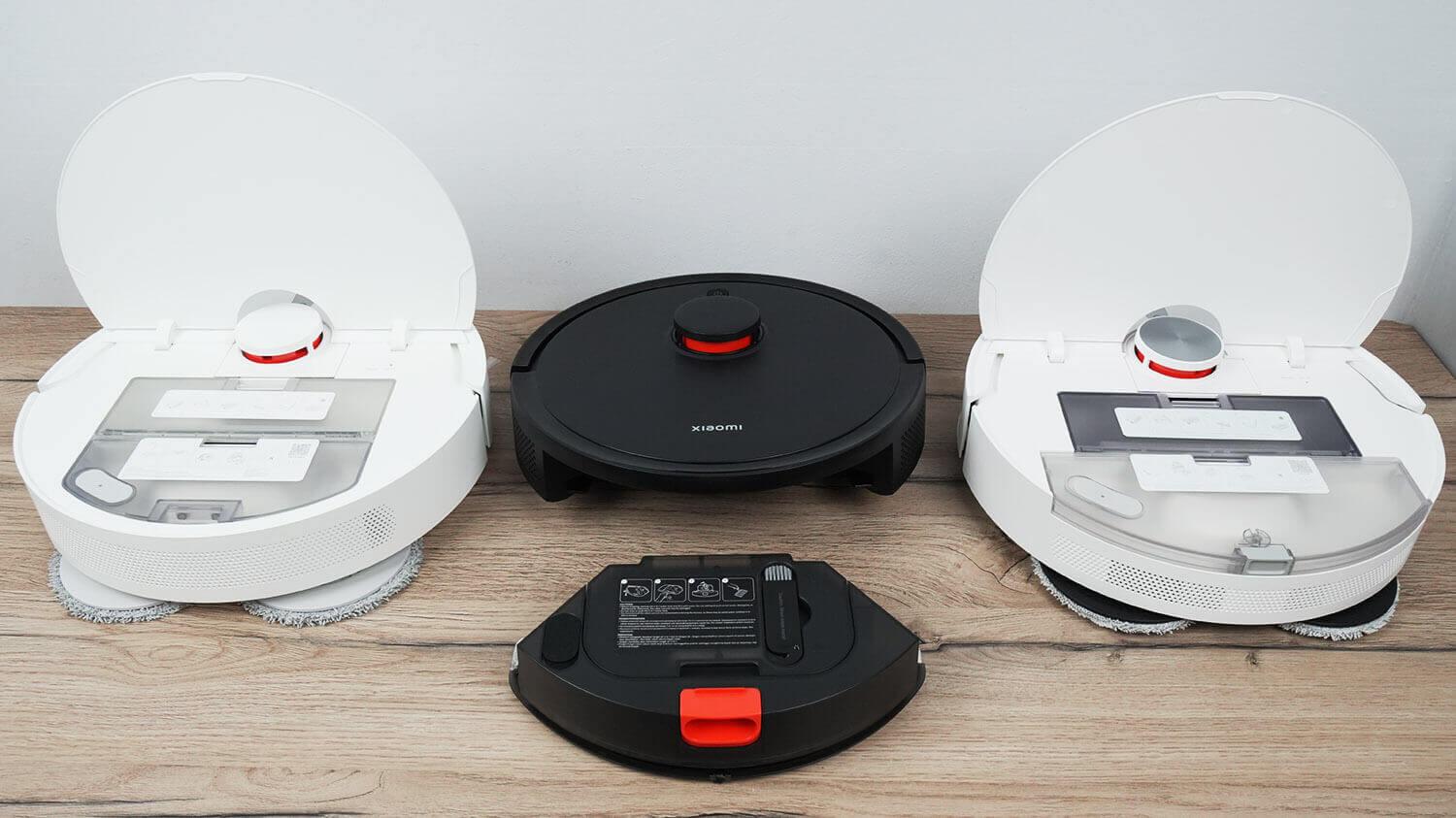
Dust collectors and water tanks
The floating turbo brush unit allows the central brush to adapt to different surfaces and adhere closely to them, improving cleaning performance. In this regard, the S20 is also inferior to its siblings in the line, as is the design of the central brush itself. The fact that it cannot be disassembled makes cleaning it very difficult.
As for floor mopping technology, the S10+ and S20+ feature two round rotating mops, which have already won the hearts of many robot owners. The S20 has an outdated straight mop option, but at least it has a Y-shaped mopping mode.
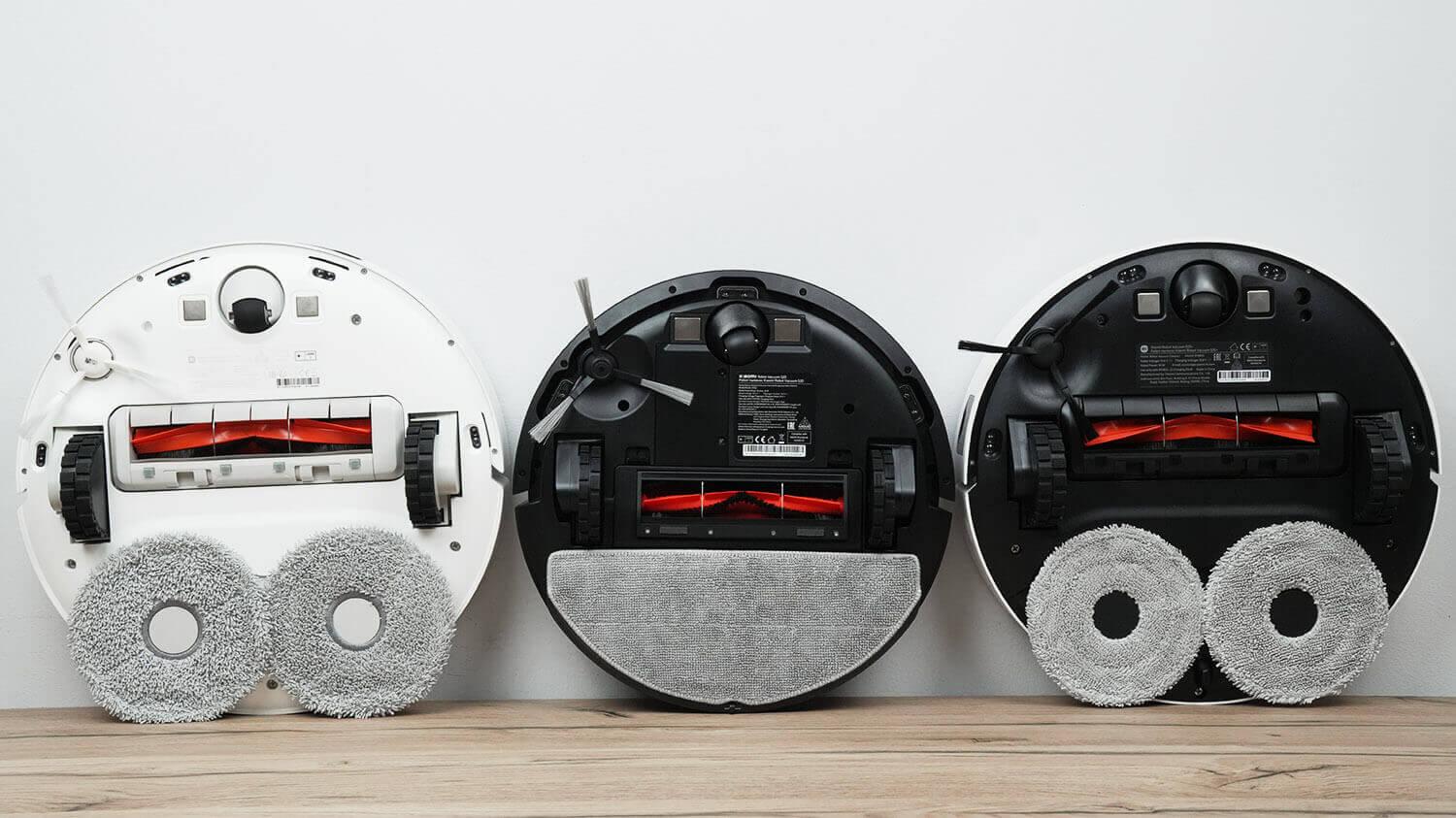
Cleaning modules
Only the S20+ features a cleaning cloth lift. This feature is not only useful for carpeted floors but is crucial for robotic vacuums in general. The cloths automatically lift while charging at the docking station, preventing prolonged contact between wet cloths and the floor. The cloths also lift when the robot passes from the docking station to the desired cleaning area and when returning to the charging station. This prevents the cloths from losing moisture while the robot is in transit and from staining the clean floor after the cleaning cycle. Overall, cleaning cloth lift is a must-have feature for robotic vacuums in 2025.
All robots have a blind spot, and it's not small in reality, but the S20's is an additional 1.5 cm larger than its counterparts.
However, the S20's case diameter is slightly smaller. It's not a huge deal, but it can be relevant in rare cases.
Ultimately, we see that the S20 is significantly cheaper than other robots. But to be fair, it's cheaper. However, for a price segment of $150-$200, some components have been unforgivably cheapened. Comparing the design of the S10+ and S20+, the older model is also significantly better than its predecessor, although the price difference between them isn't that great.
Testing
And now the most interesting part is comparing the test results. I'll highlight the most important points.
In the video review, you can clearly see the test results in comparison:
The Xiaomi S20 surprisingly showed the best performance, while the S10+ and S20+ were quite average, and their claimed specs were clearly overstated. The table summarizes the test results in different modes:
| S10+ | S20 | S20+ | |
| Declared power | 4000 Pa | 5000 Pa | 6000 Pa |
| Silent | 2 mm (partially) | 0 mm | 2 mm (partially) |
| Standard | 2 mm (partially) | There is no regime | 2 mm (partially) |
| Intensive | 2 mm (partially) | 2 mm (partial) and 4 mm (partial) | 2 mm (better) |
| Turbo | 2 mm (partially) | 6 mm (partially) | 2 mm (better) |
I also compared the robot vacuum cleaners' battery life under identical conditions, measuring how long the battery lasts when cleaning in Turbo Mode and with wet cleaning enabled. Here are the results on a single battery charge:
| S10+ | S20 | S20+ | |
| Total operating time | 88 min | 70 min | 96 min |
| Total cleaning area | 75 sq.m. | 60 sq.m. | 108 sq.m. |
It's important to note that the stated cleaning area is the effective cleaning area, meaning the specific area the robot was able to clean, excluding furniture. In reality, 75 square meters of effective cleaning area is equivalent to almost two full cleanings of a 70 square meter apartment. In this regard, the S20+ has the best battery life.
In terms of navigation and touching, the S20 is the roughest; it moves light objects when navigating and more often touches walls, baseboards, chair legs, and other objects. The S10+ and S20+ are more accurate in this regard.
And here's an equally important comparative test: checking the object detection system. The S20 doesn't have one, so I didn't even test it. The S10+'s object detection system is weak, and the robot was only able to detect and then accurately avoid two of six objects on the floor. In real-world use, the S20 would have achieved the same result, but in everyday life, the S10+ is more accurate. Meanwhile, in good lighting, the S20+ was able to detect and accurately avoid six of six objects on the floor. It also accurately avoided three of three socks, all four wires, and four of six simulated pet surprises. Even in complete darkness, the robot performed excellently and boasts one of the best object detection systems in the entire Xiaomi robot lineup.
Dry cleaning performance is roughly the same for all the compared robots, as is cleaning performance on low-pile carpets. However, on medium-pile carpets, the S20 performed worse than the S10+ and S20+. This is due to the non-floating central brush unit and the poorly designed turbo brush.
I prefer wet cleaning with robots with round cloths; the wet mark itself is more visible, the cloths press better to the floor, and there is less blind spot near the baseboard.
What's more important to note here is that the S20+ can lift the cleaning cloths on carpets during both dry and wet cleaning. This allows the robot vacuum to simultaneously vacuum and mop, leaving carpets dry and clean. With the S20, the cleaning cloth will come into contact with the carpet unless designated "no-move" zones are set. The Xiaomi S10+, on the other hand, is completely inconvenient: the robot can't even reach carpets with its cleaning cloths. You have to manually remove the cleaning cloths so the robot can clean the carpets separately, which is not very convenient.
In terms of cross-country ability, the robots are identical and can cross 2 cm thresholds. All three compared models are also comfortable on black carpets.
The last thing that's interesting to compare is the noise level. Here are the results obtained when measuring the noise level in different modes:
| S10+ | S20 | S20+ | |
| Noise level | 60.5-73.5 dB | 62-72 dB | 58.5-72 dB |
I wouldn't say that the differences are significant and should be relied upon when choosing between these three models.
Personal opinion
What can I say in conclusion? Honestly, the only robot of these three that I actually liked and had the fewest complaints about after testing was the older Xiaomi S20+. It's equipped with all the necessary sensors and features. It's very accurate and versatile. Therefore, it's superior to its siblings in every respect except power. If you have carpets, I highly recommend this model.
If you don't have a rug, you can opt for the Xiaomi S10+. It's essentially identical to the older version in many ways, just less neat and doesn't pick up napkins. However, it's better built than the S20 and surpasses it in many ways.
In my opinion, the Xiaomi S20 is the clear underdog in this comparison. Its only advantage is power, which in reality only differs at maximum power. Given its weak battery, it can only be used in Turbo Mode in small areas, and even then, it's not a good idea to wear out the robot's components that way. Overall, the build quality is significantly inferior to its competitors, both visually and in terms of the robot's efficiency.
Therefore, the leader of this comparison is the Xiaomi Robot Vacuum S20+, silver goes to the S10+ and bronze to the S20.
On that note, I'd like to conclude this comparison. If you have any questions, please ask them in the comments. Happy shopping, everyone. Bye!